Calculate two cash figures: what must be paid before the first post goes live and what you expect to pay during the first 12 months. Record your own work separately. A low monthly equivalent can require a large payment today, and an included feature should not become a second purchase elsewhere.
Guides Karan Singh BhakuniUpdated 3 Nov 2026
Cost to Start a Blog: Build Your First-Year Launch Budget
Karan Singh BhakuniUpdated 3 Nov 2026- 11 min read
- 8 sections
- 4 comparison tables
- 7 questions answered
The short answer
You can start a blog with no platform fee on a suitable free hosted plan, or pay for a custom domain, a website plan, outside help and optional tools. There is no single reliable “average startup cost” that fits all those choices. The useful answer is a budget for the blog you actually intend to launch.
Want the site rather than the reading? Build one free with Grigora
Contents8 sections
Read nextCost to Run a Blog: Renewals, Tools and a Yearly Budget
Choose the smallest launch that serves your reader
Write the initial scope before comparing prices. A personal reading journal, a business advice blog and a publication with several contributors do not need identical systems. Identify the reader, the first useful articles, the address you want and the one action the reader should be able to take.
| Launch route | Cash items to investigate | Important tradeoff |
|---|---|---|
| Free hosted blog | A genuine free publishing offer; existing equipment and original content. Optional purchases can remain zero. | Check the platform address, advertising, storage, export and commercial-use rules. Free does not mean every feature is included. |
| Paid hosted blog or website builder | The selected plan and billing term; domain registration if separate; only required external services. | Hosting and templates may be bundled. Confirm the feature and allowance you need rather than buying overlapping subscriptions. |
| Self-hosted blog | Hosting, domain and any genuinely necessary paid theme, extension or setup work. | Open-source software and the hosting service are different things. Someone must operate updates, backups and recovery. |
| Blog with hired setup or editorial help | The selected publishing route plus a written, scoped service quote. | Agree who supplies content, owns accounts, tests the result and handles work after handover. |
For example, WordPress.com currently offers a free hosted option; inspect the current plan details rather than infer its limits from an old comparison. The WordPress open-source project is a separate software choice. It does not make a separately purchased server, domain or professional’s time free.
If you are still deciding whether to pay at all, use the free-versus-paid blogging guide. This article focuses on calculating the first launch and first year once you have a route in mind. The ongoing blog-cost guide covers the later renewal and operating ledger.
List required, conditional and deferred purchases
A requirement is something your chosen launch cannot work without. A conditional item is needed only because of a real feature or workflow. A deferred item can wait until you can explain the problem it solves. Price does not turn an optional purchase into a requirement.
| Item | How to treat it at launch |
|---|---|
| Publishing and hosting | Required somewhere, but a hosted plan may already supply both. Do not add a separate hosting bill automatically. |
| Custom domain | Conditional on wanting your own registered address. Record first registration, renewal, ownership and any voucher restrictions. |
| Template and basic design | Use a suitable included or free option if it meets the task. Buy design work for a defined need, not because every serious blogger supposedly must. |
| Original articles and images | Required work; you may supply it yourself or buy a scoped service/license. Check rights to any purchased material. |
| Mailbox and newsletter delivery | Different services. Add them only when the launch needs them; subscriber management is not proof that all sending fees are included. |
| Search, scheduling and AI tools | Start with the tools that fit an actual workflow. Paid research software, automation and courses are not prerequisites to publish. |
| Selling, bookings or restricted access | Conditional on the business model. Check the complete payment, delivery and access workflow, provider fees and operational work. |
| Security, backups and support | Verify who provides the necessary functions and what recovery entails. A paid badge or extra plugin is not a substitute for that check. |
Keep existing equipment separate from new spending. If your current computer, connection and camera are adequate, do not assign their full replacement price to this launch. If you need a new purchase, record the actual additional amount and its purpose. A paid blog does not automatically require a premium laptop or a camera kit.
Read the offer as a bill, not a monthly headline
For every paid service, capture the provider, currency, quote date, selected term, amount charged now, next charge and included limits. Check whether the displayed price is a monthly bill, a monthly equivalent on annual billing or an introductory multi-year offer. Compare equal periods with equal scope.
- Multiply the advertised rate by the number of months you must prepay, then add any separately charged setup items and applicable tax.
- Record the renewal price or the provider’s stated renewal basis. Do not assume a launch discount lasts forever.
- Check which domain, mailbox, template, backup or support features are included, for how long and under what conditions.
- Look for contact, send, storage, user, site, credit or usage thresholds that could change the bill.
- Read cancellation and refund terms separately. Cancelling a future renewal is not the same as recovering money already paid.
A hypothetical plan advertised at $5 per month with 36 months prepaid requires $180 before tax today. It is not a $5 month-to-month commitment. That longer commitment may suit an established project, but a smaller initial payment may matter more when you are still testing whether you will maintain the blog.
Work a complete first-year example
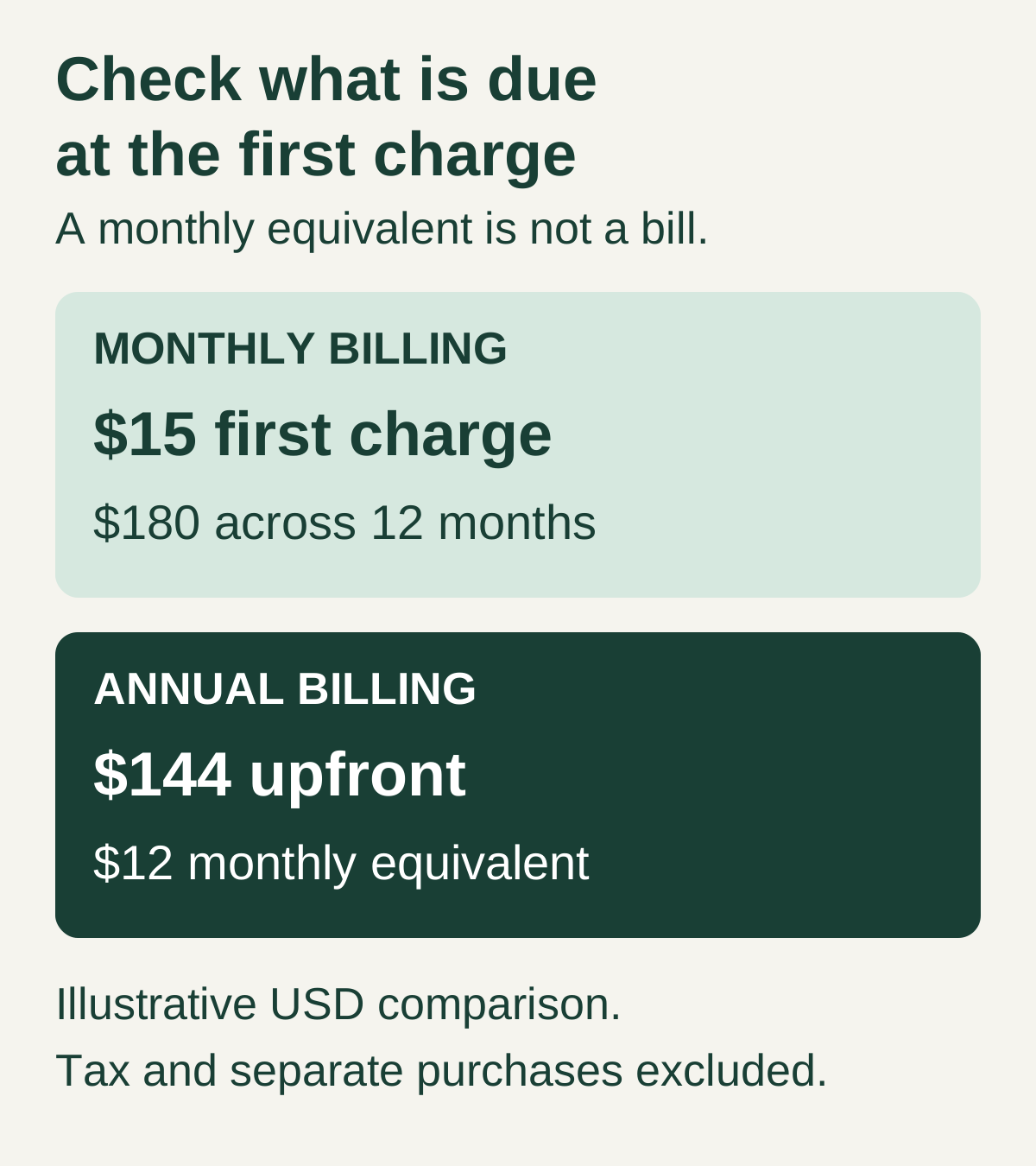
Here is a dated example using Grigora’s published Starter website prices, checked on 3 November 2026: $15 billed monthly, or $144 billed yearly upfront, before applicable tax. Paid website plans include hosting, SSL, CDN, CMS/blog and domain connection. Domain registration and renewal are separate.
To demonstrate the calculation, assume a domain quote of $18 for the first year, existing equipment, your own writing, an included template and no optional services. The $18 is an illustrative input, not a quote from a registrar. Replace it with the actual domain’s price and eligibility. The totals below exclude tax and assume the quoted website price remains unchanged for the period.
| Example choice | Due at first purchase | Cash across first 12 months |
|---|---|---|
| Starter billed monthly + illustrative domain | $15 + $18 = $33 | $15 × 12 + $18 = $198 |
| Starter billed yearly + illustrative domain | $144 + $18 = $162 | $144 + $18 = $162 |
| Same yearly choice + a hypothetical $200 one-off editing job | $144 + $18 + $200 = $362 | $362, if no other charges occur |
The annual choice has a lower first-year total here but needs more cash at the beginning. The editing row shows how one defined service changes the budget; it is not a market rate or a required purchase. None of these examples includes your labor, future renewal changes, additional email services or revenue.
Grigora’s website publishing trial lasts 14 days with no card required; a paid plan is needed to keep the website online afterward. Treat that as evaluation time, not a permanent free website. Check the current checkout, selected billing term and allowances before buying. A connected integration may require its own account and subscription.
Also worth readingReal Estate Website Cost: Build, IDX and Renewal Budget
Build a small quote sheet before paying
Use one row per actual purchase or bundle. If a feature is included, mark the parent bundle instead of adding an estimated second charge. Separate an essential launch item from an experiment, and retain the quote or terms you relied on.
| Quote-sheet field | What to enter |
|---|---|
| Job and provider | The task the purchase performs and the supplier or service. |
| Required date | Needed before publishing, during the first year or deferred until a stated trigger. |
| Cash now | Full upfront charge in the quoted currency, including the selected term. |
| Later cash within year one | Scheduled monthly or other charges not already prepaid. |
| Tax and currency | Whether tax is included; any applicable conversion/payment charges. |
| Renewal and exit | Next date, current renewal basis, cancellation notice and refund conditions. |
| Included scope | Features, usage limits, service deliverables and responsibility for support. |
| Evidence | Quote date, official plan/terms link and a saved estimate or receipt. |
Add the cash-now column to find your launch bill. Add cash now plus later first-year charges to find the first-year cash budget. Do not add the same annual payment again as 12 monthly expenses. Keep a separate reserve for uncertain but plausible work and state what it is for; it is a planning allowance, not a predicted invoice.
For a custom domain, the ICANN renewal FAQ explains that registration is for a limited term and renewal fees and terms vary by registrar. Record who controls the registrar account, the renewal date and the current renewal price. A first-year voucher does not make future years free.
Budget the work that money does not remove
Estimate your own launch tasks: selecting the platform, setting up accounts, writing and editing initial posts, preparing accessible images, reviewing important notices, testing on a phone and learning the publishing workflow. Record hours separately from cash so a “$0” route does not conceal a substantial commitment.
If you hire help, request a deliverable-based quote. State the pages or posts, research and editing depth, image rights, revisions, setup, testing, account handover and post-launch support. Verify whether the price includes the platform and domain or only the person’s work. Use the blog setup hiring guide for the handover questions.
Legal, tax, accessibility, privacy or specialist review costs depend on what the blog does and where it operates. A simple personal journal and a commercial site collecting information or selling products have different obligations. Include any advice your circumstances require rather than treating a generic policy template or business-formation package as universally compulsory.
Spend again only when you can name the next problem
A useful upgrade trigger is specific: the current plan lacks a required contributor role, media no longer fits the allowance, or a recurring task consumes enough time that a suitable tool is worth testing. “My blog should be serious now” is not a measurable requirement. Check the next plan’s complete cost before adding it.
- Publish and test a small useful starting set of articles before committing to a large outsourced batch.
- Use included design and publishing features until you identify an actual limitation.
- Keep optional subscriptions and their trial-end dates visible in the quote sheet.
- Check the public page, images, links and any form/confirmation in the actual launch environment.
- Plan first-year costs you can fund without assuming advertising, sponsorships or affiliate income will arrive.
Revenue can eventually offset costs, but it is not guaranteed and may arrive later than an invoice. Review the budget after the launch: what did you pay, what remains committed and which purchase actually helped you publish something useful? Carry confirmed renewals into your ongoing-cost ledger.
Blog launch cost FAQs
A suitable free hosted publishing plan can have no platform fee, especially if you already have the equipment and create the content yourself. Check its current publishing, address, advertising, storage and export terms. Your time, connectivity and any additional purchases still matter.
Not for every route: some services let you publish on their own address. An independently registered domain is a separate choice and usually a recurring registration expense. Check whether the desired plan can connect it and whether any first-year voucher applies.
No. A monthly equivalent is a comparison figure. An annual or multi-year offer may charge the whole term upfront. Read the amount due, billing period, next charge and cancellation/refund conditions.
Not automatically. Hosted website plans often include hosting. Check the selected plan before adding a separate host, SSL product or backup subscription. Some external services may still be needed for the actual workflow.
Buy a paid item when it solves a defined launch requirement that the available included or free tools do not meet. A paid tool does not guarantee traffic or income, and WordPress-specific plugin advice does not apply identically to every hosted builder.
No. A temporary evaluation offer is not a year of free publishing. Confirm when the website trial ends, what remains accessible and which paid term is needed to continue.
It may eventually offset spending, but income is uncertain. Choose a launch you can fund without assuming future traffic, sales or sponsorships. Track actual costs and revenue separately.
Practical writing on building a site, growing an audience and sending email people open. No more than one a week.

Karan Singh Bhakuni
118 articles on the Grigora blog
More on Guides

Guides
Cost to Run a Blog: Renewals, Tools and a Yearly Budget
Plan the next year of an existing blog: record real renewal bills, separate included features from extras, account for usage and maintenance, and compare cash due with a monthly reserve. Includes an…
20 Oct 202310 min read

Guides
Real Estate Website Cost: Build, IDX and Renewal Budget
A brochure site, an IDX search site and an integrated brokerage platform have different costs. Compare dated primary prices, identify bundled and extra services, and use a worked hypothetical…
14 Sept 202310 min read

Start a Blog
How to Start a Dog Blog: Content, Setup and Launch
Choose a dog-blog niche, build a simple site and publish useful original work. Use observation, source and review checks before promoting or monetizing it.
28 Oct 202310 min read