If you already have a suitable device and internet access, you can test a writing idea before buying a theme, a course or marketing software. Your time still has value. Start with the publishing setup you need, then add a paid tool when it solves a specific problem.
Guides Karan Singh BhakuniUpdated 2 Nov 2026
Does Starting a Blog Cost Money?
Karan Singh BhakuniUpdated 2 Nov 2026- 10 min read
- 9 sections
- 3 comparison tables
- 6 questions answered
The short answer
Starting a blog can cost $0 if you use a free publishing plan and a platform-provided address. You usually pay when you want a custom domain, a paid website plan, particular features or professional help. Separate the amount due today from the ongoing cost: an advertised monthly rate can require a full year or several years of payment upfront.
Want the site rather than the reading? Build one free with Grigora
Contents9 sections
Read nextCost to Run a Blog: Renewals, Tools and a Yearly Budget
Three ways to start, with different costs
| Publishing route | What you pay for |
|---|---|
| Free hosted blog or article platform | A free plan can cover publishing and a platform address. Optional upgrades, payment fees or extra services can cost money. |
| Paid hosted blog or website builder | The plan bundles hosting with its publishing tools. Check custom-domain support, plan limits, included features and the full billing term. |
| Self-hosted blog | The software can be free, while hosting, domain registration, maintenance and chosen extras remain separate. |
WordPress.com offers a Free publishing plan; Blogger also supplies a platform address. Our guide to starting a blog without buying a domain compares the routes. The WordPress.org software project is different from WordPress.com’s hosted service: free software does not by itself provide a managed website or hosting.
What you may need to pay for
- Domain registration and renewal. This is the custom address, rather than the blog software. Check the exact name, extension, registration term and renewal price. A first-year domain offer may end before the hosting plan does.
- Publishing or hosting plan. Choose one suitable route. Avoid adding a separate hosting bill when the website plan already includes hosting. For self-hosting, check who handles updates, backups, restores and server support.
- Features you actually need. Storage, collaborators, forms, commerce, subscriber counts, email sending or AI usage can affect the plan. A basic blog does not need every available add-on.
- Your content and maintenance work. Writing, research, editing, visuals, accessibility checks and updates take time. Specialist writing or design help is an additional quote, not a fixed fee every blogger pays.
Compare what is included before buying a second SSL certificate, backup service, theme or security add-on. For example, WordPress.com’s plan information includes hosting and SSL, and Grigora’s paid website plans include hosting, SSL and a CDN. You still need appropriate account security and a way to restore your work; an included feature should be checked, not simply assumed to cover every situation.
Current price examples: look at the whole bill
These are US-dollar public list-price examples checked on 2 November 2026, before tax and optional extras. They are examples of different products, rather than identical feature bundles. Your location, a promotion, billing term or later price change can produce a different checkout or renewal amount.
| Example | Publishing cost and domain treatment |
|---|---|
| WordPress.com Free | The plan is $0 with a platform address. Feature limits and platform advertising apply. A custom domain requires a paid plan. |
| WordPress.com Personal, yearly billing | Listed at US$4/month equivalent: US$48 for 12 months paid upfront. An eligible domain is included for the first year; domain renewal is a separate ongoing cost. Confirm the plan’s renewal quote. |
| Grigora Starter, yearly billing | US$12/month equivalent: US$144 for 12 months paid upfront. Domain registration and renewal are separate; you can use a Grigora address. |
| Grigora Starter, monthly billing | US$15 paid each month, or US$180 over 12 months if the rate stays the same. Domain registration and renewal are separate. |
Sources: WordPress.com pricing and Grigora pricing. WordPress.com’s domain guide explains the first-year offer and connection requirements. Check the final bill for your exact account, domain and region before paying.
Grigora’s 14-day website publishing trial needs no card. Choose a paid website plan to keep the site online afterward. Its small free newsletter allowance is separate from the website trial; it does not make the website free forever. A paid website plan’s audience allowance and sending setup also need to match your newsletter needs.
Monthly equivalent, upfront payment and renewal are different
Suppose a hypothetical host advertises $3/month for an initial 24-month term. The hosting payment due upfront is $72, before a domain, add-ons and tax. If a later renewal is quoted at $9/month billed annually, that later annual bill is $108. These are illustrative numbers, not an offer from a particular provider.
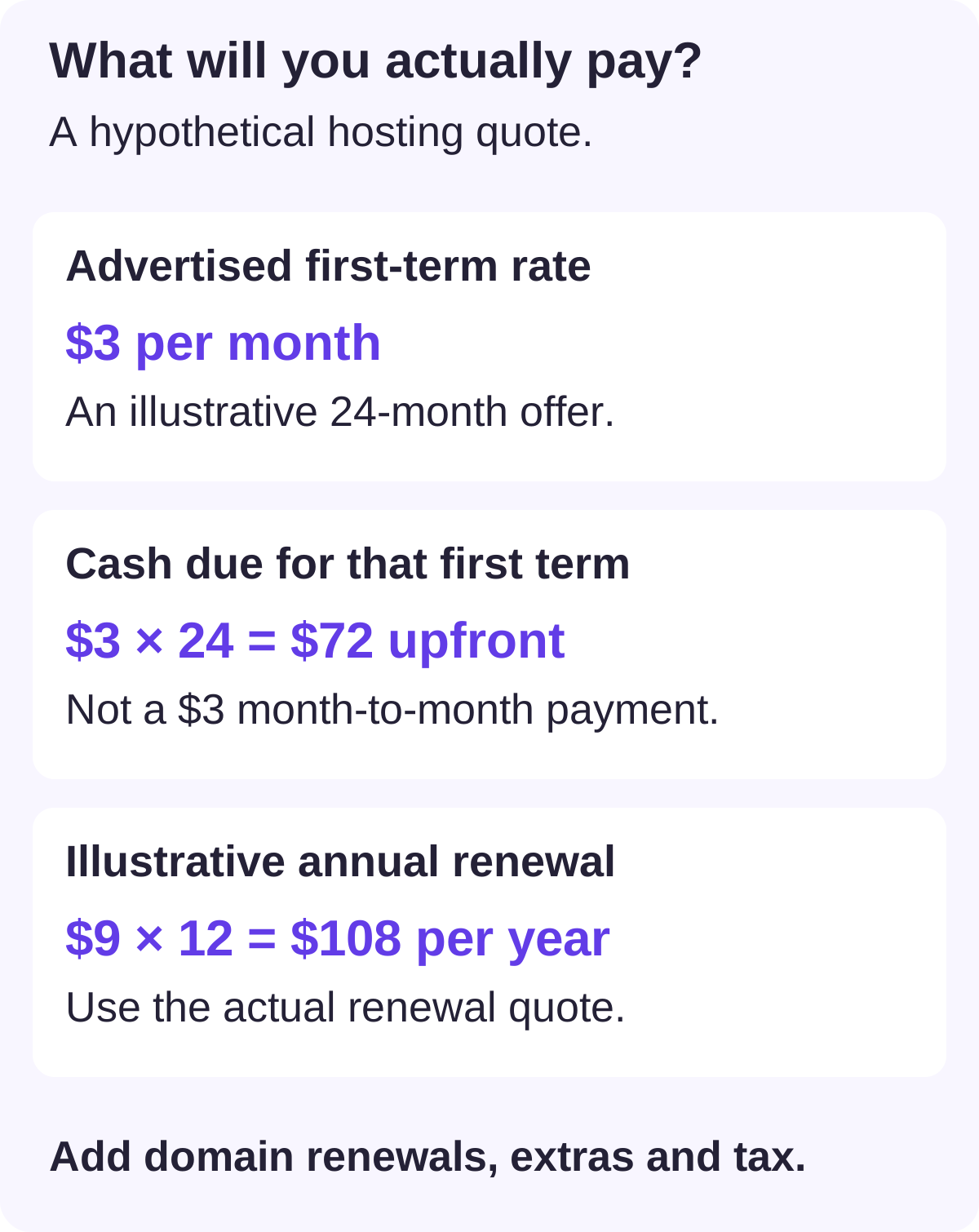
A long introductory term can reduce the monthly equivalent while increasing the cash you commit today. Compare the total payment, commitment length, renewal date, cancellation rules and what happens to the site if the plan expires. Choose a term that fits both your budget and your confidence that the service meets your needs.
Build your own first-year and renewal budget
Write down each real charge once. Use two columns: cash you expect to pay during the first year, and the recurring charges expected after introductory offers end. Add any applicable tax or currency-conversion cost from the actual checkout. Keep optional spending and new hardware separate so the minimum publishing cost stays understandable.
| Budget line | What to record |
|---|---|
| Website plan or hosting | Cash due at signup, the service term it covers, renewal date and renewal quote. |
| Domain | Registration or included-first-year offer, then renewal amount and date. |
| Optional services | Email, paid theme/apps, stock media, advertising or contractor work that you actually choose. |
| Usage-related charges | Subscriber or sending growth, storage, payment processing and any relevant platform fees. |
| Tax and conversion | The charges applicable to your checkout; do not assume a before-tax headline is the final bill. |
| Time and existing equipment | Track hours separately. Add hardware purchases only if you actually need to make them. |
Illustrative example: a Grigora Starter annual plan at $144 plus a hypothetical $15 first-year domain quote is $159 before tax and extras. If the same plan price remains $144 and the domain later renews at $20, the next annual total would be $164. The domain amounts are assumptions for the calculation, not quoted registrar prices. Replace them with the exact domain quote you receive.
Using the Grigora address instead would avoid that separate domain charge, but the paid plan still applies after the trial. On a free hosted publishing plan, the minimum publishing bill can remain $0 as long as your needs stay within its current free rules. Neither route automatically includes your time, internet access or every business expense.
Also worth readingCost to Start a Blog: Build Your First-Year Launch Budget
What can wait until you need it?
- A premium theme or custom logo. Start with a readable layout, useful navigation and suitable images. Pay for design help when a specific requirement or workload justifies it.
- Paid SEO software. Begin with useful posts, clear titles, internal links and the available search-console tools. A subscription cannot guarantee impressions or rankings.
- Advertising. Decide what outcome you are measuring and cap the experiment. Buying visits does not establish that readers will subscribe or buy.
- Writing subscriptions or courses. Free tools and official documentation can cover basic publishing tasks. Evaluate whether a paid product saves enough time or teaches something you need.
- New equipment. Use your existing device if it handles your actual work. A new laptop or camera is not a universal entry fee for blogging.
For a business blog, specialist research, editing, design or maintenance may be worth paying for at launch. Ask for a clear scope, revision allowance, rights to the work, deliverables and ongoing charges. Avoid treating a generic market estimate as the quote for your own project.
Time, income and break-even: keep the assumptions visible
A free publishing plan still takes time to use. For example, four hours a week for four weeks is 16 hours. If you value that time at an illustrative $25/hour, it represents $400 of your time, rather than a $400 invoice. Track cash spending and time separately so you can judge the work realistically.
Income is uncertain. If a product leaves $10 per sale after its variable costs, you would need 16 sales to cover the illustrative $159 annual website-and-domain bill. That calculation excludes your labor, tax and other fixed costs. It is a break-even example, not a prediction of sales or a deadline for earning your money back.
Choose a starting budget you can afford to maintain without assuming that advertising, affiliates, subscriptions or products will immediately pay for it. If you later sell something, review the platform’s eligibility rules, payment fees and obligations for that transaction. Our digital-products selling guide works through delivery and fee considerations.
A short spending checklist before you commit
- Can I publish the type of posts and media I need on this plan?
- What is due today, what period does it cover and what will renew later?
- Does the quote already include hosting, SSL or the domain’s first year?
- What happens at the trial end or when I exceed a storage, audience or sending limit?
- Can I export my work, and what would moving or redirecting old links cost?
- Which optional purchases can wait until I have evidence that I need them?
If you want to test Grigora, use the 14-day website trial to draft and preview the blog, check the editor with your own content and compare the ongoing plan against your budget. Read the current plan allowances before the trial ends.
Blog cost FAQs
The publishing bill can be $0 on a free hosted blogging or article platform if you use its supplied address and stay within its rules. Your existing equipment, internet access and time are separate, and optional upgrades can cost money.
No. You can publish on a platform-provided address. A custom domain adds registration and renewal costs and may require a paid plan. Hosting or the publishing service is a separate decision.
Usually no. A price shown as a monthly equivalent on yearly billing commonly means the full year is charged upfront. Check the actual checkout amount, service term and renewal quote.
No. Start with the tools included in your chosen service and add a paid feature when it solves a real need. Check maintenance and backup responsibilities rather than assuming every security add-on is required or that all protection is automatic.
There is no reliable universal deadline. A blog can earn nothing, and spending more does not guarantee traffic or income. Plan a sustainable cash budget and measure real results before increasing optional expenses.
No. Each website has a 14-day publishing trial with no card required. A paid website plan is needed to keep it online afterward. Domain registration/renewal, business inboxes and certain third-party or usage costs are separate.
Practical writing on building a site, growing an audience and sending email people open. No more than one a week.

Karan Singh Bhakuni
118 articles on the Grigora blog
More on Guides

Guides
Cost to Run a Blog: Renewals, Tools and a Yearly Budget
Plan the next year of an existing blog: record real renewal bills, separate included features from extras, account for usage and maintenance, and compare cash due with a monthly reserve. Includes an…
20 Oct 202310 min read
Guides
Cost to Start a Blog: Build Your First-Year Launch Budget
Separate the amount due before publishing from the cost of the first year. Use a dated quote, avoid paying twice for bundled features and defer purchases without a real job.
29 Aug 202311 min read

Guides
Does Your Startup Need a Blog? Benefits and a First Plan
A startup blog can explain a problem, support buying decisions and teach customers. Start with a specific audience and evidence—not a promise that more posts create growth.
27 Aug 202310 min read