This guide uses “gossip blog” for an entertainment/news or commentary publication. A recognizable voice can be lively and critical while the reporting stays accurate. A screenshot, a trending hashtag or several sites repeating one claim is a lead to investigate, not proof. If a story cannot be supported responsibly, hold it or choose another topic.
Start a Blog Karan Singh BhakuniUpdated 3 Nov 2026
How to Start a Gossip Blog: Sources, Setup and Publishing
Karan Singh BhakuniUpdated 3 Nov 2026- 12 min read
- 8 sections
- 3 comparison tables
- 8 questions answered
The short answer
To start a gossip blog, choose a defined entertainment beat, establish how you will verify stories, then build a site and publish an accurately sourced first post. Reviews, public-event coverage, release news and clearly labeled commentary can offer readers something useful without turning an unverified private-life claim into a headline.
Want the site rather than the reading? Build one free with Grigora
Contents8 sections
Read nextHow to Start a Science Blog: Sources, Writing and Setup
1. Choose a beat and a reason to read your site
Define the subject, audience and format before buying a theme. You might cover a particular television genre, a local arts scene, new music releases or the business of a specific entertainment field. Write a simple editorial promise: what you cover, how you source it and what readers can expect. Avoid suggesting affiliation with a performer, studio or publication you do not represent.
| Format | Useful contribution | What to keep separate |
|---|---|---|
| Public announcement or event report | Confirm what was announced, by whom, when and where readers can check it. | The announcement’s actual scope versus your inference about motives or private matters. |
| Review or recap | Original analysis with enough context to understand the work or episode. | Opinion about a performance versus an unsupported factual accusation about a person. |
| Interview | Accurate questions, responses, context and agreed recording/publication arrangements. | What was said versus your interpretation; do not invent quotes or access. |
| Source-based explainer or roundup | Explain a public development and link the original reporting/documents. | Independent confirmation versus multiple copies of the same report. |
Plan a manageable starting set of ideas using public material you can actually access: a release announcement, an event schedule explained for readers, an original review, or a comparison of official statements over time. These are illustrative formats, not claims that an interview or reporting assignment has taken place. You do not need a scandal or a quota of daily posts to launch.
2. Build a story record before drafting
For each proposed post, record the exact statement you are considering, the original source and what that source can establish. Separate a source’s direct knowledge from hearsay. Two accounts repeating the same anonymous message are not two independent confirmations. Verification depends on the quality and relevance of the evidence, not a magic source count.
| Record | What to save or answer |
|---|---|
| Claim and origin | Exact proposed claim; original document, recording, announcement or firsthand source; URL and access date. |
| Context and identity | Correct person/work/account, full relevant passage, publication/event date, time zone and whether an old item is being recirculated. |
| Independent checks | What corroborates the claim? Do seemingly separate reports trace back to one source? What contradicts it? |
| Response and uncertainty | Relevant response sought/received, meaningful deadline, what remains unconfirmed and whether the story should be held. |
| Media and rights | Original media source, date/context, permitted use, required credit and edits/crops that could mislead. |
| Editorial decision | Public relevance, privacy/harm questions, review needed, publish/hold decision and later corrections. |
The Associated Press’s published standards offer useful professional examples of source identification, fair opportunities to respond and transparent corrections. They are newsroom standards, not a license or legal shield for a new site. Develop a process you can actually follow and keep the underlying notes secure.
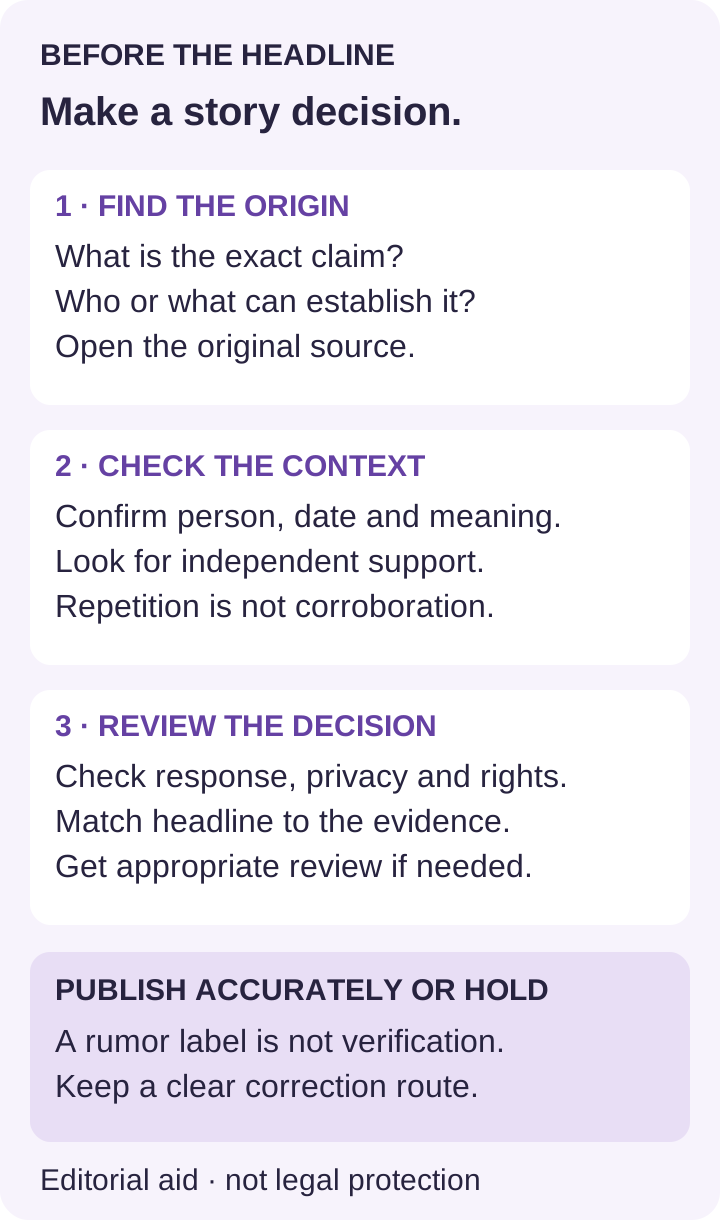
For social posts, open the original account and item rather than relying on a cropped screenshot. Check the date and surrounding exchange, and whether the account is authentic or a parody. For photos/video, look for the original publication and event context. A reverse-image search can help find earlier appearances; it does not prove authenticity by itself. If you cannot establish what an image depicts, leave it out rather than treating it as evidence.
Do not promise absolute anonymity or confidentiality casually. Understand who the source is, why they know, their interests, what can be independently checked and what protections you can actually provide. Agree on ground rules before the exchange where possible. Do not present an invented “insider” or an AI-generated quote as a real source. An anonymous tip may remain an unpublished lead.
3. Address privacy, defamation and image rights
Rules depend on the jurisdiction and circumstances. For a US starting point, the Reporters Committee’s First Amendment Handbook explains that defamation law varies by state, repeating another person’s accusation can create risk, and an “opinion” label does not automatically protect a factual allegation. Privacy can also matter when information is true. Obtain appropriate legal review for consequential reporting rather than relying on a disclaimer.
Ask what readers need to understand the public story and whether a private detail is necessary to it. Give special care to minors, bystanders, private addresses, medical/sexual details and people who have not sought publicity. Celebrity status does not make every private detail ethically justified. Do not obtain material through harassment, trespass, account access or deception. Recording, access and source-protection rules need their own jurisdiction-specific checks.
A photograph visible on a public profile is not automatically free to republish. Check the actual owner, license or other lawful basis for your proposed use, including commercial restrictions and required credit. The US Copyright Office explains that fair use depends on the circumstances and has no universal word/percentage allowance. Credit alone does not grant permission. Keep the permission record; choose original or properly permitted media when uncertain.
Caption the image actually shown, with relevant date/context and required credit. Do not use a generic person’s photo to imply they are involved in an allegation. A crop, composite or generated visual must not invent evidence or change the meaning of an event. Keep essential story information in text and write image alternatives that describe the relevant purpose, not a list of trending names.
4. Choose a platform and set up a useful publication
A domain name should be easy to communicate and appropriate to the beat. Check conflicts and renewals before committing, and avoid names that imply an official celebrity account or established newsroom. A hosted address can be enough to test a concept if the platform’s terms and features meet your needs. A separate hosting purchase is not mandatory for every blogging route.
| Route | Check in a real draft |
|---|---|
| Hosted WordPress.com or Blogger | Plan/address/visibility terms, author/date display, captions, source links, comments and export. WordPress.com features; Blogger setup. |
| Grigora website/CMS | Actual post/collection editor, source and update presentation, responsive layout and any intended integrations. Trial and paid website terms: pricing. |
| Self-hosted software | Hosting, software maintenance, backups/recovery, user access and the person responsible for security and updates. |
Grigora’s paid website plans include hosting, SSL/CDN and domain connection. AI-built sites use CMS collections and connected layouts; classic sites have their own CMS/block workflow. The classic post guide states its legacy scope. Test the editor you actually use; do not assume a historical walkthrough demonstrates current review or comment features.
- Create an About/editorial page explaining the publication’s beat, actual authorship and relevant relationships.
- Provide a working contact/corrections route and explain how readers can identify a disputed passage or source.
- Publish a correction policy, comment rules if needed, and privacy information reflecting the real forms, analytics, providers and applicable rules.
- Use clear categories, readable type, visible dates/bylines and captions; keep ads from obscuring the article or resembling editorial links.
- Secure editor accounts with the available account protections and test how to recover access and restore content.
Also worth readingHow to Start a Nursing Blog: Scope, Sources and Publishing
5. Write and check the first post
Start with a story you can support rather than a provocative claim you hope to verify later. State the confirmed development near the beginning, attribute it to the actual source and explain what is and is not known. If the article is a review, identify the work and make the evaluative purpose clear. Your own observation and someone else’s reporting should not blur together.
- Headline: accurately summarize the supported development or clearly framed review; avoid an accusation disguised as a question.
- Lead: answer what happened or what the review covers, with relevant date and attribution.
- Evidence/context: link the original material, distinguish corroboration from repetition and represent quotations fairly.
- Response/limits: include meaningful relevant responses and what the evidence does not establish.
- Media: use accurate, relevant, permitted images with appropriate captions and alternatives.
- Byline/update route: identify the actual writer, publication/update information and correction contact.
For an illustrative official-release story, an accurate headline could describe the announced title and release date once both are verified. Do not infer a cancelled relationship, hidden conflict or personal motive from the announcement. This is an editorial exercise; no fictional announcement, person or quote is presented as real news.
Before publishing, review the headline, excerpt, social card, filename/caption and body together. Qualifications buried in paragraph six do not fix a misleading preview. Check names, dates, quotations, links, rights, responses and phone layout. Open the final URL as a reader, and verify that essential sources and correction/contact routes remain usable.
6. Share accurate previews and build a repeatable schedule
Search Engine Optimization (SEO) starts with a descriptive title, understandable headings, a distinct summary and relevant links. Google’s people-first guidance supports useful content for readers; it does not guarantee rankings from a trending name, a word count or a posting streak. Do not add an allegation to metadata that the reporting cannot support.
Share the actual article and a faithful preview where the intended audience participates. Follow community rules, discuss the work and correct the preview if a fact changes. Collaborations should have clear authorship, rights and responsibility for verification. A guest post does not remove the publication’s need to check what it publishes.
Choose whether your resources support reviews, a periodic roundup or original reporting. The schedule should leave time for verification and review. Being first is not a substitute for accuracy, and posting consistently does not require publishing a new rumor whenever a topic trends. Keep a list of unfinished leads and explain a delay internally rather than filling a slot with speculation.
7. Keep commercial work distinct and maintain the archive
Monetizing your blog can involve ads, affiliate links, paid resources or sponsored work, subject to real platform and program requirements. State what the relationship is and keep editorial judgments independent. For US-covered endorsements, follow FTC disclosure guidance. A payment or free ticket can be relevant; a general disclosure page does not replace a clear disclosure with the recommendation.
Do not promise coverage in exchange for a favorable story or let a sponsor write an apparently independent review. Track actual costs and receipts, and distinguish audience attention from revenue. If a sponsor requests an unsupported claim or the removal of accurate context, decline the request or clearly change the offer instead of compromising the article.
For an error, verify the correction, update the affected text and leave a clear note explaining the substantive change and date. Review the headline, social preview, image caption and syndicated/email versions too. Correcting the web page alone may leave the wrong claim circulating elsewhere. Preserve appropriate internal records; seek legal/editorial advice for a threatened or consequential dispute.
If enabling comments, define a moderation policy for unsupported accusations, harassment, private details, impersonation and spam. Do not invite readers to identify an unnamed private person or turn an unverified comment into a reported fact. A site can use a contact route without opening a public discussion it cannot responsibly moderate.
Frequently asked questions
Yes, when its work is accurate, fair, appropriately sourced and attentive to privacy. Reviews, public-event reporting and release explainers are useful formats. A topic’s popularity does not justify publishing an unsupported allegation.
There is no universal count that establishes accuracy. Check independence, direct knowledge, relevant records, context and contrary evidence. Several outlets repeating the same message may still amount to one unverified source.
Attribution or an “unconfirmed” label does not automatically make republication appropriate or legally protected. Check the actual evidence and applicable rules; hold a consequential claim you cannot support.
Public visibility is not permission. Identify the owner and the actual license or other lawful basis, keep required credit and use the image in accurate context. Check the proposed use rather than assuming all social media images are free.
Not for every platform. A provided address can help test the concept. Check naming conflicts, plan/monetization terms, renewals and export before buying a domain or hosting.
Use a cadence that leaves time for reporting, verification and corrections. A roundup or review schedule may fit better than breaking news. No schedule guarantees traffic or revenue.
It may help organize verified notes or revise wording, subject to your editorial policy. Check every output and citation. Do not invent sources, quotes, interviews, events or documentary images, and do not put confidential material into an unsuitable service.
Verify the error, correct the article transparently, record the substantive change/date and review previews, captions and other distributed versions. Use appropriate legal/editorial advice for consequential disputes.
Practical writing on building a site, growing an audience and sending email people open. No more than one a week.

Karan Singh Bhakuni
118 articles on the Grigora blog
More on Start a Blog

Start a Blog
How to Start a Science Blog: Sources, Writing and Setup
Turn a focused science question into a readable, accurately sourced article. Check research status and limits, explain numbers in context, build a usable site, and publish a first post without…
3 Nov 202312 min read
Start a Blog
How to Start a Nursing Blog: Scope, Sources and Publishing
Choose a useful nursing-blog purpose, protect professional boundaries and build a source-review process. Then plan the site, first posts, access and realistic promotion.
22 Aug 202310 min read

Start a Blog
How to Start a History Blog: Research, Sources and First Posts
Build a history blog readers can investigate for themselves. Choose a manageable subject, distinguish evidence from interpretation and preserve a clear path to your sources.
22 Sept 202313 min read