These five steps focus on a manageable first publication. Reviews, film essays, interviews and industry reporting require different evidence. A personal project is a valid purpose; a blog does not automatically produce income, festival access, authority or influence over the box office.
Start a Blog Karan Singh BhakuniUpdated 3 Nov 2026
How to Start a Movie Blog: 5 Steps to Your First Review
Karan Singh BhakuniUpdated 3 Nov 2026- 12 min read
- 6 sections
- 3 comparison tables
- 8 questions answered
The short answer
To start a movie blog, choose the reader and kind of film writing you want to serve, set up a readable site, and publish an original review of a film you have actually watched. Support your judgment with specific observations, verify factual details, explain spoilers and check the rights to any media you use. You can begin without a press pass, professional credentials or a revenue target.
Want the site rather than the reading? Build one free with Grigora
Contents6 sections

Read next5 Essential Steps to Start a Running Blog
1. Choose your reader and editorial angle
Decide whether the reader needs a spoiler-light recommendation, a close analysis after watching, a guide to a genre or a sourced report about the industry. Start with a scope you can watch, research and maintain. A specific angle helps you choose work; it does not have to become a permanent restriction or a claim that larger publications cannot cover it.
| Format | Reader need | Evidence to prepare |
|---|---|---|
| Spoiler-light review | Should I spend time watching this? | A viewing record, accurate basic details and specific nonrevealing observations supporting the verdict. |
| Scene or theme essay | What does this part of the film suggest? | Precisely described observations, a clear interpretation, explicit spoiler warning and relevant sources. |
| Curated viewing list | What should I explore next? | A stated selection method, films actually examined and reasons for each inclusion. |
| Interview | What does a participant say about the work? | Actual agreed interview material, accurate quotations, context and any publication conditions. |
| Industry or release report | What happened, and what is confirmed? | Dated primary announcements or records; separate facts, estimates and your analysis. |
For example, “spoiler-light reviews of independent thrillers for occasional viewers” is a planning idea. It is not an existing publication, audience study or guarantee of demand. Pick a few films you can lawfully access and an editorial question you can answer after watching. Do not claim exclusive access, an interview or a screening you did not attend.
Write a short editorial note before launch: what you cover, how you use ratings, where spoilers begin, how factual corrections are handled and how commercial relationships are disclosed. Explain your relevant background truthfully. An about page should help readers understand your perspective without inventing professional experience.
2. Build a site that makes reviews easy to use
Test a representative draft before choosing a platform. Include the title/year, introduction, headings, a longer analysis section, source links, an image you have permission to use and any intended video embed. Inspect the actual preview on a phone and desktop. Choose based on the publishing and maintenance tasks you need, not a promise that one template ranks better.
When selecting a domain name, consider readability, availability, relevant name conflicts and renewal/account control. A provided platform address may be sufficient where available. Hosted publishing and self-hosted software differ: identify hosting, updates, backups, recovery and costs without paying twice for services already included.
Grigora provides hosted site-building and CMS routes that you can use for posts and related pages. Check the current plan terms and actual template for your review layout, media and navigation. Its website trial is temporary; do not assume that hosted publishing includes every external film database, media license or custom feature.
- Home/archive: make the coverage clear and give readers useful routes by series, genre or another accurate category.
- Review template: identify the film and year, show the spoiler policy and keep the verdict and supporting discussion readable.
- About/editorial policy: explain your perspective, rating method, viewing/research standards and correction process.
- Contact and moderation: provide an appropriate contact route and decide how comments and spoiler reports will be handled.
- Relevant policies: make actual privacy, commercial and other applicable disclosures fit the services and data you use.
Dark colors are optional. Test contrast, text size, visible keyboard focus, meaningful headings, image alternatives and readable captions. Avoid autoplay, intrusive overlays and spoiler-filled thumbnails that defeat your own warning. A search box or taxonomy is useful only when it helps readers navigate the real archive; a new site does not need elaborate filters before it has content.
3. Turn viewing notes into an original first review
Watch the actual film and record which version/cut, language or subtitles, viewing date and access context matter to your discussion. Distinguish a full viewing from a trailer, clip or incomplete viewing. Keep factual notes, observations and your reactions separate while drafting; another critic’s synopsis is not evidence that you watched the film.
| Record | How it supports the review |
|---|---|
| Basic identification | Exact film title/year and relevant version; check credited director/cast and release context against reliable primary material. |
| Observations | What the image, performance, editing, sound, dialogue or structure actually does; note where to verify it again. |
| Interpretation | What you think those choices suggest, with alternative readings or uncertainty where appropriate. |
| Evaluation | Why the choices work or do not work for the particular effect, and which viewers may care. |
| Limits | Unverified facts, partial viewing, unfamiliar cultural context or technical issues that affect your assessment. |
A practical first-review structure is: a clear verdict or central argument; a brief premise without unnecessary plot detail; two or three observations supporting the argument; relevant limitations or counterpoints; and a concise recommendation for the intended reader. A rating can summarize your judgment, but define the scale and keep the reasons more useful than the number.
Invented criticism exercise, not a review of an actual film: suppose a fictional scene holds one wide shot of a person waiting at an empty bus stop, with footsteps audible before another character appears. The following separates what could be observed from the writer’s interpretation and evaluation. No film was viewed or reviewed for this exercise.
| Layer | Illustrative wording |
|---|---|
| Observation | The scene holds the wide view while footsteps enter the soundtrack before another person becomes visible. |
| Interpretation | I read the delay between the sound and the arrival as a way of making the wait feel uncertain. |
| Evaluation for a reader | That restraint may appeal to viewers who enjoy quiet anticipation; it would not justify describing the whole fictional film as fast-paced. |
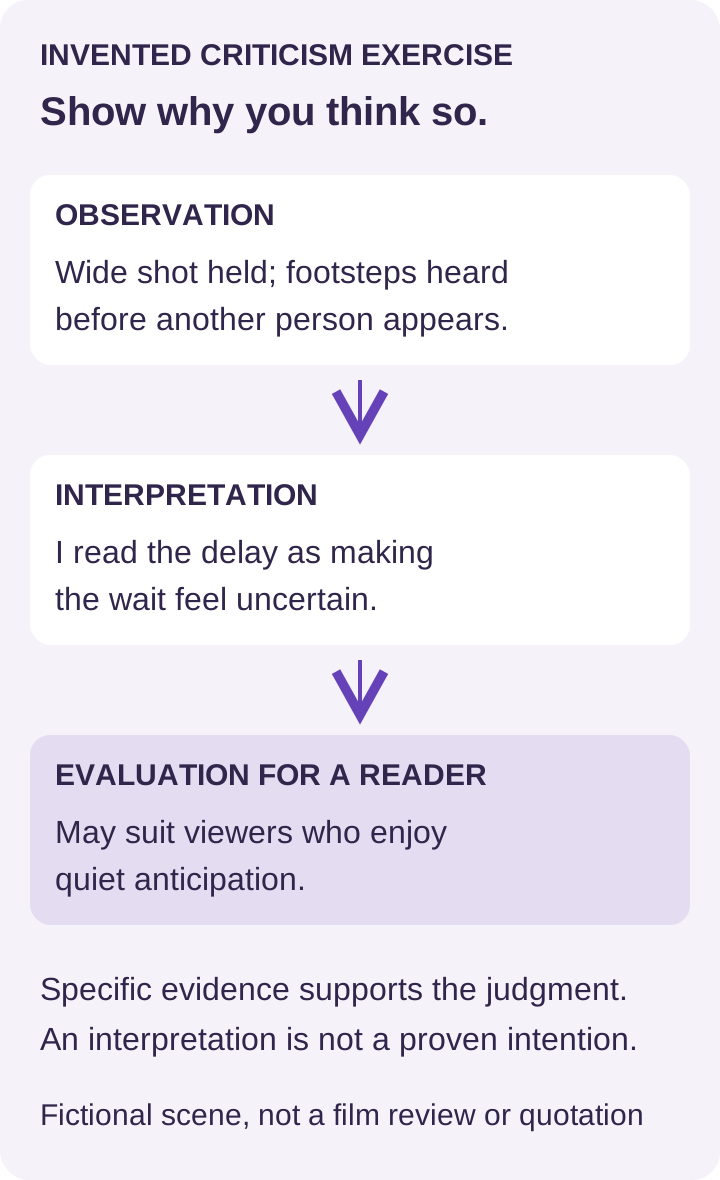
The point is to show how a claim follows from something in the work. Avoid replacing observation with adjectives such as “amazing” or “boring,” or claiming to know a filmmaker’s intention without support. You can write “I read this as…” while remaining clear about what is your interpretation. Revisit relevant moments before making precise claims.
Place a spoiler warning before the revealing material and keep the opening, title, description and sharing image consistent with it. You can offer a short recommendation first, then a clearly separated analysis. Consider quotations, scene descriptions and images as well as plot summaries: a screenshot or heading can reveal the development you meant to withhold.
Also worth readingHow to Start a Craft Blog: 9 Practical Steps
4. Check facts, media rights and commercial relationships
Check titles, credits, quotations, dates and release information against the film’s credits, authorized distributor/festival materials or other relevant primary records. Date claims about where a film is available and specify the market; streaming catalogs and versions change. For box-office or budget discussions, name the source and distinguish a reported estimate from an audited fact.
A press release is evidence of what its issuer announced, not independent proof of every promotional claim. An interview requires the actual recorded or written exchange and agreed conditions; do not invent a quote to fill a gap. Correct material factual errors visibly and distinguish a revised fact from a changed opinion.
Before using a photo you found online, identify the source, owner and applicable permission or exception. Posters, stills, trailers, soundtrack recordings and screenshots are not automatically free to reproduce because the blog is a review or gives credit. A press-kit download may have conditions; keep the actual terms with your asset record.
For a US baseline, the Copyright Office’s fair-use guidance identifies criticism and comment as possible purposes, while requiring a case-specific assessment of purpose, the work, the portion used and market effect. The official FAQ confirms there is no universal safe number of words, seconds or percentage. A review label or disclaimer does not decide the outcome; get appropriate permission or advice where needed. Other jurisdictions can differ.
Use original commentary and graphics where they explain the point. Link to an authorized source when reproducing material is unnecessary, and check the actual terms before embedding or reusing third-party media. Do not host a film or reupload a clip merely because the original is publicly accessible. Label an illustrative graphic as such instead of presenting it as a real production still.
If a review includes relevant payment, gifts, access or affiliate relationships, make the relationship clear with the recommendation. The FTC’s US-facing endorsement guidance explains material connections and honest experience. A free screening or other benefit should not be hidden when it is relevant; an agreed positive verdict is not independent criticism. Keep any embargo or publication agreement distinct from your assessment.
5. Publish, discuss and maintain a manageable archive
- Check the factual record, original wording, sources, spoiler boundary, rights and relevant disclosures.
- Inspect a real phone/desktop preview where available: readable text, working links, accessible media, no accidental spoilers in sharing details.
- Publish through the actual platform workflow and verify the signed-out public URL; a saved draft or private preview is not the finished publication.
- Invite relevant discussion where community rules allow it; moderate spoilers, harassment, personal information and unverified allegations.
- Keep source and update notes, review changing availability links and maintain account/renewal/recovery responsibilities.
Search Engine Optimization (SEO) starts with a clear public page that answers the intended question. Use descriptive titles that distinguish films with the same name, accurate summaries, meaningful headings and natural links to related work. Do not add repetition, purchased links or unrelated keywords to imitate another site’s traffic. A fixed weekly publication rule does not establish better rankings.
Choose a calendar that leaves time to watch, think, verify and edit. A focused review, a related scene essay and a carefully selected viewing list can form an initial plan without chasing every release. Current news requires current reporting; an older film can support a useful essay without a topical hook. Keep a backlog and distinguish work ready to publish from work still needing verification or rights review.
Comments, a consent-based newsletter or a chosen community can support conversation, but each adds work and privacy/moderation responsibilities. If later launching a podcast or video essay, plan its own media rights, captions/transcript, equipment and hosting workflow. Another format is optional; it does not make a review more credible by itself.
If considering monetizing your blog, compare actual costs and commercial options with the editorial purpose. Affiliate programs, advertising, memberships and sponsorships have eligibility, terms and uncertain returns. Do not copy old commission rates or assume a traffic number secures acceptance. Selling someone else’s film-related artwork or music needs its own rights review.
Before selling e-books or viewing guides, define the original value, rights, delivery and support obligations. Keep costs, tax and contractual questions appropriate to your situation. Paid products and advertising are not required to justify a thoughtful movie blog, and recurring revenue or press access should not be promised in a launch plan.
Frequently asked questions
Not to begin a personal film blog. Be honest about your background, access and the work you actually watched or researched. Professional opportunities and screenings have their own criteria and are not assured by publishing.
Choose a film you have actually watched and a focused reader question. A spoiler-light recommendation or a carefully supported analysis is more manageable than attempting every genre and current industry story at once.
Use specific observations about performance, framing, editing, sound or structure to support your interpretation and judgment. Include only the plot context needed, and distinguish what the film does from what you think it means.
No. A clear argument and recommendation can be enough. If you use a scale, explain it and apply it consistently without treating a number as a substitute for analysis.
Credit alone does not establish permission. Check the actual asset terms, rights or applicable exception. US fair use depends on the circumstances; there is no universal safe screenshot count or clip length. Other jurisdictions may differ.
Warn readers before revealing material and check the title, opening, headings, images and sharing preview as well as the main text. A short recommendation can precede a separately labeled detailed analysis.
At a pace that permits actual viewing, research, rights checks and editing. There is no universal weekly requirement for useful criticism or improved rankings. Current reporting and older-film essays have different update needs.
It can support commercial models, but eligibility and returns vary. Account for the actual work and costs, disclose relevant relationships and preserve honest criticism. Income, screening access and career opportunities depend on the circumstances.
Practical writing on building a site, growing an audience and sending email people open. No more than one a week.

Karan Singh Bhakuni
118 articles on the Grigora blog
More on Start a Blog

Start a Blog
5 Essential Steps to Start a Running Blog
Turn your running notes into useful posts. Choose a reader, set up a manageable website, document your experience, and check routes and photos before publishing.
12 Nov 202312 min read

Start a Blog
How to Start a Craft Blog: 9 Practical Steps
Turn your actual craft work into useful tutorials: record materials and measurements, photograph critical steps, choose a suitable platform, check instructions and rights, then publish and improve…
16 Nov 202314 min read

Start a Blog
How to Start a History Blog: Research, Sources and First Posts
Build a history blog readers can investigate for themselves. Choose a manageable subject, distinguish evidence from interpretation and preserve a clear path to your sources.
22 Sept 202313 min read