A nursing blog can share professional learning, career information or general education. It is not automatically a clinical service, a credential or a substitute for individual care. Keep your actual qualifications and role clear, whether you are a student, a licensed nurse, an educator or another contributor.
Start a Blog Karan Singh BhakuniUpdated 3 Nov 2026
How to Start a Nursing Blog: Scope, Sources and Publishing
Karan Singh BhakuniUpdated 3 Nov 2026- 10 min read
- 10 sections
- 2 comparison tables
- 5 questions answered
The short answer
To start a nursing blog, choose a clear audience and a topic you can responsibly cover, define the professional and privacy boundaries, then set up a maintainable publishing site. Write a useful first post with appropriate sources, check it before publication and build a realistic plan for updates and reader questions.
Want the site rather than the reading? Build one free with Grigora
Contents10 sections
Read nextHow to Start a Gossip Blog: Sources, Setup and Publishing
1. Choose an audience and editorial scope
Start with one audience and the question the blog will help answer. Fellow students, experienced nurses and general readers need different context. Pick topics that match your knowledge, access to evidence and ability to obtain suitable review. Do not assume a popular health topic is appropriate simply because it attracts searches.
| Possible focus | A useful starting direction | Boundary to establish |
|---|---|---|
| Student learning | How to organize approved study resources or prepare questions for an educator. | Represent student status accurately; do not imply independent clinical authority. |
| Career and professional development | An appropriately sourced account of roles, education routes or professional resources. | Check the relevant region, dates and official requirements; avoid guaranteed job or salary outcomes. |
| Professional reflection | Your own learning or working approach without identifying patients or confidential events. | Follow regulator, employer and school policies; reflection is not permission to disclose. |
| General public education | A clearly scoped explanation based on appropriate current evidence and qualified review where needed. | Keep it distinct from diagnosis, treatment instructions or patient-specific advice. |
Write an About page that accurately describes the author, relevant credentials and the blog’s purpose. Identify collaborators or reviewers only when they actually contributed and agreed to the attribution. Do not imply that an employer or institution endorses the blog without authorization.
2. Set privacy and professional boundaries first
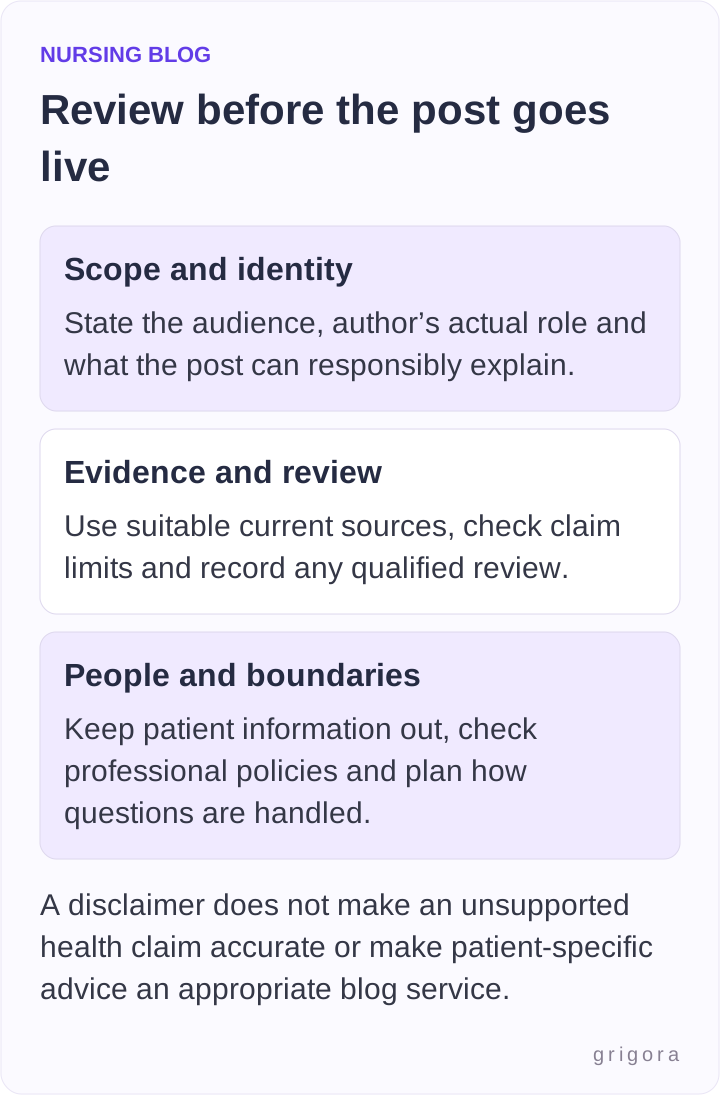
Do not use patient encounters, records, photographs or screenshots as convenient blog material. Names are only one route to identification; dates, workplace, location, diagnosis, unusual events, images and combinations of details can also reveal someone. A private account, changed name or deleted post does not establish confidentiality.
The NCSBN nursing social-media guide discusses patient privacy, online professional boundaries and employer policies. Consult the requirements of your own regulator, employer or school before publishing work-related material. Do not rely on informal permission, a nickname or a generic blog disclaimer as clearance.
In the U.S., HHS de-identification guidance describes defined Expert Determination and Safe Harbor methods for relevant HIPAA contexts. Removing a name is not the same as completing that process, and other professional or legal duties can still matter. If a proposed post depends on patient information, seek appropriate institutional/privacy review or choose another topic.
Define how you will handle comments, contact forms and direct messages. Do not invite readers to submit symptoms, medical records or identifying patient details for public discussion. A general blog is not a suitable emergency or patient-care channel. Provide a clear boundary and an appropriate route for ordinary editorial questions.
3. Choose a platform and ownership arrangement
Compare platforms for editing, categories, author/reviewer information, media, accessibility, account controls, backups/export and ongoing costs. Confirm who controls the domain, billing and recovery account. A simple site that you can maintain is a reasonable starting point; a template’s clinical imagery does not confer professional authority.
Grigora or another publishing platform can organize public pages and posts. Verify the features and plan available to your account rather than assuming the blog includes secure patient messaging, telehealth, clinical records or appointment management. HTTPS protects a connection; it does not make a general contact form an approved clinical system.
Plan the total cost, including renewals, content and review time, media permissions and any external services. Avoid depending on a specific introductory price or projected affiliate income to make the budget work. You can start with a limited editorial scope and expand when there is a real audience need and review capacity.
4. Organize the site for readers
- Home: explain the audience and purpose clearly, with links to useful starting topics.
- About and contributors: accurate roles, credentials and actual review arrangements.
- Topic pages: a manageable set of categories based on reader questions.
- Posts: meaningful titles, sources, publication/update context and a way to report a concern.
- Contact, privacy and relevant disclosures: suitable editorial contact, actual information handling and commercial relationships.
Use readable typography, clear headings and useful navigation. Check phone layouts and keyboard access. Provide appropriate text alternatives for informative images and captions/transcripts for relevant media. Keep key information in readable text rather than only in a dense graphic or video. Use illustrations or appropriately licensed media without presenting stock or generated people as actual patients or evidence.
5. Build a source and review record for each post
Use current primary or appropriately authoritative sources for the actual claim, such as the relevant regulator, professional guidance, a guideline issuer or original research. Assess date, population, setting and limitations. A single study, personal experience or a product testimonial does not automatically establish a broadly applicable health benefit.
| Review record | What to record |
|---|---|
| Question and scope | Audience, what the post answers and what it does not address. |
| Author and reviewer | Actual role/qualifications, relevant reviewer if involved, and what was reviewed. |
| Claim and evidence | The specific claim, source link/version/date, relevant context and limitations. |
| Privacy and rights | Confirmation that confidential information is excluded and media/quotes can be used. |
| Maintenance | Publication date, last substantive review, correction route and trigger for checking again. |
For clinical or other consequential information, arrange an appropriate qualified review before publication and recheck when guidance changes. If you cannot support or suitably review a claim, narrow or remove it. Clearly label opinion, personal reflection and preliminary findings rather than making them look like settled clinical guidance.
AI tools can help organize a draft, but verify sources and claims yourself and follow applicable institutional rules. Do not enter patient or confidential work information into an unapproved tool. Do not invent citations, credentials, patient cases or reviewer approval.
Also worth readingHow to Start a Science Blog: Sources, Writing and Setup
6. Write and check the first post
Choose a manageable question within the scope you set. A first post might explain how to find official nursing-registration information for a named jurisdiction, or introduce a clearly labeled study-resource organization method. These are topic examples, not a claim about your experience or a substitute for the official requirements.
Answer the question early, explain necessary terms and keep the structure clear. Whether writing in a formal tone or using conversational language, retain precision and respect. Link sources near consequential factual claims and explain important limitations. Do not include a treatment recommendation merely to make the post feel more actionable.
Before publishing, confirm every source link, image, attributed quote and author/reviewer statement. Read the page on a phone, follow the navigation and test the editorial contact route with authorized non-sensitive test information if needed. Check what the reader sees after submission and who actually receives the message; do not assume a success screen proves delivery.
7. Share the blog with professional care
Share useful posts through suitable professional communities, colleagues and channels while respecting their rules and subscriber choices. Do not disclose additional patient or workplace information while promoting a post. A reader or patient contacting you socially does not remove professional-boundary responsibilities.
Search Engine Optimization can help search engines understand relevant public pages, but it does not guarantee indexing or rankings. Google’s SEO Starter Guide provides a sensible foundation. Use clear titles and useful content; avoid unsupported health claims or keyword-stuffed posts made only to attract traffic.
A personal online-only blog is not automatically eligible for a local business listing. Google’s Business Profile guidance limits eligibility to qualifying businesses with the required in-person contact. Do not create a profile merely because the topic is nursing or you use local keywords.
8. Consider revenue separately from clinical practice
Monetizing your blog is optional and uncertain. Possible appropriate routes depend on your scope, rights and professional obligations. A resource or educational product needs accurate claims and clear terms; affiliation or sponsorship should not determine the conclusions of a health explanation.
If endorsing a health-related product, the FTC’s U.S. health-products guidance explains the need for truthful, nonmisleading claims and suitable scientific support. Personal enthusiasm, a nursing title or a genuine anecdote is not enough to establish product efficacy. Disclose material relationships clearly and decline claims you cannot support.
Do not treat paid patient-specific advice as a simple blog add-on. It can involve professional scope, licensure, location, employer restrictions, liability and appropriate clinical systems. NCSBN’s U.S. licensure guidance notes that practice includes telehealth and telephone care and is where the patient is. Check the actual requirements with the relevant regulator before offering any such service.
Keep the blog accurate and maintainable
Even robust privacy policies do not implement protections on their own. Match the notice to actual data collection and providers, keep access appropriate and avoid collecting sensitive information the blog does not need. Set a process for moderation, corrections and privacy concerns that you can actually carry out.
Choose a publishing pace that leaves time for evidence and review. Revisit high-value posts when relevant guidance or requirements change, and record substantive corrections honestly. Do not change a date just to imply a new clinical review. Remove or explain information that is no longer reliable.
Evaluate whether readers find useful resources and understand the scope, using appropriate feedback and limited analytics. Visits, subscribers or income do not establish clinical accuracy or patient benefit. Start with one responsible post and a maintenance process before expanding the site.
Frequently asked questions
A student can publish within an appropriate scope while accurately representing their status and following school, placement, professional and privacy requirements. Do not imply independent clinical authority or invent experience.
Changing names alone does not establish that a story is safe or permitted. Other details can identify someone, and professional or employer duties may still restrict disclosure. Use appropriate institutional/privacy review or choose content that does not depend on patient information.
A general blog should not be treated as a clinical or emergency channel. Establish clear boundaries and avoid collecting health records or identifying patient details. Patient-specific services require separate consideration of professional scope, licensure, systems and other requirements.
No. A manageable schedule with appropriate evidence checking and review is more important than a universal quota. Maintain important existing posts when guidance changes.
Possibly, but earnings are uncertain. Review rights, disclosures and professional obligations separately from the site setup. Sponsorship does not justify unsupported health claims, and clinical services are not automatically authorized by having a blog.
Practical writing on building a site, growing an audience and sending email people open. No more than one a week.

Karan Singh Bhakuni
118 articles on the Grigora blog
More on Start a Blog

Start a Blog
How to Start a Gossip Blog: Sources, Setup and Publishing
Build an entertainment blog around verifiable reporting and clearly labeled commentary. Use a story record, check images and privacy, prepare a useful first article, and set up a correction process…
5 Nov 202312 min read

Start a Blog
How to Start a Science Blog: Sources, Writing and Setup
Turn a focused science question into a readable, accurately sourced article. Check research status and limits, explain numbers in context, build a usable site, and publish a first post without…
3 Nov 202312 min read

Start a Blog
How to Start a History Blog: Research, Sources and First Posts
Build a history blog readers can investigate for themselves. Choose a manageable subject, distinguish evidence from interpretation and preserve a clear path to your sources.
22 Sept 202313 min read