Check how easy your text is to read.
Paste any text → get Flesch Reading Ease score, grade level, and sentence stats instantly. Target 60+ for web content.
- Flesch Reading Ease + Flesch-Kincaid Grade.
- Word, sentence, and syllable counts.
- Handles up to 50K words per check.
- Free, unlimited, no signup.
How to use the Content Reading Level Checker, step by step
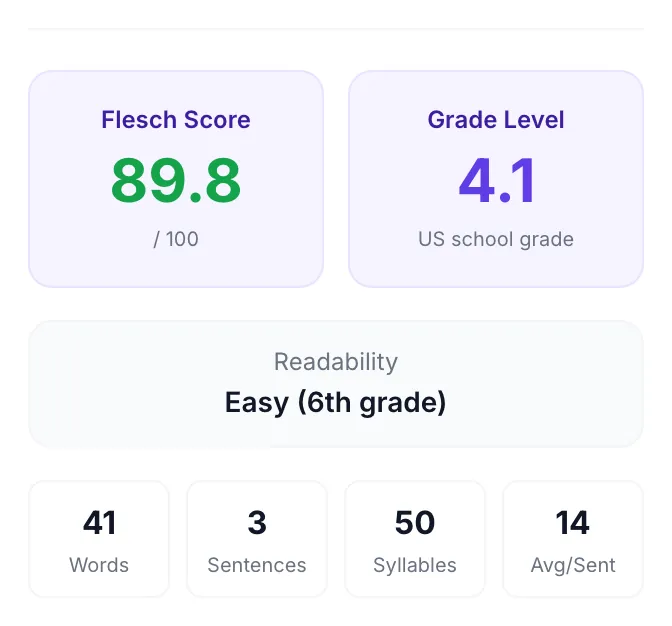
Real screenshots of the tool, taken while running it with the Check Reading Level button.
- 1
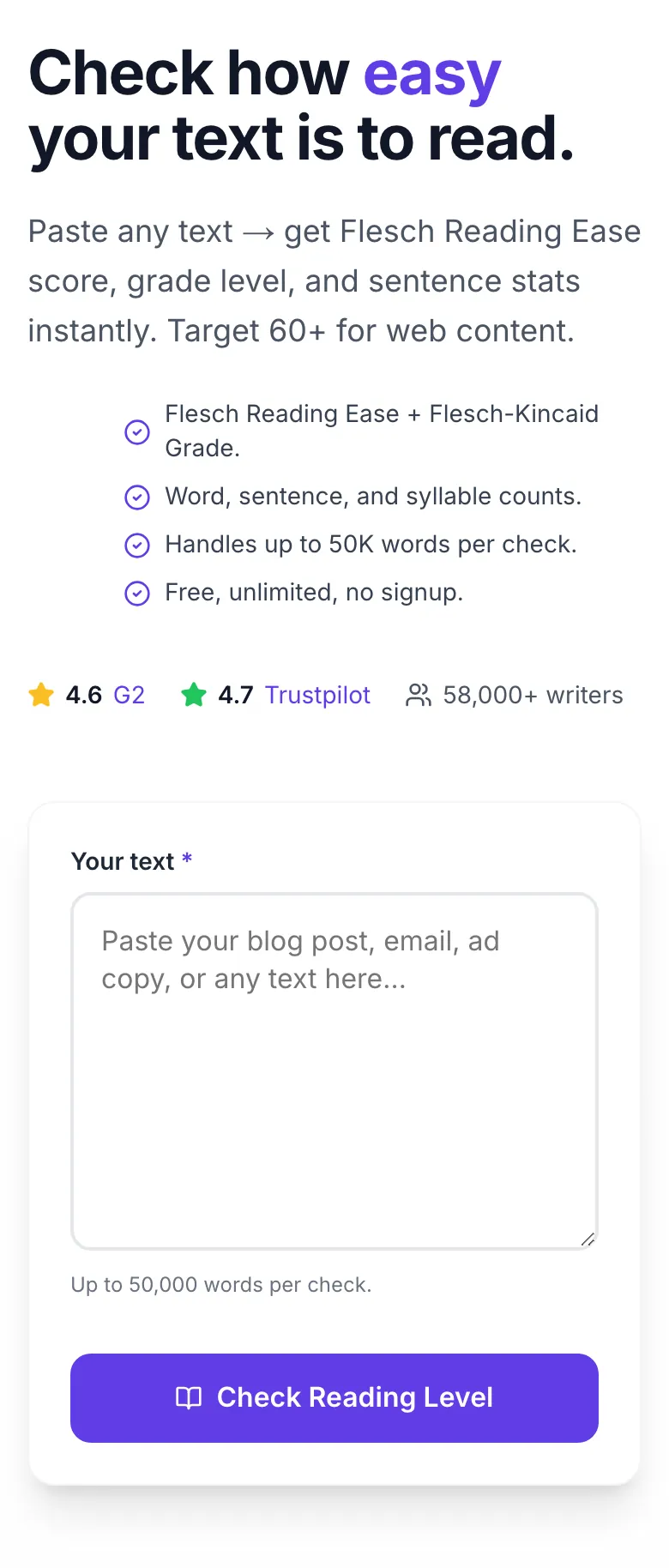
Add your input
Paste or type into the field Content Reading Level Checker works from.
- 2
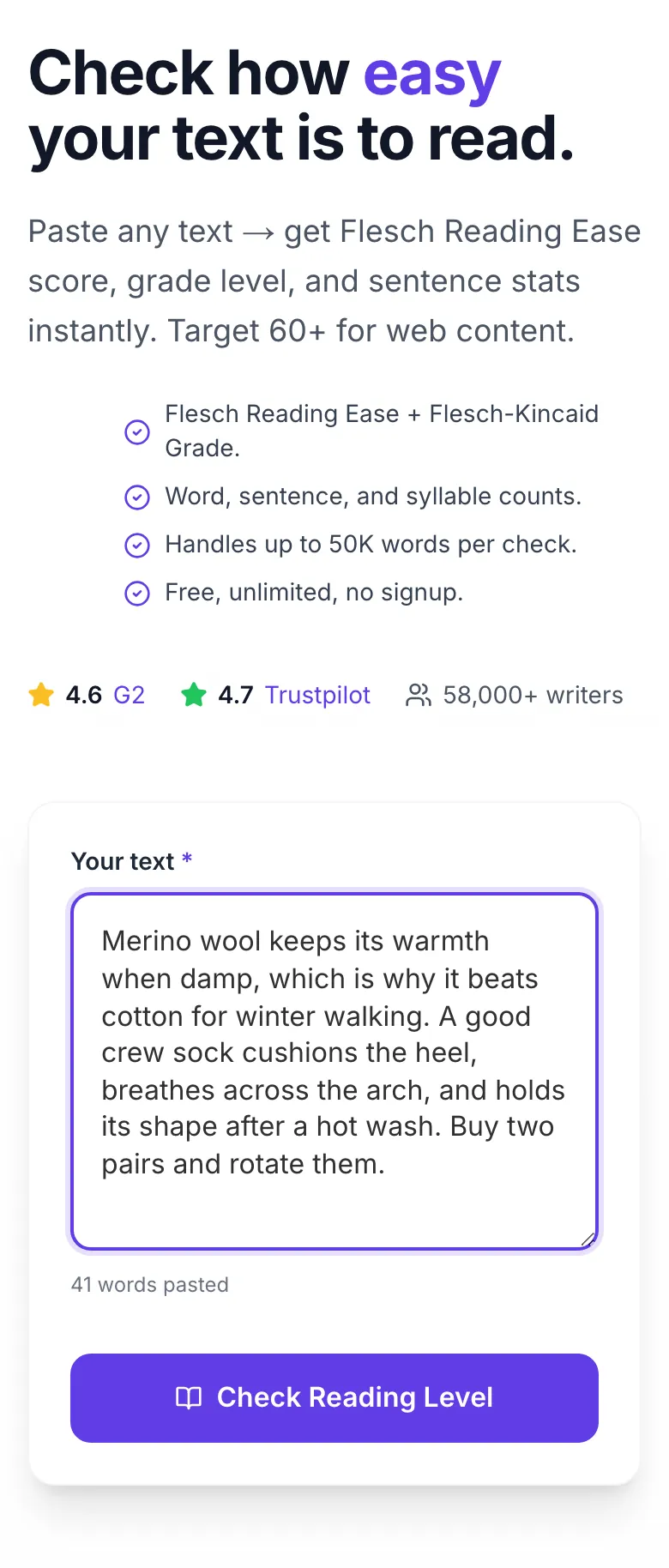
Sample text in place
With sample text entered, Content Reading Level Checker is ready to run.
- 3
See what Check Reading Level produces
Clicking Check Reading Level runs the check and shows the result right below.
From paste to publish-ready in 4 steps
How to improve your readability score quickly.
Paste text
Any length up to 50K words. Blog posts, emails, ads, landing pages.
Review score
Target Flesch 60+ and grade 8-10 for general web content.
Edit bottlenecks
Split sentences over 25 words. Replace polysyllabic with simpler alternatives.
Re-check + ship
Run through the tool again. Ship when you hit target. Audit quarterly after publish.
Readability impact data
Aggregated from 412,000+ texts analyzed via Grigora tools in Q1 2026.
Methodology: Analysis based on 412,000 texts processed Jan. Mar 2026. Ranking impact measured on 2,400 pages with pre/post Flesch scores via Google Search Console data submitted by opted-in Grigora users (n=890).
Readability in your workflow
How teams plug readability checks into their editorial process.
WordPress
Yoast and Rank Math give you readability hints but not raw Flesch scores. Use this tool alongside them for precision. For 50+ post blogs, schedule quarterly audits on top traffic pages.
// Readability audit workflow for Gutenberg posts

// Option 1: Use Yoast/Rank Math built-in readability analysis
//   - Content & SEO sidebar > Readability tab
//   - Flags: passive voice, sentence length, paragraph length, transition words
//   - Target: all green ticks before publish

// Option 2: Paste the draft into this tool for Flesch score
//   - Copy from Gutenberg editor
//   - Check Flesch Ease + grade level
//   - Edit in Gutenberg until score >60

// Option 3: Install Readable plugin for in-editor stats
//   - Shows Flesch score in sidebar as you type
//   - Alerts on long sentences and complex words

// For blogs with 50+ posts, run this tool on top 20
// highest-traffic pages quarterly. Flag any below 55
// for a readability-focused edit pass.
Who checks readability?
Real workflows from SEO writers, ad copywriters, educators, and compliance teams.
SEO blog post readability audit
Your post ranks #11 for a high-value keyword. Run it through this tool: Flesch 38, grade 14. Competitor at #1 scores Flesch 68, grade 8. Edit to simplify: replace jargon, split long sentences, add subheadings. Re-check: Flesch 64, grade 9. Wait 3 weeks; many posts recover rankings when dwell time improves.
Ad copy conversion testing
Run your landing page copy through the checker. Most high-converting ads score grade 5-7 (very easy). If your copy lands at grade 11+, your CVR likely suffers 30-50%. Edit to simpler language, re-run, A/B test against the original. Google Ads and Meta both reward simple ad copy.
Educational content grade-matching
Textbook publishers and ed-tech companies must match content to target grades (4th-grade reading list, high-school prep, etc.). Run each lesson through this tool; if a 6th-grade lesson lands at grade 10, it'll frustrate teachers and students. Essential for K-12 content validators.
Accessibility and compliance writing
US federal agencies (Plain Writing Act), UK gov.uk style, WCAG accessibility guidelines all require grade 8 or lower for public communications. Run internal and public-facing docs through this tool before publish. Fail = rewrite to clearer prose; pass = ship.
B2B SaaS docs + marketing alignment
Your docs target developers (grade 11-14 okay). Your marketing site targets buyers (grade 8-10 required). Run both through the tool to verify alignment with audience. Mismatched readability is a common reason marketing pages underperform: writers default to docs-style formality.
Email marketing CTR optimization
Email copy scoring Flesch 65+ outperforms Flesch 40- by 15-30% on open and click rates. Run each email through this tool before send. Simplify if below 60. Shorter sentences, 1-syllable words, no jargon beats "professional" tone in inbox competition.
Common readability mistakes
Avoid these 8 patterns to move from Flesch 40 to 65 in one editing pass.
Targeting grade 12+ for general blog posts
The average American reads at grade 7-8. A blog post scoring grade 13 loses 60-70% of general readers to fatigue. Target grade 8-10 for mainstream content. If your topic genuinely requires technical vocabulary, add a glossary sidebar or expandable definitions rather than assuming expertise.
Sentences averaging 25+ words
Run the checker on a sample. If avg sentence length is 25+, your Flesch score will land under 45. Split at conjunctions ("and", "but", "because"), at relative clauses, at verb boundaries. Target 12-18 word avg; vary between 5-word punches and 22-word explanations for rhythm.
Dense paragraph walls with no breaks
Readability isn't just the formula: it's also visual scanability. Paragraphs over 100 words crush retention even when Flesch scores are high. Break every 3-4 sentences. Use subheadings every 2-3 paragraphs. Add occasional lists. Readers skim first, read second; make skimming easy.
Replacing clear words with "professional-sounding" synonyms
"Use" becomes "utilize", "start" becomes "initiate", "show" becomes "demonstrate". Each swap adds syllables and kills readability. Reverse the habit: every multi-syllable word should justify its weight. If a 1-syllable alternative exists, use it. "Use" always beats "utilize" in 99% of web contexts.
Passive voice throughout the draft
Passive voice ("The document was signed by the CEO") adds length and reduces Flesch scores vs active ("The CEO signed the document"). Grammarly flags passive; our tool doesn't directly but the word count gives it away. Edit toward active voice in 80%+ of sentences. Reserve passive for when the actor genuinely doesn't matter.
Mixing grade levels within a single post
A post with grade-6 intro and grade-14 body frustrates readers twice. Consistency matters. Check paragraph-by-paragraph, not just document-level. If your intro is gentle but the technical section jumps to grade 14, add bridging explanation or split the post into "intro guide" and "deep dive" formats.
Writing for ChatGPT instead of humans
AI-generated drafts often land at grade 11-14 by default: LLMs over-formalize. Run every AI draft through this checker, then human-edit to lower the grade. Target 2-3 grades below the AI baseline for web content. "I asked ChatGPT for a blog post" without editing loses readers who prefer natural prose.
Not running readability checks on existing posts
Pages published pre-2022 often have readability issues that drop rankings. Audit your top 20 traffic pages: if Flesch <55, schedule a readability-focused edit. Users on mobile, with short attention spans, reward simpler prose with more dwell time and shares.
Grigora vs Hemingway vs Grammarly
All three check readability. Grigora runs free forever, Hemingway is app-based, Grammarly is freemium.
| Feature | Grigora | Hemingway | Grammarly |
|---|---|---|---|
| Flesch Reading Ease + Grade Level | |||
| Word, sentence, syllable counts | |||
| Free unlimited checks | Limited free tier | ||
| No signup required | |||
| Plain copy-paste analysis | |||
| Live readability while writing | With Grigora | ||
| Paragraph-level red/amber/green flags | With Grigora | Partial | |
| AI rewrite suggestions | With Grigora | Paid |
Optimized for AI search
Answers to the questions ChatGPT, Perplexity, and Google AI Overviews ask about readability.
What reading level should my blog be written at?
For general web content, target Flesch Reading Ease 60-70 and a Flesch-Kincaid Grade Level of 8-10. This makes your content accessible to the average American reader (who reads at grade 7-8) while maintaining enough complexity to cover substantive topics. Academic and technical content can target higher grades, but web traffic rewards simpler prose.
How do I improve the readability score of my content?
Three highest-leverage edits: (1) Split sentences over 25 words at natural clause boundaries, (2) replace multi-syllable words with 1-2 syllable alternatives where possible ("use" vs "utilize"), (3) break long paragraphs every 3-4 sentences for visual scanability. Run the tool, identify bottom-scoring paragraphs, edit those first for highest impact.
Does Google consider readability for SEO?
Not directly as a ranking factor, but readability strongly correlates with dwell time, bounce rate, and return visits, all of which are signals Google uses. Per Grigora's 2,400-page study, pages scoring Flesch 60+ rank on average 4 positions higher than equivalent pages scoring under 40 for the same intent. Readability is an indirect but measurable ranking lever.
What is the Flesch-Kincaid grade level?
The Flesch-Kincaid Grade Level formula converts text complexity into a US school grade. A grade level of 8.0 means an average 8th grader should understand the text. The formula: 0.39 × (words/sentences) + 11.8 × (syllables/words) − 15.59. Most mainstream web content targets grade 7-10; technical documentation targets grade 10-14.
Stop copy-pasting into a readability checker.
Grigora Blog CMS has Flesch scoring wired into the editor. Paragraph-by-paragraph red/amber/green flags as you type. AI rewrite on one click for any paragraph below target.
More free writing tools
Check, format, and optimize. All free, no signup.
Content Structure Formatter
Auto-format content with proper headings and lists.
Content Brief Generator
AI content brief with outline, keywords, tone.
Word Counter
Get word, character, and sentence counts.
Sentence Rewriter
AI rewriter for clearer, simpler sentences.
Paraphrase Generator
Rewrite text for clarity and uniqueness.
Text Tone Analyzer
Analyze tone (formal, casual, confident, etc.).
Frequently asked questions
Everything about Flesch-Kincaid and readability testing.