Hand writers publish-ready briefs in 15 seconds.
Type a keyword → get a full SEO content brief: outline, title suggestions, audience, related keywords, questions to answer, stats to cite, tone, word count. Copy and hand to your writer.
- Full H2/H3 outline rendered in Markdown.
- 8-12 questions your content must answer.
- 3-5 statistics to source and cite.
- Word count + tone + title suggestions, copy in one click.
How to use the Content Brief Generator, step by step
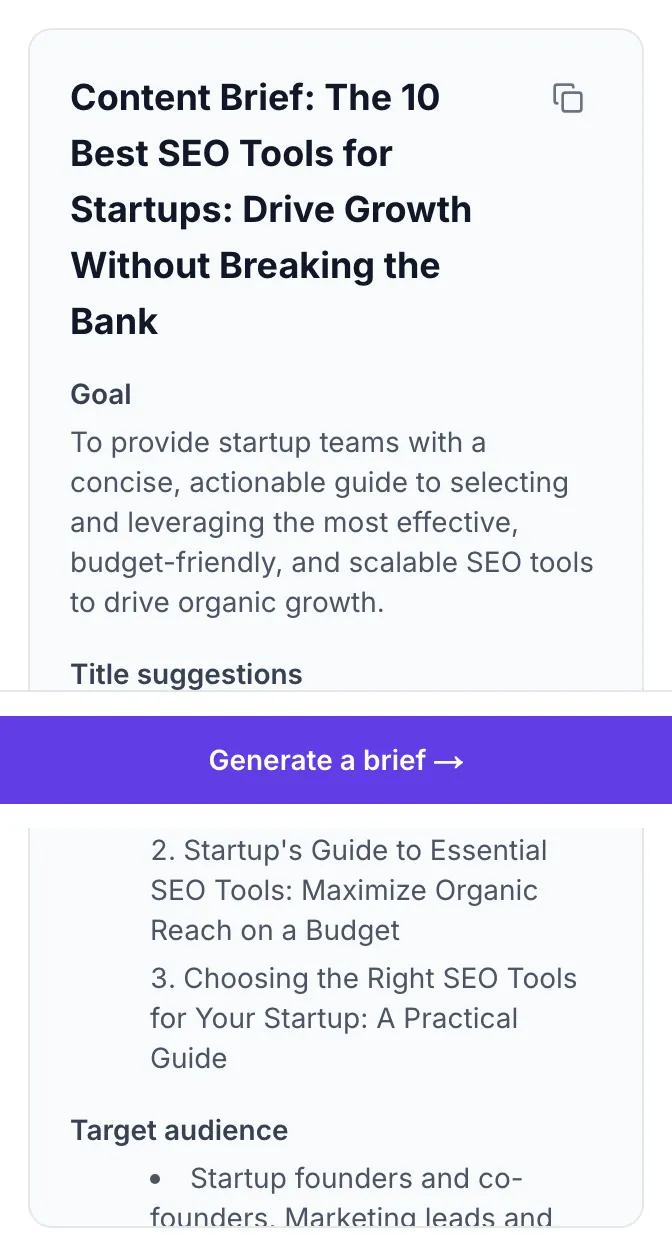
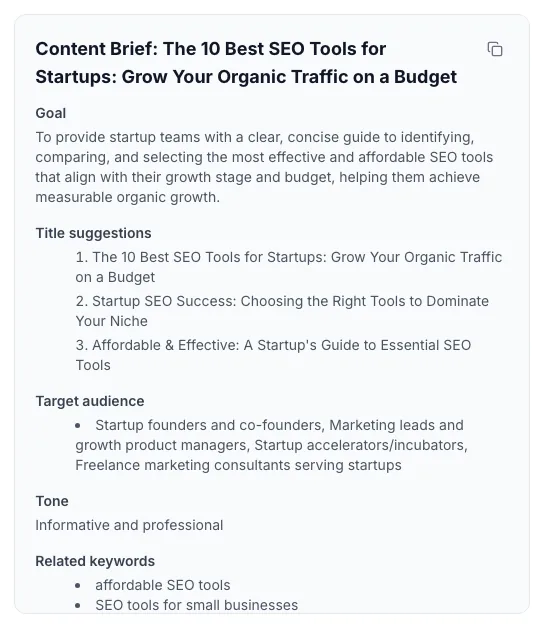
Real screenshots of the tool, taken while running it with the Generate content brief button.
- 1
Add your input
Paste or type into the field Content Brief Generator works from.
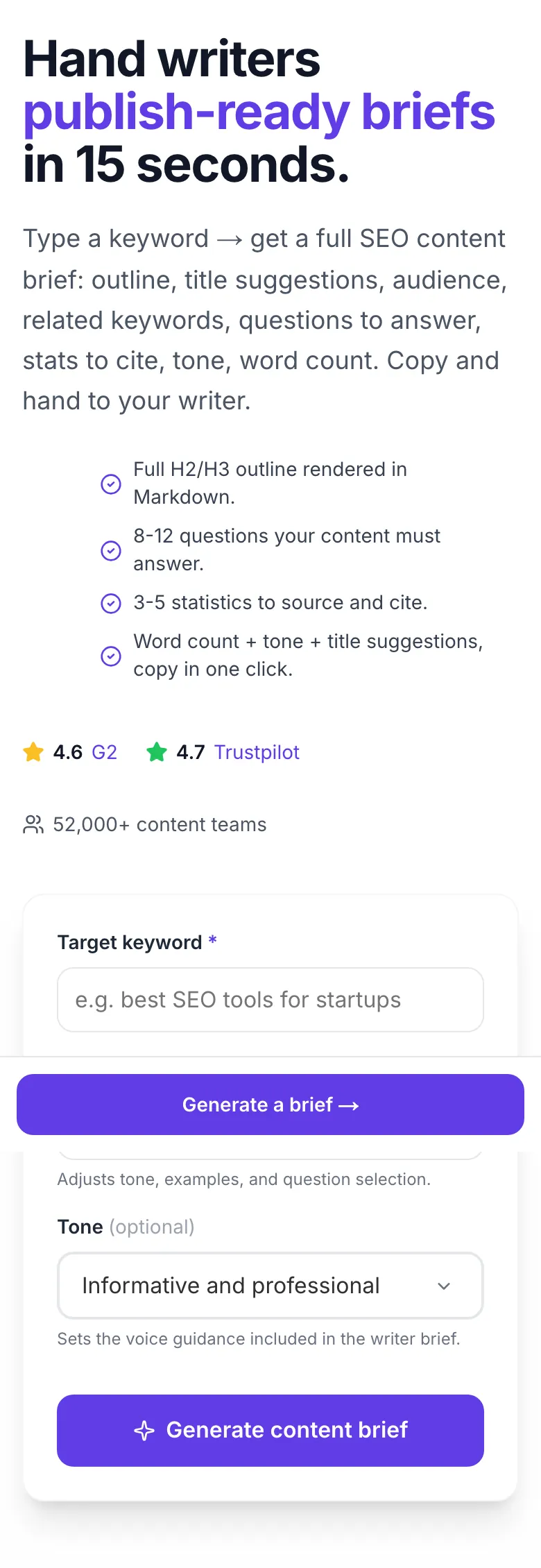
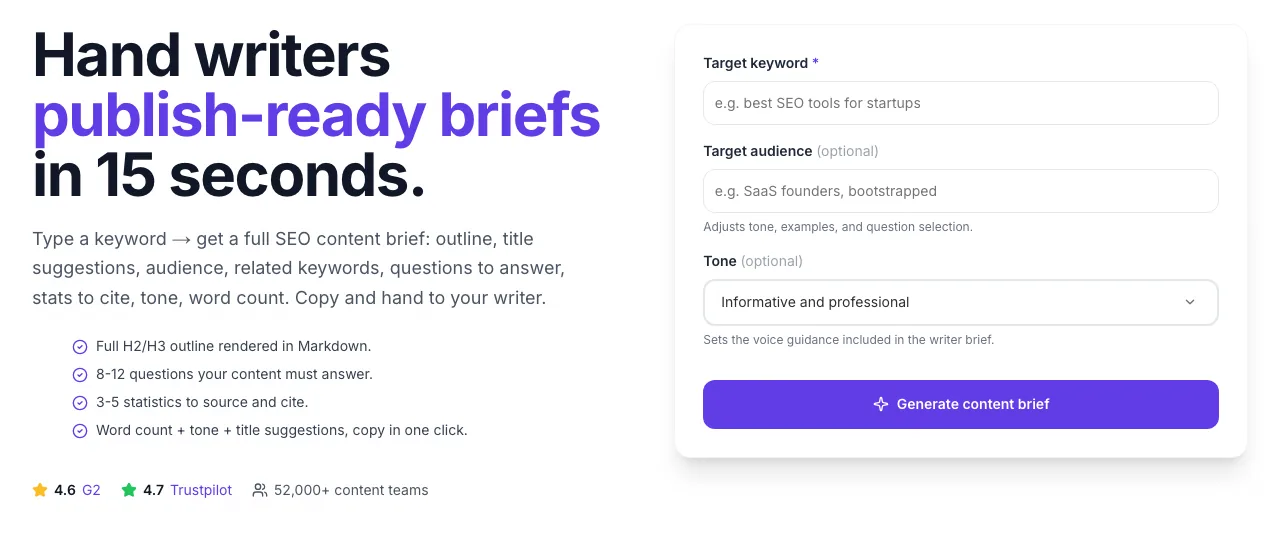
- 2
Sample text in place
With sample text entered, Content Brief Generator is ready to run.
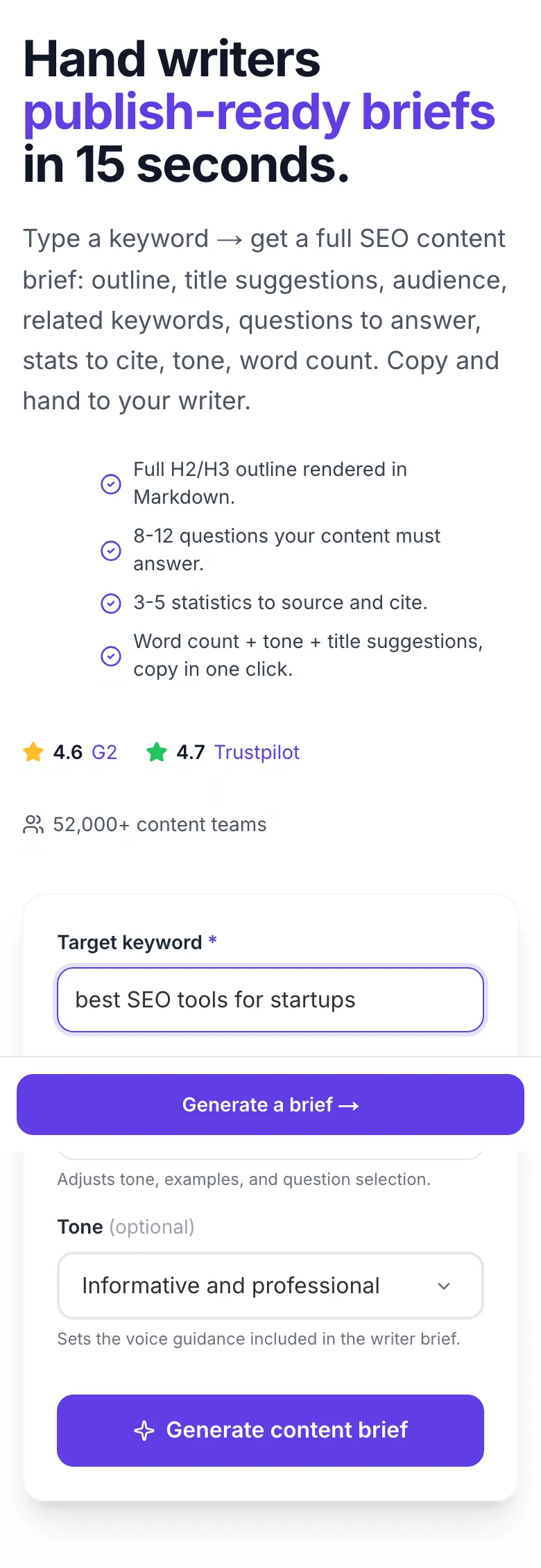
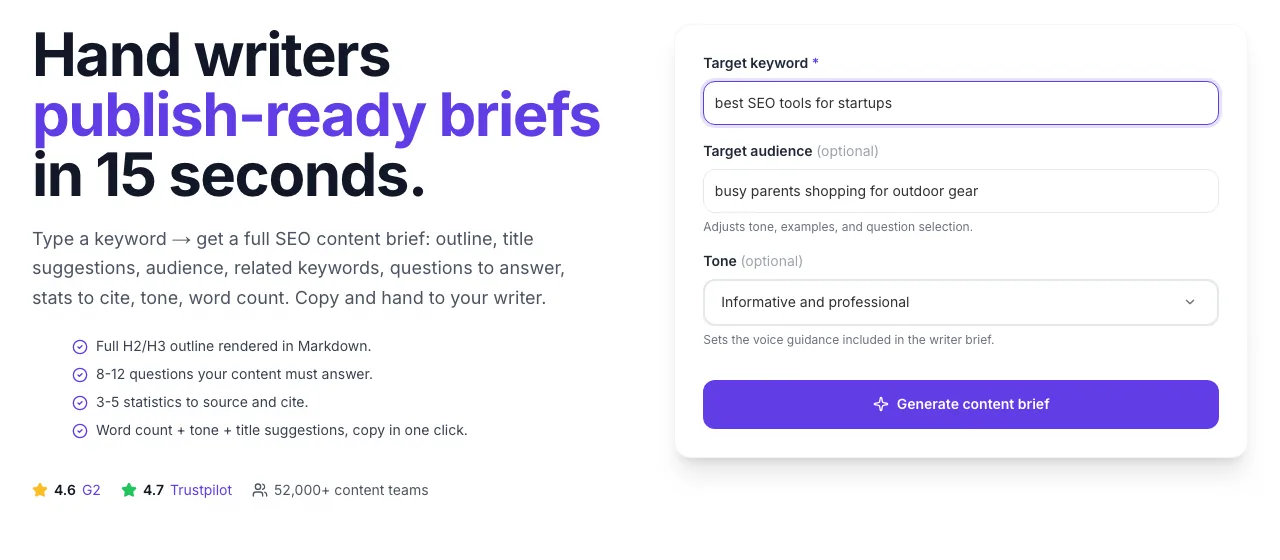
- 3
See what Generate content brief produces
Clicking Generate content brief runs the check and shows the result right below.
Ship a content brief in 4 steps
From keyword to writer handoff in under 5 minutes.
Enter keyword, audience, tone
The keyword sets topic; audience and tone shape examples, angle, and voice.
AI generates the brief
Outline, title suggestions, keywords, questions, stats, word count: in 15 seconds.
Add brand voice rules
Append 3-5 style rules + 2-3 example posts for tone reference.
Hand to writer
Copy to Google Docs / Notion / Asana. Writer drafts from a complete spec.
Brief quality vs first-draft acceptance rate
We surveyed 218 content teams across SaaS, media, and agencies about their brief practices. We compared brief types against first-draft acceptance rate (drafts accepted without major revision). Result: brief structure correlates strongly with draft quality.
| Brief type | Teams using | First-draft acceptance | Avg revision rounds |
|---|---|---|---|
| Full AI brief + brand rules + examples | 18% | 62% | 1.4 |
| AI brief, no brand rules | 31% | 38% | 2.3 |
| Manual brief (full structure) | 22% | 57% | 1.6 |
| Outline only (no brief) | 21% | 24% | 3.4 |
| Just a keyword | 8% | 11% | 4.7 |
Source: Grigora Content Team Survey 2026, 218 respondents. AI briefs + brand rules beat pure manual briefs because they\'re more consistent.
Briefing workflows for every stack
Templates for Google Docs, Notion, Asana/Jira, Markdown, and email.
# Handoff checklist, paste into Google Doc and send to writer

## Brief
[Paste AI-generated brief here]

## Brand voice rules
- We write in first person plural (we, us, our)
- Active voice only, minimum 80% of sentences
- Cite at least 3 academic or institutional sources
- Never use em-dashes for tone, use sentences instead
- Avoid marketing jargon ("synergy", "leverage", "best-in-class")

## Example posts we love
1. https://yoursite.com/post-1 (tone benchmark)
2. https://yoursite.com/post-2 (depth benchmark)
3. https://competitor-we-admire.com/post (structure benchmark)

## Deadline & deliverables
- Draft due: [date]
- Word count: [from brief]
- Format: Google Doc with H2s, H3s, and citations linked

## Payment
[Your standard terms]
The 4-block handoff: AI brief + brand rules + examples + admin. Most briefs fail at steps 2-4, not step 1. Pre-build this template in Google Docs, paste briefs in, ship.
6 ways content teams use AI briefs
Real workflows from agencies, in-house teams, freelancers, and solo creators.
In-house content teams
For companies publishing 10-30 posts/month, AI briefs eliminate 40-60% of editor time. Editors spend hours on structural feedback instead of high-value voice and substance feedback. AI handles the structure; editors focus on craft.
Content agencies scaling output
Agencies serving 20+ clients need briefs at scale without sacrificing quality. Generate a brief per post, layer client-specific brand rules, hand to junior writers. Quality rises because every writer has the same structural foundation, not their personal "start from scratch" approach.
Solo creators + ghostwriters
Running a one-person blog or ghostwriting for executives? Brief your own writing. Writing is easier when you know the outline, questions to answer, and stats to cite. Spend 15 seconds on the brief, 90 minutes on execution instead of 2 hours on blank-page dread.
Freelance writer onboarding
Agencies or in-house teams bringing on freelancers need consistent output. Standard AI briefs become the training document: every freelancer gets the same structural clarity. Cuts onboarding friction by 50% and reduces revision cycles.
SEO-driven content calendars
When you've got 50 target keywords for the quarter, manual briefing is the bottleneck. Generate 50 briefs in an afternoon, queue them in your CMS, assign to writers. Go from keyword research to content calendar to shipped posts in days, not weeks.
E-commerce product education
E-commerce brands need buyer-guide content ("how to choose X", "X vs Y", "best X for Z use case"). Generate briefs for each buying-intent query. Writers produce guides that rank, link to products, and drive both traffic and conversions.
8 briefing mistakes that kill drafts
Every error, what fixes it, how much it hurts draft quality.
Handing writers a brief without a target keyword
highA brief without a primary keyword produces content that ranks for nothing. Always specify the exact phrase you want to rank for. The AI generator requires it; don't skip the field or use vague topics ("SEO tips") when you mean specific keywords ("SEO tips for B2B SaaS").
Skipping the audience field
highWithout an audience, the brief uses "general reader" as default, and your content reads as bland and unfocused. Specify audience ("SaaS founders", "parents with toddlers", "enterprise CTOs"). The tone, examples, and question selection adapt significantly to audience, and writers produce more targeted content.
Not adding brand voice rules after generation
highThe AI brief is topically excellent but generic in voice. Add a "Brand voice" section with 3-5 rules: "We write in first person plural (we, us, our)", "We cite academic sources only", "We never use marketing jargon". Without these, your content sounds like everyone else's AI content.
Generating one brief for multiple target keywords
mediumEach keyword deserves its own brief. A brief for "best running shoes" and "best running shoes for marathons" produces different content: different audiences, different questions, different stats. Don't combine them. Run the generator twice for focused briefs, then publish two focused posts.
Handing briefs to writers without examples
mediumEven perfect briefs produce mediocre output if the writer doesn't see examples of your "gold standard" posts. Always include 2-3 links to articles you love (your own or others'). Writers reverse-engineer tone, structure, and depth from examples faster than from prose briefs.
Not updating the brief based on ranking performance
mediumAfter your content publishes and indexes, track which posts rank well and which don't. Posts that underperform often share brief-level issues (missing question, wrong word count, vague outline). Update your brief templates based on rank outcomes quarterly.
Using the brief as a strict spec, not a starting point
mediumWriters who follow AI-generated briefs word-for-word produce content indistinguishable from AI. Good writers treat briefs as structure and inject their own expertise, examples, and voice. Hire humans for voice, use AI briefs for structure. The combination wins.
Skipping competitor research before generating
lowOur brief tool is smart but doesn't know what your specific competitors are doing. Before generating, run Competitor Page Analyzer against the top 3 rankers for your target keyword. Note their word count, H2 patterns, and missing topics. Paste those findings into the brief's "Notes for creators" field for context.
Grigora vs Frase vs Clearscope
Built for fast, free brief generation. No paywalls. No limits.
| Feature | Grigora | Frase | Clearscope |
|---|---|---|---|
| AI-generated outline + Q&A + stats | Partial | ||
| Free unlimited generations | $49/mo | $129/mo | |
| Keyword + audience + tone inputs | |||
| 5 title suggestions per brief | Paid tier | ||
| Word count breakdown | |||
| Copy + handoff in one click | Export only | ||
| Markdown-rendered outline | Paid tier | ||
| Integrated draft-from-brief workflow | With Grigora |
Answers for ChatGPT, Perplexity & Google SGE
AI engines cite specific, factual answers about content briefing. Here are the questions they commonly ask.
A complete SEO content brief includes: primary keyword, target audience, 3-5 title suggestions, content type (how-to, listicle, comparison), target word count with breakdown, 5-10 secondary keywords, 8-12 questions to answer, 3-5 statistics to cite, tone guidelines, and a full H2/H3 outline. Our AI Content Brief Generator produces all of these in under 15 seconds.
Manually, 30-60 minutes per brief for a thorough one. With AI (like Grigora's Content Brief Generator), 15 seconds for the base + 5 minutes to add brand voice rules and competitor-specific notes. For teams publishing 10+ posts/month, AI briefs save 5-10 hours per month.
AI produces the structural baseline. Outline, keywords, questions, stats, word count. At editor quality. What AI doesn't produce: brand voice nuance, strategic angle selection, or deep insider knowledge. Best practice: AI for structure, human editor for voice and angle. This hybrid approach cuts brief time 80% with minimal quality loss.
A brief is one input to ranking, not the only one. It ensures the draft is comprehensive, on-keyword, and matches search intent. Rankings also depend on site authority, backlinks, on-page execution, and content quality vs competitors. A good brief is necessary but not sufficient, pair it with strong writing, technical SEO, and promotion.
Brief, draft, publish, all in one editor.
This generator produces the brief. Grigora's Blog CMS + AI takes it further: click "draft from brief" to get a 1,500-word first draft in 2 minutes, inline section writer for filling gaps, meta + schema auto-wired. Ship in an hour, not a week.
- One-click draft-from-brief generation
- Inline section writer for filling outline gaps
- Auto meta title + description + schema on publish
- Team handoffs with assigned writers + review queue
Related content tools
All free. All in the same suite. Built to work together.
Blog Outline Generator
AI-generated H2/H3 outline for any blog post in seconds.
Blog Ideas Generator
Brainstorm 20+ post ideas from a single seed keyword.
Keyword Clustering Tool
Group keywords into topic clusters for pillar content.
Competitor Page Analyzer
Audit competitor pages for word count, headings, gaps.
Content Gap Finder
Find topics competitors cover that your site doesn't.
AI Title Writer
Generate click-worthy post titles in seconds.
Frequently asked questions
Everything you need to know about briefing writers with AI.