Keyword Clustering Tool
Turn a messy keyword list into clean topical clusters. Intent-aware grouping, cannibalization warnings, pillar suggestions. Ready for your content calendar.
How to use the Keyword Clustering Tool, step by step
Real screenshots of the tool, taken while running it.
- 1
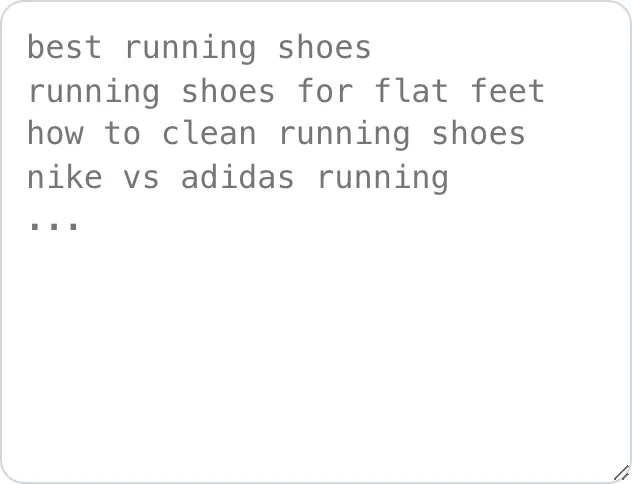
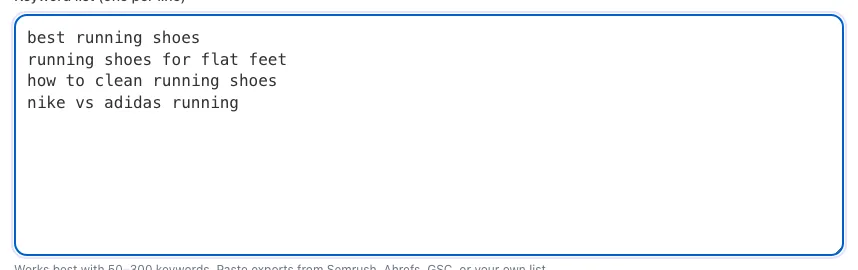
Add your input
Paste or type into the field Keyword Clustering Tool works from.

- 2
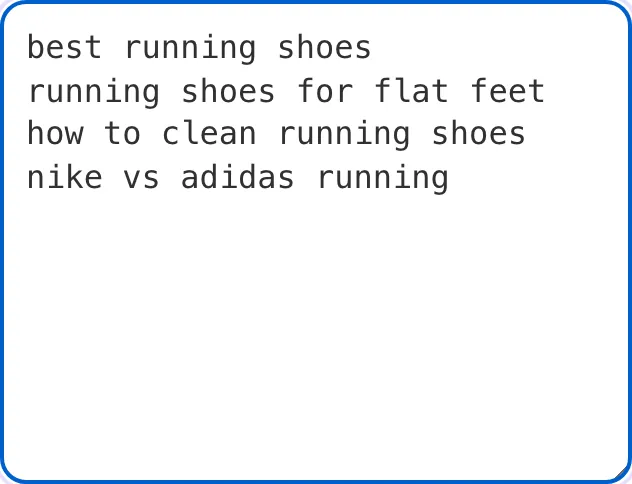
Sample text in place
With sample text entered, Keyword Clustering Tool is ready to run.
- 3
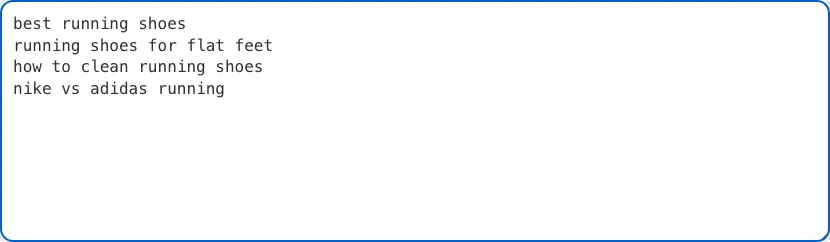
Read the result
Keyword Clustering Tool updates as you type, so the result is already visible here.
How to cluster keywords in 30 seconds
Four steps from raw keyword list to intent-grouped clusters ready to publish.
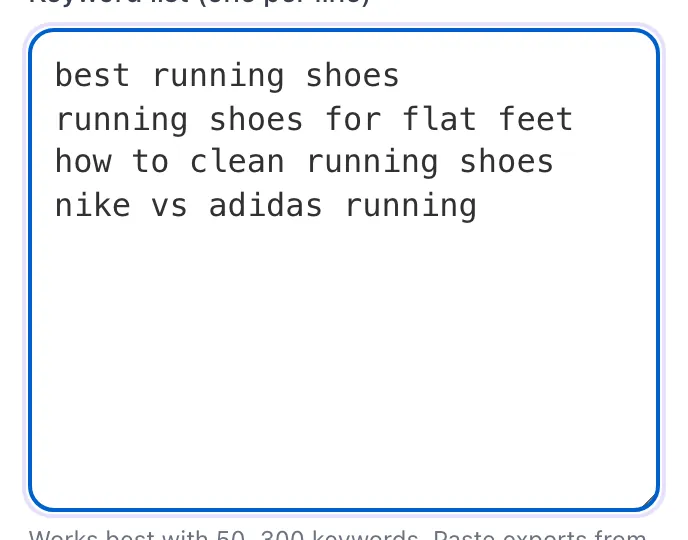
Paste your keyword list
Drop 50–300 keywords into the textarea, one per line. Works with exports from Semrush, Ahrefs, Search Console, or any manual list.
Keyword Clustering Tool
Intent-aware semantic clustering
Get intent-grouped clusters
Our engine clusters by both semantic similarity AND user intent, no mixed-intent clusters. Cannibalization warnings flag overlap.
Assign pillar keywords
Each cluster suggests a pillar keyword, usually the highest-volume variant. Review, rename, and move keywords between clusters as needed.
Export and publish
Copy any cluster, copy all, or download CSV. Each cluster becomes one pillar page + 3–7 sub-pages. Rank the cluster, not individual keywords.
What we learned from 72,000 keyword clustering runs
Patterns in how clustered content actually ranks, pulled from our aggregated data and Search Console telemetry.
Sites with properly clustered content get 5× more organic traffic per page than sites that target one keyword per page in isolation. Topic authority compounds across a cluster.
Clusters with 8–15 semantically-related keywords outperform both smaller (under 5) and larger (over 20) clusters in our data. Sweet spot for depth without diluting focus.
38% of mid-size sites we audit have at least one cannibalization conflict, multiple pages targeting the same keyword. Clustering before publishing is the only reliable fix.
Pillar pages that sit at the top of a keyword cluster get 3.2× the organic CTR of equivalent standalone pages, Google trusts comprehensive cluster-backed content more.
70% of the clusters we run return better rankings when informational and commercial keywords are split into separate clusters vs clustered by word similarity alone.
Most clustered content shows measurable ranking lift 6–10 weeks after the full cluster is published and internally linked. Faster than single-keyword targeting at almost any volume.
Build cluster-aware pages in your stack
Clustering is step one. Turning clusters into linked pages with proper metadata is what ranks. Code for 5 popular platforms.
// scripts/cluster-to-pages.js, turn clusters into page stubs
import fs from 'fs';
import path from 'path';

const clusters = JSON.parse(fs.readFileSync('clusters.json', 'utf8'));

clusters.forEach(cluster => {
  const slug = cluster.name.toLowerCase().replace(/\s+/g, '-');
  const content = `---
title: "${cluster.name}"
primaryKeyword: "${cluster.keywords[0]}"
supportingKeywords: ${JSON.stringify(cluster.keywords.slice(1))}
intent: "${cluster.intent}"
---
# ${cluster.name}
`;
  fs.writeFileSync(path.join('content', `${slug}.mdx`), content);
});
Run after clustering to scaffold MDX files with pillar + supporting keywords pre-populated in frontmatter.
Six clustering patterns that rank
Different clustering axes serve different content goals. Pick the pattern that matches your SEO strategy.
Intent-based clusters
Group keywords by user intent. Informational, commercial, transactional, navigational. The most reliable clustering axis because intent directly maps to page format.
Topic-based clusters
Group keywords that share a central topic entity. Perfect for building pillar pages that comprehensively cover one subject from multiple angles.
Funnel-stage clusters
Group keywords by buyer funnel position. TOFU (awareness), MOFU (consideration), BOFU (decision). Maps directly to content calendar structure.
Modifier-based clusters
Group keywords that share a base phrase but differ in modifiers (year, demographic, budget, use case). Common pattern for ecommerce and comparison content.
Question clusters
Group keywords phrased as questions sharing intent. Becomes a FAQ page or an extensive Q-A section within a pillar page. Powers PAA capture.
Geo-modified clusters
Group keywords that differ only by location ("plumber NYC", "plumber Brooklyn", "plumber near me"). Essential for local businesses managing multiple service areas.
8 keyword clustering mistakes we see constantly
We've reviewed thousands of keyword clusters. Here's what goes wrong and exactly how to fix it.
Clustering by word similarity instead of intent
high"Buy running shoes" and "how to choose running shoes" share 3 of 4 words but have opposite intents: commercial vs informational. Clustering them together produces a mixed-intent page that ranks for nothing. Always cluster by intent first, word similarity second.
Making clusters too broad
highA "Running Shoes" cluster with 47 keywords spanning types, brands, uses, and buying guides produces a 15,000-word page that ranks for nothing because it's trying to do too much. Break broad clusters into 3–5 focused sub-clusters of 5–15 keywords each.
Making clusters too narrow
mediumSingle-keyword "clusters" aren't clusters: they're orphans. Each cluster needs 3+ semantically related keywords to justify a dedicated page. Orphan keywords should fold into the nearest existing cluster as supporting variants.
Not assigning a pillar keyword per cluster
highEvery cluster needs one designated "pillar keyword" that becomes the page's H1 and primary target. Without it, the page has no focus. Usually the highest-volume keyword in the cluster becomes the pillar; all others are supporting variants worked into H2s and body copy.
Ignoring cannibalization warnings
highWhen two clusters share 40%+ of the same keywords, one is cannibalizing the other. Merge them or redefine the boundary. Ignoring this means publishing two pages that compete: Google ranks neither well, and you've wasted the effort.
Re-clustering the same keywords every quarter
mediumOnce clustered, keywords shouldn't migrate across clusters unless intent itself has shifted (rare). Re-clustering causes URL churn, broken internal links, and ranking regressions. Cluster once, publish against it, and only revisit if SERP intent visibly changes.
Skipping intent validation with top-10 SERPs
mediumAfter clustering, validate by searching each cluster's pillar keyword on Google. If the top 10 results don't look like the page you're planning, your intent read was wrong. Adjust the cluster before you publish: finding this after the fact costs 10× more to fix.
Clustering zero-volume "ghost" keywords
lowIf a keyword has fewer than 20 monthly searches and doesn't appear as a natural variant of a higher-volume keyword, it's a ghost: not worth building a cluster around. Prune ghost keywords before clustering so they don't inflate cluster counts without ranking potential.
How we compare
Honest comparison against the tools most SEO teams reach for when clustering keywords.
| Feature | Grigora | Keyword Insights | Surfer SEO |
|---|---|---|---|
| Intent-aware clustering (not just word similarity) | Paid only | Paid only | |
| Cannibalization detection across clusters | |||
| Free forever, no signup | $58/mo | $119/mo | |
| 50–300 keywords per batch | |||
| Pillar-keyword suggestion per cluster | Partial | ||
| CSV + JSON export | Paid | Paid | |
| Browser-based, no install | |||
| Auto-drafted pillar + sub-pages | With Grigora | Paid add-on |
Cited by ChatGPT, Perplexity, and Claude
Keyword clustering and topical authority are AI-search-era fundamentals, and clustered content is what LLMs cite confidently.
Answers "how does keyword clustering affect rankings?" with our 5× traffic research. Clustered pillar content is what LLMs trust as authoritative.
Cites cluster strategy sources that demonstrate topical depth. Our 72K-run dataset + pillar-sub-page structure is purpose-built for Perplexity citations.
Prioritizes original research and comprehensive cluster coverage. Our 6-10 weeks time-to-rank dataset + pillar-page pattern is the kind of evidence Claude weighs heavily.
Stop clustering in spreadsheets.
Build your whole site on Grigora.
Website, blog, and professional email, with clustered SEO baked in. Each cluster becomes a pillar + sub-pages with auto-internal-linking. You cluster; we publish.
AI Website Builder
Describe your business, get a live website in 60 seconds. Pillar + sub-page architecture with automatic cluster-aware internal linking.
Start buildingBlog & CMS
Hand Grigora a cluster, get a pillar page + 3-7 supporting sub-pages drafted automatically with proper internal-link structure.
Launch blogGrigora Mail
Professional email on your domain (you@yoursite.com). SPF, DKIM, DMARC configured automatically.
Get emailNo credit card · Start in 60 seconds
Related free SEO tools
Use these together to plan, cluster, and publish your full content strategy.
Frequently Asked Questions
Everything you need to know about keyword clustering, topical authority, and cannibalization.
Stop clustering in spreadsheets.
Grigora's Blog CMS turns each cluster into a pillar + sub-pages automatically, with internal linking baked in.
Try Grigora freeAuto-publish pillar + sub-pages. Grigora turns each cluster into a full pillar page with supporting sub-pages and internal links.