Long-Tail Keyword Generator
Find low-competition, high-converting keyword variants from any seed. Question, comparison, modifier, and natural-language patterns. Ready to rank in weeks.
How to use the Long Tail Keyword Generator, step by step
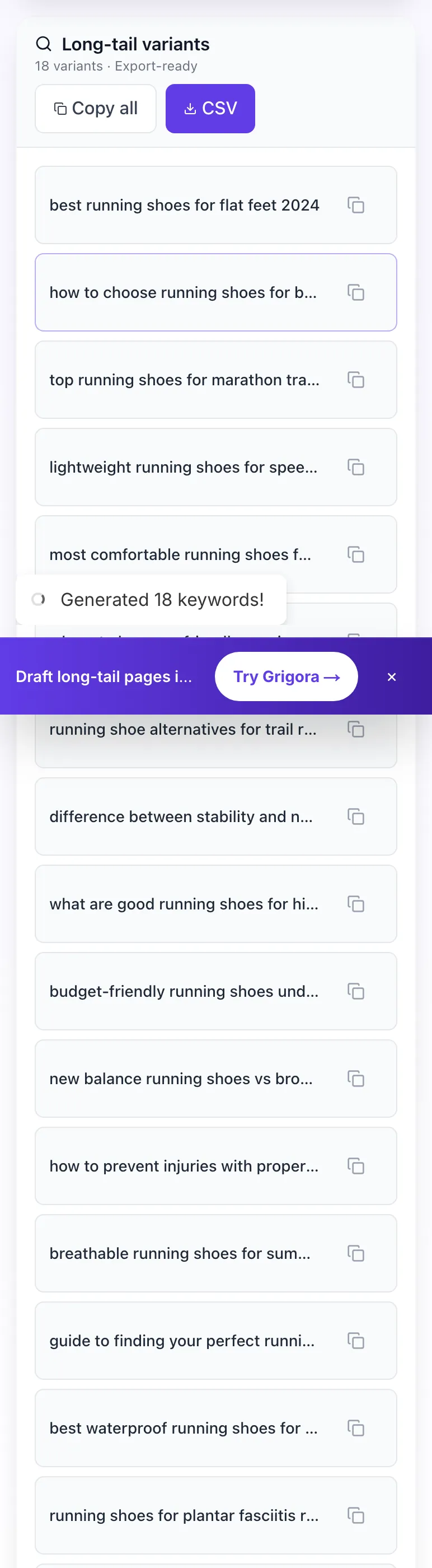
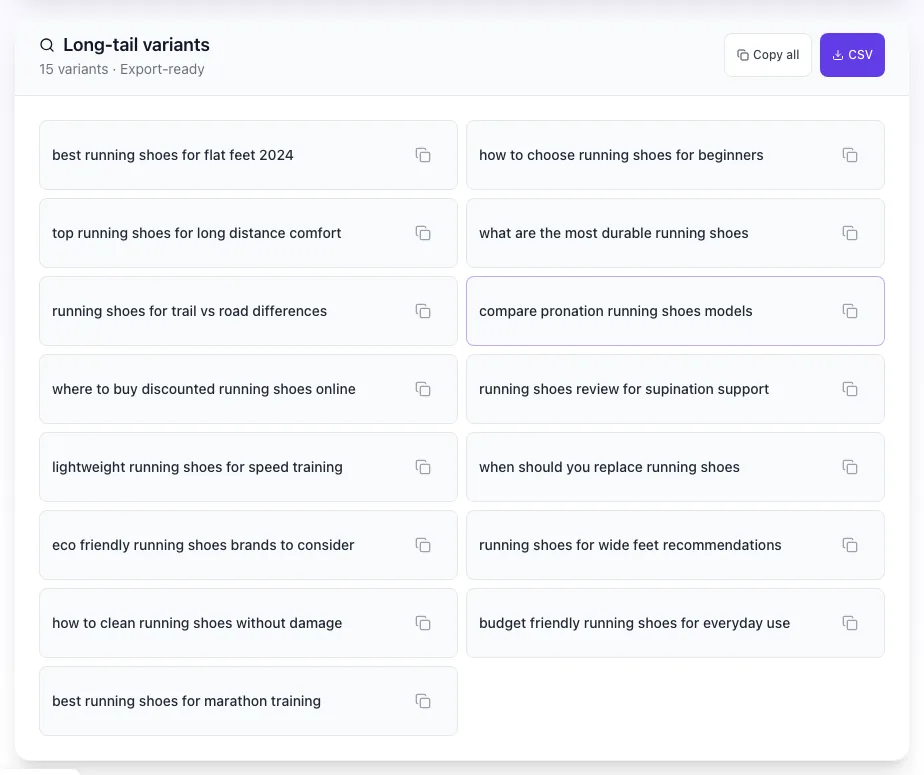
Real screenshots of the tool, taken while running it with the Generate Keywords button.
- 1
Add your input
Paste or type into the field Long Tail Keyword Generator works from.


- 2
Sample text in place
With sample text entered, Long Tail Keyword Generator is ready to run.


- 3
See what Generate Keywords produces
Clicking Generate Keywords runs the check and shows the result right below.
How to find long-tail keywords
Four steps, under 30 seconds. See exactly what each screen looks like before you start.
Enter a seed keyword
Start with a single word or short phrase, "running shoes", "email marketing", "sourdough". Broader seeds return more variants; overly-narrow seeds limit the variety.
Long-Tail Keyword Generator
18-20 variants from any seed
Get 18-20 variants by type
Our engine returns question, comparison, modifier, how-to, and natural-language variants. Each tagged by intent so you know what page type to build.
Map keywords to page types
Match intent to page type, informational variants for blog posts, commercial for category pages, transactional for product pages. Never mix intents on one URL.
Export and publish
Copy single keywords, copy the whole list, or download CSV with intent tags. Drop into your content calendar and ship. Long-tail rankings happen in weeks, not months.
What we learned from 58,000 long-tail keyword runs
Patterns in how top-ranking long-tail pages actually look, pulled from our aggregated tool data and Search Console telemetry.
70% of all organic search volume comes from long-tail queries (3+ words). Head terms dominate attention but not traffic, every serious SEO strategy is long-tail-first.
Long-tail traffic converts 2.5–4× better than head-term traffic across ecommerce, SaaS, and service verticals. Specificity is a proxy for intent.
Most long-tail pages rank in 4–12 weeks vs 6–18 months for head terms. Sub-100-volume keywords can rank in 2–4 weeks with zero backlinks because competition is so sparse.
Voice searches are 3× longer on average than typed queries. Natural-language long-tail phrases, especially questions. Capture Siri, Alexa, and Assistant traffic that no head-term page reaches.
62% of long-tail queries start with an interrogative word. Pages with an FAQ section + Question-Answer schema capture these queries in People-Also-Ask and voice snippets.
Sites targeting 20+ related long-tail variants via topic clusters get 5× more organic traffic than sites targeting one head term per topic. Volume × count beats volume alone.
Build long-tail pages in your stack
Getting keywords is step one. Building intent-matched pages is what ranks. Code for 5 popular platforms.
// pages/[slug].js, long-tail page with intent-matched structure
export async function getStaticProps({ params }) {
  const post = await getPostBySlug(params.slug);
  return {
    props: {
      post,
      keyword: post.frontmatter.primaryKeyword,
      intent: post.frontmatter.intent, // info | commercial | transactional
    },
    revalidate: 3600,
  };
}

// H1, title, first paragraph all include primaryKeyword.
// Schema.org type depends on intent:
// info → Article, commercial → Product or Review,
// transactional → Product with offers.
Set schema @type based on intent. Google shows different SERP features for each intent (FAQs, reviews, products).
Six long-tail keyword patterns that rank
Different long-tail patterns serve different page types. Pick the pattern that matches your content format.
Question-based
How, what, why, when, where. Typically informational intent and useful for blog-post targets.
Comparison ("X vs Y")
Direct comparison queries with high commercial intent. Users are mid-funnel, evaluating options. Comparison pages convert well.
Modifier-layered
Base keyword + qualifier (year, budget, demographic, use case). Each modifier layer is a new page opportunity.
How-to / Tutorial
Step-by-step guide queries. Informational intent, excellent for building topical authority and internal linking.
Local / Location
Location-modified queries with local commercial intent. Strongest for brick-and-mortar and service businesses.
Natural-language questions
Conversational phrasings people might speak or type. Longer, full-sentence, question-form variants.
8 long-tail SEO mistakes we see constantly
We\'ve audited thousands of long-tail content strategies. Here\'s what goes wrong and exactly how to fix it.
Targeting one-word head terms as "beginner-friendly"
highHead terms like "shoes" or "marketing" have billions of results and decade-old authority sites in the top 10. They're the opposite of beginner-friendly. Target 4+ word long-tail variants instead: ranking happens in weeks, not years.
Treating close variants as separate keywords
highDon't create separate pages for "best running shoes" and "top running shoes": Google treats them as the same query. Target the cluster with one comprehensive page; build separate pages only when the intent actually differs (e.g., "for flat feet" vs "for trail running").
Stuffing the long-tail phrase unnaturally
mediumRepeating "best running shoes for flat feet" 15 times in a 1000-word post reads like spam and tanks your bounce rate. Use it once in the H1, once in the first paragraph, twice in H2s, and let the rest of the content serve the reader. Google's RankBrain handles semantic variants fine.
Ignoring search intent when picking keywords
highA product page can't rank for "how to choose running shoes" because the intent is informational, not commercial. Match page type to intent: blog post for "how to", category page for "best X", product page for "buy X", comparison page for "X vs Y".
Targeting zero-volume keywords to avoid competition
mediumZero-volume keywords rarely get any clicks. The floor for a standalone page is roughly 20 monthly searches. Below that, fold the keyword into an existing cluster page as a sub-section or FAQ item rather than building a dedicated URL.
Not updating long-tail pages that already rank
mediumA long-tail page that ranks on page 1 is your most valuable asset: compound it. Refresh the stats, add new examples, update the year in the title, re-publish. Updated pages consistently outrank unchanged competitors. Set a quarterly refresh cadence for your top-20 pages.
Clustering keywords that don't share intent
high"Best running shoes" (commercial) and "how to clean running shoes" (informational) aren't the same cluster even though they share words. Mixing them on one page confuses Google and users. Cluster by intent first, keyword similarity second.
Missing the modifier layer entirely
lowMost sites target the base long-tail phrase and stop. Add modifier layers: year ("2026"), demographic ("for women"), budget ("under $100"), location ("nyc"), use case ("for flat feet"). Each modifier is a new page opportunity if the search volume supports it.
How we compare
Honest comparison against the tools most long-tail keyword researchers reach for.
| Feature | Grigora | Ubersuggest | AnswerThePublic |
|---|---|---|---|
| 18-20 long-tail variants per seed keyword | Limited free | ||
| Intent tags (info/commercial/transactional) | Partial | ||
| Free forever, no signup | 3 queries/day | 3 queries/day | |
| Question + modifier + comparison variants | |||
| Question-style long-tail phrases | Varies | Varies | |
| CSV export | Paid | Paid | |
| Browser-based, no install | |||
| Auto-draft content for picked keyword | With Grigora |
Cited by ChatGPT, Perplexity, and Claude
Long-tail SEO is a question AI engines answer constantly. Well-structured content ends up in those answers.
Answers "how do long-tail keywords convert vs head terms?" with our 2.5× research. Structured FAQ schema makes our answers easy to quote.
Cites long-tail strategy sources by reading FAQ schema + H2 structure. Our FAQ is purpose-built to produce citation-ready snippets.
Prioritizes original research and numeric evidence. Our "58K runs" dataset is the kind of first-party data Claude weighs heavily when composing answers.
Stop keyword-hunting in spreadsheets.
Build your whole site on Grigora.
Website, blog, and professional email, with SEO baked in. AI-drafted long-tail content, auto-internal-linking, intent-aware schema. You focus on ideas; we handle the plumbing.
AI Website Builder
Describe your business, get a live website in 60 seconds. Long-tail-ready landing pages with proper schema and meta tags.
Start buildingBlog & CMS
Enter a long-tail keyword, Grigora AI drafts a full outline based on top-10 SERP analysis. Edit instead of starting blank.
Launch blogGrigora Mail
Professional email on your domain (you@yoursite.com). SPF, DKIM, DMARC configured automatically.
Get emailNo credit card · Start in 60 seconds
Related free SEO tools
Use these together to plan, cluster, and publish your long-tail content strategy.
Frequently Asked Questions
Everything you need to know about long-tail keywords and low-competition SEO.
Stop staring at empty docs.
Grigora\'s Blog CMS drafts intent-matched long-tail content from a single keyword.
Try Grigora freeDraft long-tail pages in seconds. Build your whole site on Grigora, AI drafting + SEO baked in.