Seasonal Keyword Generator
Find keywords that peak at the right time of year. Plan your content calendar 6 weeks ahead of the ranking window.
How to use the Seasonal Keyword Generator, step by step
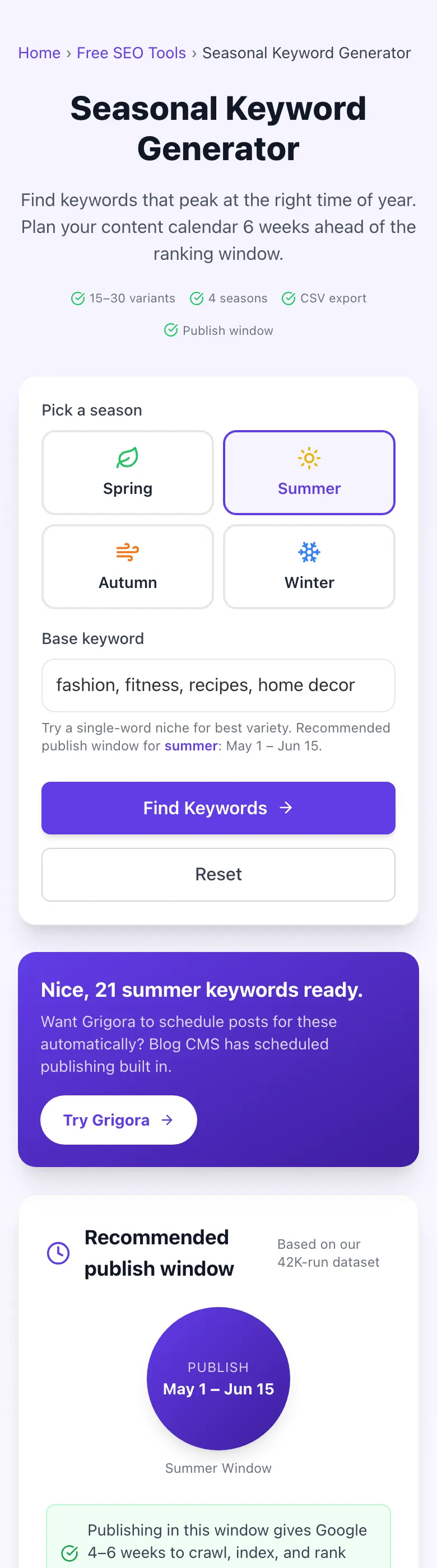
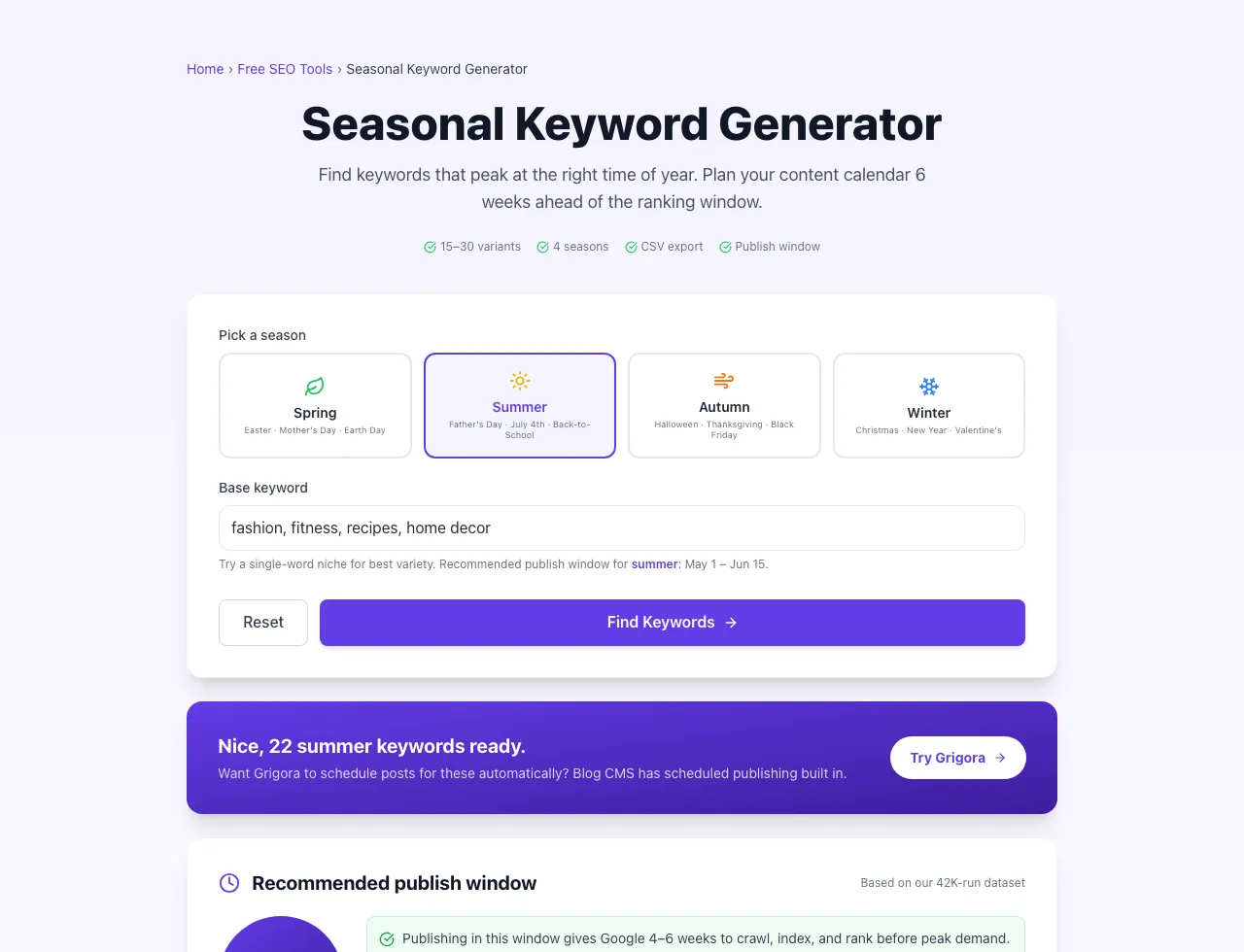
Real screenshots of the tool, taken while running it with the Find Keywords button.
- 1
Add your input
Paste or type into the field Seasonal Keyword Generator works from.


- 2
Sample text in place
With sample text entered, Seasonal Keyword Generator is ready to run.


- 3
See what Find Keywords produces
Clicking Find Keywords runs the check and shows the result right below.
How to generate seasonal keywords
Four steps, under 30 seconds. See exactly what each screen looks like before you start.
Enter your base keyword
Start with the niche or topic you write about, "fashion", "fitness", "home decor". Single word works fine.
Seasonal Keyword Generator
Find keywords that peak at the right time
Pick a season
Four seasons, each covering their major holidays. Winter includes Christmas and New Year; summer covers back-to-school prep; autumn catches Halloween and Thanksgiving.
Generate and review
Get 15–30 seasonal variants instantly. Each is a long-tail keyword you can target with a dedicated post, less competition, clearer intent.
Export and schedule
Copy single keywords, copy all, or download CSV. Pair with our scheduling guides below and publish 4–6 weeks before the peak.
Practical seasonal keyword planning benchmarks
Use these directional planning principles, then confirm demand and competition in your preferred keyword platform.
Publish well before peak demand so search engines can discover, index, and evaluate the page.
Combine a relevant holiday or season with the product, audience, location, or problem being searched.
Explore “how to,” “best,” “ideas,” and “guide” variations when they fit the searcher's task.
Search volume and ad competition change by market and year. Verify generated ideas before prioritizing them.
Set drafting, publishing, promotion, and refresh dates from the event date instead of publishing at the peak.
When the topic remains relevant, update the established page instead of creating a new competing URL each year.
Schedule seasonal content in your stack
Your content is written 6 weeks early, make it ship 6 weeks early too. Code for 5 popular platforms.
// pages/blog/[slug].js, scheduled seasonal post
export async function getStaticProps({ params }) {
  const post = await getPost(params.slug);
  // Don't render drafts or future-dated posts
  if (new Date(post.publishedAt) > new Date()) {
    return { notFound: true };
  }
  return { props: { post }, revalidate: 3600 };
}
💡 Use ISR + publishedAt check to auto-publish seasonal content on schedule.
Types of seasonal keywords
Different seasonal keyword categories have different peak windows, intent signals, and competition levels.
Season-based (4 seasons)
Spring, summer, autumn, winter. Each with 20+ variants. Base evergreen keyword meets seasonal angle.
Holiday-based
Christmas, Valentine's, Mother's Day, Halloween, Easter, Diwali, Lunar New Year. Narrow time windows, massive traffic spikes.
Shopping events
Black Friday, Cyber Monday, Prime Day, Singles' Day (11.11), Back to School, Boxing Day. High commercial intent.
Cultural / religious events
Diwali, Eid, Hanukkah, Lunar New Year, Ramadan. Country-specific but globally relevant with diaspora audiences.
Sports events
Super Bowl, World Cup, Olympics, March Madness, Wimbledon. Recurring calendar with predictable query patterns.
Hybrid evergreen-seasonal
Evergreen topics with seasonal twists. "skincare routine" becomes "summer skincare routine". Stackable content play.
8 seasonal SEO mistakes we see constantly
We\'ve audited thousands of seasonal pages. Here\'s what goes wrong and exactly how to fix it.
Publishing seasonal content too late
highPublish 4–6 weeks before peak interest. Google needs crawl + index + ranking-assessment time. A Valentine's Day post published February 5 won't rank by February 14. Build a content calendar that puts publish dates 6 weeks ahead of the event.
Ignoring the interest ramp-up phase on Google Trends
highCheck Trends for the ramp-up curve before the peak. Most holidays have a 2–3 week ramp-up. Publish just before ramp-up starts, not at the peak. For Black Friday, that means late October: not Thanksgiving week.
Stuffing seasonal keywords into evergreen pages
mediumCreate dedicated seasonal URLs (/gifts/christmas-2026) instead of retrofitting "Christmas" into your evergreen /gifts page. Evergreen pages ranking for seasonal terms get outranked by dedicated pages every year.
Not updating last year's seasonal posts
highRefresh the existing URL instead of writing a new one. Update the date in the title, refresh examples, bump the lastmod. Old-URL backlinks carry over; new URLs start from zero authority. This is the highest-leverage move in seasonal SEO.
Missing alt text and meta for seasonal images
mediumEvery holiday image should have alt text with the seasonal keyword ("Christmas gift box wrapped in red ribbon") and file names that reflect the season ("christmas-gift-wrap.webp", not "IMG_4832.jpg"). Google Images drives a surprising share of seasonal traffic.
Deleting seasonal content after the peak passes
highArchive and update annually instead. Keep the URL. Add a banner like "Updated for 2026" when you refresh. The page keeps its backlinks, domain authority, and year-over-year ranking improvements.
Targeting only 1–2 broad seasonal terms
mediumBroad terms ("christmas gifts") have massive competition. Cluster 15–30 long-tail variants ("christmas gifts for coworkers under 25", "eco-friendly christmas gifts for mom") and target each with its own page. Volume × count beats volume alone.
Forgetting year references in URLs or meta tags
lowInclude the year in the title and slug for year-sensitive content: "Best Christmas Gifts 2026" not "Best Christmas Gifts". Users actively filter search results by recent year, and Google's freshness signal favors dated content for these queries.
How we compare
Honest comparison against the tools most seasonal content teams use.
| Feature | Grigora | Google Trends | AnswerThePublic |
|---|---|---|---|
| Generates 15–30 keyword variants per query | Limited | ||
| Works across 4 seasons + major holidays | Historical only | ||
| No signup, no email, no watermark | Limited free | ||
| Export to CSV + Calendar | Paid only | ||
| Intent + search-stage analysis | |||
| Browser-based, nothing to install | |||
| Shows publishing window (4–6 weeks early) | Manual | ||
| Auto-maintained content calendar | With Grigora |
Cited by ChatGPT, Perplexity, and Claude
Seasonal keyword planning is a prompt AI engines answer constantly. Well-structured content ends up in those answers.
Answers "when should I publish Christmas content?" with our 6-week lead-time research. Structured data and clear sub-headings make it easy for the model to quote.
Cites seasonal SEO sources by reading FAQ schema + H2 structure. Our FAQ section is designed to be lifted as citation-ready snippets.
Prioritizes clear sourcing and concrete evidence. Cite the first-party or industry sources behind any seasonal claims you publish.
Stop planning seasonal content manually.
Build your whole site on Grigora.
Website, blog, and professional email, with SEO baked in. Scheduled publishing, auto-sitemaps, structured data. You focus on content; we handle the plumbing.
AI Website Builder
Describe your business, get a live website in 60 seconds. Seasonal landing pages auto-generated with proper schema and meta tags.
Start buildingBlog & CMS
Scheduled publishing for seasonal posts: write in October, ship in November. Sitemap auto-updates on publish. Zero plugins.
Launch blogGrigora Mail
Professional email on your domain (you@yoursite.com). SPF, DKIM, DMARC configured automatically.
Get emailNo credit card · Start in 60 seconds
Related free SEO tools
Use these together to plan, cluster, and publish your seasonal content.
Frequently Asked Questions
Everything you need to know about seasonal keyword research and content timing.
Tired of missing the seasonal ranking window?
Grigora\'s Blog CMS schedules your posts 6 weeks early and auto-updates your sitemap.
Try Grigora freeSkip manual seasonal planning. Build your whole site on Grigora, scheduled publishing baked in.