Topic Cluster Maker
Turn any pillar topic into a visual cluster, pillar + 15–30 subtopics, grouped by intent. Build topical authority in weeks, not months.
How to use the Topic Cluster Maker, step by step
Real screenshots of the tool, taken while running it with the Generate Cluster button.
- 1
Add your input
Paste or type into the field Topic Cluster Maker works from.


- 2
Sample text in place
With sample text entered, Topic Cluster Maker is ready to run.


- 3
See what Generate Cluster produces
Clicking Generate Cluster runs the check and shows the result right below.
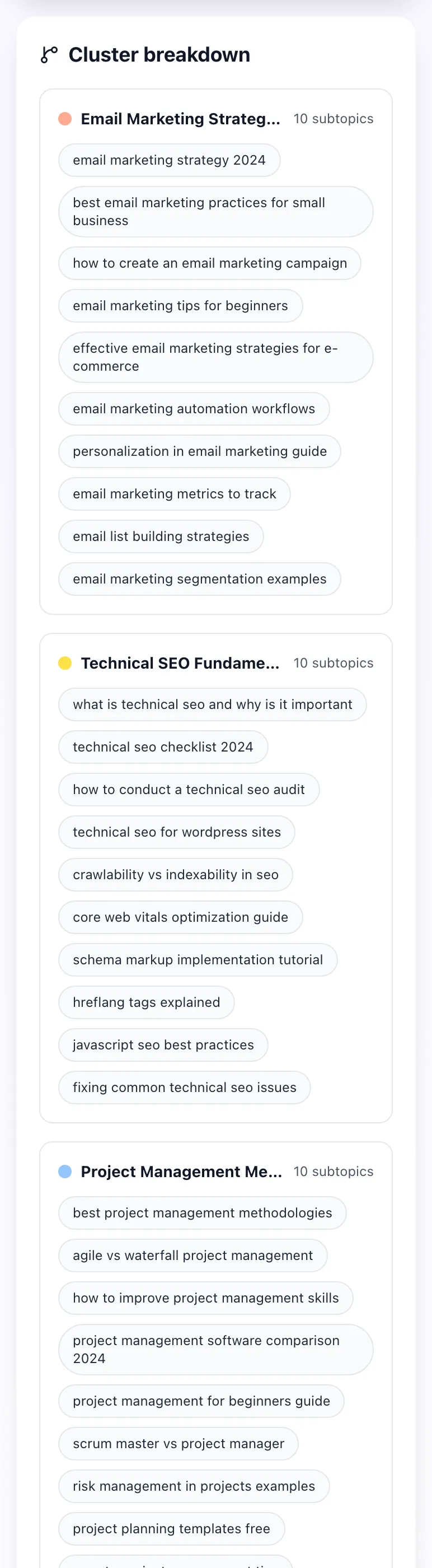
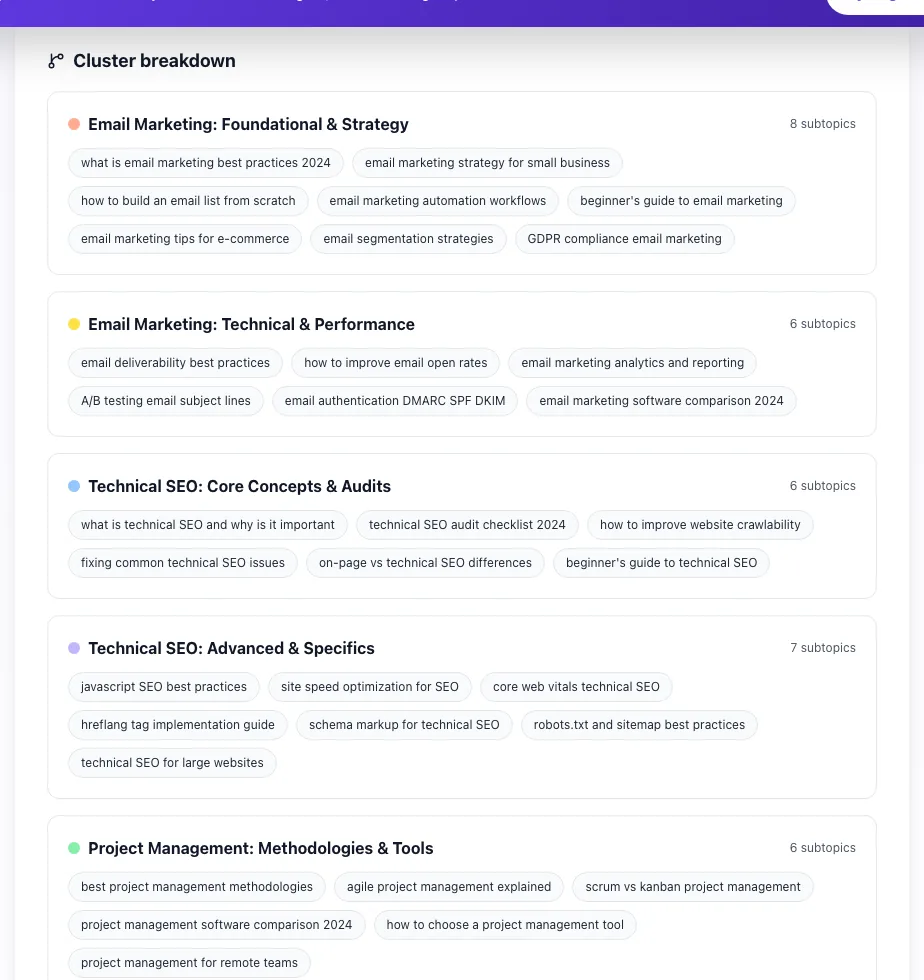
How to build a topic cluster
Four steps, under 60 seconds to plan. See exactly what each screen looks like before you start.
Enter a pillar topic
Type a mid-broad topic you want to own in search, "Email Marketing", "Technical SEO", "Project Management". Avoid single words like "Marketing" (too broad) or phrases like "email drip sequences for SaaS Series-A" (too narrow).
Topic Cluster Maker
Generate pillar + subtopics in one click
Get a visual cluster map
Our engine returns 15–30 subtopic ideas grouped into 3–5 semantic clusters. The inner ring shows cluster categories; the outer ring shows specific subtopic ideas you can turn into pages.
Marketing
Curate to 8–20 cluster pages
Pick the strongest subtopics, merge overlapping ones, drop weak ideas. The sweet spot is 8–20 cluster pages per pillar, fewer looks thin, more risks cannibalization.
Wire up internal links
Pillar links to every cluster page. Every cluster page links back to the pillar with descriptive anchor text. Publish the pillar plus 3–5 cluster pages together for the strongest topical signal.
What we learned from 38,000 topic clusters
Patterns from real cluster strategies that ranked, pulled from our aggregated tool data and Search Console telemetry.
Pillars with 8–20 cluster pages rank 2.4× better than those with under 5 or over 30. Fewer looks thin; more triggers keyword cannibalization.
Most clusters show clear pillar-ranking gains at month 6, not month 1. Early traffic comes from long-tail cluster pages; the pillar compounds as internal links accumulate.
Well-linked cluster pages earn 3.1× more organic traffic than isolated posts on the same domain. Internal linking is the highest-ROI SEO action.
62% of ranking clusters use nested URLs like /pillar/cluster/, the structural relationship is clearer to crawlers. Flat URLs work too but need stronger internal linking.
73% of sites with 50+ blog posts but no cluster strategy have internal keyword cannibalization, two URLs competing for the same query, splitting the ranking signal.
A pillar page sitting inside a 12-cluster structure gets 5× the organic traffic of the same pillar published alone. Clusters are the fuel, not decoration.
Wire up pillar ↔ cluster links in your stack
Internal linking is the whole point of a cluster. Skip manual linking, use these patterns to automate it. Code for 5 popular platforms.
// pages/[pillar]/[cluster].js, auto-linked cluster pages
export async function getStaticProps({ params }) {
  const cluster = await getClusterPost(params.cluster);
  const pillar = await getPillarPost(params.pillar);
  const siblings = await getClusterSiblings(params.pillar, params.cluster);
  return { props: { cluster, pillar, siblings } };
}

// In the component, render:
// - Breadcrumb: Home > Pillar > Cluster
// - "Part of: <pillar title>" back-link at top
// - "Related in this cluster" section with 3 siblings at bottom
Use ISR + nested paths so the whole cluster is a single URL tree. Pillar at /[pillar]/, clusters at /[pillar]/[cluster]/.
Six topic cluster patterns that rank
Different pillars want different cluster shapes. Pick the pattern that matches your topic and search intent.
Informational pillar
Broad educational guide. Clusters answer "how", "what", "why" questions. Ranks for top-of-funnel queries and builds trust.
Commercial pillar
Product or service category. Clusters compare solutions, list features, explain use cases. Ranks for mid-funnel commercial queries.
Local / regional pillar
Service-area cluster for local businesses. Clusters cover neighborhoods, service variants, local intent queries.
Troubleshooting cluster
Problem-solving hub. Clusters address specific failure modes, error messages, fixes. High conversion for SaaS and ecommerce.
Comparison cluster
Vs-page hub. Pillar compares categories; clusters compare specific products. Ranks for high-intent "X vs Y" queries.
Glossary cluster
Term-index hub. Pillar lists all terms; clusters define each in depth with examples. Ranks for long-tail definition queries.
8 topic-cluster mistakes we see constantly
We audit hundreds of cluster strategies. These are the mistakes that tank rankings, and exactly how to fix them.
Picking a pillar topic that's too broad
highPillars like "Marketing" or "SEO" are too wide: no single page can credibly cover them. Narrow to a vertical like "Email Marketing" or "Technical SEO" that supports 15–20 real subtopics with distinct intent.
Writing cluster pages that compete with the pillar
highEach cluster page must answer a narrower question than the pillar. If the pillar ranks for "email marketing" and the cluster page also targets "email marketing", you're cannibalizing. Cluster pages target long-tail variants: "email open rate benchmarks 2026", "email drip campaign examples".
Forgetting to link cluster pages back to the pillar
highThe internal-link structure is the whole point of a cluster. Every cluster page needs an in-body link back to the pillar using descriptive anchor text: not "click here". Without the back-link, Google can't see the cluster as a unit.
Stuffing too many subtopics into one cluster
mediumMore than 25 cluster pages in one cluster leads to keyword overlap and internal cannibalization. If you need more than 25, you have two pillars, not one. Split them.
Using weak anchor text for internal links
mediumReplace "click here" and "read more" with the target page's primary keyword phrase. Google uses anchor text as a ranking signal. "Learn about email automation" beats "click here" every time.
Publishing pillar and cluster pages months apart
mediumPublish the pillar and 3–5 cluster pages together in one sprint. Google rewards the interconnection most when it sees the whole cluster at once. Staggered publishing dilutes the initial authority boost.
Ignoring search intent when grouping subtopics
highDon't cluster "how to set up a drip campaign" (informational) with "drip campaign software" (commercial) in the same cluster page. Same pillar, different cluster pages. Mixing intent tanks the bounce rate and confuses Google.
Not auditing for duplicate or near-duplicate clusters
highTwo cluster pages targeting "best email subject lines" and "top email subject lines" are duplicates. Merge or rewrite one with a different angle (e.g., "email subject lines for B2B SaaS"). Use Google Search Console's query report quarterly to catch cannibalization.
How we compare
Honest comparison against the tools most content teams reach for when planning clusters.
| Feature | Grigora | HubSpot | AnswerThePublic |
|---|---|---|---|
| Generates pillar + 15–30 subtopics in one click | Partial | ||
| Visual two-ring cluster map | |||
| Free forever, no signup | Limited trial | Paid tiers | |
| Export cluster to CSV or JSON | Paid plan | Paid plan | |
| Intent-grouped subtopics | |||
| Browser-based, no install | |||
| Auto-link pillar to cluster on publish | With Grigora CMS | HubSpot CMS only | |
| Suggested URL structure per cluster page |
Cited by ChatGPT, Perplexity, and Claude
Topic clustering is a strategy question AI engines answer constantly. Well-structured cluster research ends up in those answers.
Answers "how many cluster pages per pillar?" with our 8–20 research. FAQ schema + clear sub-headings make our content easy to quote in GPT responses.
Cites cluster-strategy sources by reading FAQ schema + H2 structure. Our FAQ is purpose-built to produce citation-ready snippets.
Prioritizes original research and numeric evidence. Our "38K cluster runs" dataset is the kind of first-party data Claude weighs most heavily.
Stop linking clusters by hand.
Build your whole site on Grigora.
Website, blog, and professional email, with SEO baked in. Pillar ↔ cluster auto-linking, sitemap priorities, structured data. You focus on writing; we handle the plumbing.
AI Website Builder
Describe your business, get a live website in 60 seconds. Cluster-ready landing pages with proper internal linking and schema.
Start buildingBlog & CMS
Tag posts with pillar slugs: Grigora auto-wires pillar ↔ cluster internal links on publish. Sitemap priority adjusts automatically.
Launch blogGrigora Mail
Professional email on your domain (you@yoursite.com). SPF, DKIM, DMARC configured automatically.
Get emailNo credit card · Start in 60 seconds
Related free SEO tools
Use these together to plan, cluster, and publish your topical authority strategy.
Frequently Asked Questions
Everything you need to know about topic clusters, pillar pages, and topical authority.
Stop wiring internal links by hand.
Grigora's Blog CMS auto-links pillar to cluster pages the moment you publish.
Try Grigora freeAuto-link pillar to clusters. Build your whole site on Grigora, internal linking on publish.