Free Website Page Planner
Plan the pages for your website
Describe the business and the planner lists the pages to launch with, what goes on each one and the pages to add later.
Free, no signup. Your description is sent to Grigora's AI service to write the plan, so leave out anything private.
The Website Page Planner answers the question every new site starts with: what pages should my website have? Describe your business and it plans the pages to launch with, the pages to add over the first three months and the legal pages for the footer, with the sections, call to action and search phrase for each one. Think of it as an AI sitemap planner for before you build; once the pages are live, the XML Sitemap Creator makes the sitemap.xml search engines read. Also known as website sitemap planner, AI sitemap planner, website structure planner, page list generator.
- Free, no signup
- Written for the business you describe
- Export as text, Markdown or CSV
Questions this planner answers
what pages should my website have, how many pages does a website need, what pages does a small business website need, what goes on a homepage. Describe your business above and the plan answers each one for your site specifically.
Plan done? Build it
Turn the page plan into a real website.
The Grigora AI builder makes a complete multi-page website from a description. Give it this plan and it builds your Launch pages with the sections listed, then you refine them by chatting. 14-day free trial, no card required.
How to use the Website Page Planner
Four steps from a description to a page plan you can build.
Describe your business
Say what you do, who it is for and where you work, in a few sentences.
Choose a goal and options
Pick the main action you want visitors to take, and whether you serve a local area, sell online or want a blog.
Plan my pages
The planner returns launch, growth, legal and later pages, each with sections, a call to action and SEO ideas.
Write, build, launch
Copy or download the plan, write the pages, or hand the plan to the Grigora AI builder.
How to plan your website pages, step by step
Real screenshots of the tool, taken while planning a site for a local business.
- 1
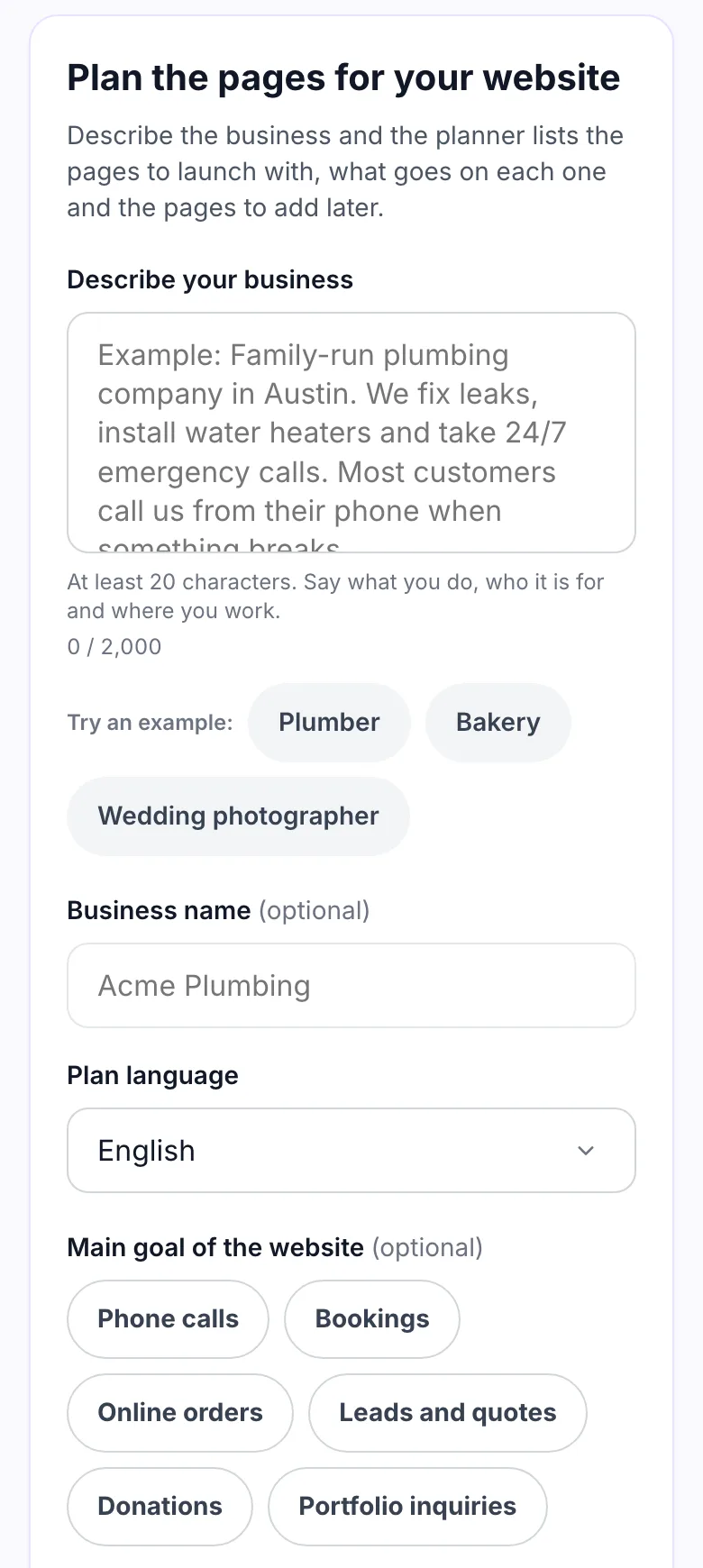
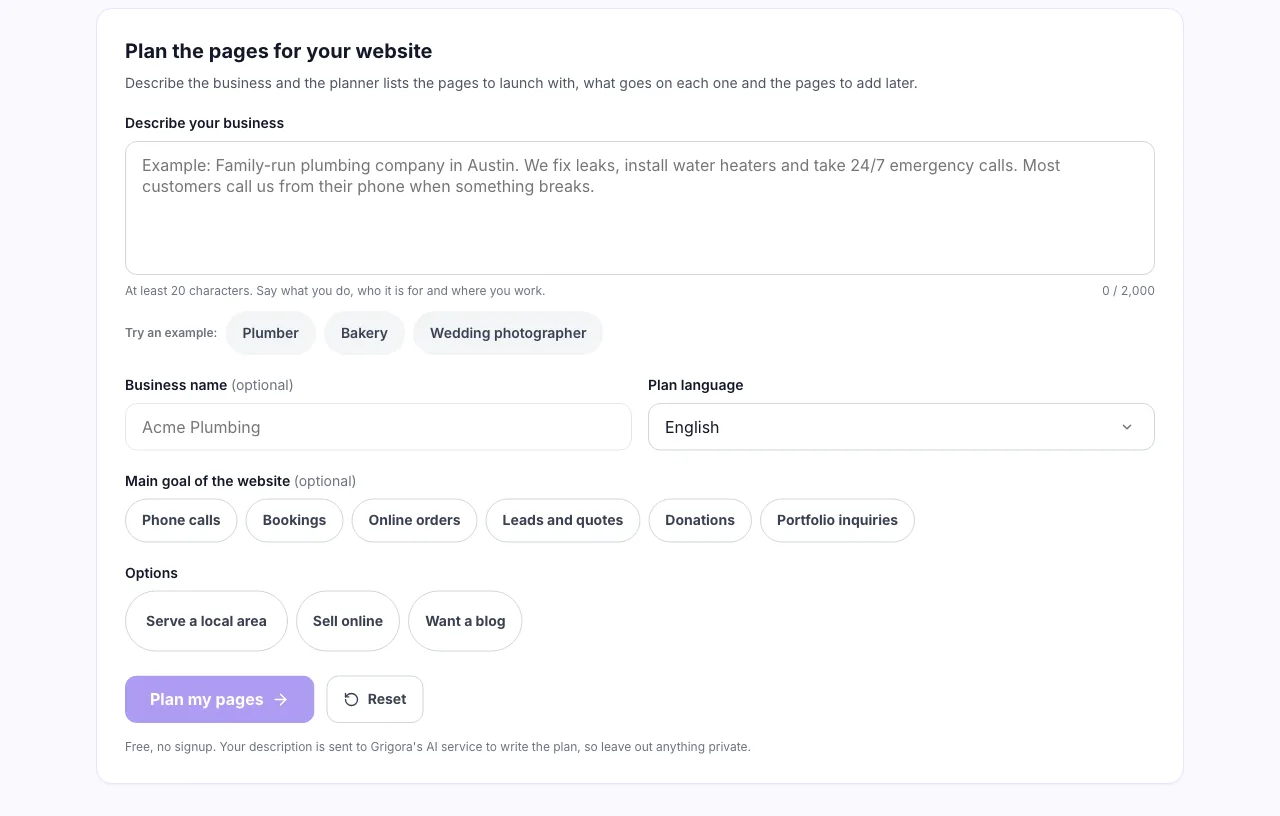
Describe your business
A few sentences about what you do, who it is for and where. Add a name and a main goal if you have them.
- 2
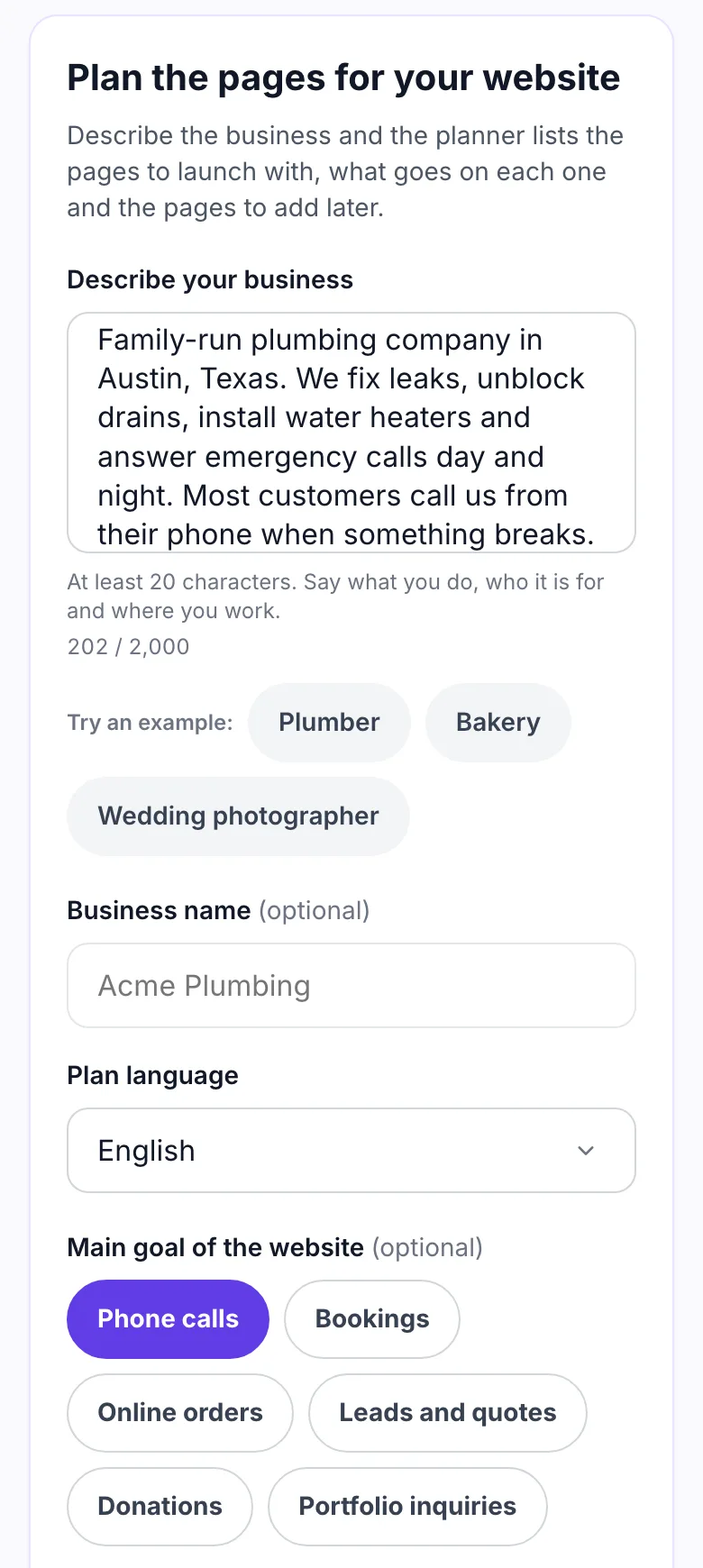
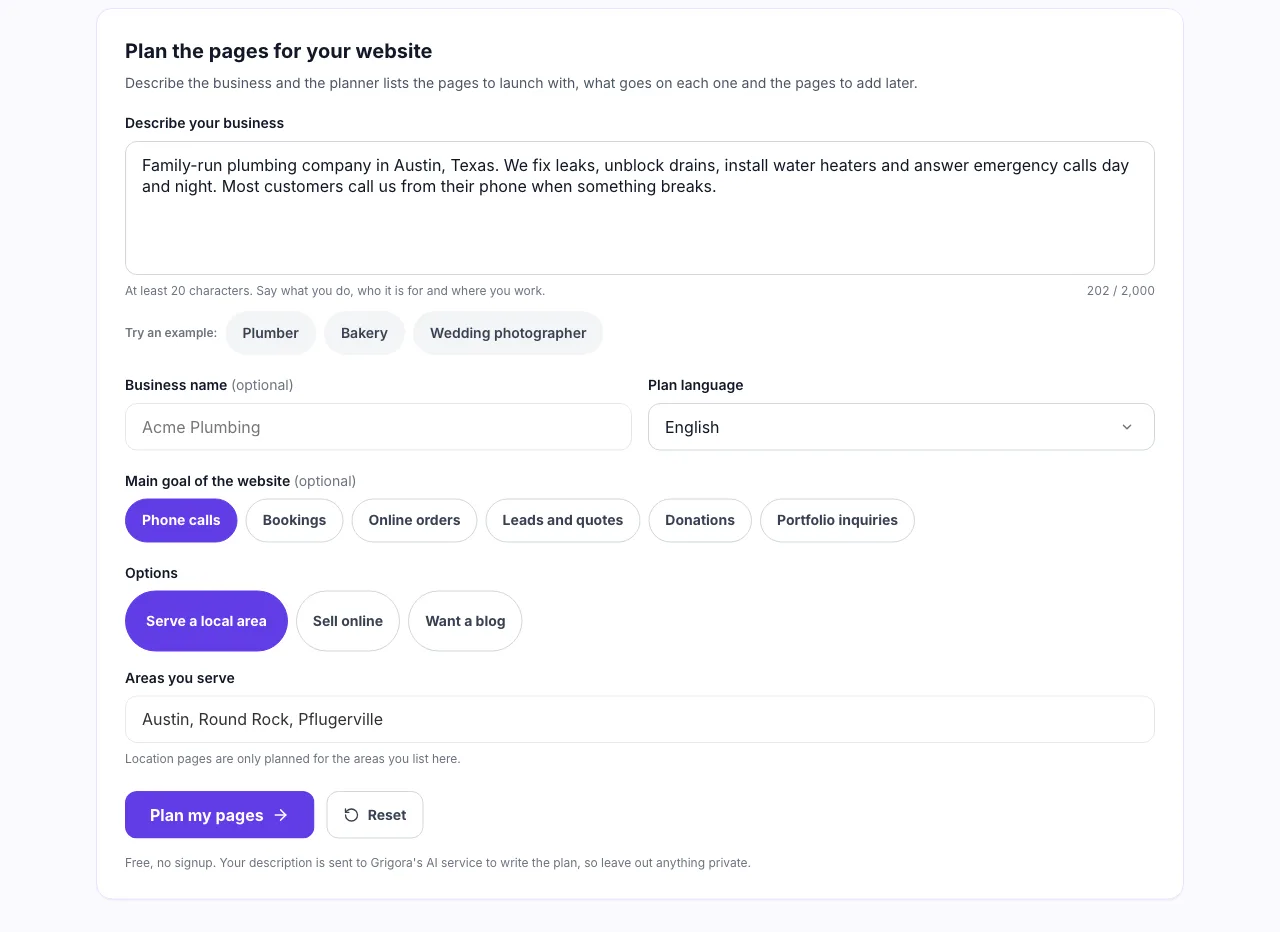
Set the options
Turn on a local area, online sales or a blog, and pick the language the plan is written in.
- 3
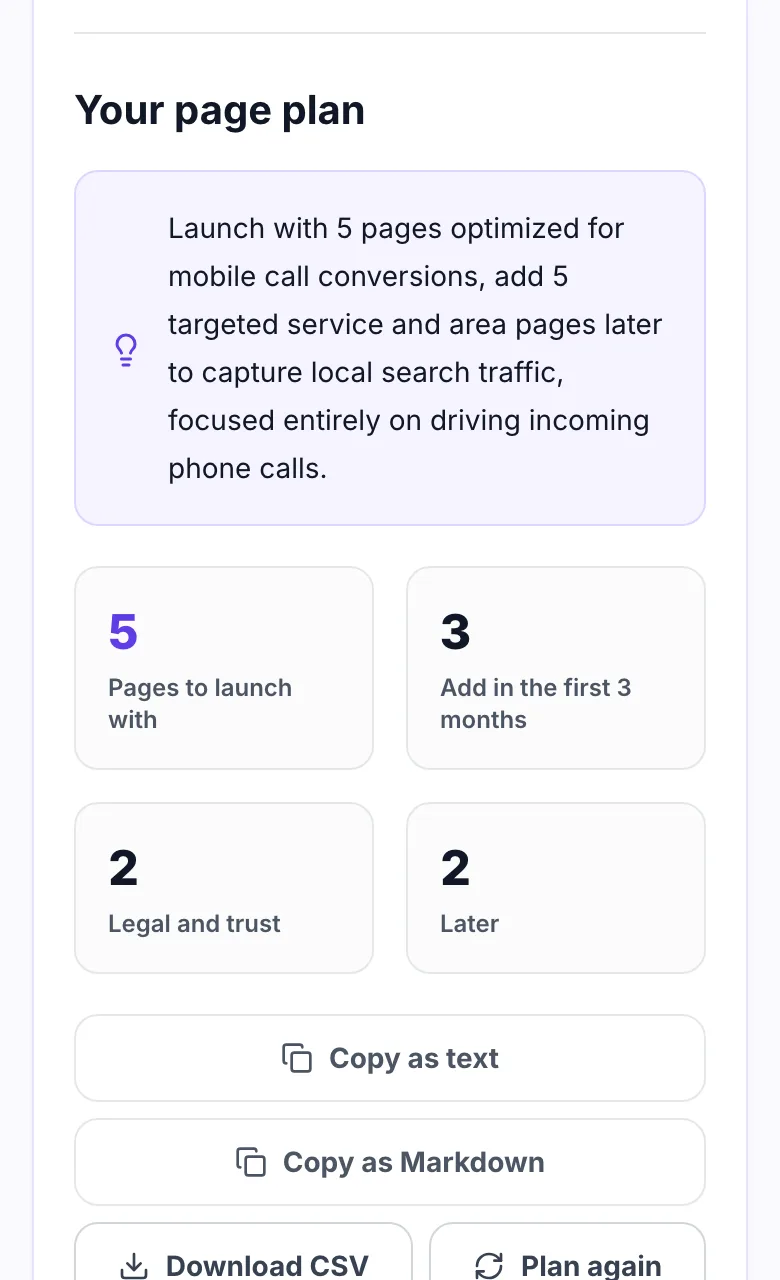
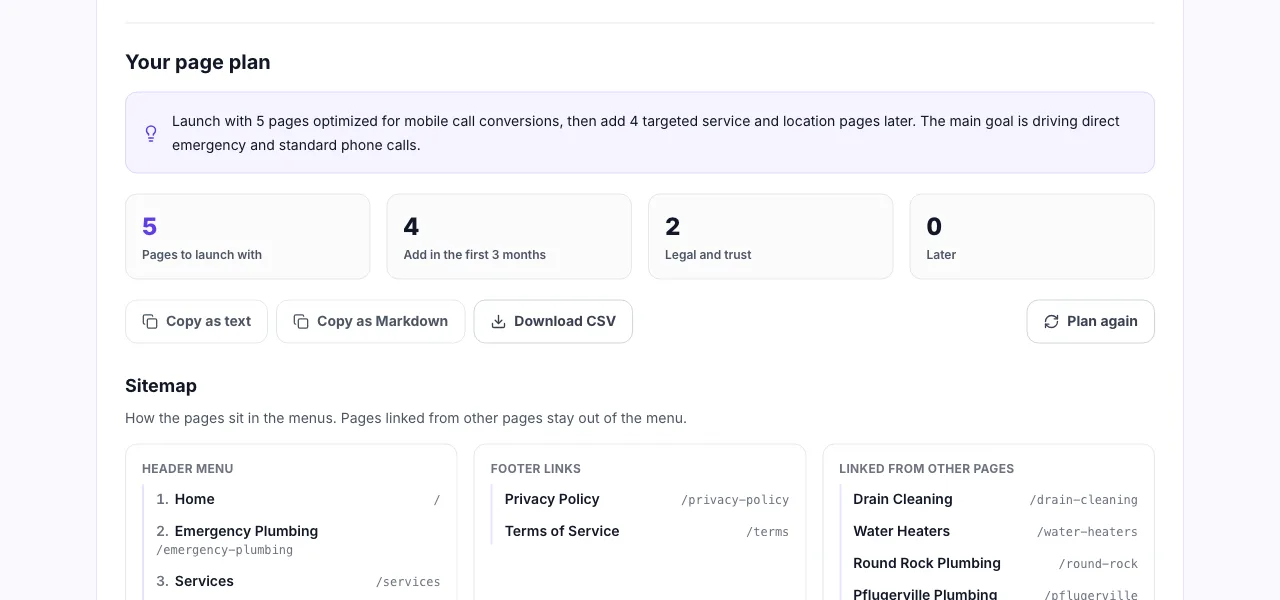
Read your page plan
Pages are grouped into Launch with, Add in the first 3 months, Legal and trust, and Later, each with its sections and SEO title.
Why plan your pages before you build
A page list is the cheapest part of a website to change, so settle it first.
Every page needs a job
A page earns its place when it answers one question and asks for one action. Planning first stops the menu filling up with pages nobody needs.
Search engines rank pages
Each service, product line or area you want to be found for usually needs its own page with its own title and description. The plan gives you both.
Writing is the slow part
Knowing the sections and the material to gather for each page turns a blank page into a checklist, whether you write it yourself or hand it to AI.
What pages should a website have? It depends on the business
Typical launch pages for six kinds of business. Every one of them also needs a Privacy Policy and Terms in the footer, plus a Cookie Policy for EU and UK visitors and a Refund or Return Policy when it sells online.
Local service business
Plumber, electrician, cleaner
- Home
- Services
- One page per core service
- Service areas
- About
- Reviews
- Contact or quote request
Restaurant or cafe
Dine-in, takeaway, bakery
- Home
- Menu
- About
- Reservations or order online
- Location and hours
- Private events
- Contact
Online store
Clothing, crafts, specialty food
- Home
- Shop
- Collections
- About
- FAQ
- Shipping and returns
- Contact
Consultant, coach or agency
Accountant, trainer, studio
- Home
- Services
- About
- Case studies
- Pricing or packages
- Contact or booking
Nonprofit
Charity, club, community group
- Home
- About and mission
- Programs
- Get involved
- Donate
- Contact
Creative portfolio
Photographer, designer, artist
- Home
- Portfolio
- About
- Services and pricing
- Contact or inquiry
When to plan your pages
Six moments a page plan saves time.
Starting a new website
Know which pages to write before you pick a template or open a builder.
Redesigning an old site
Check your current menu against a plan written for what the business does today.
Briefing a designer or agency
Hand over a page list with sections and content to gather, so every quote covers the same work.
Adding local service pages
Plan service and location pages only for the areas you really cover.
Opening an online store
See which shop, policy and support pages a store needs beside the products.
Launching a nonprofit site
Plan the mission, programs, volunteer and donate pages around one clear goal.
How to use your plan: write, build, launch
The plan is a brief. These are the three jobs it feeds.
1Write
Gather the listed content first, then write the Launch pages in menu order. Grigora has free generators for the pages most sites share.
2Build
Build the Launch pages first. Press Build this site with Grigora AI at the end of your plan to hand it to the AI builder, or give the plan to your designer as the brief.
3Launch
Before going live, run through a launch checklist, then create an XML sitemap so search engines find every page you planned.
How the Grigora AI builder uses your plan
What happens when you press Build this site with Grigora AI.
- The Launch pages in your menus become the pages of the site, in menu order, each linked from the menu.
- The sections listed for each page go into the brief, so the builder knows what every page should contain.
- Contact and quote forms send their submissions to your Grigora dashboard.
- A blog runs from the Grigora CMS, and a store uses Grigora Commerce when your plan includes it.
- Content is written in the language you picked, and you refine any page by chatting with the builder.
- Legal pages and the later tiers stay in your plan, ready to add when you are.
Page plan vs. XML sitemap
Both list pages. They are made at different times, for different readers.
| Feature | Page plan | XML sitemap |
|---|---|---|
| When you need it | Before you build | After the pages are live |
| Who reads it | You, your writer and the AI builder | Search engine crawlers |
| What it lists | Pages to create, with purpose, sections and SEO ideas | URLs that already exist |
| Format | Text, Markdown or CSV | sitemap.xml |
| Grigora tool | Website Page Planner | XML Sitemap Creator |
Common page planning mistakes and how to fix them
The problems that make a site harder to use and harder to find.
Launching with too many pages
Cause: Every idea became a page before any page had content.
Fix: Launch with the pages that answer the questions customers ask first, and add the rest once you have real content for them.
One page trying to sell every service
Cause: All services share a single Services page.
Fix: Give each core service its own page with its own title, so each one can be found for its own search.
Location pages that only swap the town name
Cause: One page copied for every nearby town.
Fix: Only create a page for an area you really serve and can describe with local jobs, photos or reviews.
No clear next step
Cause: A page ends without asking the visitor to do anything.
Fix: Give every page one primary action that serves the main goal, and repeat it at the end of the page.
Contact details hidden on one page
Cause: The phone number or booking link lives only on Contact.
Fix: Put it in the header and footer so it is one tap away on every page.
No privacy policy
Cause: Forms and analytics collect personal data with no policy to explain it.
Fix: Add a Privacy Policy and Terms to the footer before launch.
A blog with no posts
Cause: The blog was added because other sites have one.
Fix: Only add a blog when you can publish regularly. An empty blog makes a site look abandoned.
Menu labels nobody searches for
Cause: Clever names such as Our World instead of plain ones.
Fix: Use the words customers use, such as Services, Pricing and Contact.
What one plan covers
The limits of this planner, stated plainly.
Frequently asked questions
Short answers about planning the pages of a website.
Related free tools
Write the pages you planned, then check the site before launch.
About Us Page Generator
Draft the About page from your plan.
Try itFAQ Page Generator
Turn common customer questions into a FAQ page.
Try itPricing Page Generator
Write a pricing page with clear plan tiers.
Try itXML Sitemap Creator
Build a sitemap.xml once the pages are live.
Try itWebsite Cost Calculator
Compare agency, freelancer and DIY costs for the site.
Try itWebsite Launch Checklist
Everything to verify before the site goes live.
Try itFrom page plan to published site
The Grigora AI builder builds your Launch pages with the sections you planned. Forms send to your dashboard, a blog runs from the Grigora CMS, and a store uses Grigora Commerce when your plan includes it. 14-day free trial, no card required.
Start your free trial