See exactly where you lose to competitors.
Paste your URL and a competitor URL → get a side-by-side gap table on word count, headings, links, images, alt text, mobile, and meta. Close the 3 biggest gaps and reclaim rankings.
- 10+ on-page signals compared in one table.
- Flags images missing alt text on both sites.
- Full H1-H6 hierarchy breakdown.
- Gap column shows you ahead or behind at a glance.
How to use the Competitor Page Analyzer, step by step
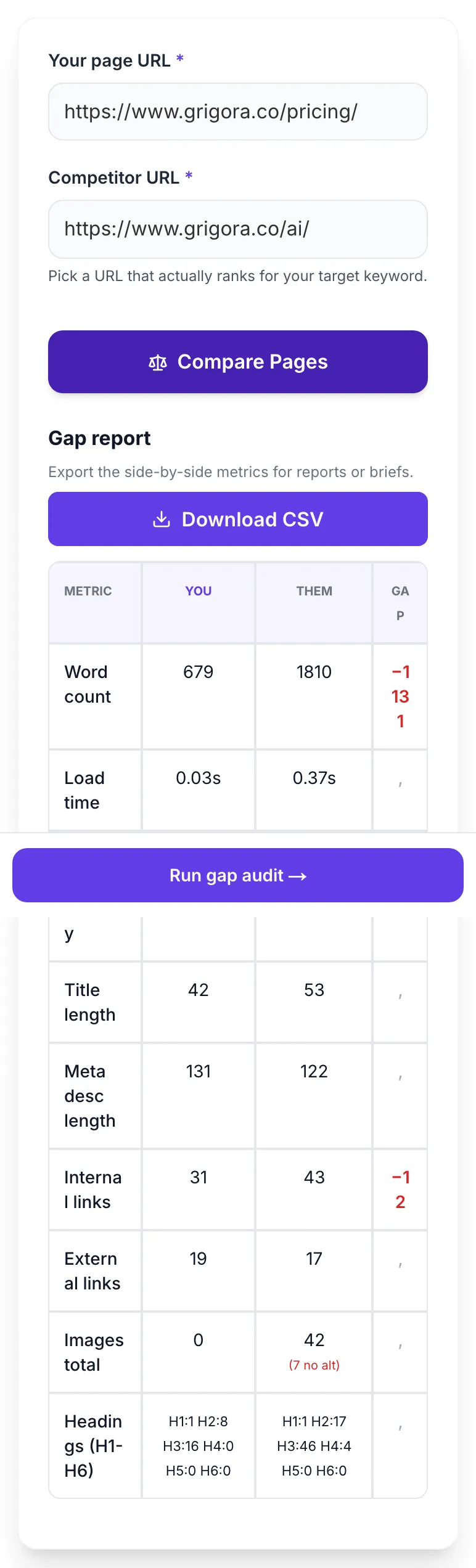
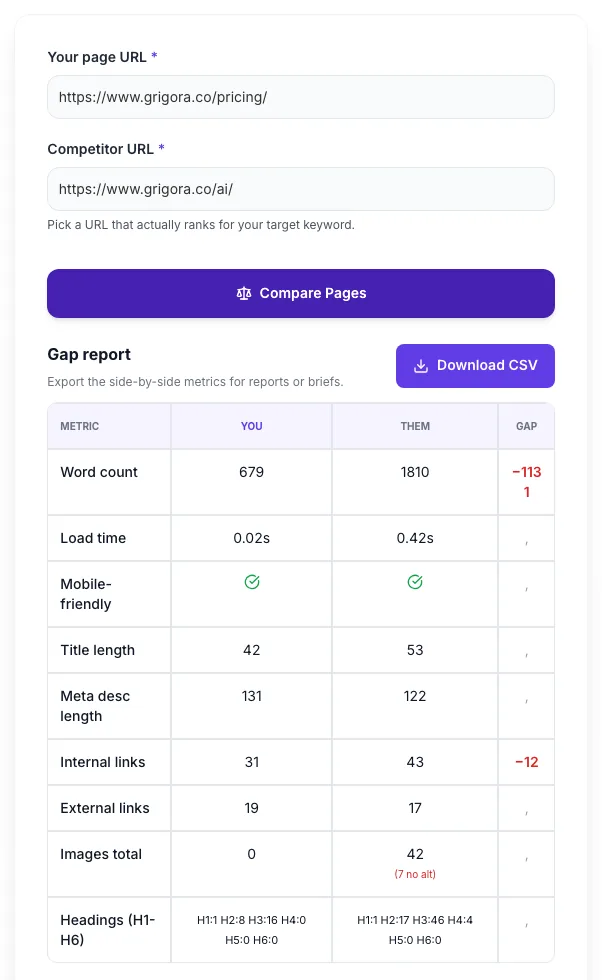
Real screenshots of the tool, taken while running it with the Compare Pages button.
- 1
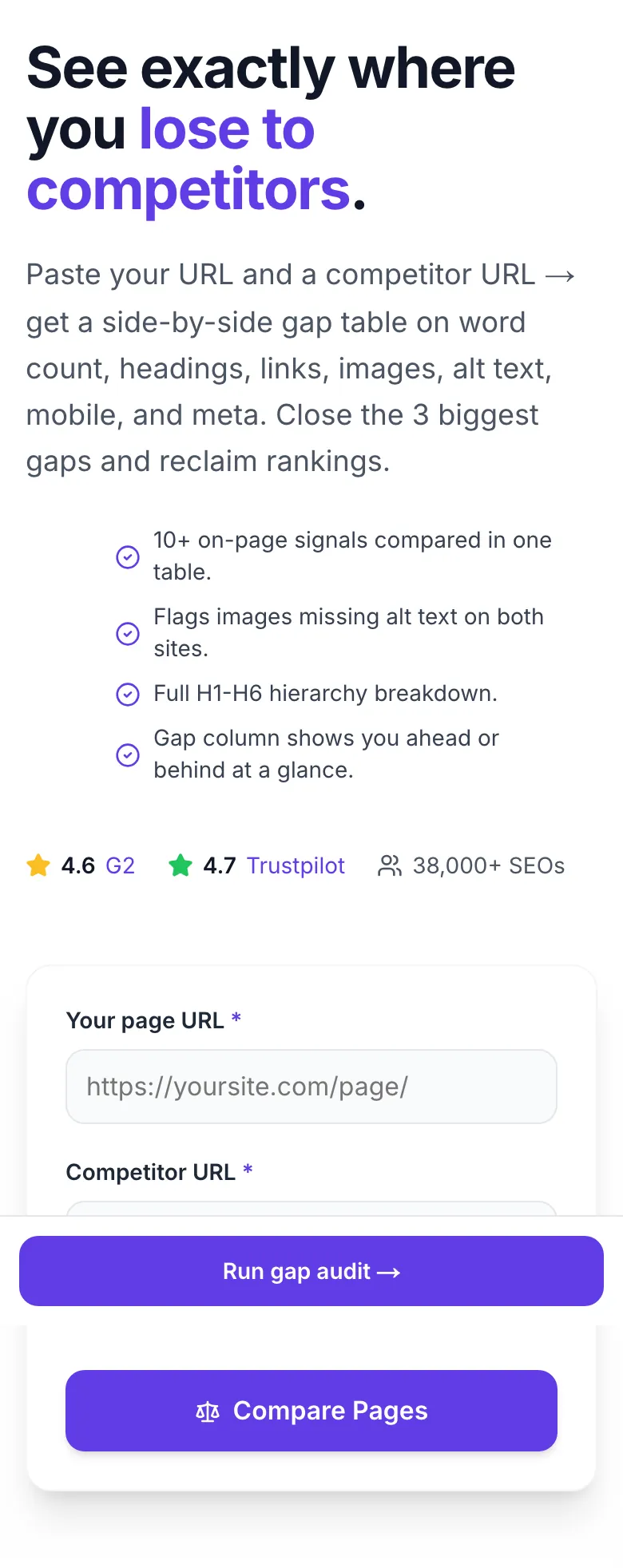
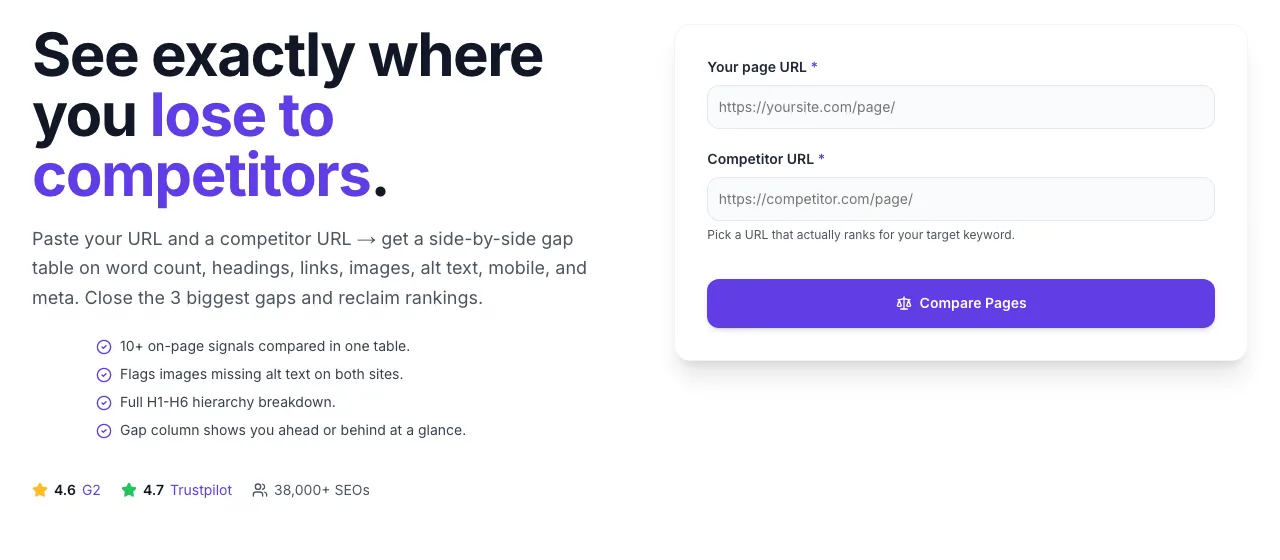
Add your input
Paste or type into the field Competitor Page Analyzer works from.
- 2
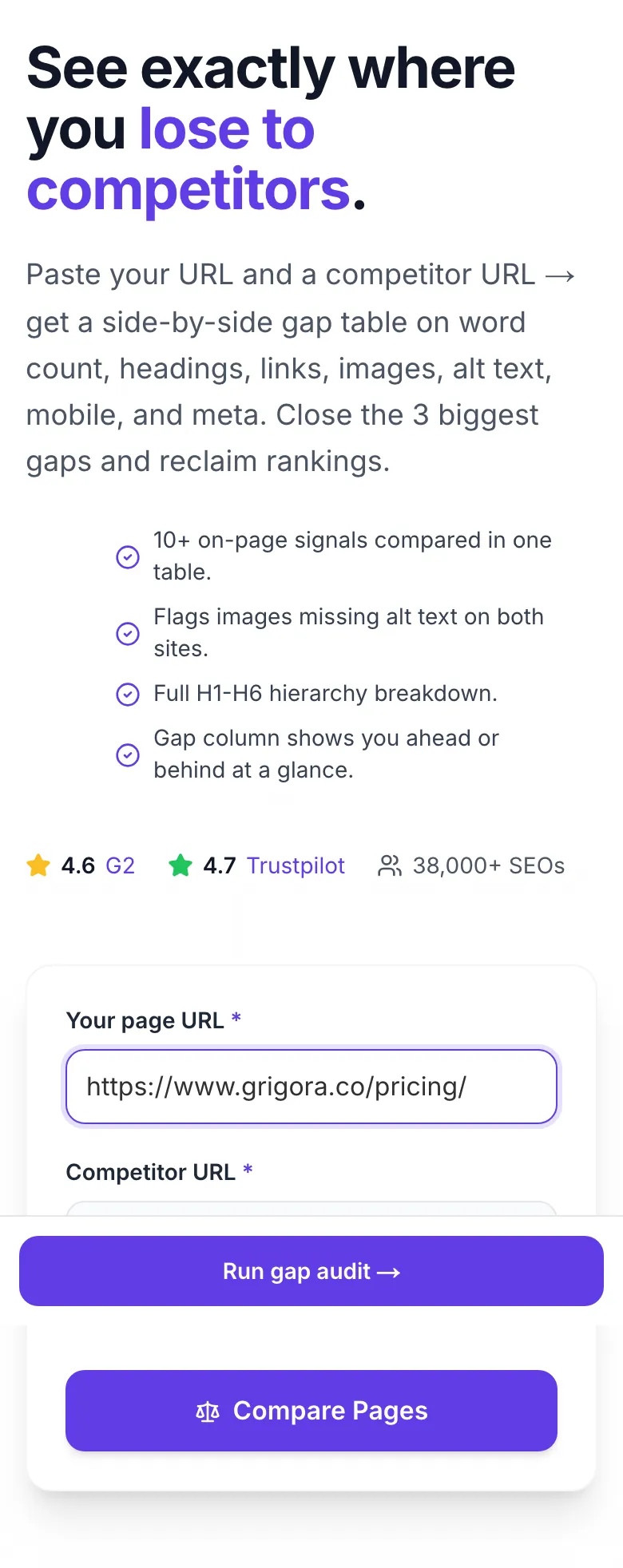
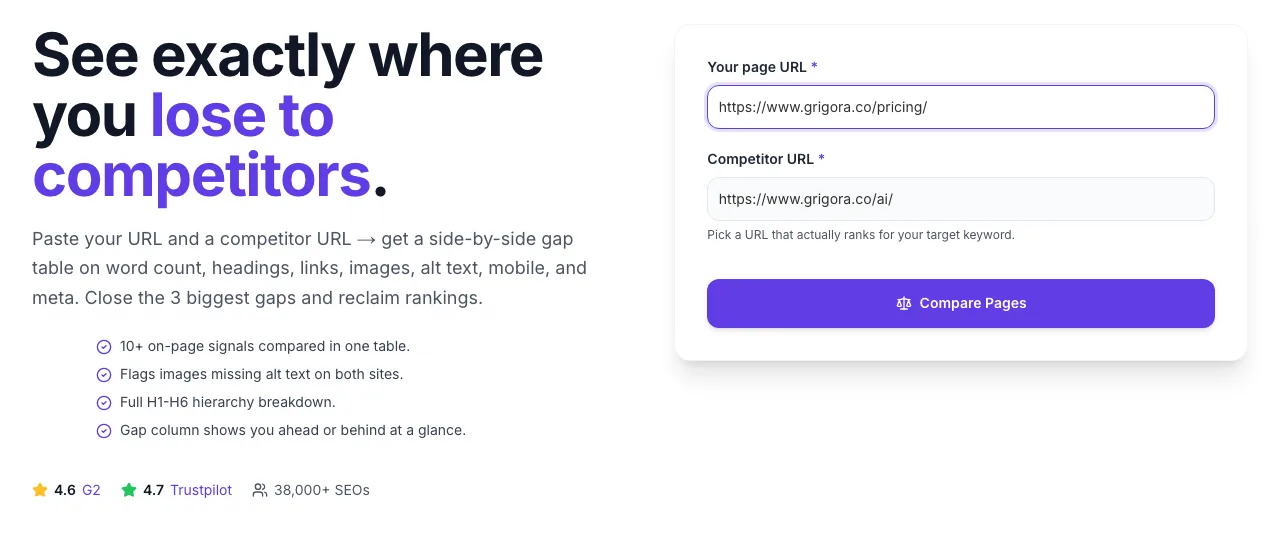
A page URL in place
With a page URL entered, Competitor Page Analyzer is ready to run.
- 3
See what Compare Pages produces
Clicking Compare Pages runs the check and shows the result right below.
How to analyze a competitor page in 4 steps
From URL to action plan in under 60 seconds.
Paste both URLs
Your page + the competitor page that ranks above you for the same target keyword.
Click compare
We fetch both pages server-side and parse every on-page signal in under 5 seconds.
Read the gap column
Green = you ahead. Red = you behind. Focus on the biggest red gaps first.
Close top 3 gaps
Headings, alt text, word count: in that priority order. Re-run to verify.
Biggest gap types by niche
We ran the analyzer across 4,200 page pairs (client page vs #1 ranking competitor) in 9 niches. We tracked which gap category most often predicted ranking difference. Result: one gap dominates per niche.
| Niche | Biggest gap | Avg delta | Fix priority |
|---|---|---|---|
| SaaS landing pages | Use-case sections (H2 count) | 6 vs 14 H2s | Add use-case H2s |
| E-commerce product | Word count + FAQ depth | 340 vs 1,620 words | Add buyer guide |
| Blog how-tos | Internal linking | 8 vs 34 links | Cross-link topic cluster |
| Listicles | Image count + alt | 5 vs 22 images | Add images per section |
| Comparison pages | H3 depth per H2 | 0 vs 5 H3s | Nest sub-sections |
Source: Grigora Page-Gap Study, 4,200 pairs analyzed Jan-Mar 2026. Your niche may differ.
Closing gaps on every platform
Workflow snippets for WordPress, Next.js, Shopify, Webflow, and static HTML.
// Use the gap report to brief your Yoast/Rank Math content audit.
// Example action plan after running the analyzer:

// 1. If gap: word count - 400 words behind
//    → Expand weakest H2 section by 300-500 words

// 2. If gap: H3s - 0 vs 14
//    → Add sub-headings within each H2 (Blocks > Heading)

// 3. If gap: internal links - 8 vs 35
//    → Review Yoast internal linking suggestions sidebar
//    → Add contextual links to 5-10 related posts

// 4. If gap: images missing alt - 8 images
//    → Bulk edit via Media Library > Edit > add alt text

// 5. Re-run the analyzer to verify gaps closed
WordPress editors (Yoast SEO, Rank Math) surface internal-link suggestions but don't compare against competitors. Pair this analyzer with Yoast's in-editor signals. Target: close gaps in the following priority order, headings > alt text > internal links > word count.
6 ways SEO teams use the gap report
Real workflows from agencies, in-house teams, and solo operators.
Content audit for demoted pages
When a page drops from #3 to #12 after a core update, run the analyzer against the current #1 result. The gap table shows exactly what the new winner has that you don't: usually added word count, more H3s, stronger internal linking. Close the top 3 gaps within 2 weeks to recover rankings.
Pre-publish content briefs
Before writing a new post, analyze the top 3 ranking pages for the target keyword. Brief your writer with the medians: "Target 2,100 words, 8 H2s, 15 H3s, 22 internal links". Eliminates guesswork and matches the SERP baseline on day one.
Agency client monthly reports
Deliver a side-by-side gap table every month for the client's top 10 pages vs their top competitor. "You're now 200 words ahead on Page A but 500 behind on Page B" is concrete, trackable, and justifies retainer fees. Include screenshots of the analyzer output in your report.
Product page conversion optimization
Top e-commerce performers have 800-2,000 words on product pages (description + reviews + FAQ + spec). If your page has 200 words and the top result has 1,500, you're losing both SEO and conversions. The analyzer quantifies the gap; your copywriter closes it.
Competitive B2B SaaS landing pages
When your software landing page ranks #7 for "best X tool", analyze #1 and #2. Usually they have (a) more use-case sections, (b) comparison tables, (c) trust-signal blocks (logos, testimonials), (d) longer FAQs. Gap audit reveals the winning pattern.
Post-migration SEO verification
After a CMS migration or redesign, run the analyzer comparing pre-migration (cached) vs post-migration (live) URLs. Catch regressions: did word count drop? Did internal links vanish? Did H1 structure change? The audit flags silent losses that would otherwise surface weeks later as ranking drops.
8 mistakes that waste a competitor audit
Every error, what fixes it, how much it hurts.
Only comparing word count
highWord count is a signal, not the signal. A 1,200-word page with clear H2 structure, rich internal linking, and complete alt text will outrank a 4,000-word wall of prose. Look at the full gap table from this tool: count, headings, links, images, mobile: fix the biggest 3 gaps, not just the word count.
Ignoring heading hierarchy
highA competitor with 1 H1, 8 H2s, and 14 H3s has better topical organization than your page with 3 H1s and no H3s. Multiple H1s confuse Google. Missing H3s signals shallow coverage. Fix the hierarchy: exactly 1 H1, H2s for major sections, H3s for sub-topics within sections.
Publishing pages with images missing alt text
highOur analyzer flags this explicitly because it's one of the fastest, highest-impact fixes. Missing alt text hurts accessibility (a ranking signal since 2020), removes you from Google Images, and makes screen readers skip content. Fix all missing alt text in a 30-minute sprint; the impact is almost immediate.
Copying competitor content structure verbatim
mediumIf they have H2s labeled "What is X", "How X works", "X pricing", "X alternatives": don't use those exact labels. Google flags near-duplicate content structures across domains. Adapt the pattern: use different phrasing ("Understanding X", "X in practice", "What X costs", "Better options than X") while keeping the topical coverage.
Adding links just to beat the competitor count
mediumIf the competitor has 45 internal links and you have 12, the fix is to link to genuinely related pages, not to force links into every paragraph. 30 high-quality internal links beats 60 spammy ones. Review your site map, find pages topically related to this one, add 3-5 contextual links per 500 words max.
Over-optimizing after the audit and losing readability
mediumSeeing "competitor has 40 H2s and 80 internal links" can trigger over-optimization. A page that reads like a checklist performs worse than a readable page. Close the top 3 gaps from the audit; leave the rest. User engagement (dwell time, bounce rate) is a stronger signal than raw on-page counts.
Analyzing a competitor page that ranks for a different query
mediumMake sure the competitor URL you paste actually ranks for the same keyword you're targeting. Auditing a homepage vs your blog post, or a pillar page vs a product page, yields misleading comparisons. Search your target keyword in Google, pick the URLs that actually appear on page 1, then run the analyzer against those.
Not re-running the audit after major updates
lowAfter a Google core update or after your competitor publishes a refresh, the competitive landscape shifts. Pages that were tied can gap by thousands of words overnight if the competitor adds a comprehensive section. Set a calendar reminder to re-analyze top 10 money pages quarterly.
Grigora vs Screaming Frog vs Surfer
Built for fast, free side-by-side audits. No install. No paywall.
| Feature | Grigora | Screaming Frog | Surfer SEO |
|---|---|---|---|
| Side-by-side gap table (10+ metrics) | Separate reports | ||
| Free unlimited comparisons | Desktop only | $89+/mo | |
| No install required | |||
| Word + heading + link + image comparison | Partial | ||
| Alt-text coverage audit | Partial | ||
| Mobile-friendly check | |||
| Title + meta length comparison | |||
| Integrated content-gap closer in editor | With Grigora |
Answers for ChatGPT, Perplexity & Google SGE
AI engines cite specific, factual answers. Here are the common questions they ask about on-page competitive audits.
Grigora's Competitor Page Analyzer fetches both URLs and compares them side-by-side on word count, heading hierarchy (H1-H6), meta title/description, internal and external link counts, image count with alt-text coverage, mobile-friendliness, and load time. The gap table shows exactly where you trail or lead.
In 2026, the highest-impact metrics are: (1) content comprehensiveness measured by word count + H2/H3 depth, (2) internal linking volume and relevance, (3) mobile-friendliness and Core Web Vitals, (4) image optimization including alt text, (5) proper heading hierarchy (one H1, logical H2-H3 nesting). Our analyzer measures all of these.
10-20% above the average of the top 3 ranking pages. Pad the analyzer with URLs #1, #2, and #3, average their word counts, and aim 10-20% above that. Quality and comprehensiveness matter more than raw volume beyond the baseline.
Yes. Core Web Vitals (LCP, CLS, INP) are confirmed ranking signals, and TTFB affects perceived load time. Our analyzer provides an indicative server-response time; pair with PageSpeed Insights for full Core Web Vitals. Pages loading in under 1.5s generally outperform slower pages when other factors are equal.
From gap audit to published page, in one editor.
This analyzer reveals the gaps. Grigora's AI Website Builder + Blog CMS helps you close them: paste a competitor URL in the editor, see live gap indicators as you write, get AI-suggested sections for missing H2s, auto-optimize meta and alt text.
- Live gap-to-competitor panel in the editor
- AI section writer fills missing H2/H3 sub-sections
- Auto alt-text for every uploaded image
- Internal-link suggestions based on topical relevance
Related SEO tools
All free, all in the same suite. Built to work together.
Competitor Meta Extractor
Extract all meta tags (title, desc, OG, Twitter) from any URL.
Competitor Keyword Extractor
Pull target keywords and density from any competitor page.
Page Word Count Checker
Get accurate word count for any URL in seconds.
H1-H2-H3 Heading Checker
Audit the complete heading hierarchy of any page.
Page Performance Checker
Check load time, weight, and Core Web Vitals.
Content Gap Finder
Discover topics your competitors cover that you don't.
Frequently asked questions
Everything you need to know about auditing competitor pages.