
A Magento (Adobe Commerce) alternative for a smaller store with integrated publishing
Grigora is a Magento alternative for smaller businesses that need a managed website, blog, newsletter and straightforward store from $12/month billed annually. Magento Open Source provides self-hosted commerce, while Adobe Commerce offers enterprise packages with custom pricing. Keep Magento or Adobe Commerce for B2B purchasing, complex catalogues, multiple warehouses or custom integrations that Grigora cannot replace.
Published by Grigora · Updated · Sources and method
Is Grigora the right Magento alternative?
Grigora is a Magento alternative for smaller businesses that need a managed website, blog, newsletter and straightforward store from $12/month billed annually. Magento Open Source provides self-hosted commerce, while Adobe Commerce offers enterprise packages with custom pricing. Keep Magento or Adobe Commerce for B2B purchasing, complex catalogues, multiple warehouses or custom integrations that Grigora cannot replace.
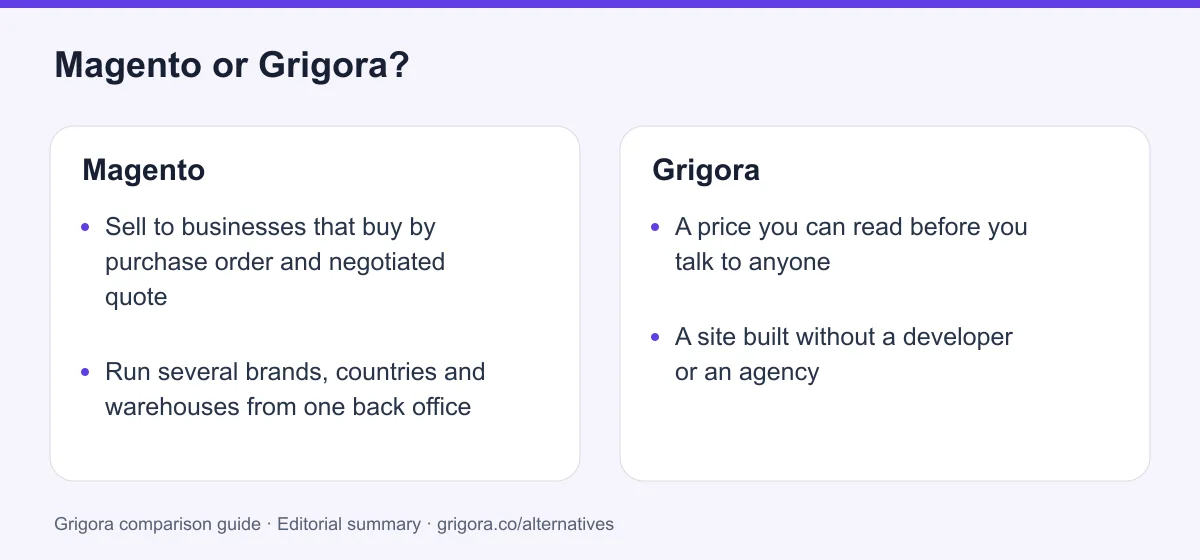
Choose Grigora if you want…
- A price you can read before you talk to anyone
- A site built without a developer or an agency
- A blog, a newsletter and a store in one subscription
- A bill that does not move when sales go up
- Hosting, SSL, CDN and security patches handled for you
Stick with Magento (Adobe Commerce) if you…
- •Sell to businesses that buy by purchase order and negotiated quote
- •Run several brands, countries and warehouses from one back office
- •Have a developer team or an implementation agency already
Magento or Grigora: the decision in one view
Magento (Adobe Commerce) alternatives at a glance
How the enterprise commerce platforms and the self-serve builders compare when nobody on your team writes PHP.
Swipe the table sideways to see every column
| Platform | Best for | Free access | Starting price | Sales fees | Data and site portability |
|---|---|---|---|---|---|
| Grigora | Site, CMS, newsletter and store on a published price | Free trial | From $12/mo billed annually | 0% platform fee; Stripe/Razorpay fees apply | Posts/content; rebuild design |
| Magento (Adobe Commerce) | Enterprise and B2B commerce with a dev team | Open Source edition only | Quote only | 0% (licence banded by GMV) | Yes |
| Shopify | Serious online stores without servers | No (trial) | Basic $29/mo billed annually | 0% with Shopify Payments; third-party fees apply | Data/themes; platform features need rebuilding |
| BigCommerce | Catalogue depth without a plugin stack | No (trial) | Core $29/mo billed annually | 0% embedded providers; 2%–0.6% on other providers | Partial |
| Shopware | Open-source B2B in Europe | Community edition | Community free; Rise from €600/mo | 0% (processing only) | Yes |
| WooCommerce | Stores bolted onto WordPress | Free plugin | Free plugin plus hosting | 0% (processing only) | Yes |
List pricing (billed annually where published) as of September 2026; payment-processor fees apply to all. Adobe publishes no price for any Adobe Commerce package. Verify current pricing on each provider's site.
Sources for the overview table
- Grigora: official reference 1
- Shopify: official reference 1, official reference 2
- BigCommerce: official reference 1, official reference 2
- Shopware: official reference 1, official reference 2
Why people look past Magento (Adobe Commerce) to Grigora
Consider these trade-offs against your existing setup before planning a move.
You never find out the price
Adobe's pricing page lists three packages and no figures. Every one of them ends at a form. Budgeting for a platform you cannot price is not a planning exercise, it is a negotiation.
Growth is a renewal conversation
The licence metric is a Pricing Level set by GMV and AOV tiers or an order limit, and Adobe asks you to report annual GMV for compliance. Selling more is how the bill goes up.
Every meaningful change needs the agency
Themes, templates, integrations, upgrades and most of the storefront are engineering work. The Page Builder covers the middle of a page, not the shape of the business.
The free edition is only free in licence terms
Magento Open Source costs nothing to download, then costs hosting, a developer, paid extensions, PCI work, and a major upgrade project when the three-year support window on your release line closes.
What Magento does well
- Deep B2B: company accounts, approval workflows, requisition lists and online quote negotiation
- Multi-website, multi-store-view scale with per-view currency, language and tax
- Open-source code you can host, read and modify, with a large extension marketplace
- Enterprise integration and compliance: ERP and OMS connectors, PCI Level 1, SOC 2, a HIPAA-ready option and 24x7 support on the commercial editions
Where Magento falls short
- No published price for any package; every route ends at a lead form
- Licence banded by GMV and AOV tiers, with annual revenue reporting for compliance
- No native blog and no campaign email; Adobe's docs point you to a third-party provider
- Needs a developer or an agency to launch, and again to upgrade
Grigora vs Magento (Adobe Commerce) at a glance
A published subscription against a negotiated licence.
| Feature | Magento (Adobe Commerce) | Grigora |
|---|---|---|
| Starting paid plan | No published price | $12/mo billed annually |
| Free option | Magento Open Source licence, self-hosted | Free trial, hosted |
| What the licence is priced on | GMV and AOV tiers, or an order limit | Plan subscription plus provider fees and optional services |
| Launch without a developer | No | Yes |
| Blog with posts, categories and authors | Extension or a second CMS | Built in |
| Marketing email campaigns | Newsletter list only | Campaigns, automations, segmentation |
| B2B company accounts and quotes | Licensed module | No |
| Hosting, patching and upgrades | Adobe managed, or yours on Open Source | Included, nothing to patch |
| Free SEO tools suite | No | Free tools |
Grigora vs Magento: feature by feature
A category-by-category breakdown, pricing, AI, design, e-commerce, email, SEO, performance, and support.
Getting a price out of Adobe
Fit: GrigoraAdobe's pricing page is titled Adobe Commerce packages and pricing, and it contains no prices. Read live on 11 September 2026, all three packages end at a Get pricing button that scrolls to a lead form. The product page offers a demo booking instead. Grigora publishes self-serve prices and offers a free trial.
| Feature | Grigora | Magento |
|---|---|---|
| Figures on the pricing page | $12, $20 and $45 a month | None |
| How you learn the price | Read it, then sign up | Lead form, then a sales conversation |
| Free plan | Free trial | Magento Open Source licence only |
| Trial without a signed contract | Free trial, no card | None published |
| Time from interest to a live site | The same afternoon | A sales cycle, then a build |
Takeaway: Grigora has self-serve pricing; Adobe scopes an enterprise quote.
A licence banded by your own revenue
Fit: GrigoraAdobe's legal product descriptions define the licence metric as a Pricing Level, which is in Adobe's words the GMV and AOV tiers, Order Limit, or other pricing tier named in your sales order. GMV is the total value of all transactions processed through your sites in a contract year, and the same descriptions require customers to report annual GMV to verify licence compliance. A good year is therefore a renewal conversation. Grigora does not charge a platform sales commission, but published plan allowances and processor fees still apply.
| Feature | Grigora | Magento |
|---|---|---|
| What the licence is priced on | The plan | GMV and AOV tiers, or an order limit |
| Platform commission per order | 0% | 0%, the licence band moves instead |
| Revenue reported to the vendor | No published GMV-based licence | Annual GMV, for compliance |
| Effect of a strong trading year | No GMV-based licence; usage limits still apply | A higher band at renewal |
| Published payment rates | Your Stripe or Razorpay rate | Set in the sales order, not published |
Takeaway: Neither takes a cut of a sale. Only one re-prices you for making more of them.
Who actually builds it and who keeps it alive
Fit: GrigoraAdobe's own description of the buyer is a mid-market or enterprise merchant with a developer team or an implementation agency. That is not a criticism of the software, it is the shape of it. Themes, templates, integrations and upgrades are engineering work. Grigora generates the first draft of a site from a sentence and hands you a block editor.
| Feature | Grigora | Magento |
|---|---|---|
| First draft of the site | AI generates it, plus website templates | Theme work or Edge Delivery templates |
| Day-to-day editing | Block editor in the browser | Admin and Page Builder; developer for templates |
| Servers, patching and upgrades | Included, nothing to patch | Adobe managed, or entirely yours on Open Source |
| Team needed to launch | One person | Developer or implementation agency |
| Extensions to reach a blog and email | None, both are in the plan | Marketplace extensions, often paid |
Takeaway: Adobe Commerce is designed around enterprise requirements; evaluate implementation capacity and partner support.
Caps and metered packs on the Cloud Service
Fit: GrigoraThe newest edition, Adobe Commerce as a Cloud Service, is multi-tenant SaaS with limits written into the product description. Exceeding them means buying a pack, and no pack price is published either. Grigora has its own plan allowances and does not publish an equivalent enterprise catalogue-ingestion service. Confirm catalogue size and operational needs before comparing costs.
| Feature | Grigora | Magento |
|---|---|---|
| Products | Confirm catalogue needs against plan limits | Up to 250,000 SKUs, more sold per 10,000 |
| Catalogue variations | Different model; verify required variants | Up to 100, more sold per 100 a year |
| Catalogue ingestion | No equivalent enterprise ingestion SLA published | 1,000 updates a minute, 100,000 a day |
| Environments | Not applicable | 1 production, 2 sandbox; extras are add-ons |
| Product video | Embed your own | Up to 300 videos of one minute each |
| Storefront storage | Included | 1 TB, more sold in packs |
Takeaway: Almost every limit has a price list behind it, and none of those prices are published.
Company accounts, approvals and negotiated quotes
Fit: MagentoThe honest category, and it is not close. Adobe Commerce ships genuine B2B buying as a licensed module: company accounts with multiple buyers, roles and purchasing permissions, purchase approval workflows, requisition lists, quick order, customer-specific catalogues and price books, payment on credit terms, and quote negotiation carried out online between seller and buyer. Grigora has none of it.
| Feature | Grigora | Magento |
|---|---|---|
| Company accounts with buyer roles | No | Yes |
| Purchase approval workflows | No | Yes |
| Requisition lists and quick order | No | Yes |
| Customer-specific catalogues and price books | No | Yes |
| Online quote negotiation | No | Yes |
| Payment on credit terms | No | Yes |
Takeaway: If your customers buy by purchase order, Grigora is not in the running and Adobe Commerce is.
Store views, warehouses and catalogue scale
Fit: MagentoStore views are literally a licensed unit at Adobe, sold in packs of 15, because running several brands, languages, currencies and tax regimes from one back office is what the platform is for. Add multi-source inventory across warehouses, configurable, bundled and grouped product types, catalogue and cart price rules, and tiered customer-group pricing. Grigora runs a straightforward storefront per site.
| Feature | Grigora | Magento |
|---|---|---|
| Websites and store views from one admin | One storefront per site | Up to 15 store views, packs of 15 beyond |
| Per-view currency, language and tax | Single storefront settings | Yes |
| Multi-source inventory across warehouses | No | Yes |
| Configurable, bundled and grouped products | Variants and stock | Yes |
| Peak throughput | Not published | Adobe states over 200,000 orders an hour |
| PCI Level 1 Solution Provider certification | Processing via Stripe and Razorpay | Yes |
Takeaway: At several brands, several countries and a warehouse network, Adobe Commerce does things Grigora has no answer for.
URL rewrites, sitemaps and robots.txt
Depends on your needsAdobe's SEO overview documents real, technical control: editable keyword-rich metadata on products, categories and CMS pages, XML sitemap generation, the URL Rewrite tool that changes any URL tied to a product, category or CMS page and can create the 301, and a dynamically served robots.txt with editable directives. It is configuration rather than guidance, and on the SaaS and Optimizer editions the Edge Delivery storefront moves some of it into templates. Grigora covers the same ground and adds tooling around it.
| Feature | Grigora | Magento |
|---|---|---|
| Editable titles and meta descriptions | Yes | Yes |
| XML sitemap | Yes | Yes |
| 301 redirects and URL rewrites | Yes | URL Rewrite tool |
| robots.txt control | Yes | Editable directives |
| IndexNow submission | Yes | Not documented |
| Free SEO tools suite | Free tools | No |
Takeaway: Adobe's SEO controls are strong and developer-adjacent; Grigora's are guided and come with free tools.
Security patches and the upgrade you schedule every few years
Fit: GrigoraAdobe's software lifecycle policy states that extended-support security patches are available to Adobe Commerce customers only and are not available for the Magento Open Source code base. Each release line is supported for three years from release: 2.4.6 ends on 11 August 2026, 2.4.7 on 9 April 2027, 2.4.8 on 11 April 2028. Development is active on an annual May cadence, with 2.4.9 released on 12 May 2026 for both editions. That cadence is a commitment, not a courtesy.
| Feature | Grigora | Magento |
|---|---|---|
| Who applies security patches | Grigora | You, or Adobe on the managed editions |
| Extended-support patches on the free edition | Not applicable | Not available for Magento Open Source |
| Support window per release line | Continuous | Three years from release |
| Major version upgrade project | None | Every couple of years |
| Hosting, SSL and CDN | Included | Included on cloud editions, yours on Open Source |
Takeaway: Free on GitHub is a licence price, not a maintenance plan.
Explore Grigora before switching from Magento
Current public product pages and plans, so you can inspect what you would be moving to. Open any image at full size.

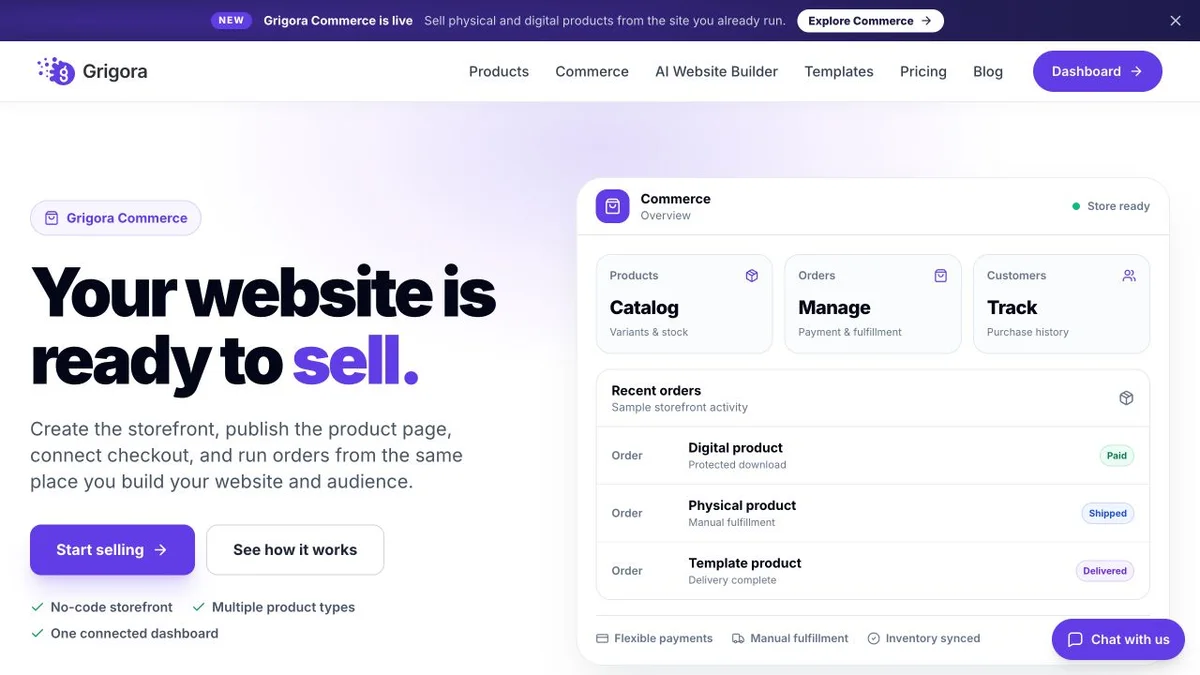
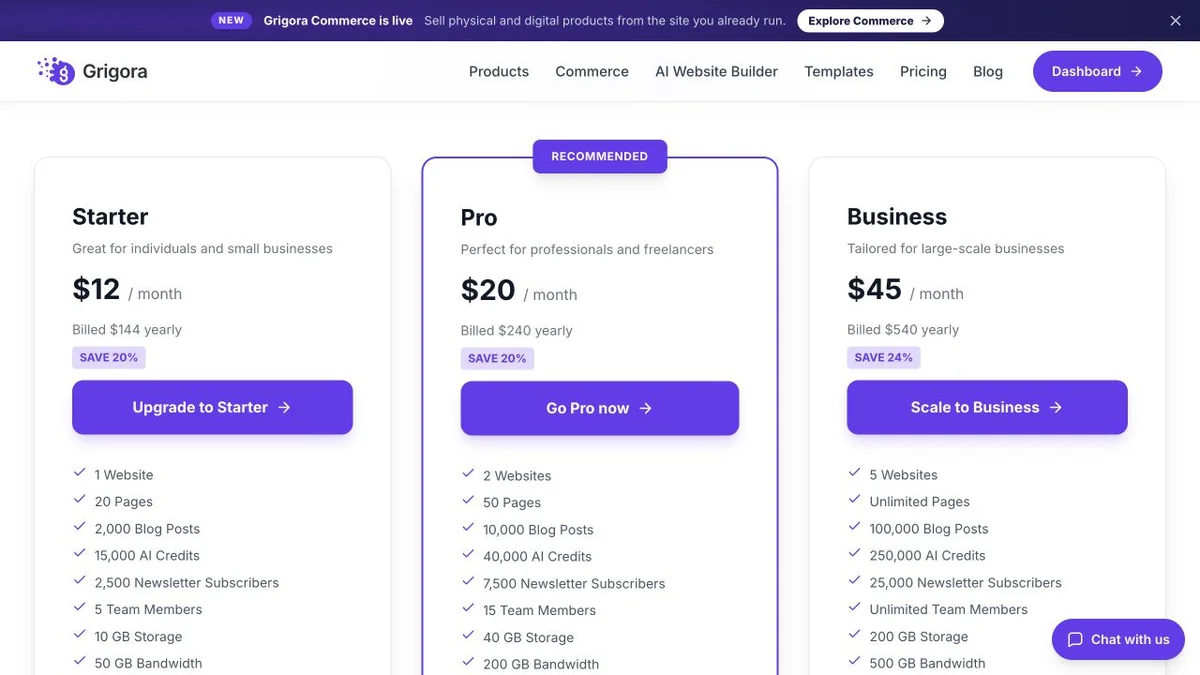
Grigora vs Magento (Adobe Commerce) pricing
Grigora prints three numbers. Adobe prints none.
Website, newsletter and store in one plan
Grigora Starter, Pro and Business rates are $12, $20 and $45 per month billed annually ($144, $240 and $540 per year), or $15, $25 and $59 month to month. Plan limits apply to sites, storage, bandwidth, AI credits and newsletter subscribers. Payment-provider fees and optional paid services are additional.
Three packages, none of them priced
Read live 2026-09-11 at business.adobe.com/products/commerce/pricing.html: no dollar figure appears on the page and all three packages route to a Get pricing form. Licence mechanics from Adobe's product descriptions on helpx.adobe.com. Agency blogs circulate figures from roughly $22k to $200k a year, but those are third-party estimates, not Adobe's.
Grigora Starter is $12/month billed annually with a free trial available. Adobe Commerce publishes its editions and capabilities but requires a quote; include implementation, integrations and operations in that comparison.
The real cost: Grigora vs Magento (Adobe Commerce)
A growing brand with about 400 products, one country, a blog and a newsletter, and nobody on the payroll who writes code.
| What you pay for | Magento | Grigora |
|---|---|---|
| Platform licence, year one | Quote only; third-party estimates run well into five figures | $144 to $540 a year |
| Who builds the site | An implementation agency or a Magento developer | AI first draft, then the block editor |
| Hosting, patching and PCI on the free edition | Yours to buy and to maintain | Included |
| Blog and CMS | Marketplace extension or a second CMS | Included |
| Marketing email | Separate ESP or a licensed Adobe product | Included, 2,500 to 25,000 subscribers |
| B2B company accounts, approvals and quotes | Included as a licensed module | Not offered |
Payment-processor fees apply on both. Adobe publishes no licence figure, so no total is stated here; the five-figure range comes from agency blogs rather than Adobe. If your buyers place purchase orders and negotiate quotes, the last row outweighs every other one.
Magento and Grigora: public website references
These captures show each product’s public website. See the feature and pricing sections for capabilities and plan details.


Is Grigora the right Magento (Adobe Commerce) alternative for you?
Where each platform is the right one.
Magento (Adobe Commerce) alternative for a team with no developer
Describe the business in a sentence, get a designed site, edit it in the browser. No theme work, no deployment, no agency retainer.
… for anyone who needs the price before the meeting
$12, $20 or $45 a month, billed annually, with a free trial available. No sales order, no GMV band, no renewal negotiation.
… for shops that publish as well as sell
Posts, categories, author profiles, directories and moderated comments beside the catalogue, plus the newsletter to send them. Adobe gives you CMS pages and a subscriber list.
Magento (Adobe Commerce) is the right call if…
You sell B2B with company accounts, approval workflows and negotiated quotes, run several brands or countries from one back office, need ERP and OMS integration, or want to own and modify the code. Those are real capabilities Grigora does not have.
Which one is right for you?
Choose Grigora if…
- You want to know the cost before you speak to a salesperson
- Nobody on the team is going to maintain a PHP application
- You need a blog and a newsletter as much as a catalogue
- You would rather your bill ignored your GMV
- You are an agency reselling sites under your own brand
Choose Magento (Adobe Commerce) if…
- •Your buyers are companies with roles, approvals and credit terms
- •You run a very large catalogue across brands, countries and warehouses
- •You have engineers, or an agency, and you want to own the code
How to move from Magento (Adobe Commerce) to Grigora
Magento exports products, customers and orders from the admin or over the API, but data formats and supported fields must be checked before importing. The work is in the rebuild, and the rebuild is the part that used to need an agency.
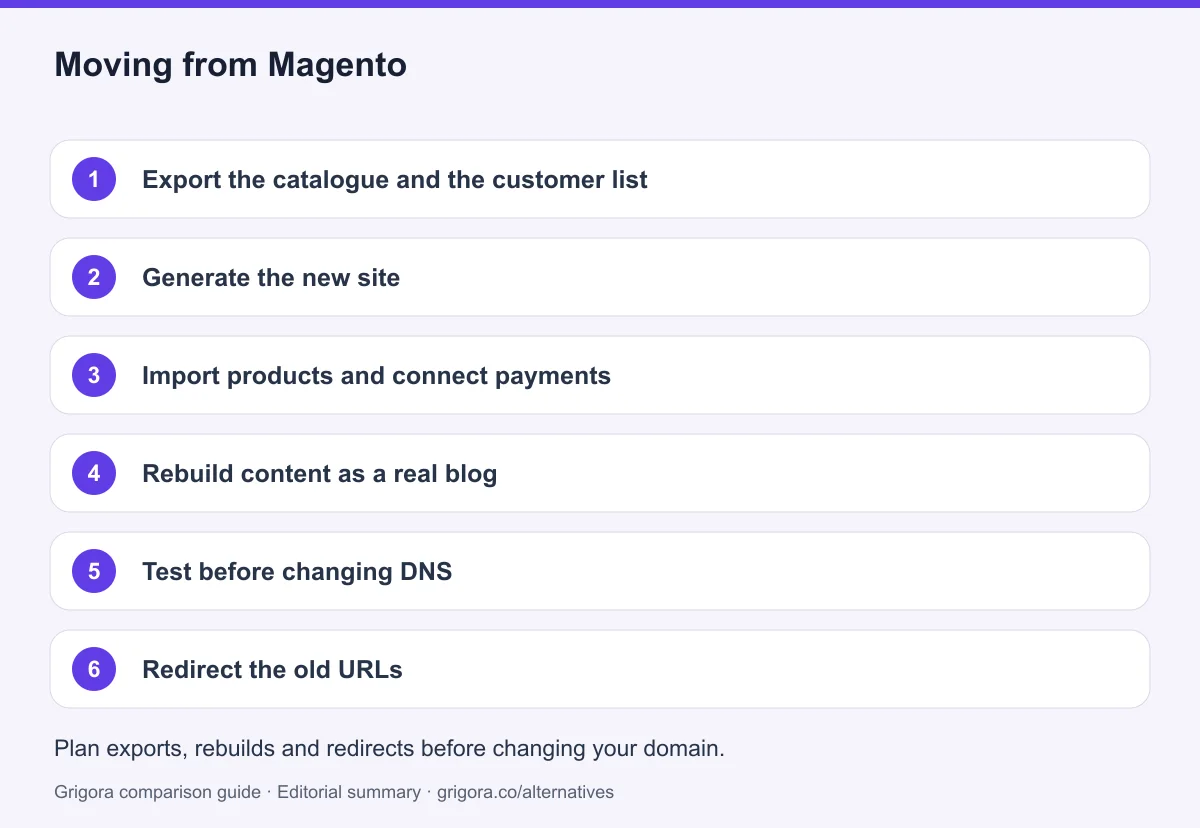
- 1
Export the catalogue and the customer list
Use the admin export or the API for products, customers, orders and newsletter subscribers. Keep the URL keys, you will need them for redirects.
- 2
Generate the new site
Describe the business in a sentence and Grigora produces a designed site with its own art direction, or start from one of the website templates.
- 3
Import products and connect payments
Bring the catalogue into Grigora Commerce with variants, stock and digital downloads, then connect Stripe or Razorpay. There is no platform commission on either.
- 4
Rebuild content as a real blog
CMS pages, blocks and widgets become posts with categories and author profiles, with moderated comments and AI writing if you want them. Import the subscriber list and set up the first campaign.
- 5
Test before changing DNS
Trial-import a small product set with variants and images. Reconcile taxes, shipping, payment methods, customer records and historical orders; do not assume B2B accounts, order history or saved payment methods transfer. Check page titles, descriptions, canonical URLs, internal links, image alt text, forms and checkout on the new site. Keep an old-to-new URL map, add relevant 301 redirects and monitor indexing after launch; redirects cannot guarantee unchanged rankings.
- 6
Redirect the old URLs
Map every Magento URL key to its new address before you point the domain, to reduce broken links and preserve relevant page relationships; rankings can still change.
Why people look for a Magento (Adobe Commerce) alternative in 2026
Magento has been through a lot in eight years. Adobe announced the acquisition of Magento Commerce on 21 May 2018 and completed it that June for about $1.68 billion, the commercial edition was renamed Adobe Commerce in 2021, and in 2025 the line-up was restructured again into a multi-tenant Cloud Service, the single-tenant Cloud edition and a storefront layer called Adobe Commerce Optimizer. Magento Open Source continued throughout and is still free on GitHub, still shipping on an annual May cadence, with 2.4.9 released on 12 May 2026. None of that is a decline story. The platform is healthy. The reason people go looking for an alternative is much simpler: Adobe Commerce is licensed software that assumes you already have an agency, and a great many of the businesses evaluating it do not.
A pricing page with no prices on it
Adobe's page is headed Adobe Commerce packages and pricing. It lists three packages. Each one has a Get pricing button, and each button scrolls to a form headed Get customized pricing for Adobe Commerce. Read live on 11 September 2026, there is no dollar figure anywhere on it. The product page offers a demo booking and nothing else.
That is a deliberate choice and a defensible one for enterprise software. It is also a wall. A five-person brand with 400 products cannot put Adobe Commerce into a spreadsheet next to two other platforms, because two of the three cells have numbers in them and the third has a form. The figures that circulate, roughly $22,000 to $200,000 a year depending on edition and revenue, come from agency blogs rather than from Adobe, and should be treated as third-party estimates rather than quotes.
The licence moves with your GMV
Adobe's own legal product descriptions are more revealing than the marketing pages. The licence metric is a Pricing Level, defined as the GMV and AOV tiers, Order Limit, or other pricing tier named in your sales order. GMV is defined as the total value of all transactions processed through your sites during a contract year, and the descriptions require the customer to report annual GMV so that Adobe can verify licence compliance.
There is no per-order commission, which is genuinely good. But the effect over a few years is similar in spirit: the better the shop trades, the higher the band at renewal. On the Cloud Service edition there is a second meter running alongside it, because SKUs above 250,000, catalogue variations above 100, ingestion above 1,000 updates a minute, extra environments, extra storage and extra Dynamic Media operations are all sold in packs whose prices are also unpublished.
It was designed around an implementation team
This is the part that decides most evaluations. Adobe Commerce is a platform for merchants with a developer team or an implementation partner, and every layer reflects that: themes and templates, integration starter kits, App Builder, API Mesh, staging environments, vCPU day allowances, observability ingest. Page Builder gives a merchandiser drag-and-drop control over the middle of a page. It does not give a founder a website.
Magento Open Source looks like the escape hatch and mostly is not. The licence is free, and then you are buying hosting, a developer or an agency, paid extensions and your own PCI work. Adobe's software lifecycle policy states that extended-support security patches are available to Adobe Commerce customers only and are not available for the Magento Open Source code base, and each release line is supported for three years: 2.4.6 to 11 August 2026, 2.4.7 to 9 April 2027, 2.4.8 to 11 April 2028. A major upgrade project every couple of years is part of the deal.
How Grigora compares
Grigora is built for the reader Adobe Commerce is not built for: someone who wants a proper website with a store in it, who wants to know the price today, and who has no intention of maintaining a PHP application.
A published price and a site you can build this afternoon
Starter is $12 a month billed annually, Pro is $20 and Business is $45, with a free trial available and month-to-month rates of $15, $25 and $59 if you prefer not to commit. Grigora does not publish a GMV-based licence, although usage allowances and provider fees apply, and there is no revenue reporting to anyone. Every paid plan includes AI site generation from a text description alongside website templates, a block editor with custom code injection, the CMS with posts, categories, author profiles, directories and moderated comments, email marketing with campaigns, automations and segmentation, and an online store with variants, stock and digital downloads at 0% platform commission on Stripe or Razorpay.
Hosting, SSL and the CDN are included, and there is nothing to patch. SEO covers metadata, schema controls, sitemaps and IndexNow submission, with free SEO tools on the marketing site. For agencies, White Label is a separate plan at $199 a month, and professional mailboxes start at $5 each. The whole thing is one subscription and one login, which is the point.
Where Adobe Commerce still wins
Business-to-business selling, above everything else. Company accounts with multiple buyers, roles and purchasing permissions, purchase approval workflows, requisition lists, quick order, customer-specific catalogues and price books, payment on credit terms and quote negotiation conducted online are a whole category of functionality that Grigora does not attempt. If your customers raise purchase orders, the comparison ends there.
Scale is the other one. Store views are a licensed unit at Adobe because running several brands, languages, currencies and tax regimes from one admin is the job; multi-source inventory spans real warehouse networks; Adobe states capacity above 200,000 orders an hour in a flash sale. Add PCI Level 1 Solution Provider certification, SOC 2, an optional HIPAA-ready configuration, prebuilt connectors for IBM Sterling, Microsoft Dynamics 365 and SAP S/4HANA, and 24x7 support on the commercial editions. And with Magento Open Source you genuinely own the code: checkout logic, pricing rules and the schema are all yours to change, which no hosted platform can offer. Those advantages are real, and they cost an agency, an upgrade cycle and a price nobody will print.
Frequently asked questions
Grigora is a Magento alternative for smaller businesses that need a managed website, blog, newsletter and straightforward store from $12/month billed annually. Magento Open Source provides self-hosted commerce, while Adobe Commerce offers enterprise packages with custom pricing. Keep Magento or Adobe Commerce for B2B purchasing, complex catalogues, multiple warehouses or custom integrations that Grigora cannot replace.
Adobe does not publish a price. Read live on 11 September 2026, business.adobe.com/products/commerce/pricing.html lists Adobe Commerce as a Cloud Service, Adobe Commerce on Cloud and Adobe Commerce Optimizer, and every one routes to a Get pricing form with no figure attached. Adobe's legal terms price the licence on a Pricing Level set by GMV and AOV tiers or an order limit. Magento Open Source is free to download; hosting, developers and extensions are your cost. Grigora is $12, $20 or $45 a month billed annually.
Magento Open Source is, as a licence. Adobe keeps it on GitHub and calls it a free ecommerce platform for small businesses. You pay for hosting, development, extensions and PCI compliance yourself, you get no Adobe support, and Adobe's lifecycle policy excludes the Open Source code base from extended-support security patches. Adobe Commerce, the commercial edition, has no free plan and no published free trial.
No. Adobe's Content and Design documentation covers CMS pages, static blocks, widgets, media and Page Builder, with no posts, categories, authors or editorial feed. Blogging needs a Marketplace extension or a separate CMS. Grigora includes posts, categories, author profiles, directories and moderated comments on every paid plan.
Only in a limited sense. There are transactional templates and a newsletter subscriber list with double opt-in, a send queue and an archive. There is no native segmentation, automation or campaign reporting, and Adobe's own documentation suggests integrating a third-party newsletter service provider. Real campaign tooling means a separate ESP or a separately licensed Adobe product such as Marketo Engage or Journey Optimizer.
Yes, if your requirements fit. Export products, customers, orders and subscribers from the Magento admin or the API and test the catalogue field mapping before importing supported data into Grigora Commerce, then connect Stripe or Razorpay. Rebuild CMS pages as posts and pages, and redirect every old URL key before pointing the domain. What will not move is B2B company accounts, approval workflows, negotiated quotes and multi-store-view configuration, so check those first.
Sources and comparison method
Published by Grigora, one of the products compared here. This is a comparison of public product documentation and published plans. Recommendations reflect the use cases described; they are not independent performance benchmarks. Homepage screenshots show how each product presents itself and do not establish feature availability.
Check the billing term, currency, regional availability, usage limits and add-ons before purchasing. A content export does not necessarily include the design, integrations or a working store. Migration steps need testing on your own site.
- Adobe Commerce pricing and packages
Custom pricing and differences between SaaS, PaaS and Optimizer packages.
- Adobe Commerce product capabilities
Enterprise commerce, B2B and global-storefront scope.
- Grigora pricing and included features
Annual and monthly billing, plan allowances, included features and trial terms.
Grigora references: plans and limits, commerce, MCP access, and help documentation.
Compare Grigora with other platforms


A commerce site without the quote and the agency
Site, CMS, newsletter and store on one published price, from $12/mo. Try Grigora free, no credit card required.
14-day free trial • No credit card required • Cancel anytime