Free Duplicate Meta Tag Checker
Check one page for duplicate title and meta description tags. Spot HTML tag conflicts fast. Free, instant.
How to use the Duplicate Meta Tag Checker, step by step
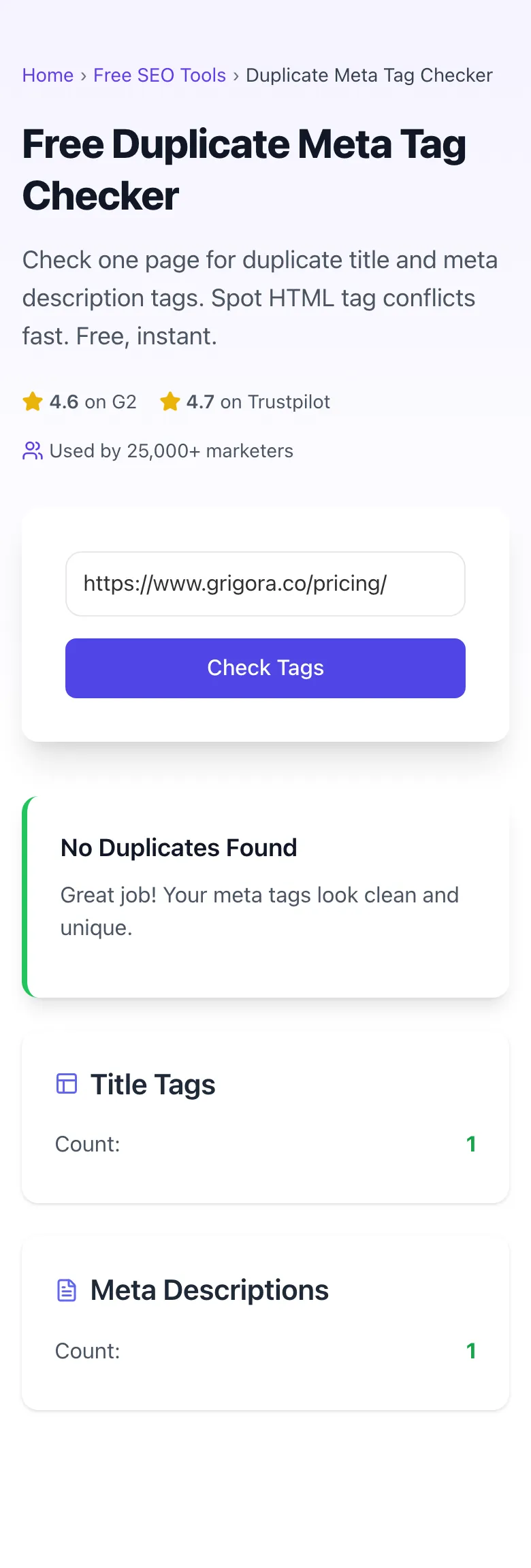
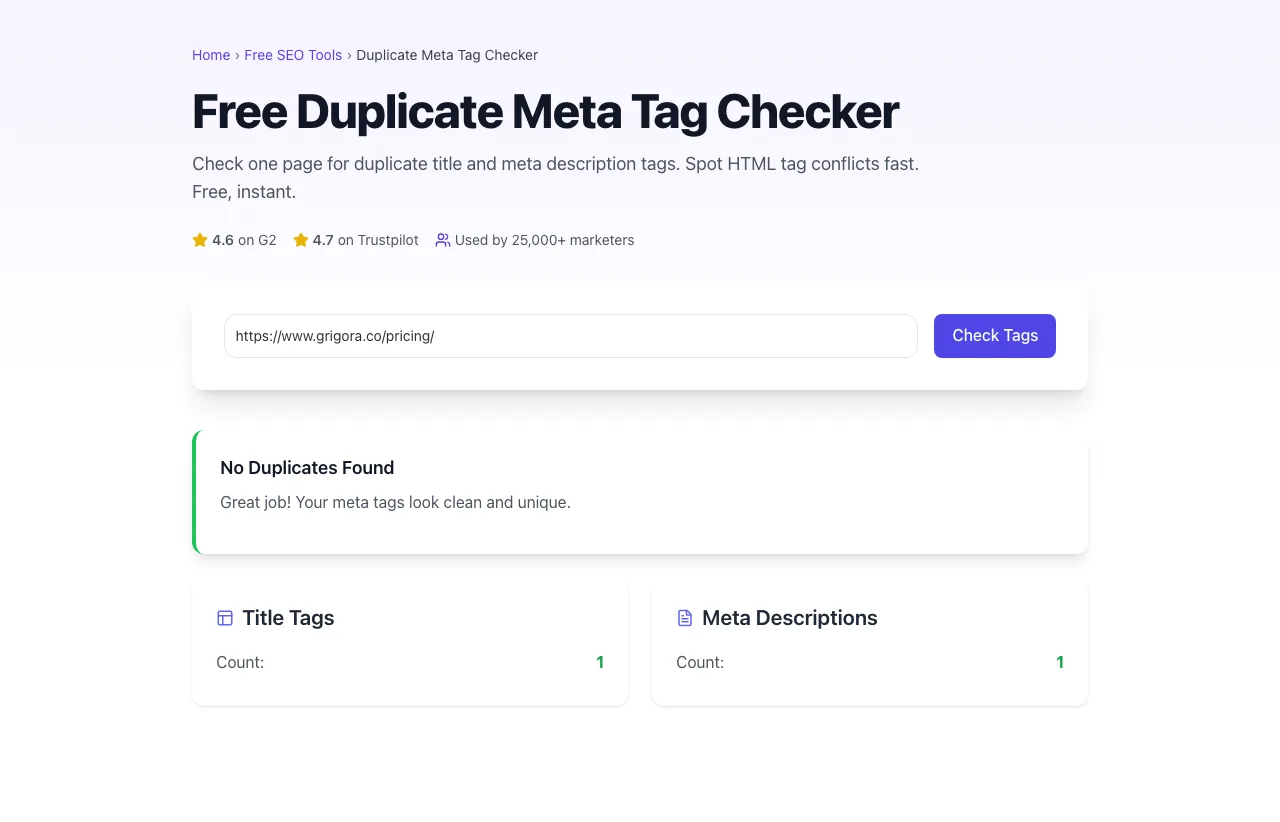
Real screenshots of the tool, taken while running it with the Check Tags button.
- 1
Add your input
Paste or type into the field Duplicate Meta Tag Checker works from.


- 2
A page URL in place
With a page URL entered, Duplicate Meta Tag Checker is ready to run.


- 3
See what Check Tags produces
Clicking Check Tags runs the check and shows the result right below.
What this tool does
Duplicate Meta Tag Checker delivers fast, reliable results for check one page for duplicate title and meta description tags. spot html tag conflicts fast. free, instant.
Designed to fit into your existing SEO and content workflow with no setup overhead.
How to use it
Five steps.
Enter one page URL
Paste the exact public page you want to inspect.
Run the check
The tool fetches the page HTML and reads the head tags.
Review tag counts
See how many title and meta description tags were found.
Inspect duplicates
If duplicates exist, review the repeated tag content.
Fix and re-check
Remove the extra template or plugin output, then run the URL again.
When teams use it
Six common workflows.
SEO leads checking key templates
Test a product page, category page, article, and landing page after theme changes to catch duplicate tags before the template scales.
SEO agencies onboarding new clients
Run quick checks on priority pages during discovery to identify plugin conflicts, theme issues, and duplicate head output.
Content teams running publication QA
Verify a newly published article has one title tag and one meta description before promoting it.
Migration project managers
After a CMS or domain migration, sample important page types to catch metadata reset or duplicate plugin output.
Technical SEO consultants
Use the page-level check alongside canonical and hreflang reviews during pre-launch QA.
Programmatic SEO operators
Spot-check generated page templates so variables render correctly and each page sends clean metadata.
Platform guides
Integrate with major platforms.
Screaming Frog SEO Spider
- Use Screaming Frog for full-site crawling.
- Open a flagged URL in the browser.
- Paste that exact URL into the Grigora checker to inspect duplicate tags on the page.
- Fix the template or plugin that outputs the extra tag.
Sitebulb
- Run a Sitebulb audit for site-wide discovery.
- Pick a representative flagged page.
- Check that single URL in Grigora for a quick readable result.
- Resolve the shared template issue first because it fixes many pages at once.
Google Search Console
- Open Search Console > Pages or URL Inspection.
- Copy one affected live URL.
- Paste it into the Duplicate Meta Tag Checker for a page-level check.
- After fixes, request indexing in URL Inspection to accelerate re-crawl.
Ahrefs Site Audit
- Run Ahrefs Site Audit and open an issue example.
- Copy one affected page URL.
- Use the Grigora tool to verify duplicate tags on that page.
- Push the template fix into your content or development queue.
WordPress with Yoast
- Check a published URL after theme or plugin changes.
- If duplicates appear, inspect whether Yoast and the theme both render tags.
- Disable duplicate theme metadata or adjust plugin settings.
- Re-run the same URL to confirm one title and one description remain.
Grigora vs. alternatives
Side-by-side.
| Capability | Grigora | Screaming Frog | Sitebulb | Free | Manual |
|---|---|---|---|---|---|
| Free single-page metadata check | Yes | Limited | 14-day trial | Paid | Manual |
| Duplicate title tag count | Yes | Yes | Yes | Yes | Manual |
| Duplicate meta description count | Yes | Yes | Yes | Yes | Manual |
| Shows duplicate tag content | Yes | Yes | Yes | Limited | Manual |
| Best for quick page QA | Yes | No | No | Limited | Manual |
| No install required | Browser | Desktop | Desktop | Browser | Manual |
| Full-site scheduled crawl | No | No | Yes | Paid | Manual |
Common errors and fixes
Eight issues users hit.
Page blocked by robots.txt or bot protection
Cause: The site blocks server-side requests from unknown user agents.
Fix: Allow server-side fetches temporarily, or test a public page that is reachable without login or bot protection.
Title tags appear unique here but differ in Search Console
Cause: Google may rewrite titles, or the page may inject tags after the initial HTML loads.
Fix: Compare the page source, rendered HTML, and Search Console URL Inspection output to find which system is changing the title.
Plugin and theme both output metadata
Cause: An SEO plugin adds a title or description while the theme also hardcodes one.
Fix: Disable one source of metadata so the page renders a single title and description tag.
Layout and page component both add a title
Cause: A shared layout renders a title while the page component also injects one.
Fix: Keep metadata in one place, usually the framework metadata API or one SEO component.
Empty description on a template page
Cause: The CMS template is missing a description field or the field only renders when optional metadata exists.
Fix: Add a fallback description to the template or require editors to fill the field before publishing.
Local page works but production shows duplicates
Cause: Production has a different theme, plugin, tag manager snippet, or layout wrapper than your local environment.
Fix: Check the live URL, then compare the rendered head output against the deployed template.
Report misses JavaScript-injected tags
Cause: The page adds metadata after load instead of sending it in the initial HTML response.
Fix: Render SEO tags server-side with Next.js metadata, getStaticProps, or your CMS template so crawlers see them reliably.
Language pages share the same metadata
Cause: Translated pages inherited the same title and description from the default locale template.
Fix: Check one page per locale and add localized metadata fields to the template.
Original data
2026 study.
Frequently asked questions
Twelve answers.
Related free tools
Other utilities.