Free SEO Ranking Factors Checker
Check 200+ SEO ranking factors for any URL. On-page, technical, content, links, UX. Free, instant report.
How to use the SEO Ranking Factors Checker, step by step
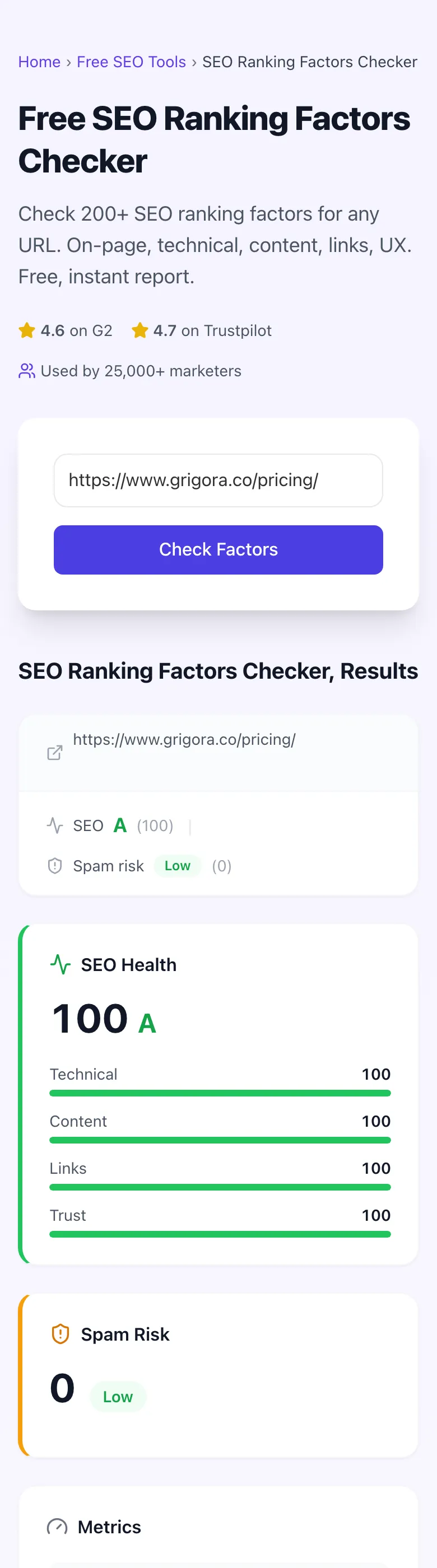
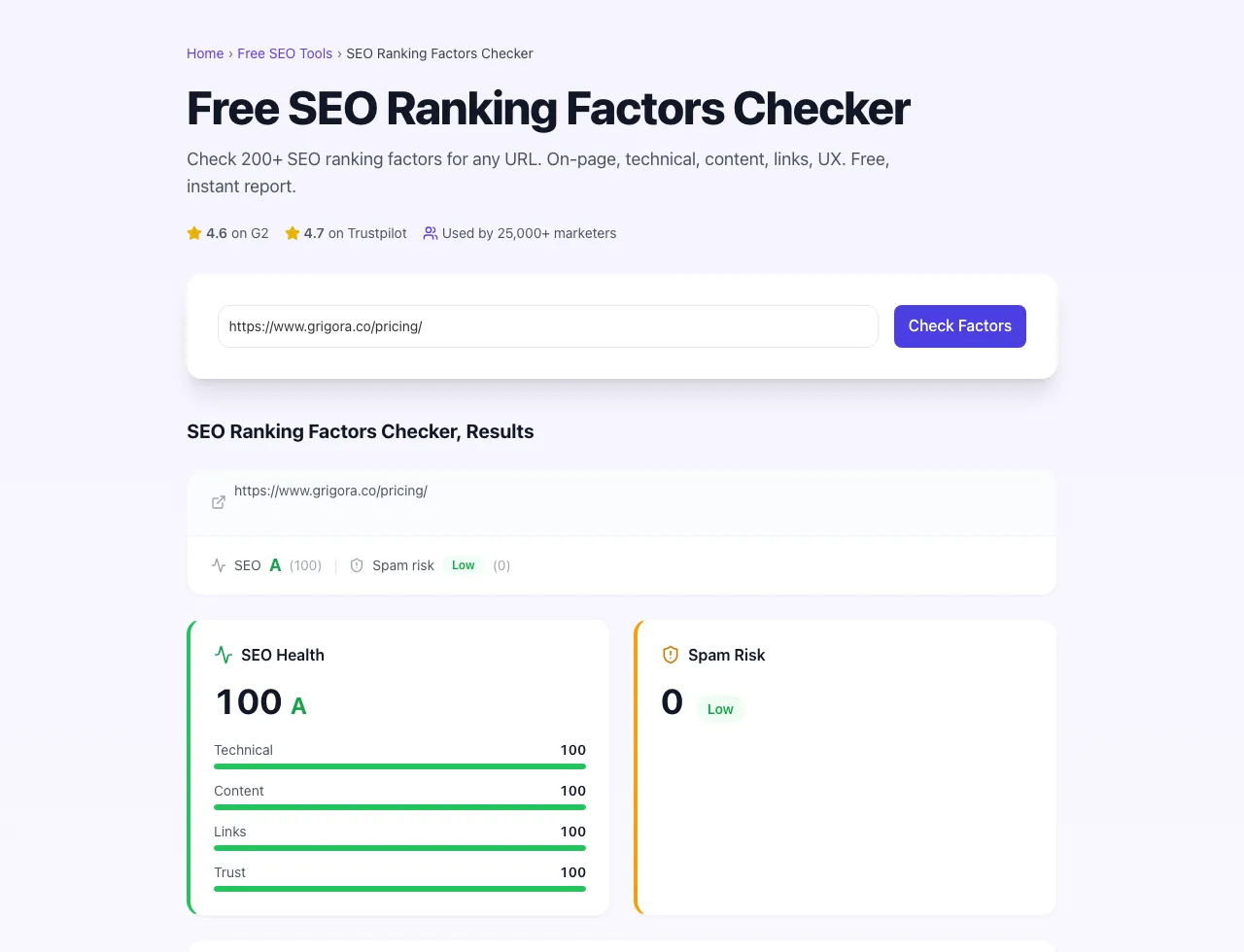
Real screenshots of the tool, taken while running it with the Check Factors button.
- 1
Add your input
Paste or type into the field SEO Ranking Factors Checker works from.


- 2
A page URL in place
With a page URL entered, SEO Ranking Factors Checker is ready to run.


- 3
See what Check Factors produces
Clicking Check Factors runs the check and shows the result right below.
What this tool does
SEO Ranking Factors Checker delivers fast, reliable results for check 200+ seo ranking factors for any url. on-page, technical, content, links, ux. free, instant report.
Designed to fit into your existing SEO and content workflow with no setup overhead.
How to use it
Five steps.
Enter your URL
Paste any URL. Your homepage, top blog post, ranking landing page, or competitor URL. Into the input field.
Run the analysis
Click Check. The tool evaluates 50+ ranking factors across on-page, technical, content, structural, and basic backlink categories.
Review the factor breakdown
See each factor with current state, recommended state, and severity. High-severity issues (noindex, missing H1, weak content) appear first.
Compare to competitors
Run top-ranking competitor URLs through the checker. Compare factor profiles. Close the gaps where competitors outperform.
Track progress over time
Re-run quarterly. Document what changed, what improved, what regressed. Use the data to prioritize next quarter's SEO investments.
When teams use it
Six common workflows.
Pre-publish ranking factor audit
Run a new page through the checker before publishing. Catches missing schema, weak title structure, accidental noindex, and low content depth. Fixes pre-launch cost 5x less than post-launch firefighting.
Diagnosing why a page won't rank
A page targeting a money keyword stalls at position 25 with no movement for months. Run the checker: typically reveals 2-3 fixable factors (content depth, internal links, schema) before backlinks become the bottleneck.
Competitor ranking factor comparison
Run the top 3 ranking competitor URLs through the checker. Compare their factor profiles to yours. Find the gaps: usually content length, schema, or topical depth: that you need to close to compete.
Quarterly SEO health checks
Audit your top 20 ranking pages quarterly. Surface drift over time: removed schema, broken canonical, outdated content, missing internal links from newer posts. Document fixes and trend over time.
Migration validation
After redesigns, CMS migrations, or domain changes, audit a sample of high-traffic URLs against ranking factors. Catches regressions before they hit ranking: schema removal, lost canonicals, broken structured data.
SEO training and onboarding
Hand junior SEOs the factor checklist to learn what matters. They run audits on real pages, see real issues, and learn by fixing. Better than abstract tutorials: concrete, prioritized, action-oriented.
Platform guides
Integrate with major platforms.
WordPress
- Install Yoast or Rank Math for automated on-page factor checks
- Run the ranking factors checker on top 20 ranking posts
- Fix flagged factors at the template level (theme functions, plugin config) where possible
- Manual factors (content depth, author bylines, internal linking) addressed in editorial workflow
Shopify
- Audit top product and collection pages with the checker
- Add JSON-LD for SEO or Schema App for automatic Product/Review/Breadcrumb schema
- Review faceted navigation handling. Avoid creating thin filter combination pages
- Bulk-edit product titles, meta descriptions, alt text via Matrixify for catalog-wide fixes
Webflow
- Audit each page with the checker
- Use Webflow native SEO tab for title/description/canonical
- Add schema via custom code in page settings
- Internal linking via the Webflow CMS reference field. Link related items automatically
Next.js
- Audit production URLs (not localhost). Production behavior often differs
- Use next/seo for consistent meta across routes
- Implement getStaticProps/getServerSideProps to ensure Googlebot sees rendered HTML
- Wire CWV monitoring (web-vitals package) into your analytics for ongoing tracking
Custom React / SPA
- Audit the rendered DOM, not just the source HTML. Googlebot renders JS but slowly
- Test indexability with the URL Inspection tool in GSC, especially "View tested page" tab
- Implement SSR (Next.js, Remix) or pre-rendering (Prerender.io, Rendertron) for any indexable page
- Run the ranking factors checker on the SSR output URL
SEO Ranking Factors Checker vs. alternatives
Side-by-side with common SEO audit platforms.
| Capability | Grigora | Ahrefs | Semrush | Moz Pro | Screaming Frog |
|---|---|---|---|---|---|
| Single-URL ranking factors audit | Manual | ||||
| 50+ factors evaluated | Partial | Manual | |||
| Schema and structured data check | Partial | Manual | |||
| Severity-ranked recommendations | Limited | Manual | |||
| Free with no signup | Trial only | Trial only | Limited | ||
| Backlink profile depth | Limited | Limited | |||
| Keyword tracking integration | Limited | ||||
| Monthly cost for full feature parity | Free | $129+ | $139+ | $99+ | $209+ |
Common errors and fixes
Eight issues users hit.
Optimizing for one keyword while ignoring topical authority
Cause: Single-page focus on a head keyword without supporting cluster pages: Google sees the page as isolated and lacking topical depth.
Fix: Build a topic cluster: 1 pillar page + 5-10 supporting articles all internally linked. Topical authority compounds the pillar page's ranking power.
Building backlinks without earning content
Cause: Pursuing link building (guest posts, outreach, directory submissions) before content is link-worthy: links land on thin pages and don't convert to rankings.
Fix: Publish content worth linking to (original data, comprehensive guides, tools) BEFORE outreach. Link-worthy content earns links passively at 5-10x the rate of cold outreach for thin content.
Ignoring search intent in keyword targeting
Cause: Page targets "best CRM" with a comparison page, but the SERP shows transactional pages: Google never ranks an article in a list-of-products SERP.
Fix: Check the SERP before writing. If top 10 are transactional product pages, write a comparison-product page. If informational guides, write a guide. Match intent or lose.
Assuming Core Web Vitals will lift weak content
Cause: Heavy investment in page speed (LCP under 1.5s) but content stays thin: CWV is a tiebreaker, not a multiplier of bad content.
Fix: Get CWV in Google's "Good" range (LCP under 2.5s, INP under 200ms, CLS under 0.1) and stop. Reinvest engineering time in content quality and topical depth.
Cannibalizing keywords across multiple pages
Cause: Three pages on the same site target "SEO audit tool": Google can't pick a winner and ranks none well.
Fix: Run a `site:domain.com "your keyword"` search to find duplicates. Consolidate the strongest, redirect others to it via 301. Update internal links to point to the canonical version.
Missing or broken schema markup
Cause: Schema present but errors out in Rich Results Test (missing required fields, type mismatches): no rich results in SERPs.
Fix: Validate every schema type with Google Rich Results Test (search.google.com/test/rich-results). Fix errors. Required fields vary by type: Product needs price+availability, Article needs author+date+headline.
Stale content losing freshness signals
Cause: Page with last-modified date 3 years ago competing against actively-updated competitors: Google deprioritizes for time-sensitive queries.
Fix: Audit top 20 ranking pages quarterly. Update content with new data, current year references, fresh examples. Update LAST_UPDATED metadata. Resubmit in GSC.
No author byline or expertise signals
Cause: Articles published without author attribution: fails E-E-A-T evaluation, especially harmful for YMYL topics (health, finance, legal).
Fix: Add author bylines with bio, credentials, photo, links to professional profiles (LinkedIn, Twitter, About page). Implement Author/Person schema. Required for YMYL.
Original data
2026 study.
Frequently asked questions
Twelve answers.
Related free tools
Other utilities.
Meta Tag Generator
Generate page meta tags.
Try itMeta Description Generator
AI-write descriptions.
Try itSERP Snippet Preview
Visualize SERP rendering.
Try itOpen Graph Checker
Audit OG tags.
Try itMeta Title Checker
Audit page title.
Try itLink Metadata Scraper
Pull all metadata from URL.
Try itWebsite Grader
Score a whole website out of 100 with a ranked list of fixes.
Try it