Free Title Tag Length Checker
Check title tag length in characters and pixels. Validate against Google's 580px limit. Free, instant.
How to use the Title Tag Length Checker, step by step
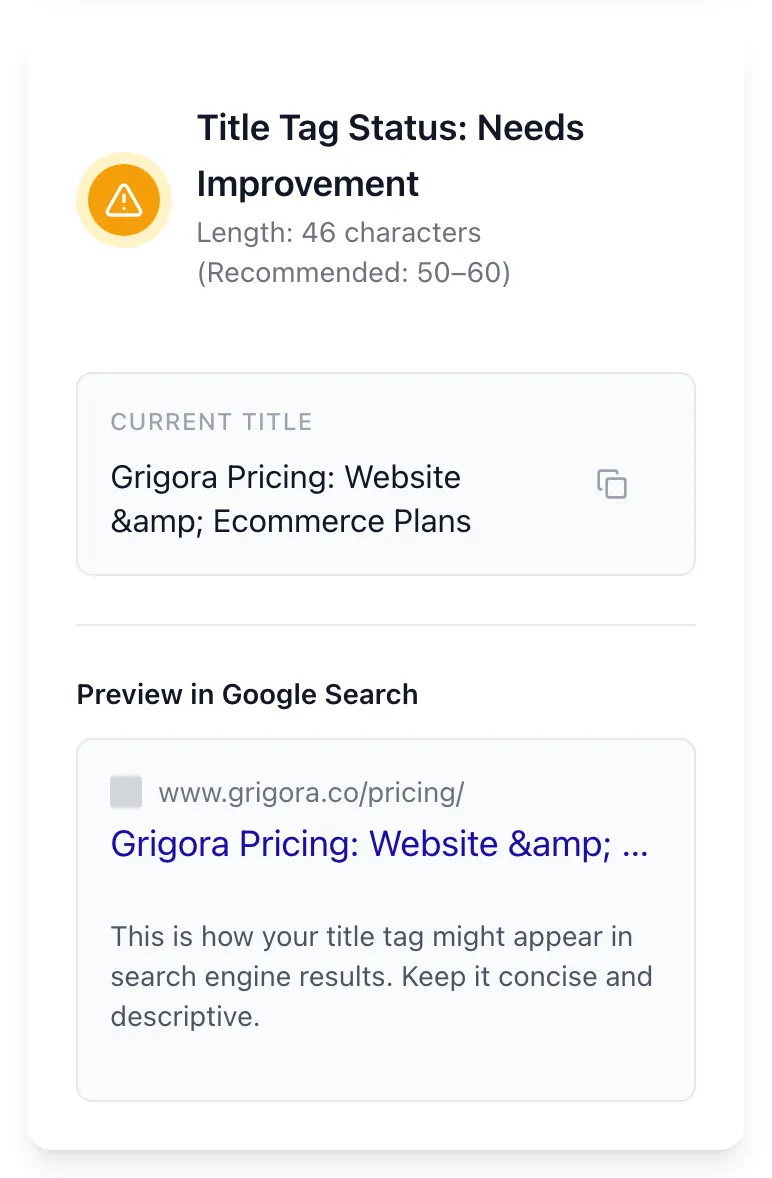
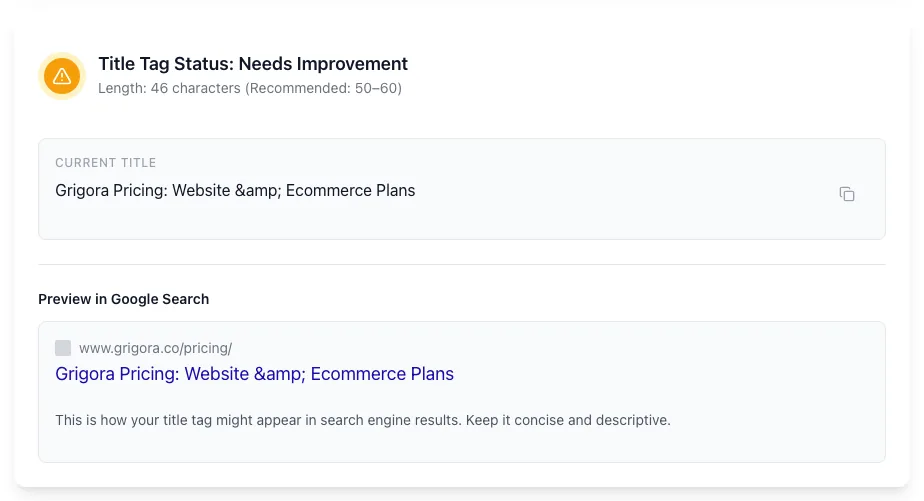
Real screenshots of the tool, taken while running it with the Check Title button.
- 1
Add your input
Paste or type into the field Title Tag Length Checker works from.


- 2
A page URL in place
With a page URL entered, Title Tag Length Checker is ready to run.


- 3
See what Check Title produces
Clicking Check Title runs the check and shows the result right below.
What this tool does
Title Tag Length Checker delivers fast, reliable results for check title tag length in characters and pixels. validate against google's 580px limit. free, instant.
Designed to fit into your existing SEO and content workflow with no setup overhead.
How to use it
Five steps.
Paste your URL or title text
Enter a live URL or paste the title tag string you are drafting. URL input fetches the live <title> from the rendered page.
Run the length and pixel-width check
The checker counts characters and renders pixel width using Google's SERP font baseline (Arial 18px desktop, 16px mobile).
Review desktop and mobile previews
Inspect how the title renders in both desktop (580px cutoff) and mobile (510px cutoff) SERPs side by side.
Optimize based on warnings
If the title exceeds limits, trim modifiers or shorten the brand suffix. If under 30 characters, add a benefit or location.
Publish and verify in Search Console
Update the title in your CMS, request re-indexing via Search Console URL Inspection, and confirm Google renders the new title.
When teams use it
Six common workflows.
SEO content audit
Bulk-check titles across a 200-page blog or content hub before launching a Q4 SEO refresh. Identify pages with truncated, duplicate, or under-30-character titles in minutes rather than spreadsheets.
Pre-publish QA for editors
Editors paste the proposed title into the checker before clicking publish. Flag pixel-width violations and weak structure before they reach the SERP.
Ecommerce product page optimization
Stores with thousands of SKUs need title-tag templates that fit pixel limits across product names, brand suffixes, and modifiers like "in stock" or "free shipping".
Migration validation
After replatforming from Shopify to Next.js or WordPress to Webflow, validate titles survived the move correctly and meet pixel limits in the new template system.
Competitor SERP analysis
Compare your title pixel widths against the top 5 ranking competitors for a target keyword. Identify whether competitors run shorter and tighter titles in your niche.
CTR optimization sprints
Pages with high impressions and low CTR in Search Console get rewritten titles. Use the checker to ensure rewrites stay within pixel limits while testing new value props.
Platform guides
Integrate with major platforms.
WordPress (Yoast / Rank Math)
- Open the page or post editor and scroll to the Yoast or Rank Math meta box.
- Type the new title in the SEO Title field; both plugins show a real-time pixel width meter.
- Aim for the green indicator (under 580 pixels). Use {separator} {site_name} variables sparingly.
- Save and re-fetch via Search Console URL Inspection to confirm Google sees the new title.
Shopify
- From Admin, open the product, collection, or page and scroll to "Search engine listing preview".
- Click Edit website SEO and enter the new title in the Page title field.
- Shopify shows the title preview but no pixel meter; paste into this checker first to validate.
- Save changes and use Shopify's sitemap.xml refresh to push the update to Google faster.
Next.js
- Use the next/head component and place a <title> tag inside, or use the Next.js 13+ Metadata API in the page route.
- For dynamic routes, generate titles in generateMetadata() using fetched data and template literals.
- Pre-validate templated titles for the longest expected variable values to ensure no overflow.
- Deploy and verify with view-source on the live page that the rendered <title> matches expectations.
Webflow
- Open Page Settings (gear icon next to the page in the left panel).
- In the SEO settings tab, fill the Title Tag field. Webflow shows character count but not pixels.
- Paste into this checker before saving to confirm pixel width compliance.
- Publish the site and run a re-crawl request through Search Console.
Wix
- Click the page in the Pages panel, then click the SEO (Google) tab in page settings.
- Enter the new title in the What's the page title? field.
- Wix shows a SERP preview but uses character count rather than pixels. Verify with this tool.
- Save and re-publish; allow 24-48 hours for Google to recrawl the change.
Grigora vs. alternatives
Side-by-side.
| Capability | Grigora ✓ | Moz | Yoast | Free | Manual |
|---|---|---|---|---|---|
| Pixel width measurement | Yes (canvas-rendered) | Yes | Character only | Yes | Character only |
| Mobile vs desktop preview | Both | Desktop only | Both | Desktop only | Both |
| Bulk URL checking | Single URL (free) | Bulk (paid) | Single | Bulk (paid) | Single |
| Live SERP rendering preview | Yes | Yes | No | Yes | Yes |
| Free with no signup | Yes | Limited free | Yes | Trial only | Yes |
| Title rewrite detection | Yes | Paid feature | No | Paid feature | No |
| Brand-suffix detection | Yes | No | No | Manual | No |
| Bulk export to CSV | Coming soon | Yes (paid) | No | Yes (paid) | No |
Common errors and fixes
Eight issues users hit.
Title exceeds 580 pixels (truncated on desktop)
Cause: Title is over 60 characters or uses many wide capital letters that push pixel width past Google's desktop SERP cutoff.
Fix: Trim non-essential modifiers and brand suffixes. Aim for 50-58 characters and re-measure pixel width using this checker.
Title under 30 characters (Google appends brand)
Cause: Title is too short and Google fills empty space by appending site name, breadcrumbs, or category, often producing awkward results.
Fix: Expand the title to 50-60 characters with a benefit, modifier, or location. Add the brand yourself rather than letting Google guess.
Duplicate title tags across multiple pages
Cause: Boilerplate templates output identical titles for paginated, filtered, or category pages without unique tokens.
Fix: Inject dynamic variables (page number, filter, location) into the title. Run a Screaming Frog audit and fix all duplicates flagged in the Page Titles report.
Keyword stuffing in the title tag
Cause: Repeating the same keyword 2-3 times to game rankings, which triggers Google's spam classifier and rewrites.
Fix: Use the keyword once in the first 30 characters. Add semantic variations like synonyms or modifiers instead of repeating.
Brand name dominates the title
Cause: Brand placed first or repeated, pushing the actual keyword past the SERP cutoff and lowering relevance score.
Fix: Move brand to the end after a pipe or dash separator. Drop brand entirely on inner pages if the page already has clear topical signals.
Mobile truncation (title fine on desktop)
Cause: Title fits 580 pixels on desktop but exceeds the 510-pixel mobile limit, cutting off critical words on phone SERPs.
Fix: Optimize for mobile first. Place the primary keyword in the first 50 characters so even mobile truncation preserves intent.
Generic title like "Home" or "Untitled Document"
Cause: CMS default not overridden, common after migrations or new theme installs where title fields are blank.
Fix: Audit all pages for default titles using Search Console Coverage report. Write unique, keyword-rich titles for every indexable page.
Title contains pipe or dash that breaks rendering
Cause: Special separators like || or: copied from styled documents render as garbled characters in older browsers or non-UTF-8 contexts.
Fix: Use plain ASCII separators: pipe (|), hyphen (-), or colon (:). Validate the encoding is UTF-8 in your <head> meta charset.
Original data
2026 study.
Frequently asked questions
Twelve answers.
Related free tools
Other utilities.