
A Statamic alternative for sites with no PHP developer on call
Statamic is a Laravel CMS sold as a perpetual $349 licence per site, and it assumes someone on your side writes PHP. Grigora is a managed platform where the site, the CMS, the newsletter and the store already exist, from $12/mo with no licence and no server.
Published by Grigora · Updated · Sources and method
Is Grigora the right Statamic alternative?
Grigora is a Statamic alternative for a team that wants a managed website, CMS, newsletter and store without maintaining a Laravel application. Statamic is the stronger fit for custom content models, Git-based publishing and developers who need source control. Its free Core edition and perpetual Pro licence remain distinct from hosting costs.
Choose Grigora if you want…
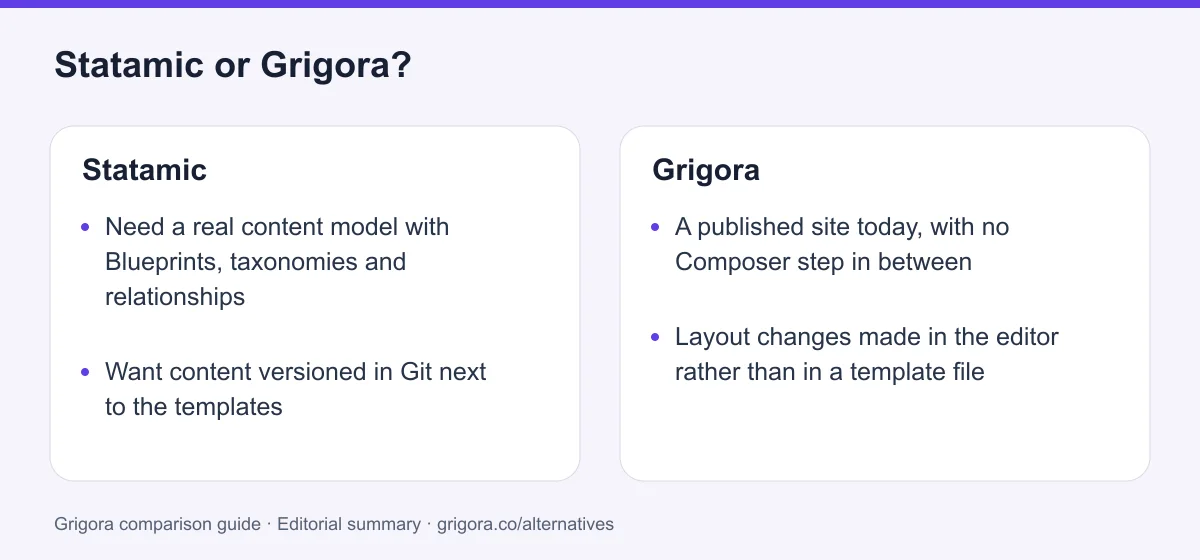
- A published site today, with no Composer step in between
- Layout changes made in the editor rather than in a template file
- A newsletter and subscriber list without buying an addon
- A store that switches on instead of being built
- One bill covering five sites, not five licences
Stick with Statamic if you…
- •Need a real content model with Blueprints, taxonomies and relationships
- •Want content versioned in Git next to the templates
- •Have a Laravel developer who will own the site long term
Statamic or Grigora: the decision in one view
Statamic alternatives at a glance
How Grigora and the other platforms Statamic buyers shortlist compare on the essentials.
Swipe the table sideways to see every column
| Platform | Best for | Free access | Starting price | Sales fees | Data and site portability |
|---|---|---|---|---|---|
| Grigora | All-in-one site, store and newsletter | Free trial | From $12/mo billed annually | 0% platform fee; Stripe/Razorpay fees apply | Posts/content; rebuild design |
| Statamic | Laravel sites with a real content model | Yes, Core tier | $349 per site (Pro) | None taken (addon + processor) | Yes |
| Craft CMS | PHP content sites templated in Twig | Free while in development | Per-site licence + hosting | None taken (Commerce sold separately) | Yes |
| Kirby | Small flat-file sites with no database | Free to build locally | Per-site licence + hosting | None taken (you build checkout) | Yes |
| WordPress | Maximum plugin choice | Software is free | Hosting + plugins | 0% (processing only) | Yes |
| Custom Laravel build | Teams already deep in Laravel | Framework is free | Developer time | 0% (processing only) | Yes |
As of September 2026. Statamic's figures were read from statamic.com/pricing on 11 September 2026; Grigora's are annual-billed list prices. Craft, Kirby and WordPress costs are indicative rather than quoted. Verify current pricing on each provider's site.
Sources for the overview table
- Grigora: official reference 1
Why people switch from Statamic to Grigora
The friction Statamic teams hit most often, and what Grigora does instead.
The developer moved on and the site froze
A Statamic site is a Laravel application. When the person who built it leaves, a new section, a new content type or a Composer update all stop being routine. Grigora sites stay editable by whoever happens to need the page changed.
The licence is per site, and sites multiply
One $349 licence is easy to justify. The fourth one, plus $99 a year each to keep receiving updates, is a conversation. The $1,500 Master License covers five. Grigora's Business plan covers five sites for $45 a month with nothing bought per site.
Three purchases before you can sell or send
Cargo for a store at around $199 plus around $85 a year, Postmaster for email at around $99 a site, SEO Pro for meta management at $75 a site, and a sending account on top. That is roughly $373 of addons before the first order or campaign.
You are administering a server to publish a blog
PHP versions, extensions, Composer, deployment, SSL renewals, backups and uptime are all yours on Statamic, because there is no first-party hosting. Grigora manages the hosting and platform updates.
What Statamic does well
- Blueprints, unlimited collections and 40+ fieldtypes, most of it free in Core
- Content stored as flat files in Git, so edits diff, branch and revert
- A Laravel package with no ceiling: Eloquent, Blade, queues, REST and GraphQL
- Perpetual, transferable licence and no commission on anything you sell
Where Statamic falls short
- Self-hosted only, with no first-party hosting product of any kind
- Free Core stops at one super admin account and one content form
- No store and no email marketing, so both are paid third-party addons
- No visual page builder; layouts are Antlers or Blade written by hand
Grigora vs Statamic at a glance
The differences that decide whether you need a PHP developer on the project.
| Feature | Statamic | Grigora |
|---|---|---|
| Starting cost | Free Core, $349 per site for Pro | $12/mo all in |
| Server you provide | PHP 8.3+, Composer, GD or ImageMagick | None |
| Developer required | In practice, yes | No |
| Templates written by hand | Antlers or Blade | Block editor |
| Online store included | No | Built in, 0% commission |
| Newsletter included | No | Included |
| Content modelling | Blueprints, 40+ fieldtypes | Posts, collections, directories |
| Content versioned in Git | Yes | No |
| Free SEO tools suite | SEO Pro addon, $75 per site | Free tools |
Grigora vs Statamic: feature by feature
A category-by-category breakdown, pricing, AI, design, e-commerce, email, SEO, performance, and support.
The $349 per-site licence
Depends on your needsCore has a free licence and genuinely useful. The bill starts the moment a second person needs an account, or you want revisions, multi-site or the APIs: that is Pro, at $349 once per site, with $99 per site per year afterwards to keep receiving updates. Sensible for one flagship site. Awkward when you run five small ones.
| Feature | Grigora | Statamic |
|---|---|---|
| One production site, first year | $144 on Starter, billed annually | $349 one-time, updates included |
| Five production sites, first year | $540 on Business, billed annually | $1,500 Master License (5 Pro licences) |
| Keeping updates coming after year one | Included | $99 per site, per year |
| Hosting, SSL, CDN and backups | Included | A separate bill you arrange |
| If you stop paying | The subscription ends | Licence is perpetual and transferable |
Takeaway: Compare licence ownership, optional renewals, hosting and implementation across the expected lifetime of your sites.
Who runs the PHP
Fit: GrigoraStatamic states its mission as building the best self-hosted publishing platform, and it means it: there is no first-party hosting. You supply PHP 8.3 or newer, Composer, a list of extensions and an image library, then own deployment, SSL, backups and uptime. Sherpa, the free Mac app released in August 2026, removes the terminal from that job, but only on macOS 14 and Apple silicon.
| Feature | Grigora | Statamic |
|---|---|---|
| Server you have to provision | No | PHP 8.3+, Composer, GD or ImageMagick |
| Deployment, SSL and CDN | Included and managed | Yours to set up and pay for |
| Security patching and upgrades | Handled for you | composer update, run by you |
| Setup without a terminal | A browser, on any device | Sherpa, macOS 14+ on Apple silicon |
| First-party hosting | Included in the price | None offered |
Takeaway: Statamic hands you a Laravel application. Somebody has to keep that application running.
Blueprints, collections and 40+ fieldtypes
Fit: StatamicThis is Statamic's best category and the honest reason people buy it. Blueprints let you define content types properly, with unlimited collections, unlimited taxonomies, relationships between entries and more than 40 fieldtypes, and almost all of it sits in the free tier. Grigora gives you posts, categories, author profiles and directories, which is a fraction of that reach.
| Feature | Grigora | Statamic |
|---|---|---|
| Defining your own content types | Posts, collections and directories | Blueprints, unlimited collections |
| Fieldtypes available | A fixed set | 40+, plus custom ones you write |
| Taxonomies and entry relationships | Categories and simple links | Unlimited, and queryable |
| Reading that content elsewhere | Inside the site | Antlers, Blade, REST and GraphQL |
| What the modelling costs | Included | Free in Core; the APIs need Pro |
Takeaway: Statamic wins this one outright, and the surprising part is how much of it costs nothing.
Flat files, Git history and owning the source
Fit: StatamicBy default Statamic stores entries as flat files inside your repository, so content diffs, branches and reverts exactly like code, and an optional first-party Eloquent Driver moves it into a database if you would rather. You hold the source, you choose the host, and the licence transfers to the client. Grigora has none of that: content sits in a managed store and there is no code to check out.
| Feature | Grigora | Statamic |
|---|---|---|
| Where content lives | Managed store | Flat files in your repo by default |
| Rolling back a bad edit | No | git revert |
| Content on a staging branch | No | Branch the repository |
| Who holds the source code | Grigora | You |
| Switching to database storage | Standard | Free first-party Eloquent Driver |
Takeaway: If you want editors' work in version control beside the templates, nothing on this page matches Statamic.
Bard blocks vs editing the page in front of you
Fit: GrigoraBard is a block-based content editor and a good one, but it edits content, not layout. There is no drag-and-drop page designer and no theme store to click through: pages are Antlers or Blade templates written by hand, so a new section or a restyled hero is a developer task. Live Preview renders those templates as you type, which is the part Statamic does better than most.
| Feature | Grigora | Statamic |
|---|---|---|
| Drag-and-drop page design | Yes | No |
| Ready-made designs | website templates | Starter kits, then code |
| Moving a section on a page | Drag it in the editor | Edit the template |
| AI first draft from a sentence | Yes | No |
| Live preview of real templates | The editor is the preview | Built in, and very good |
Takeaway: Bard handles words beautifully. It will not move a hero or change a column count.
Selling: the Cargo addon vs a store in the plan
Fit: GrigoraStatamic ships no e-commerce at all, in any tier. Selling means a third-party marketplace addon, currently Cargo at around $199 for a new licence and around $85 a year after that, wired to your own Stripe or Mollie account. Statamic itself takes no commission, which is a real advantage, and you still write every storefront template yourself.
| Feature | Grigora | Statamic |
|---|---|---|
| First-party store | On every paid plan | No |
| Route to selling something | Switch it on | Cargo addon, around $199 plus $85/yr |
| Storefront and cart templates | Included | You build them |
| Platform commission | 0% | None taken; processor fees apply |
| Gateways | Stripe and Razorpay | Stripe or Mollie through Cargo |
Takeaway: Neither company takes a cut. Only one of them gives you a working checkout on day one.
SEO Pro at $75 a site vs SEO already in the box
Depends on your needsStatamic gives you absolute control of every tag, URL and template and no interface in which to set any of it. Meta titles, Open Graph, schema and sitemap.xml are things you model in a Blueprint and write into your own templates. The polished version is a paid first-party addon, SEO Pro at $75 per site, which is bundled free with a Platform subscription.
| Feature | Grigora | Statamic |
|---|---|---|
| Meta, Open Graph and schema controls | Built into the dashboard | Model it yourself, or SEO Pro at $75/site |
| sitemap.xml | Generated for you | Write it, or buy SEO Pro |
| IndexNow submission | Yes | No |
| Automatic redirects on slug change | Not offered | SEO Pro |
| Free SEO tools suite | Free tools on the marketing site | No |
Takeaway: Compare the published SEO controls with your actual content and workflow. Test representative pages for crawlability, metadata and performance; platform features do not guarantee rankings or AI citations.
Editor accounts, revisions and the one-admin ceiling
Depends on your needsFree Core stops at one super admin account and one content form. Everything a team needs sits behind Pro: unlimited users, granular roles, drafts, revisions, full content history, two people editing at once, multi-site and multilingual variants. That workflow is deeper than Grigora's, and it is priced per site, which is the trade this whole page turns on.
| Feature | Grigora | Statamic |
|---|---|---|
| Editor accounts | Included on paid plans | One on Core, unlimited on Pro |
| Roles and permissions | Basic roles | Granular, Pro only |
| Drafts, revisions and history | No | Pro only |
| Two people editing one entry | No | Pro only |
| Multilingual variants of a page | No | Pro only |
| Cost of unlocking all of it | Nothing extra | $349 per site, then $99/yr |
Takeaway: Statamic's editorial workflow is the better one. It is also the reason the licence exists.
Explore Grigora before switching from Statamic
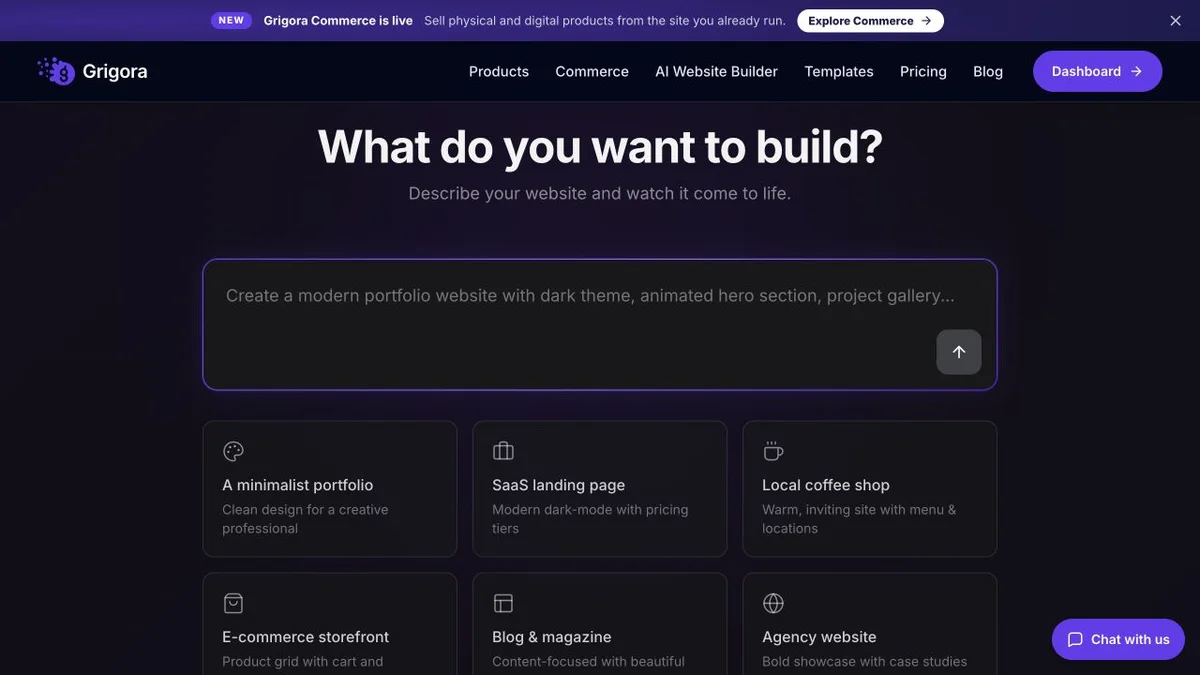
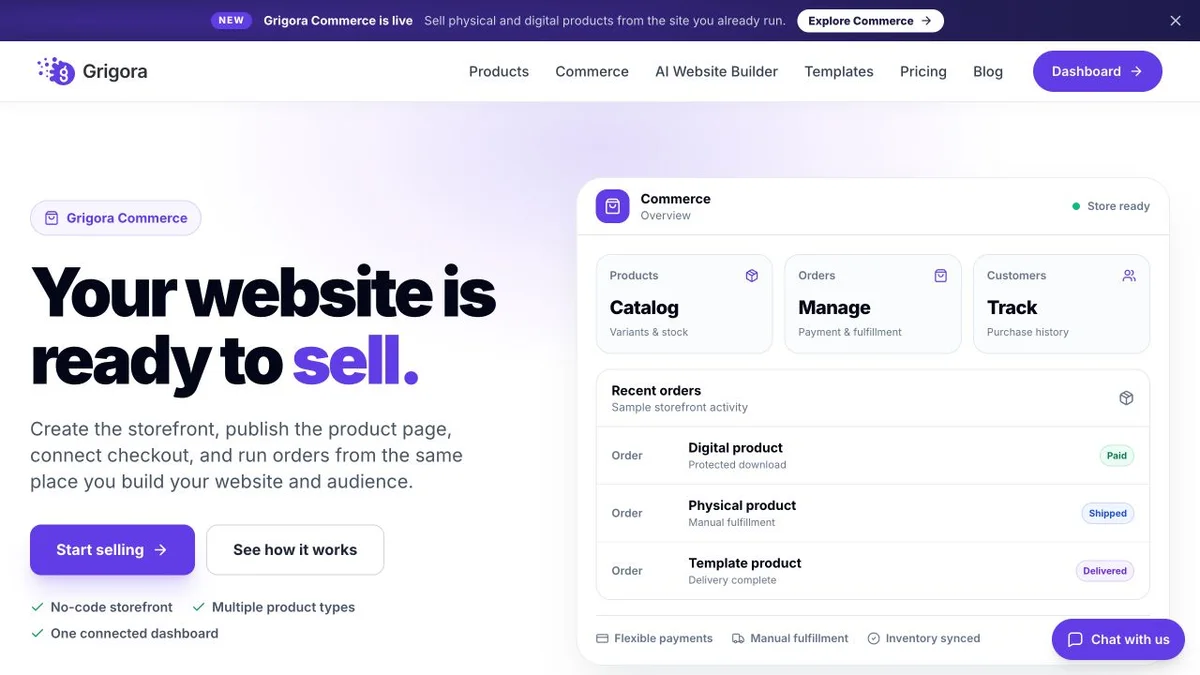
Current public product pages and plans, so you can inspect what you would be moving to. Open any image at full size.
Grigora vs Statamic pricing
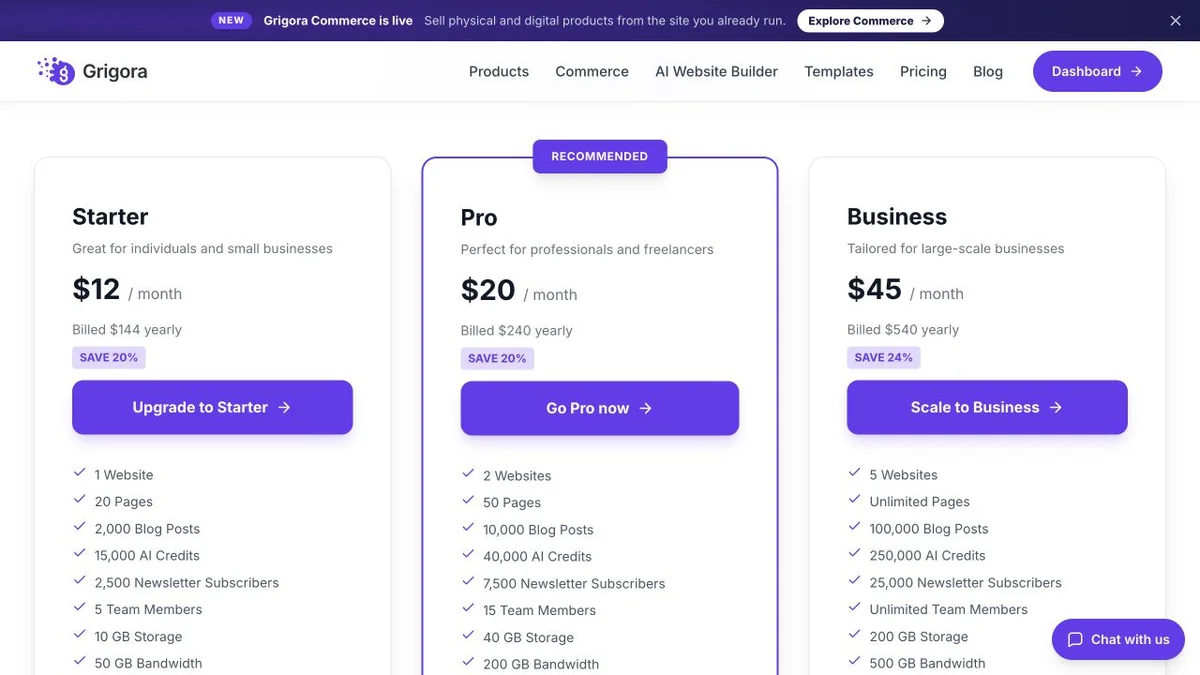
Statamic sells a perpetual licence per site. Grigora sells a subscription that already includes hosting, the store and the newsletter.
Website, newsletter & store in one plan
Annual rates shown; month-to-month is $15, $25 and $59. Every plan includes hosting, CDN, SSL, backups, the CMS, the newsletter and the store, with 0% platform commission on your own gateway. White Label is a separate $199/mo plan and professional mailboxes start at $5 each.
A perpetual licence, bought per site
Read from statamic.com/pricing, /pricing/volume and /pricing/platform on 11 September 2026. Pro is a one-time per-site licence and not a subscription: the $99 a year buys continued updates and Basic Developer Support, and the site keeps running if you stop. These rates took effect on 1 May 2026. Platform pricing applies to new subscriptions, so existing subscribers may be on older rates. Enterprise pricing is custom and not published. A 20% non-profit and education discount is offered; purchasing-power rates are handled by support and are not listed.
Grigora Starter at $12/mo covers the server, the CMS, the newsletter and the store with nothing else to buy. Statamic Pro is $349 for the licence and then the stack underneath it is yours to assemble and pay for.
The real cost: Grigora vs Statamic
One production site, a couple of editors, a small store and a newsletter, costed over the first two years. Statamic's licence is the smallest number in this table.
| What you pay for | Statamic | Grigora |
|---|---|---|
| Software licence | $349 one-time for Pro, per site | Included in the plan |
| Updates and support after year one | $99 per site, per year | Included |
| Hosting, SSL, CDN and backups | Your own PHP 8.3 host | Included |
| Building the templates | Antlers or Blade, written by a developer | website templates and an AI first draft |
| Selling anything | Cargo addon, around $199 plus around $85/yr | Store included, 0% commission |
| Sending a newsletter | Postmaster around $99, plus your own sending account | Included, 2,500 to 25,000 subscribers |
| If you stop paying | Licence is perpetual, the site keeps running | The subscription ends and the site comes down |
Statamic and addon prices read on 11 September 2026; Cargo and Postmaster are third-party listings and can change without notice. Payment-processor fees apply on both platforms. Developer day rates vary enormously, which is exactly why the template row has no number in it.
Statamic and Grigora: public website references
These captures show each product’s public website. See the feature and pricing sections for capabilities and plan details.

Is Grigora the right Statamic alternative for you?
Where Grigora is the stronger Statamic alternative, by situation.
Best Statamic alternative for teams with no PHP developer
If the person who set up Composer has moved on, a Laravel application is a liability rather than an asset. A managed platform removes the whole category of problem.
… for agencies running many small client sites
At $349 a site plus $99 a year, twelve modest brochure sites is a licence line nobody enjoys explaining. One Grigora plan covers five sites, and White Label is available at $199/mo.
… for sites that need to sell and send
Statamic needs Cargo for a store, Postmaster plus your own provider for email and SEO Pro for meta management. Grigora includes all three functions on a $12 plan.
Statamic is the right call if…
You have a Laravel developer who will own the site, the content model genuinely matters, and you want entries version-controlled in Git with a licence you own outright rather than rent.
Which one is right for you?
Choose Grigora if…
- Nobody on your side wants to maintain a PHP application
- Editors should change layouts without opening a template
- You would rather pay monthly than buy a licence per site
- The site needs a store and a newsletter without three addons
- You want hosting, SSL, CDN and backups in the same price
Choose Statamic if…
- •A Laravel developer is already on the project
- •Blueprints and a real content model are the point of the build
- •Content belongs in Git, and the licence belongs to the client
How to move from Statamic to Grigora
Statamic content is flat files or a database you already control, so getting the material out is the easy half. The templates are rebuilt, which is usually the reason for the move. Before moving everything, test a representative content export and check supported import formats. Keep media backups, reconcile product variants and retain subscriber consent and unsubscribe records; an export does not guarantee a direct import.
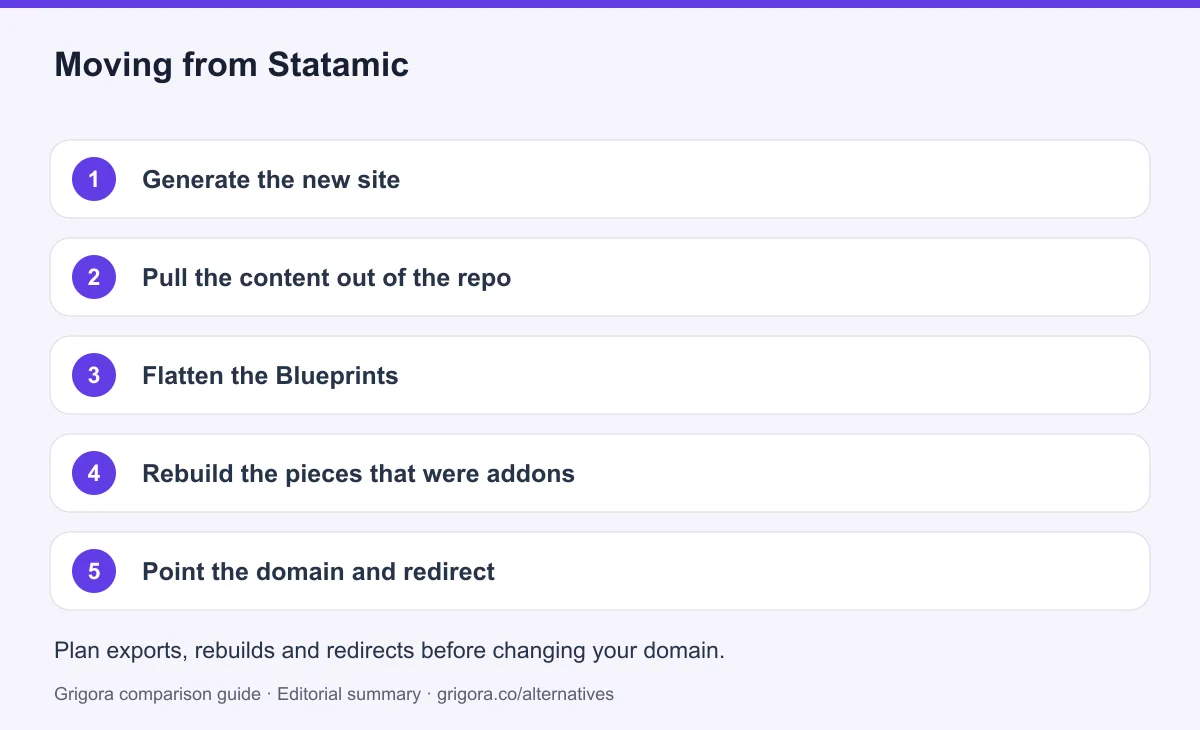
- 1
Generate the new site
Describe the business in a sentence and Grigora's AI produces a first-draft site with pages, layout and copy, or start from a website template.
- 2
Pull the content out of the repo
Entries live as Markdown and YAML in your content directory, or behind the REST API on a Pro licence. Export collections and assets, then import posts and pages into Grigora's CMS.
- 3
Flatten the Blueprints
Most Blueprints map onto pages, posts and one or two directories. Decide that mapping deliberately rather than trying to reproduce every field, because the modelling depth is the thing you are trading away.
- 4
Rebuild the pieces that were addons
Move a Cargo catalogue into Grigora's store and a Postmaster list into the built-in newsletter, then switch off the sending account you were paying for separately.
- 5
Point the domain and redirect
Keep the old service active while you test the new site. Match existing URL paths or configure permanent redirects, verify canonicals and the sitemap, and test forms and checkout on mobile. Change DNS after these checks, then monitor indexing and errors before cancelling services you no longer need. Rankings may change during a migration.
Why people look for a Statamic alternative in 2026
Statamic has an unusually good reputation among the people who use it, and it earns that reputation honestly. Statamic 6 landed in January 2026 with a rebuilt control panel, a command palette, passkeys and more than a thousand merged pull requests behind it. Laravel's own website moved onto the platform in August. Statamic reports more than fifteen thousand sites and over thirty thousand registered developers, figures it publishes itself and does not date. None of that is in dispute. What people run into is the shape of the product: Statamic is a Laravel package sold as a licence per site, and it quietly assumes a developer is already in the room.
The licence is per site, and the second site changes the maths
Core has a free licence, with commercial use allowed and no time limit, which is more generous than most. It is also capped at one super admin account and one content form. A second editor, drafts, revisions, content history, multi-site, multilingual variants and the REST and GraphQL APIs all live behind Pro, which is a one-time $349 per site with the first year of updates included, then $99 per site per year to keep receiving them. The licence is perpetual and transferable, so it is genuinely owned rather than rented, and that is a real advantage over every subscription on this page. It still means the cost scales with the number of sites rather than with how much you use any of them. Five sites is $1,500 through the Master License bundle. Twelve small client sites is a spreadsheet. Those rates took effect on 1 May 2026 and are a documented price change, which Statamic announced openly in March.
Somebody has to own the PHP
There is no first-party hosting, and Statamic is clear that this is deliberate: the stated mission is to build the best self-hosted publishing platform. In practice you provide PHP 8.3 or newer with Composer, the usual extension list and either GD or ImageMagick, then take responsibility for deployment, SSL, backups, CDN and uptime. Sherpa, the free Mac app released in August 2026, removes the terminal from that work and is a thoughtful piece of software, but it is macOS 14 and later on Apple silicon only, and it does not change who gets paged when the server falls over. Statamic Platform, the usage-based tier that starts at $240 a month for the first twenty sites, is licensing rather than hosting: it changes how you pay for licences, not who runs the machines.
The store, the newsletter and the SEO panel are all bought separately
Statamic ships no e-commerce in any tier and no email marketing beyond transactional notifications from Forms through Laravel Mail. Selling means Cargo, a third-party marketplace addon listed at around $199 for a new licence and around $85 a year afterwards, wired to your own Stripe or Mollie account, with every storefront template written by you. Sending a campaign means Postmaster at around $99 a site, and Postmaster does not deliver anything: you still contract with Amazon SES, Mailgun, Postmark or SendGrid. Meta tags, Open Graph, schema and sitemaps are yours to model in a Blueprint unless you buy the first-party SEO Pro addon at $75 a site. Those three come to roughly $373 on top of the $349 licence, before hosting and before the developer time to connect them. Addon prices are set by their authors and can change, so check the listings before budgeting.
How Grigora compares
Grigora starts from the opposite assumption: nobody on your side writes PHP, and nobody wants to. There is no licence to buy per site, no server to provision and no Composer step. You describe the business in a sentence and the AI produces a first-draft site, or you start from a website template and edit blocks directly on the page. Hosting, SSL, CDN and backups are included, and there is nothing to patch.
One subscription instead of a licence plus a stack
Starter at $12 a month billed annually covers one site with the CMS, posts, categories, author profiles, directories and moderated comments, a newsletter with 2,500 subscribers, a store with 0% platform commission on your own Stripe or Razorpay account, and SEO controls with schema, sitemaps and IndexNow submission, plus free SEO tools on the marketing site. Pro at $20 covers two sites and 7,500 subscribers. Business at $45 covers five sites and 25,000 subscribers, which is the direct comparison with the $1,500 Master License bundle: the same five sites, paid monthly, with the server and the store and the email already in the number. Agencies get White Label as a $199/mo plan, and professional mailboxes start at $5 each.
Where Statamic still wins, and it is not close
Content modelling and ownership. Blueprints, unlimited collections, unlimited taxonomies, entry relationships and more than forty fieldtypes let you define content types that can be queried, syndicated and re-rendered in any layout later, and nearly all of that is in the free tier. Content lives as flat files in your repository by default, so an editor's work diffs and reverts in Git next to the templates, and a free first-party Eloquent Driver moves it into a database if you prefer. Because it is a Laravel package, the ceiling is Laravel's: Eloquent, Blade, queues, events, custom fieldtypes, REST and GraphQL, static generation, or the whole CMS dropped inside an existing application. Grigora has none of this. There is no code access, no self-hosting and no Git-based content workflow. If your content model is the hard part of the project, or the client needs to own the software outright, Statamic is the correct answer and this page will not pretend otherwise. This page is for the much larger group who bought a CMS for developers and then had no developer.
Frequently asked questions
Grigora is a Statamic alternative for a team that wants a managed website, CMS, newsletter and store without maintaining a Laravel application. Statamic is the stronger fit for custom content models, Git-based publishing and developers who need source control. Its free Core edition and perpetual Pro licence remain distinct from hosting costs.
Core has a free licence but capped at one super admin account and one content form. Pro is a one-time $349 per site with the first year of updates included, then $99 per site per year to keep receiving updates and Basic Developer Support. A Master License bundles five Pro licences for $1,500. Statamic Platform is usage-based licensing starting at $240 a month for the first twenty sites. Enterprise pricing is custom and not published. Figures read from statamic.com/pricing on 11 September 2026.
Core is, with no time limit and no restriction on commercial use, and it includes Blueprints, all the fieldtypes, unlimited collections and taxonomies, asset management and Live Preview. The limits are one super admin account and one content form. Pro is also free while a site is in development; you buy the $349 licence when it goes to production. You still pay for your own server either way.
No, neither, in any tier. A store means a third-party addon such as Cargo, listed at around $199 plus around $85 a year, connected to your own Stripe or Mollie account, with the storefront templates written by you. Email marketing means an addon such as Postmaster at around $99 a site, and you still supply and pay for SES, Mailgun, Postmark or SendGrid. Grigora includes both on every paid plan, with 0% platform commission.
In practice, yes. Statamic is a Laravel package you host yourself on PHP 8.3 or newer, and layouts are Antlers or Blade templates written by hand rather than designed in a visual builder. Sherpa, the free Mac app released in August 2026, removes the terminal from setup on macOS 14 and later with Apple silicon, but changing how a page looks is still a code change.
Blueprints and the depth of content modelling that comes with them, content stored in Git, code and database access, self-hosting, revisions and content history, simultaneous editing and multilingual variants. Grigora covers the common ground natively, including blogging, comments, directories, forms, a newsletter and a store, and adds hosting, SSL, backups and free SEO tools to the same price.
Sources and comparison method
Published by Grigora, one of the products compared here. This is a comparison of public product documentation and published plans. Recommendations reflect the use cases described; they are not independent performance benchmarks. Homepage screenshots show how each product presents itself and do not establish feature availability.
Check the billing term, currency, regional availability, usage limits and add-ons before purchasing. A content export does not necessarily include the design, integrations or a working store. Migration steps need testing on your own site.
- Statamic pricing
Primary source for the product, plan or migration scope discussed in this comparison.
- Statamic official documentation
Primary source for the product, plan or migration scope discussed in this comparison.
- Grigora pricing and plan limits
Annual and monthly billing, free trial, page/bandwidth/storage allowances, support and optional services.
Grigora references: plans and limits, commerce, MCP access, and help documentation.
Compare Grigora with other platforms


Make the switch from Statamic to Grigora
Run your site, newsletter and store on one subscription, with no licence per site and no PHP server to keep alive. Try Grigora free, no credit card required.
14-day free trial • No credit card required • Cancel anytime