
A Uniform alternative for teams with nothing to orchestrate yet
Uniform is an orchestration layer. It composes one page from the CMS, commerce engine, DAM and customer data platform you already license, which means it assumes you already license several. Grigora is the opposite bet: the website, the CMS, the newsletter and the store are one product, from $12/mo.
Published by Grigora · Updated · Sources and method
Is Grigora the right Uniform alternative?
Grigora is a Uniform alternative only when the requirement is a simpler managed website with content, email and commerce. Uniform is designed for teams composing experiences across an existing technology stack, with personalisation and orchestration. If those capabilities are required, Grigora is not a like-for-like replacement.
Choose Grigora if you want…
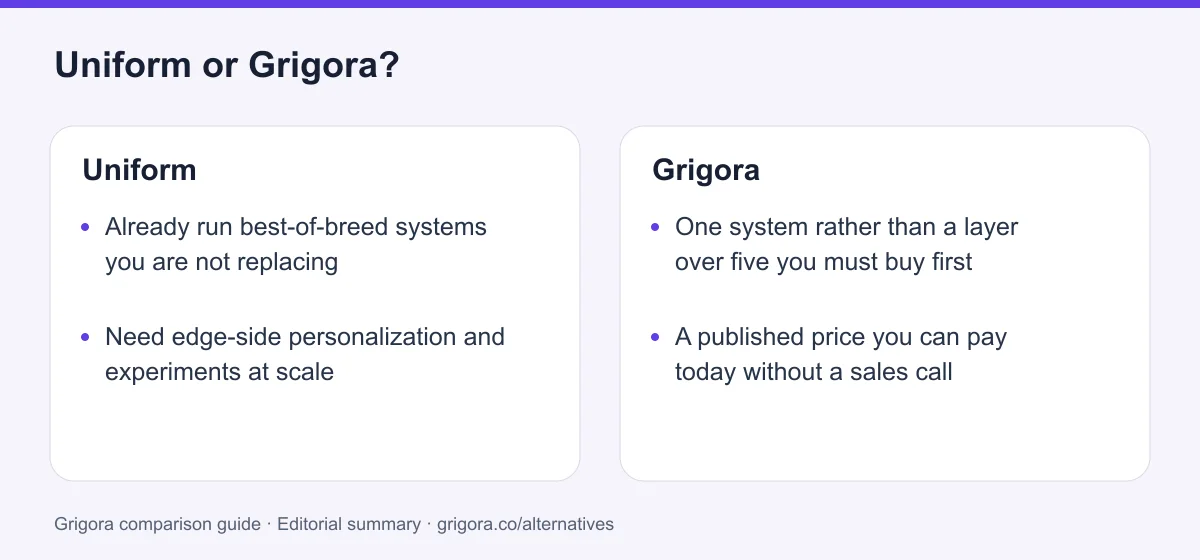
- One system rather than a layer over five you must buy first
- A published price you can pay today without a sales call
- The front end, hosting and CDN included instead of built
- A store and a subscriber list in the same subscription
- A marketer to publish a page with no developer in the loop
Stick with Uniform if you…
- •Already run best-of-breed systems you are not replacing
- •Need edge-side personalization and experiments at scale
- •Have developers and a CDN pipeline of your own already
Uniform or Grigora: the decision in one view
Uniform alternatives at a glance
How Grigora and the other platforms people shortlist against Uniform compare on the essentials.
Swipe the table sideways to see every column
| Platform | Best for | Free access | Starting price | Sales fees | Data and site portability |
|---|---|---|---|---|---|
| Grigora | All-in-one sites, fully managed | Free trial | From $12/mo billed annually | 0% platform fee; Stripe/Razorpay fees apply | Posts/content; rebuild design |
| Uniform | Orchestrating systems you already run | No | From $12,000/yr (Lite) | No checkout of its own | Content via API |
| Contentstack | Headless content for large teams | Not published | Quoted by sales | No checkout of its own | Content via API |
| Hygraph | Federated content with GraphQL | Yes | Growth $199/mo annually or $299 monthly | No checkout of its own | Content and assets via API |
| Sitecore XM Cloud | Enterprise marketing suites | No | Quoted by sales | No checkout of its own | Content via API |
| Drupal | Complex structured content, self-hosted | Software is free | Hosting + developers | 0% (processing only) | Yes |
As of September 2026. Only Uniform's figure was read live for this page, from uniform.dev/pricing on 11 September 2026, and it is a starting point rather than a quote. Verify current pricing on each provider's site.
Sources for the overview table
- Grigora: official reference 1
- Hygraph: official reference 1, official reference 2
Why people look past Uniform
The objections that come up most often, and how Grigora answers them.
The layer costs more than the things it joins
Uniform's published floor is $12,000 a year and it composes systems you are already paying for. When the stack underneath is one CMS and a Shopify store, the orchestration line item is the largest one on the page and the least visible to anybody outside the team.
You cannot see what it costs, let alone buy it
Professional, Enterprise and the standalone personalization package are all Contact us, and so is Lite. There is no free plan, no self-serve checkout and no published monthly option. Access runs through a requested trial account or a demo, and the trial terms are not published anywhere.
Nothing renders until somebody builds it
Uniform is honest that your frameworks, CDN and CI/CD stay yours. That also means no hosting, no templates and no rendered page on day one. A third-party review site reports roughly one to two weeks of developer ramp-up on the core concepts before the build itself begins.
The agentic story sits above the published price
Scout is the headline of Uniform's 2026 positioning, and Agentic AI is listed on Enterprise while AI Copilot is listed on Professional. Neither appears on Lite, the only tier with a number against it.
What Uniform does well
- Composes one page from several back ends through 70+ pre-built integrations
- Personalization and A/B testing chosen at the CDN edge, not in the browser
- Releases, workflows, editions, locale management and SSO for large teams
- Unlimited users, bandwidth and API calls listed on every DXP plan, with no per-seat charge
Where Uniform falls short
- Only one price is published: a $12,000 a year floor on the capped Lite tier
- No free plan, no self-serve signup and no published monthly billing
- No front end, hosting, CDN or templates; developers build and deploy the app
- No store, no payments and no email sending of its own
Grigora vs Uniform at a glance
The differences that decide whether you need a stack underneath.
| Feature | Uniform | Grigora |
|---|---|---|
| Lowest published price | From $12,000/yr | $12/mo billed annually |
| Free plan | No | Yes |
| Buy without talking to sales | No | Yes |
| Front end, hosting and CDN | You build and run them | Included |
| Templates to start from | None | Template library |
| Online store | Connect an external engine | Built in, 0% commission |
| Email marketing | No | Included |
| Composes pages from other systems | 70+ integrations | No |
| Edge-side A/B testing | Yes | No |
Grigora vs Uniform: feature by feature
A category-by-category breakdown, pricing, AI, design, e-commerce, email, SEO, performance, and support.
Orchestrating the systems you already run
Fit: UniformThis is Uniform's real job and it does it well. A single composition can pull an article from Contentful or Sitecore, products from Shopify or commercetools, images from a DAM and audience data from a CDP, then let a marketer arrange all of it on one canvas. Grigora cannot do that at any price, because Grigora only surfaces what lives inside Grigora. The catch is the entry requirement: the value arrives in proportion to how many systems you already pay for.
| Feature | Grigora | Uniform |
|---|---|---|
| Composes one page from several back ends | No | Core capability |
| Pre-built integrations | Not applicable, one system | 70+, plus bring your own API |
| Keeps a legacy CMS in place while you migrate | No | Yes |
| Sits over a commerce engine you already license | No | Shopify, commercetools, SAP and others |
| Systems you must already run | One | Several, by design |
Takeaway: If you already run four systems and want one editing surface across them, Uniform is the right shape and Grigora is not.
The $12,000 floor and the sales call
Fit: GrigoraUniform publishes exactly one number. Lite starts at $12,000 USD a year, and that is described as a starting point rather than a quote. Professional, Enterprise and the standalone Personalization and A/B testing package are all Contact us, and so is Lite: every button on the pricing page opens a conversation rather than a checkout. Grigora publishes three prices and lets you pay one of them.
| Feature | Grigora | Uniform |
|---|---|---|
| Lowest published price | $12/mo billed annually | Starting at $12,000 USD a year (Lite) |
| Prices published for higher tiers | All three | None, Contact us |
| Self-serve signup | Yes | No |
| Free plan | Free trial | No |
| Monthly billing | $15 to $59 month to month | No monthly option published |
| Try before you buy | Free trial | Request a trial account or a demo; terms not published |
Takeaway: One figure exists on Uniform's pricing page, it is a floor, and you still have to ask before you can pay it.
What the entry tier actually contains
Fit: GrigoraLite is described on the pricing page as being for small projects, small businesses and individuals. Read the grid and that framing gets harder to sustain: one production project, one integration, two locales, one release, one workflow, Bronze support, and the word Limited against entries, content types, compositions, assets, personalization and A/B testing, with no number attached to any of them. There is no AI at all on Lite.
| Feature | Grigora | Uniform |
|---|---|---|
| Production projects | 1 to 5 sites by plan | 1 on every DXP tier |
| Entries, content types and assets | Posts, categories, collections and directories included | Limited on Lite, never quantified |
| Locales | No equivalent native locale governance documented | 2 on Lite and Professional |
| Integrations | Not applicable, one system | 1 on Lite, 2 on Professional, 4 on Enterprise |
| AI on the cheapest paid plan | 15,000 credits on Starter | None on Lite |
| Meaning of Unlimited | Plan limits stated as numbers | Footnoted Fair use policy applies |
Takeaway: The only tier with a published price is also the one with the tightest caps and no AI in it.
Who builds and hosts the front end
Fit: GrigoraUniform is explicit about this and deserves credit for the clarity. The composable DXP page states that your frameworks, your CDN and your CI/CD stay yours, and that the application layer belongs to you. In practice a developer builds a Next.js class application, registers components so they can be composed, deploys it and wires up edge middleware before a marketer sees a canvas worth using. Grigora hands you a rendered site on day one.
| Feature | Grigora | Uniform |
|---|---|---|
| Hosting, CDN and SSL | Included | Yours to run |
| Templates or themes | Template library | None shipped |
| Developer needed before marketing can work | No | Yes |
| Time to a first live page | Minutes | After the app is built and deployed |
| Developer ramp-up on the core concepts | None | Reported at roughly 1 to 2 weeks by a third-party review site |
Takeaway: Nothing is live on Uniform the day you sign, because Uniform renders nothing itself.
Personalization decided at the edge
Fit: UniformUniform supports personalisation and experimentation at the edge, which can reduce reliance on browser-side variation scripts. Its actual performance depends on the implementation and connected stack. Grigora does not offer an equivalent experimentation product.
| Feature | Grigora | Uniform |
|---|---|---|
| Where the variant is chosen | Not offered | CDN edge middleware |
| Flash of original content | Not applicable | Avoided by design |
| Built-in A/B testing | No | Yes |
| Effect on Core Web Vitals | No experiment script to load | No render-blocking experiment script |
| Published customer result | Not applicable | Sainsbury's cited at +5.9% conversion rate on the pricing page |
Takeaway: Uniform’s experimentation architecture is a meaningful capability; measure performance on the actual implementation.
Releases, workflows and editions
Fit: UniformLarge marketing organisations have approval chains, campaign launches and regional variants, and Uniform models all three as first-class objects. Releases let you preview, edit and schedule a coordinated batch of changes so they go live together. Workflows bind approval stages to content types. Editions give a market or campaign its own version of a composition with its own publishing lifecycle. Grigora has roles and a publish button.
| Feature | Grigora | Uniform |
|---|---|---|
| Coordinated batch of scheduled changes | No | Releases |
| Approval stages bound to content types | Basic roles | Workflows |
| Market or campaign specific versions | No | Editions |
| Single sign-on | No | Listed on Enterprise |
| Charged per editor | Priced per site, not per seat | Unlimited Users on every DXP plan |
| Releases and workflows on the entry tier | Not applicable | 1 release, 1 workflow on Lite |
Takeaway: If six people have to sign off before a page ships, Uniform has the machinery for it and Grigora does not.
Commerce: a layer, not a shop
Fit: GrigoraUniform's commerce integrations page is clear that it is a content and experience layer over a commerce platform you license separately. You can compose and personalise a storefront in Uniform, but the cart, the checkout, the payments, the tax, the shipping and the catalogue all belong to somebody else's product, and to somebody else's invoice. Grigora includes the store on every paid plan and takes no cut of what you sell.
| Feature | Grigora | Uniform |
|---|---|---|
| Cart and checkout | Built in | No |
| Product catalogue, variants and stock | Built in | Pulled from an external engine |
| Digital downloads | Yes | Whatever your engine supports |
| Platform commission | 0% | None, it processes no payments |
| Payment gateways | Stripe and Razorpay | Whatever your commerce engine uses |
| Extra licence needed to sell | No | Yes, such as Shopify, BigCommerce or commercetools |
Takeaway: Uniform charges nothing on your sales because it never touches them; the engine that does is a second bill.
The channel Uniform never owns
Fit: GrigoraThere is no email sending in Uniform. No campaign builder, no newsletter, no automation, no contact list. Email and customer data vendors appear as integration categories whose data can drive on-site personalization, which is useful, but the message itself is always sent by a product you bought elsewhere. Grigora treats the list as part of the website rather than a neighbouring subscription.
| Feature | Grigora | Uniform |
|---|---|---|
| Subscriber list | 2,500 to 25,000 by plan | No |
| Campaign builder | Included | No |
| Automations and segmentation | Included | Integration target only |
| Forms and lead capture | Built in | No forms product is documented |
| Professional mailboxes | From $5/mailbox | Separate provider |
Takeaway: Uniform can personalise a page using data from your email platform, and it will never send the email.
Scout, AI credits and who actually gets them
Depends on your needsUniform now leads with agents. The May 2026 Scout release added MCP connectivity, vector search, skills and bulk operations, and the AI agents page describes Scout running SEO analysis and fixes, generating FAQ and TL;DR blocks, rewriting copy in a citation-friendly style and refreshing AEO and GEO fields, on drafts only, so publishing stays a human decision. That is more sophisticated than anything Grigora's AI does to a page. The gate is the tier: Agentic AI is listed on Enterprise, AI Copilot on Professional, and neither appears on the tier with the published price.
| Feature | Grigora | Uniform |
|---|---|---|
| AI included on the cheapest paid plan | 15,000 credits on Starter | None on Lite |
| What the AI does | Generates the site, writes posts, drafts copy | SEO analysis and fixes, FAQ and TL;DR blocks, AEO and GEO fields |
| Publishing stays human | You approve every change | Scout works on drafts only |
| Credit allocation published | Yes, 15K to 250K by plan | No, agreed with sales |
| Sitemaps, schema and IndexNow | Built in | You model the fields and render them yourself |
Takeaway: Scout does more than Grigora's AI, and almost nobody paying Uniform's only published price is entitled to it.
Explore Grigora before switching from Uniform
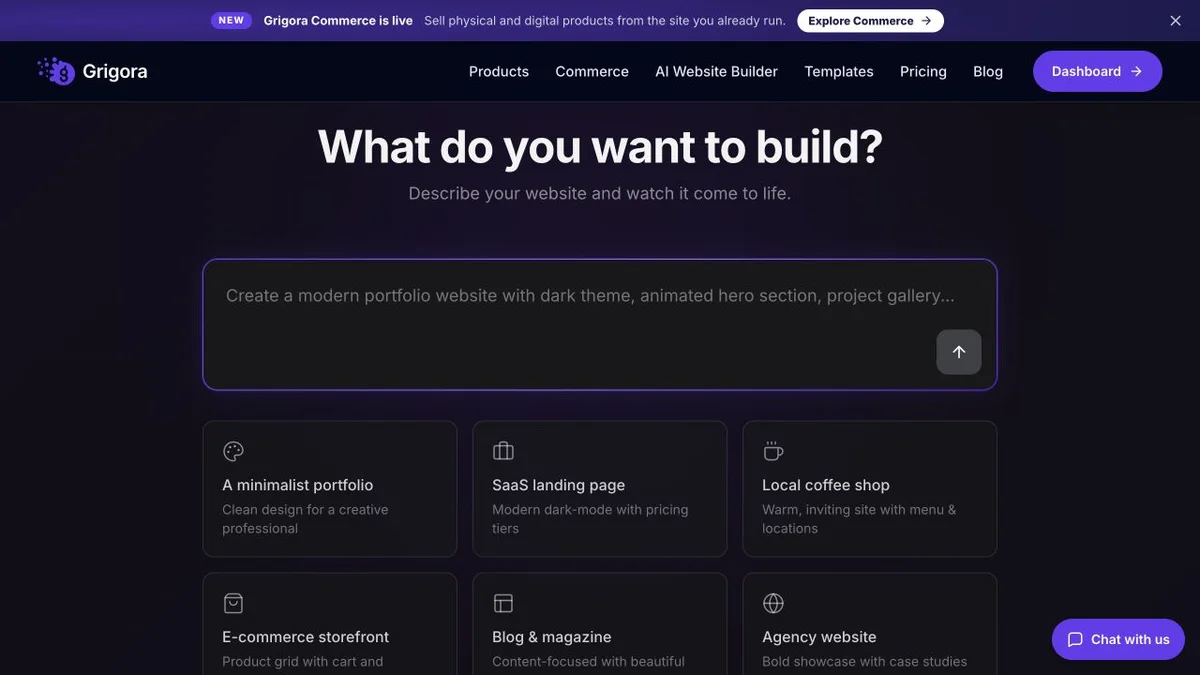
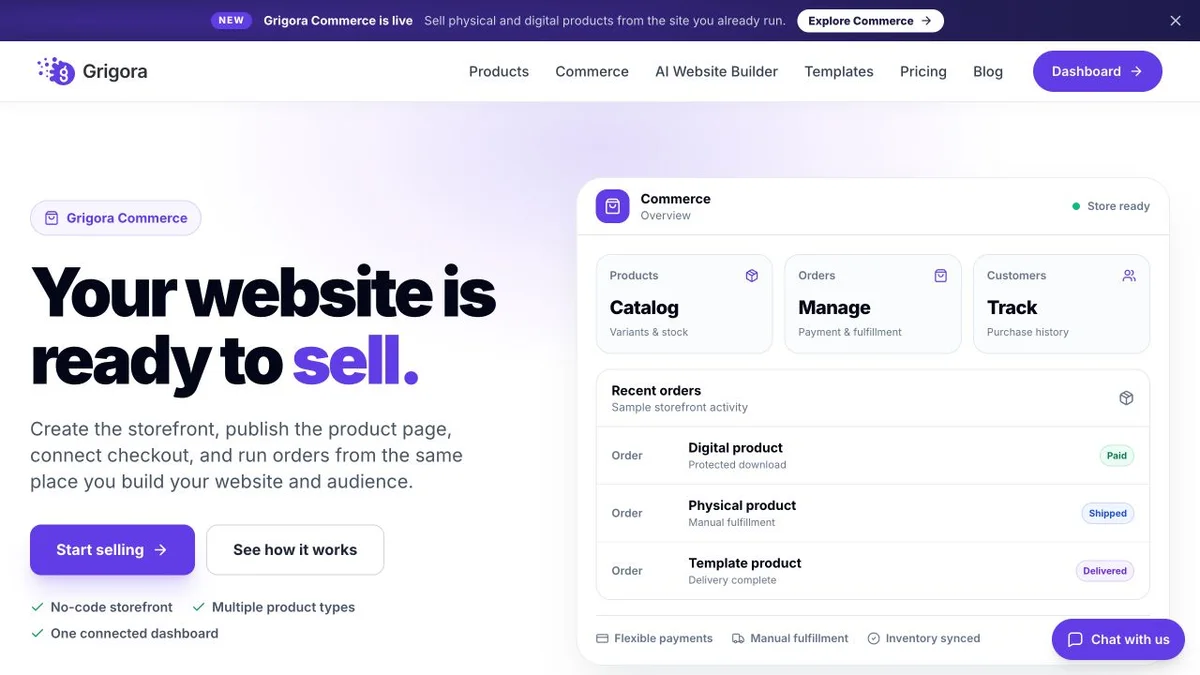
Current public product pages and plans, so you can inspect what you would be moving to. Open any image at full size.
Grigora vs Uniform pricing
Uniform publishes one number for four packages. Here is what each side costs before anything is live.
Website, newsletter & store in one plan
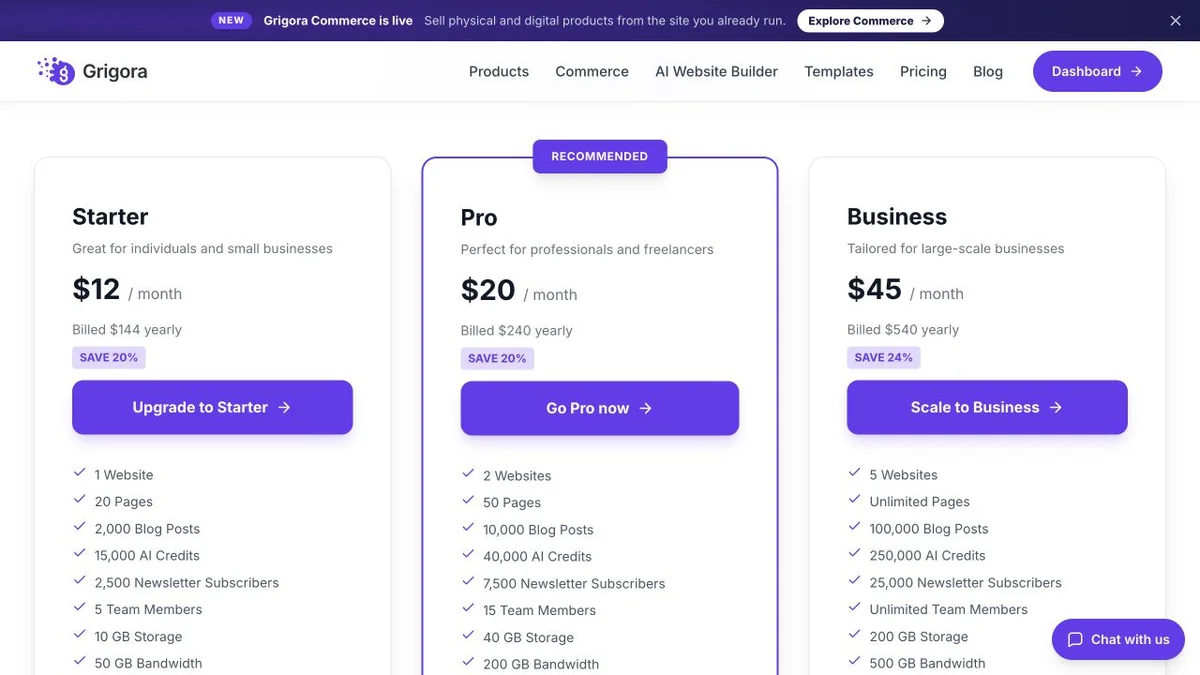
Annual rates shown. Hosting, CDN, SSL, backups, the CMS, the newsletter and the store are included on every plan, with 0% platform commission on any connected gateway. White Label is a separate plan at $199/mo.
Quoted, not listed
Read live from uniform.dev/pricing on 11 September 2026. Starting at $12,000 USD a year on Lite is the only price Uniform publishes, and it is a starting point rather than a quote. Every plan, Lite included, has a Contact us button; there is no free tier and no self-serve checkout. No monthly billing option is shown. Unlimited lines on Professional and Enterprise carry the footnote Fair use policy applies, and Lite's limits are written as Limited with no numbers given.
Grigora Business is $540 a year for five sites, the store, 250,000 AI credits and 25,000 email subscribers. Uniform's published floor is $12,000 a year for one production project, one integration, two locales and no AI, before you build the front end it runs on.
The real cost: Grigora vs Uniform
Model a 40-person company that wants a marketing site, a blog, a newsletter and a modest store. Uniform is priced as a layer, so the honest comparison counts the things the layer needs underneath it as well as the licence itself.
| What you pay for | Uniform | Grigora |
|---|---|---|
| Platform licence | From $12,000/yr on Lite; other tiers quoted | $144 to $540/yr billed annually |
| Front end, hosting and CDN | Your application, your CDN, your CI/CD | Included on every plan |
| Systems being orchestrated | The CMS, DAM or customer data platform it composes from, each licensed separately | None, because content lives in one place |
| Online store | Shopify, commercetools or similar, licensed separately | Included, 0% platform commission |
| Email marketing | A separate sending platform | Included, 2,500 to 25,000 subscribers |
| Personalization and A/B testing | Included, and running at the edge | Not offered |
| Developer time before launch | Build and deploy the app, register components, wire edge middleware | None |
Uniform's $12,000 figure is the on-page floor for Lite, read on 11 September 2026, and is not a quote. Uniform charges no commission and processes no payments; transaction fees come from whichever commerce engine and processor you connect. Scout runs on AI credits included with Uniform plans, with allocations agreed with sales rather than published. Payment-processor fees apply on Grigora too.
Uniform and Grigora: public website references
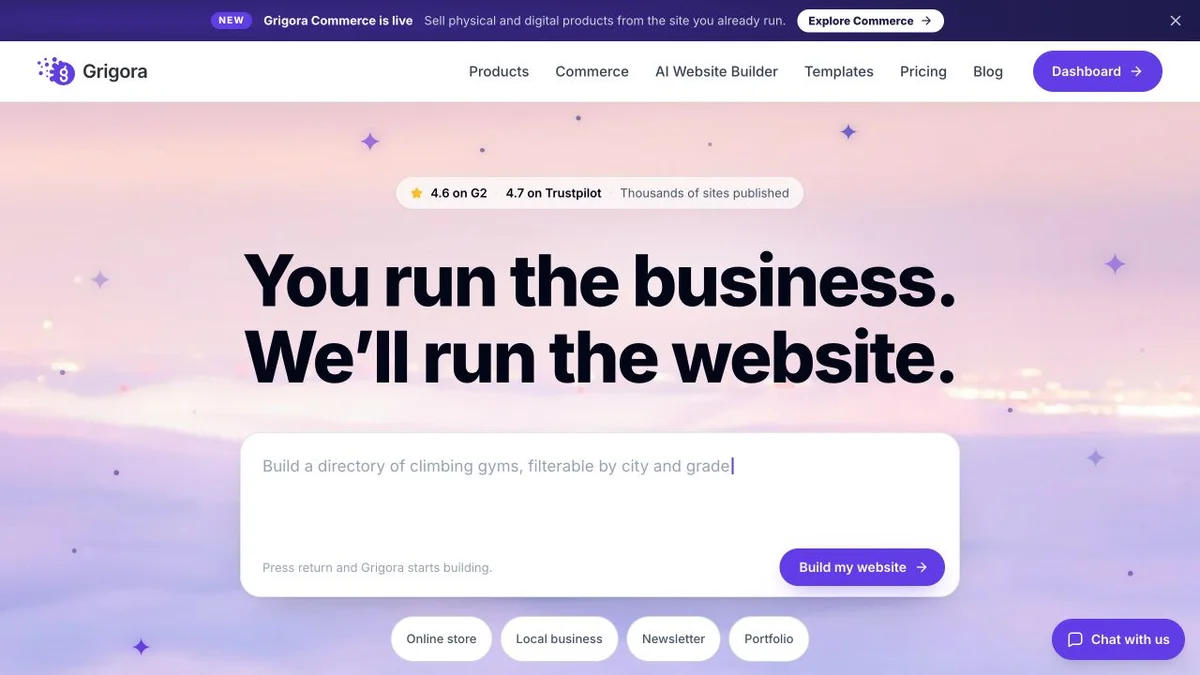
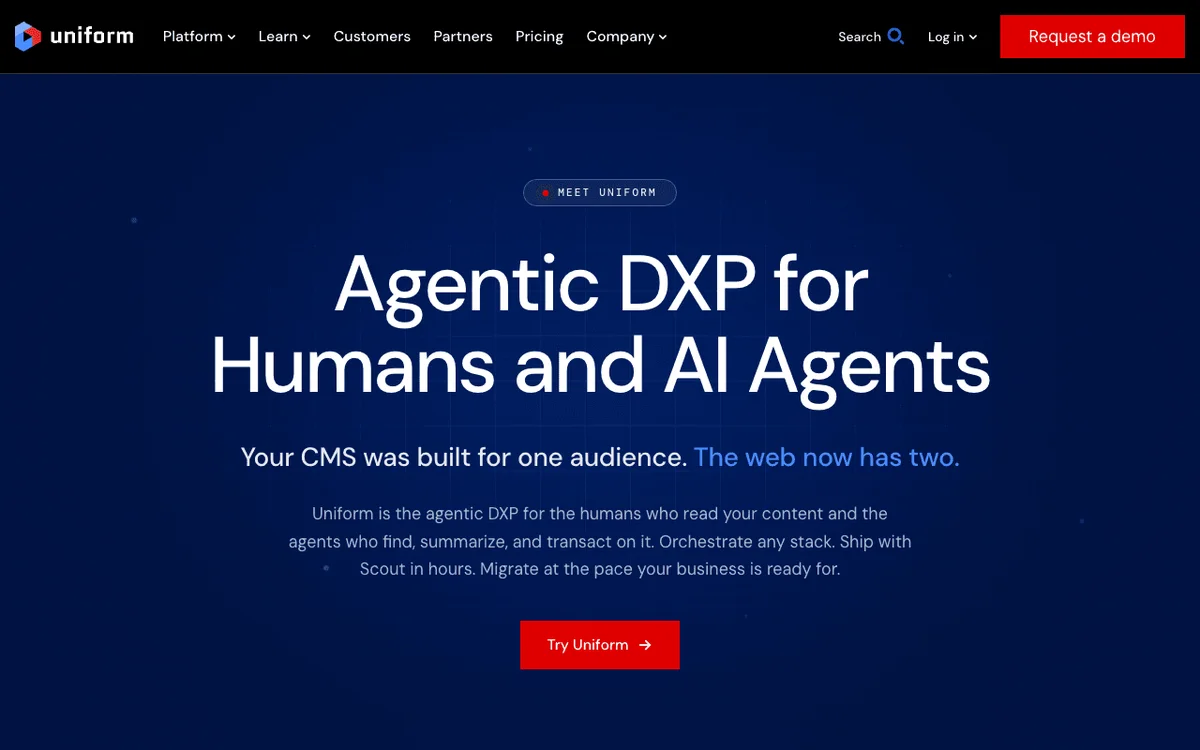
These captures show each product’s public website. See the feature and pricing sections for capabilities and plan details.
Is Grigora the right Uniform alternative for you?
Where Grigora is a suitable Uniform alternative, by use case.
Best Uniform alternative for teams with one system, not five
If your content, your products and your subscribers could all live in the same place, an orchestration layer is solving a problem you do not have yet.
… for companies that need the site live this month
Uniform starts working once a developer has built and deployed the application it composes into. Grigora starts with a description of the business and a first-draft site.
… for marketing teams without a platform engineer
Canvas, Mesh and edge middleware are developer concepts. If nobody on staff owns a CDN pipeline, the layer has nowhere to sit.
Uniform is the right call if…
You already run a headless or legacy CMS, a commerce engine and a customer data platform, you have developers maintaining a front end on your own CDN, and you need edge-side personalization, scheduled releases and approval workflows across all of it. That is a real problem and Grigora does not solve it.
Which one is right for you?
Choose Grigora if…
- You have one content source, not a portfolio of them
- You want a published price and a card, not a quote
- The front end, hosting and CDN should come with the platform
- You need a store and a subscriber list without two more vendors
- Nobody on the team wants to own a deployment pipeline
Choose Uniform if…
- •Several best-of-breed systems already hold your content and products
- •You need edge-side personalization and experiments across them
- •Releases, workflows, editions and SSO describe how you publish
How to switch from Uniform to Grigora
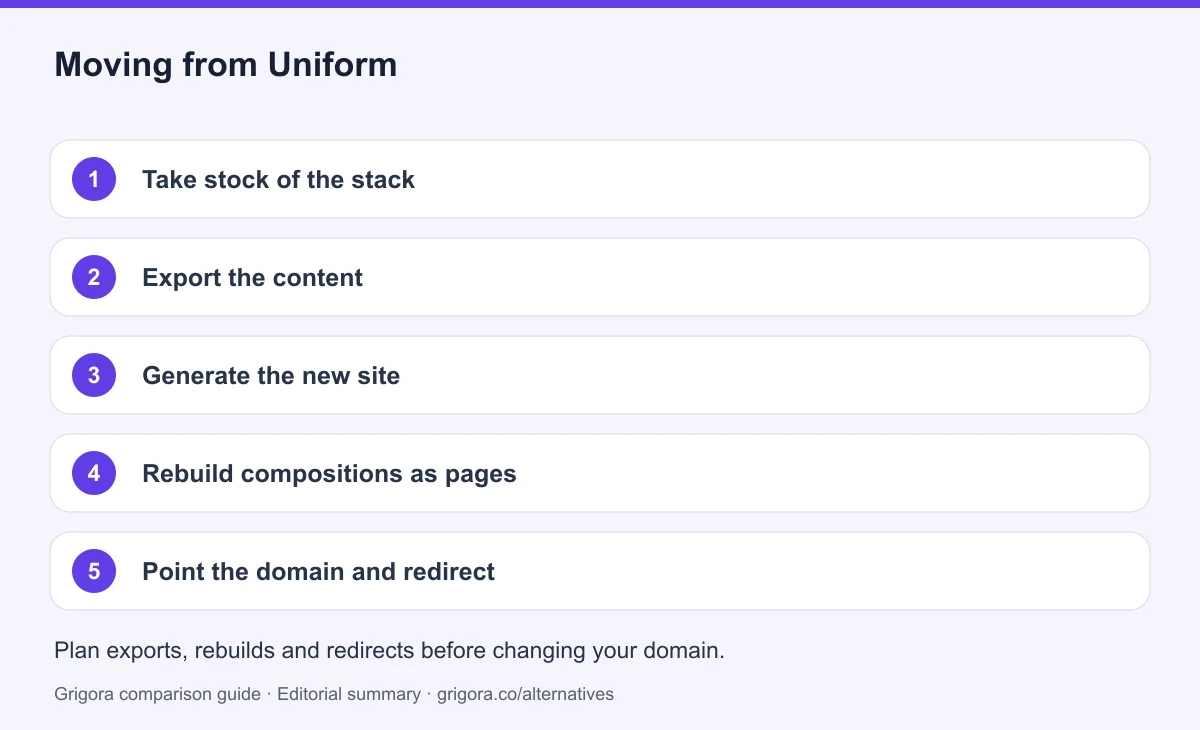
Uniform content is typed and delivered by API, so the material itself moves cleanly. The harder part is deciding which of the systems Uniform was joining together you still need afterwards. Before moving everything, test a representative content export and check supported import formats. Keep media backups, reconcile product variants and retain subscriber consent and unsubscribe records; an export does not guarantee a direct import.
- 1
Take stock of the stack
List every system Uniform composes from. Anything that only existed to feed the layer, rather than to run part of the business, is a candidate to retire with it.
- 2
Export the content
Pull entries, content types and assets through Uniform's APIs and SDKs while the subscription is live, including anything sitting in draft.
- 3
Generate the new site
Describe your business in a sentence and Grigora produces a first-draft site with pages, layout and copy, then edit it block by block or start from a website template.
- 4
Rebuild compositions as pages
Most compositions collapse into a page plus a collection. Import posts into the CMS, products into the store, and subscribers into the built-in newsletter.
- 5
Point the domain and redirect
Keep the old service active while you test the new site. Match existing URL paths or configure permanent redirects, verify canonicals and the sitemap, and test forms and checkout on mobile. Change DNS after these checks, then monitor indexing and errors before cancelling services you no longer need. Rankings may change during a migration.
Why people look for a Uniform alternative in 2026
Uniform is not mis-sold in the way some enterprise software is. Its own site is unusually clear about what it is: a vendor-agnostic orchestration and visual editing layer that sits above the systems you already own, leaving the application layer to you. Named customers include TELUS Digital, Sainsbury's and Taxfix, and the product is built for the way organisations of that size actually work. The reason people end up searching for an alternative is simpler than dissatisfaction. They read the pricing page, count the systems they would need underneath it, and realise the shape of the product does not match the shape of their company.
The layer assumes the stack
Every strength Uniform has is relational. More than 70 pre-built integrations are only valuable if you run several of those systems. Composing one page from a CMS, a commerce engine, a DAM and a customer data platform is only valuable if those four things exist and are staying. Bring your own API is only valuable if you have an API. A company whose content lives in one place is buying a join with nothing on either side of it, and paying more for the join than for the parts.
One price is published, and it is a floor
The pricing page, read on 11 September 2026, carries a single number: Starting at $12,000 USD a year for Lite. Professional, Enterprise and the standalone personalization and A/B testing package are all Contact us, and so, despite having a figure attached, is Lite. There is no free tier, no self-serve checkout and no published monthly billing. The route in is a requested trial account or a demo, and the trial page itself carries no trial terms at all. For a buyer who wants to compare four platforms in an afternoon, that is where the comparison stops.
Nothing renders on day one
Uniform ships no front end. The composable DXP page puts it plainly: your frameworks, your CDN, your CI/CD, and the application layer stays yours. So there is no hosting, no domain management, no templates and no themes. Before a marketer can use the visual workspace at all, a developer has to build an application, register the components that can be composed into it, deploy it and wire up edge middleware. One third-party review site puts developer ramp-up on the core concepts at roughly one to two weeks, before the build starts. If the deadline is a launch rather than a replatform, that sequence is the wrong way round.
How Grigora compares
Grigora is built on the assumption Uniform does not make: that there is nothing to orchestrate. The website, the CMS, the subscriber list and the store are one product with one login and one bill. There are no integrations to count because there is only one system, and nothing has to be joined to anything. That is a smaller idea than a composable DXP, and for most companies it is the accurate one.
One subscription instead of a layer plus a stack
Starter is $12 a month billed annually and includes the site and its hosting, CDN and SSL, the CMS with posts, categories, directories and moderated comments, a newsletter with 2,500 subscribers, a store with 0% platform commission on Stripe or Razorpay, and 15,000 AI credits. Business is $45 a month for five sites, 25,000 subscribers and 250,000 credits. Against those figures, Uniform's published floor of $12,000 a year buys one production project, one integration, two locales, entry and asset counts described only as Limited, no AI, and no rendered page until somebody builds the application it composes into. Professional and Enterprise, which is where releases, editions, SSO and Scout live, have no published price at all.
Where Uniform is still the better buy
Three things, and they are not small. First, orchestration itself: if a legacy CMS, a commerce engine, a DAM and a customer data platform are all staying, Uniform puts one visual editing layer across them and lets you migrate at your own pace instead of replatforming in one go. Grigora cannot do any part of that. Second, personalization and A/B testing chosen in CDN edge middleware rather than in client-side JavaScript, which can reduce visible layout changes associated with some browser-side experiments; Sainsbury's is cited on Uniform's own pricing page reporting a 5.9% conversion rate improvement from one experiment. Grigora has no experimentation product whatsoever. Third, enterprise content operations: releases that schedule a coordinated batch of changes, workflows with approval stages bound to content types, editions for market-specific versions, locale management and single sign-on, with unlimited users listed on every DXP plan. If your publishing process has stages and sign-offs, Uniform models it and Grigora does not. This page is for the reader whose publishing process is one person deciding the page is ready.
Frequently asked questions
Grigora is a Uniform alternative only when the requirement is a simpler managed website with content, email and commerce. Uniform is designed for teams composing experiences across an existing technology stack, with personalisation and orchestration. If those capabilities are required, Grigora is not a like-for-like replacement.
Uniform publishes exactly one figure. The Lite tier of its composable DXP is listed as Starting at $12,000 USD a year, read from uniform.dev/pricing on 11 September 2026. Professional, Enterprise and the standalone personalization and A/B testing package are all Contact us, so no figure for those tiers is public. There is no free plan, no self-serve checkout and no monthly billing option published anywhere on the page.
No. Uniform's composable DXP page states that your frameworks, your CDN and your CI/CD stay yours and that the application layer belongs to you. There is no hosting, no CDN, no domain management and no templates or themes. Developers build and deploy the application, register components for it and configure edge middleware before the visual workspace is usable. Grigora includes hosting, CDN, SSL and website templates on every plan.
Not directly. Uniform has no cart, checkout, payments, tax, shipping or product catalogue; its commerce integrations page presents it as a content and experience layer over an engine such as Shopify, BigCommerce or commercetools that you license separately. There is no email sending, campaign builder, automation or contact list either, and no forms product is documented. Grigora includes the store, with 0% platform commission, and the newsletter on every paid plan.
No. The pricing grid lists Agentic AI, the Scout agent, on Enterprise and AI Copilot on Professional. Neither appears on Lite, which is the only tier with a published price. Scout runs on AI credits included with plans and consumed as it works, and the allocations are agreed with sales rather than published, so treat AI usage as metered. Whether Scout can be bought as an add-on at lower tiers is not stated.
Orchestration of external systems, edge-side personalization and A/B testing, scheduled releases, approval workflows, editions, deep locale management and single sign-on. Grigora covers the ground a single company usually needs, including AI site generation, a full CMS with directories and moderated comments, email marketing, a store with no platform commission, and free SEO tools, but it is one system rather than a layer across several.
Sources and comparison method
Published by Grigora, one of the products compared here. This is a comparison of public product documentation and published plans. Recommendations reflect the use cases described; they are not independent performance benchmarks. Homepage screenshots show how each product presents itself and do not establish feature availability.
Check the billing term, currency, regional availability, usage limits and add-ons before purchasing. A content export does not necessarily include the design, integrations or a working store. Migration steps need testing on your own site.
- Uniform pricing
Primary source for the product, plan or migration scope discussed in this comparison.
- Uniform official documentation
Primary source for the product, plan or migration scope discussed in this comparison.
- Grigora pricing and plan limits
Annual and monthly billing, free trial, page/bandwidth/storage allowances, support and optional services.
Grigora references: plans and limits, commerce, MCP access, and help documentation.
Compare Grigora with other platforms



Make the switch from Uniform to Grigora
Build your site, newsletter and online store in one place, with a published price, hosting included and nothing to orchestrate. Try Grigora free, no credit card required.
14-day free trial • No credit card required • Cancel anytime