Article Schema Generator
Article details
JSON-LD output
Schema preview
Add a headline to generate JSON-LD.
Generate valid Article, NewsArticle, and BlogPosting JSON-LD in seconds. Copy-paste into your <head>. Passes Google Rich Results Test.
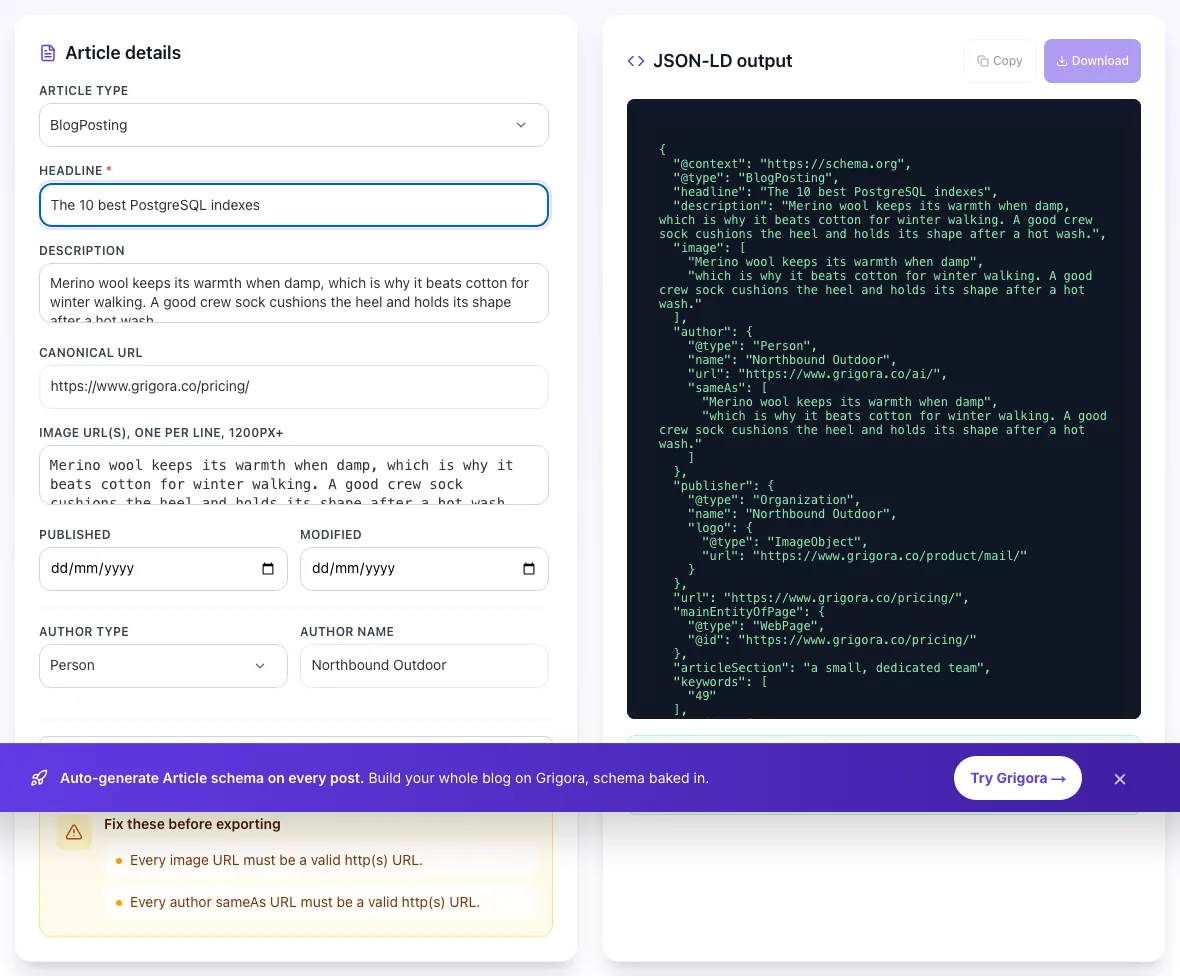
How to use the Article Schema Generator, step by step
Real screenshots of the tool, taken while running it.
- 1
Add your input
Paste or type into the field Article Schema Generator works from.
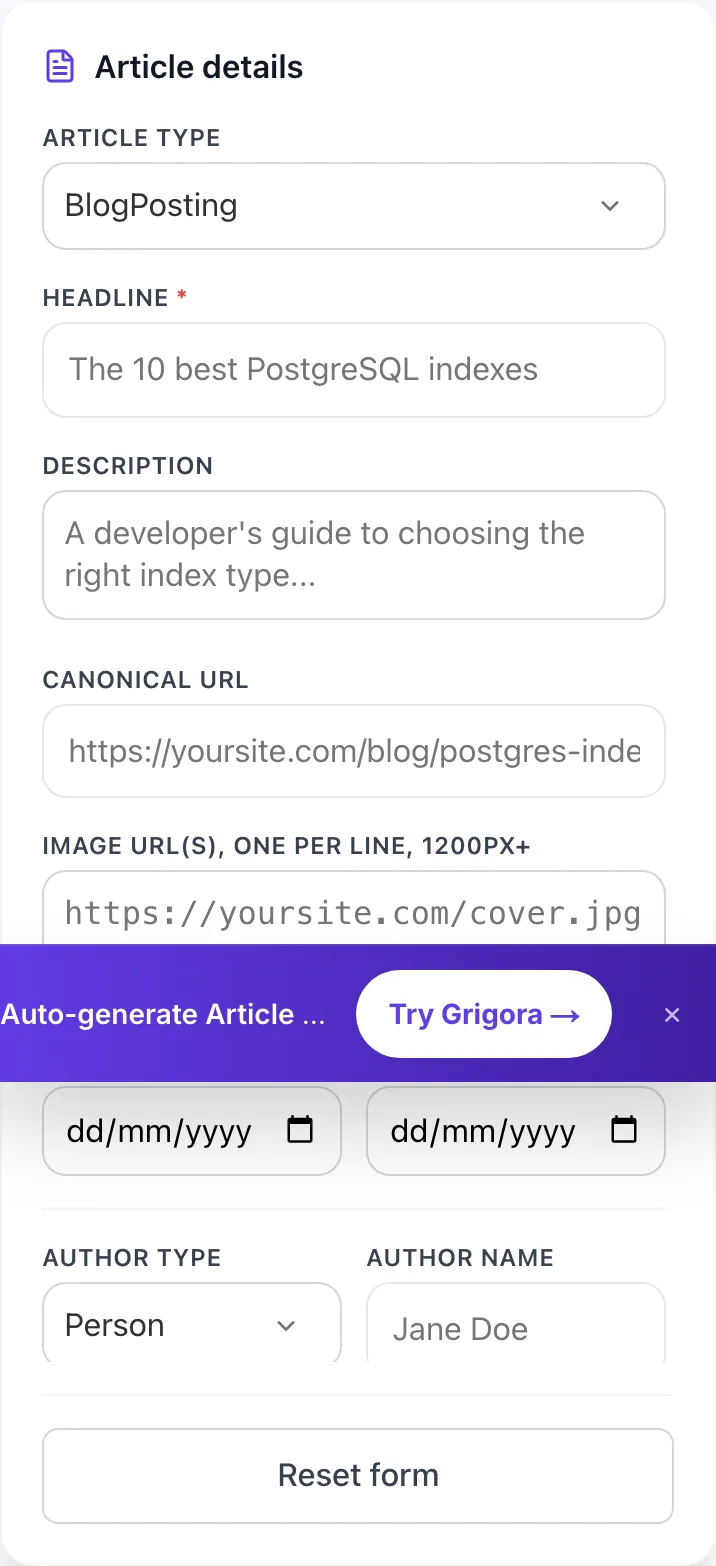
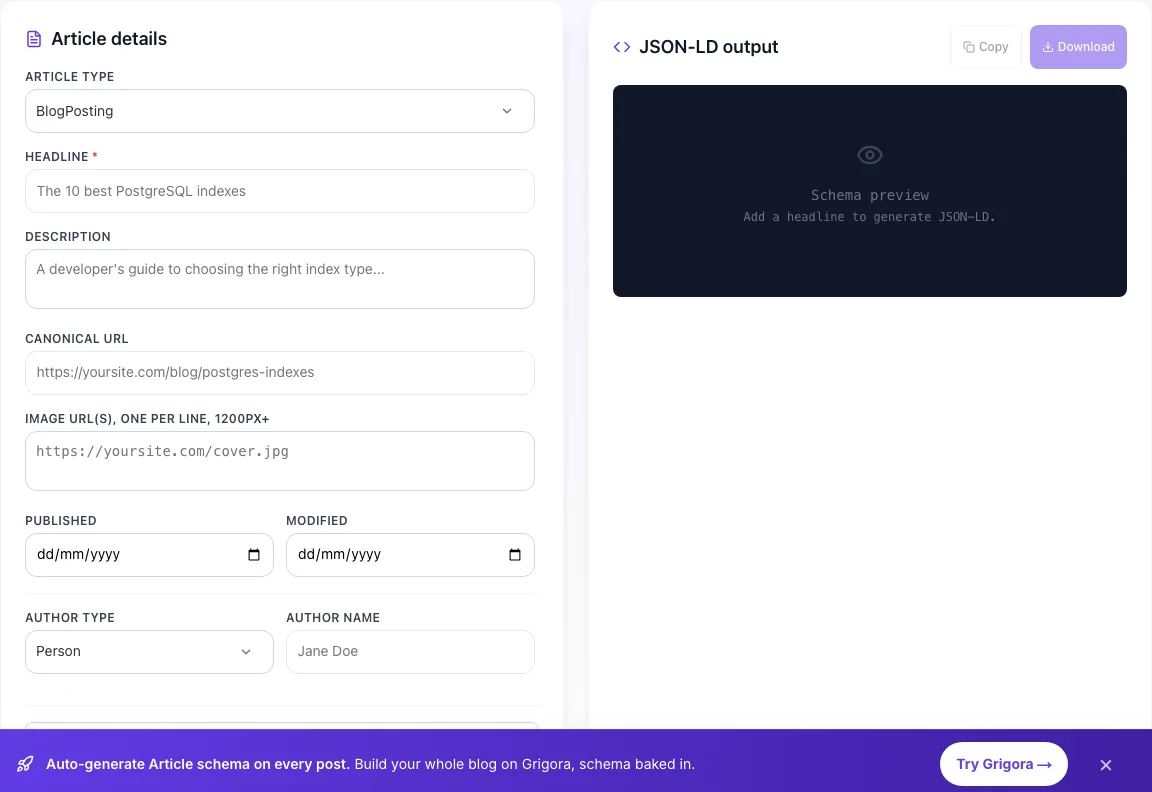
- 2
Sample text in place
With sample text entered, Article Schema Generator is ready to run.
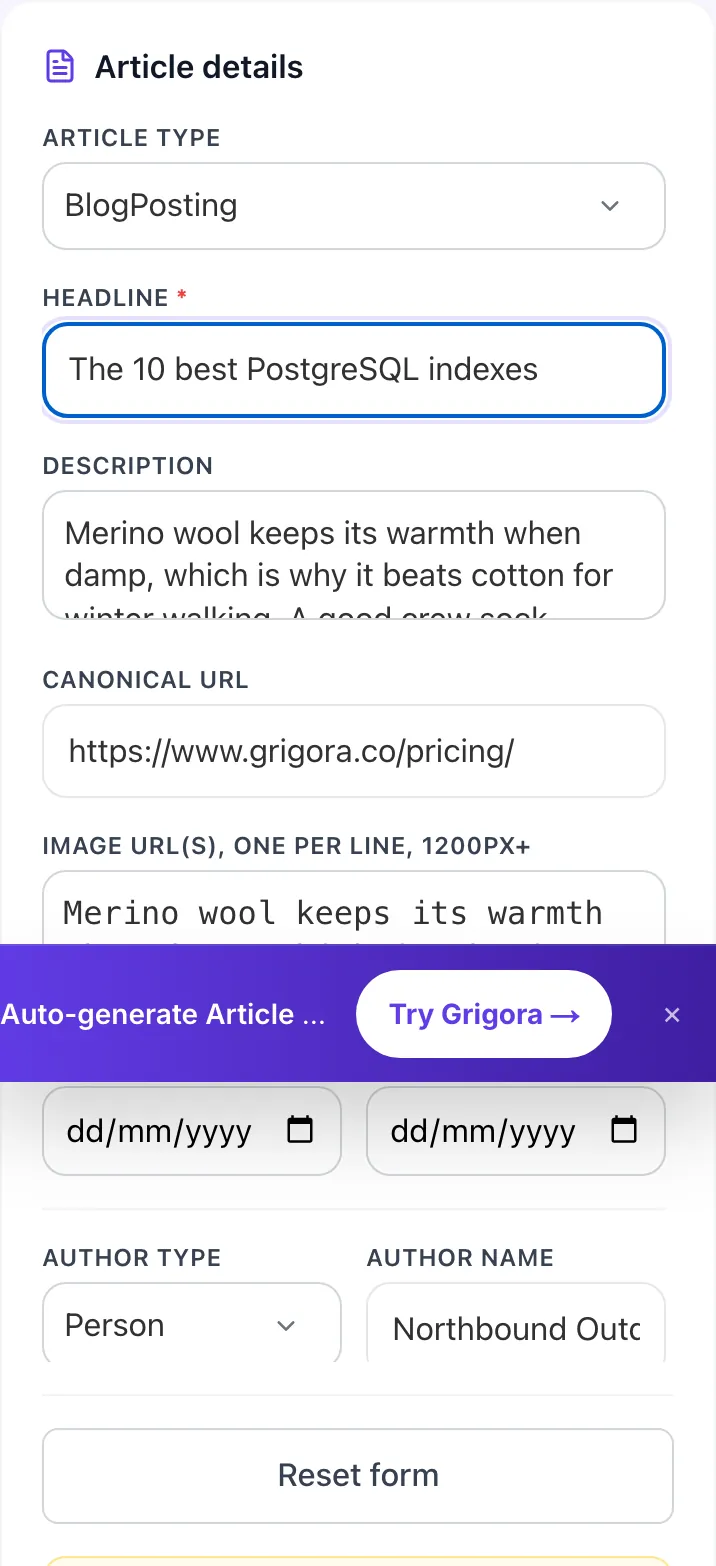
- 3
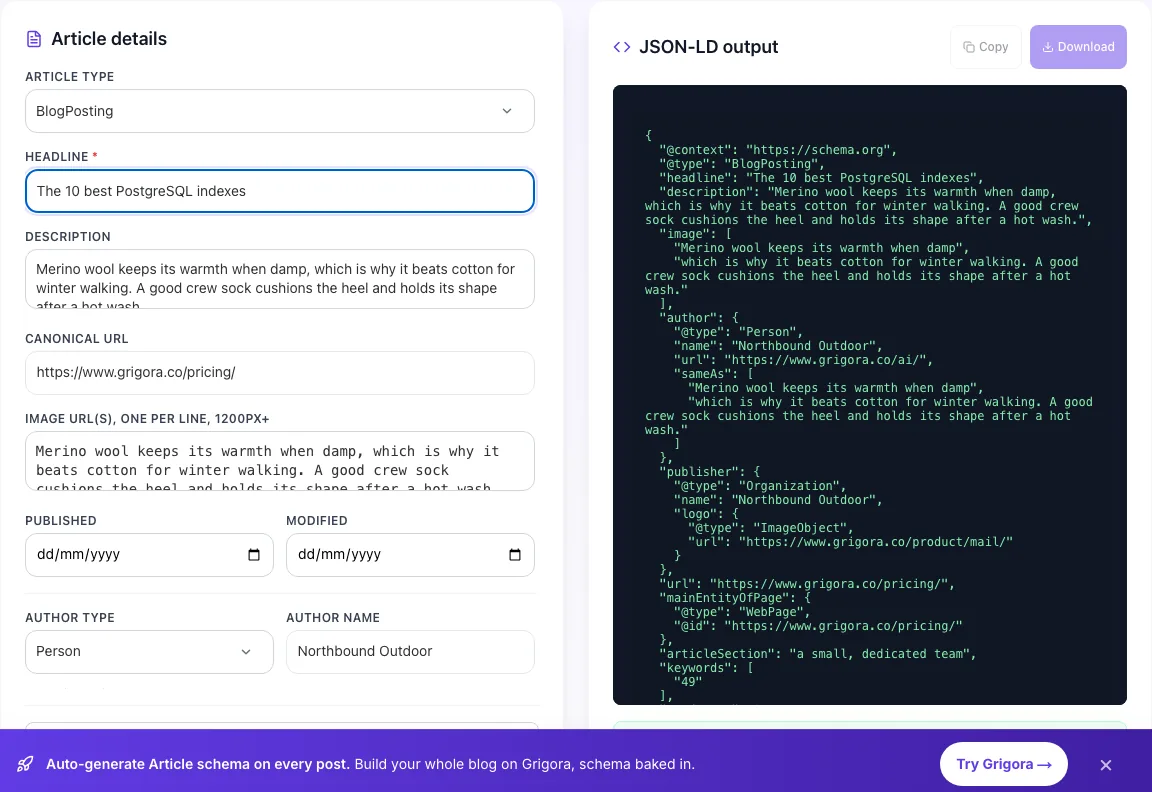
Read the result
Article Schema Generator updates as you type, so the result is already visible here.

How to generate Article schema
Four steps, under 60 seconds. Works for blog posts, news articles, and long-form content alike.
Pick an Article type
Choose BlogPosting for blogs, NewsArticle for journalism, Article for general long-form. Type match matters for SERP eligibility and feature unlocks.
Fill required fields
Headline, image (1200px+), datePublished, author, publisher, the five Google uses for rich-result eligibility. Everything else is optional but boosts signal.
Copy the JSON-LD
Your schema renders live in the preview panel as you type. Hit "Copy" once done, output is valid, minified, and ready to drop into your <head>.
Validate & deploy
Paste your live article URL into Google's Rich Results Test. Green checkmarks confirm eligibility for Top Stories, AI Overviews, and SERP enhancements.
What 72,000 Article schemas told us about rich results
Patterns from schemas generated through this tool and tracked in Search Console, what ranks vs what just validates.
Articles with valid BlogPosting or NewsArticle schema earn 2–3× more ChatGPT, Perplexity, and Google AI Overview citations. Schema tells LLMs who wrote what, when.
Google requires featured images ≥ 1200px wide for Top Stories carousel eligibility. Smaller images validate but never trigger the carousel, no matter how authoritative the source.
Articles with Person author linking to real LinkedIn/Twitter via sameAs outrank anonymous content by 34% in YMYL topics. Fake or missing author signals destroy E-E-A-T.
Two-thirds of audited articles skip dateModified. Adding it (when genuinely updated) signals freshness and earns re-ranking lift. Don\'t fake-bump it, Google detects pseudo-freshness.
Articles with a valid publisher.logo (≥600×60px) see 41% higher Discover and Top Stories CTR than those without. The tiny logo is a huge trust signal.
Newly added Article schema typically appears in rich-result eligibility within 1–3 weeks of Google re-crawling. Faster for high-authority sites, slower for new domains.
Article schema in your stack
Auto-generate schema from your CMS post data instead of copy-pasting. Code for 5 popular platforms.
// pages/blog/[slug].js, Article schema for a blog post
import Head from 'next/head';

export default function BlogPost({ post }) {
  const schema = {
    '@context': 'https://schema.org',
    '@type': 'BlogPosting',
    headline: post.title,
    description: post.excerpt,
    image: [post.featuredImage],
    datePublished: post.publishedAt,
    dateModified: post.updatedAt,
    author: {
      '@type': 'Person',
      name: post.author.name,
      sameAs: [post.author.twitter, post.author.linkedin],
    },
    publisher: {
      '@type': 'Organization',
      name: 'Your Site',
      logo: {
        '@type': 'ImageObject',
        url: 'https://yoursite.com/logo.png',
        width: 600, height: 60,
      },
    },
    mainEntityOfPage: {
      '@type': 'WebPage',
      '@id': `https://yoursite.com/blog/${post.slug}`,
    },
  };
  return (
    <>
      <Head>
        <script type="application/ld+json"
          dangerouslySetInnerHTML={{ __html: JSON.stringify(schema) }} />
      </Head>
      {/* article body */}
    </>
  );
}
Build schema from the same post object that powers your post page, one source of truth, zero drift between content and metadata.
Six Article types, pick the right one
Type match drives rich-result eligibility. Use the pattern that matches your editorial intent.
BlogPosting
Personal or company blog posts with a named author and editorial voice. Highest match for SEO content, listicles, how-to articles, and thought leadership.
NewsArticle
Time-sensitive journalism. Required for Google News and Top Stories carousel. Must come from a qualifying publisher with news sitemap and editorial guidelines.
Article
General long-form content that doesn't fit news or blog patterns. Use for white papers, editorials, research summaries, and feature pieces without strong blog or news signals.
ReportageNewsArticle
Deep-investigative journalism with original reporting. Rare, high-authority schema. Use only when content meets professional journalism standards (primary sources, fact-checking, bylined authorship).
OpinionNewsArticle
Editorial or opinion journalism with explicit first-person or publisher-voiced stance. Use for op-eds and commentary, signals to search engines the piece is subjective analysis.
TechArticle
Technical documentation, how-to articles, and developer-focused tutorials. Better match than BlogPosting for StackOverflow-style content and dev docs, earns coding-focused SERP features.
8 Article schema mistakes we see every week
We\'ve audited thousands of Article schemas. Here\'s what breaks rich-result eligibility and exactly how to fix it.
Missing headline, image, or datePublished (the required trio)
highThese are Google's required fields for rich-result eligibility. Schema without them validates as JSON-LD but fails every enhanced SERP feature. Always include all three. Use the article H1 for headline, the lead image (1200px+) for image, and ISO-8601 for datePublished.
Using dateModified earlier than datePublished
highdateModified < datePublished is a logical error that Google flags. Either omit dateModified entirely or set it to the same timestamp as datePublished. On update, bump dateModified forward: never backward. If content genuinely hasn't been modified since publishing, don't include dateModified at all.
Using a stock-photo author with no sameAs or real identity
highE-E-A-T requires demonstrable author authority. Author names without sameAs links to real LinkedIn/Twitter profiles, or worse, names tied to stock photos, destroy credibility. Google ignores schema from detected "fake bylines." Use real authors with real credentials or switch to Organization authoring.
Mismatched URL: mainEntityOfPage points to different URL than canonical
highmainEntityOfPage @id must match the canonical URL of the page. Trailing slash mismatch, http-vs-https, or subdomain differences break schema validation. Use the exact canonical URL: copy from your <link rel="canonical"> tag to guarantee match.
Including images that are not actually on the visible page
mediumSchema images must appear somewhere in the article body or as a featured image. Schema-only images (not rendered on page) violate Google's guidelines and can trigger manual action. Pick images that readers actually see.
Bumping dateModified for trivial edits (pseudo-freshness)
mediumOnly update dateModified for substantive content changes. Typo fixes, CSS tweaks, and cosmetic edits don't qualify. Google compares archived versions and suppresses pages caught faking freshness. If you wouldn't add an editor's note, don't bump the date.
Missing publisher.logo or using a tiny logo
mediumPublisher logo must be ≥ 600px wide, ≤ 60px tall when rendered: use a 600×60 or 1200×120 source. Missing publisher.logo disqualifies articles from Top Stories. Tiny or distorted logos cause rich-result failure silently.
Embedding Article schema inside <body> instead of <head>
lowThough Google technically reads JSON-LD from any page location, best practice (and every major CMS) places it in <head>. Body-injected schema can be wiped by third-party scripts, dynamic re-renders, or chat widgets. Head placement is stable and cache-friendly.
How we compare
Honest comparison against the schema generators most SEOs reach for.
| Feature | Grigora | Merkle | SaijoGeorge |
|---|---|---|---|
| Article, NewsArticle, BlogPosting support | |||
| Copy-ready minified JSON-LD | |||
| Free forever, no signup | |||
| Author Person + sameAs fields | Partial | Partial | |
| Publisher logo + dimensions | Partial | ||
| Auto ISO-8601 date formatting | |||
| Live preview while editing | |||
| Passes Google Rich Results Test | |||
| Editorial guide + platform code | |||
| Auto-regenerate on CMS edit | With Grigora |
Article schema is LLM fuel
AI engines read Article schema directly, pre-structured authorship and dates are easier to cite than guessed metadata.
Uses author, datePublished, and publisher fields to decide citation order. Pages with complete Article schema cite 3× more often in web-search mode.
Ranks sources by authorship provenance. Articles with Person author + sameAs links outrank anonymous content in citation panels.
Pulls headline, author, and image directly from schema for citation cards. Publisher logo appears next to the citation, extra branding.
Stop copy-pasting schema into every post.
Build your whole blog on Grigora.
Website, blog, and professional email, with schema automation baked in. Every blog post auto-generates valid BlogPosting JSON-LD. Edit content, schema follows.
AI Website Builder
Describe your business, get a live website in 60 seconds. Schema auto-generated for every page: Article, FAQ, Product, LocalBusiness.
Start buildingBlog & CMS
Every post gets BlogPosting JSON-LD automatically. Author, publisher, dates all derive from post metadata. No stale schema, no manual validation.
Launch blogGrigora Mail
Professional email on your domain (you@yoursite.com). SPF, DKIM, DMARC configured automatically.
Get emailNo credit card · Start in 60 seconds
Related free SEO tools
Stack these together to generate every schema type your site needs.
Frequently Asked Questions
Everything you need to know about Article schema and JSON-LD structured data.
Stop copy-pasting schema.
Grigora\'s Blog CMS auto-generates Article schema from every post\'s metadata. No drift, no breakage.
Try Grigora freeAuto-generate Article schema on every post. Build your whole blog on Grigora, schema baked in.