
A Gatsby alternative when you need a running website, not a React build
Gatsby is a free React framework for custom websites, with a GraphQL data layer and multiple rendering modes. Grigora is an alternative for teams that want a managed editor, CMS, newsletter and store from $12/mo billed annually.
Published by Grigora · Updated · Sources and method
Is Grigora the right Gatsby alternative?
Grigora is a Gatsby alternative when a team wants a managed website, CMS, newsletter and store without maintaining a React build. Gatsby remains useful for custom rendering, GraphQL data sourcing and code ownership. Existing Gatsby sites can support nontechnical editors through a CMS integration, so compare the actual workflow before replacing the framework.
Choose Grigora if you want…
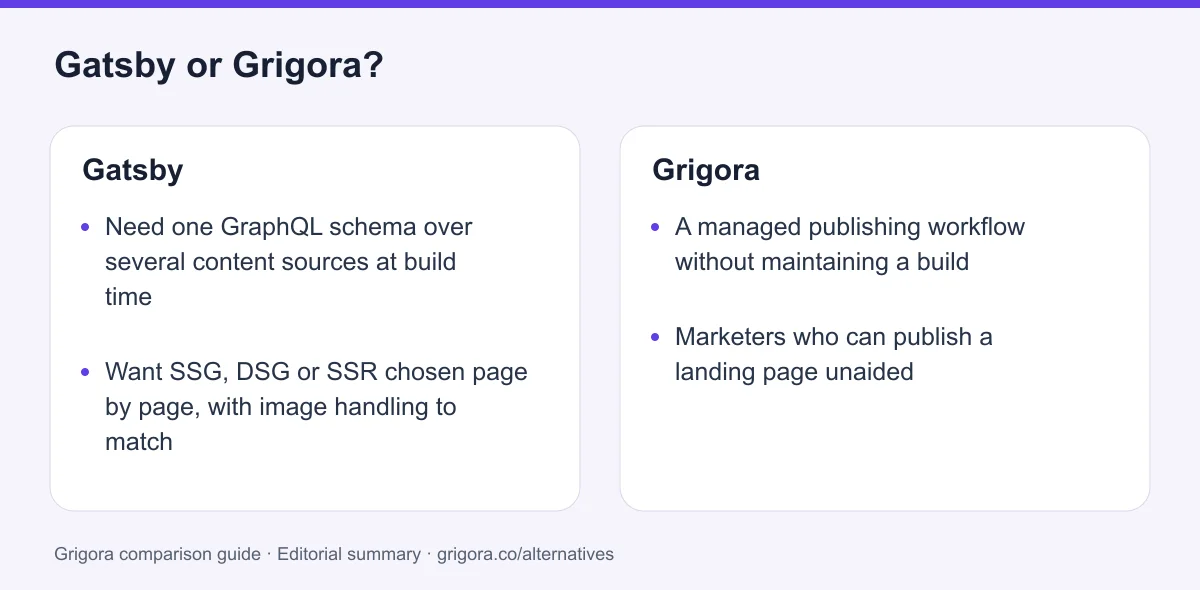
- A managed publishing workflow without maintaining a build
- Marketers who can publish a landing page unaided
- A subscriber list and campaigns in the same subscription
- A store with catalogue, variants and stock already wired up
- One bill instead of a host, a CMS, an email tool and a payments build
Stick with Gatsby if you…
- •Need one GraphQL schema over several content sources at build time
- •Want SSG, DSG or SSR chosen page by page, with image handling to match
- •Have React developers, a Git review process and somewhere to host
Gatsby or Grigora: the decision in one view
Gatsby alternatives at a glance
How Grigora and the other platforms in Gatsby's orbit compare on the essentials.
Swipe the table sideways to see every column
| Platform | Best for | Free access | Starting price | Sales fees | Data and site portability |
|---|---|---|---|---|---|
| Grigora | Managed site, CMS, newsletter and store | Free trial | From $12/mo billed annually | 0% platform fee; Stripe/Razorpay fees apply | Posts/content; rebuild design |
| Gatsby | React sites with a GraphQL content mesh | Framework is free (MIT) | Free, hosting billed separately | No store to take one | Yes |
| Next.js | React apps and marketing sites together | Framework is free (MIT) | Free, hosting billed separately | No store to take one | Yes |
| Astro | Content sites with minimal JavaScript | Framework is free (MIT) | Free, hosting billed separately | No store to take one | Yes |
| Eleventy | Markdown-first static sites | Framework is free (MIT) | Free, hosting billed separately | No store to take one | Yes |
| Webflow | Designer-grade builds with a CMS | Yes | From $15/mo | 0% except 2% Ecommerce Standard; processing extra | Static code on eligible Workspace; CMS/store separately |
Checked September 2026. Gatsby, Next.js, Astro and Eleventy are free open-source frameworks; the bill is hosting, a CMS, a developer and every service you bolt on. Verify current pricing on each provider's site.
Sources for the overview table
- Grigora: official reference 1
- Webflow: official reference 1, official reference 2
Why people switch from Gatsby to Grigora
The friction Gatsby teams hit most often once the site is live, and how Grigora handles it.
The marketing calendar runs at the speed of your deploy queue
If a Gatsby implementation keeps content in code, routine changes may wait for a developer. A connected CMS can improve that workflow; Grigora includes an editor without a separate integration.
The vendor you signed up with is not there any more
Netlify acquired Gatsby Inc. in February 2023, Gatsby Cloud was wound down and the Valhalla Content Hub was discontinued. gatsbyjs.com/pricing, /dashboard and the Valhalla product page all redirect to Netlify today. There is no Gatsby support tier left to buy.
Who maintains the build
The latest stable npm release is 5.16.1 from February 2026, and the repository remains active. Check your dependency update and support plan rather than assuming what a future release will contain.
The bill is five bills
Host, headless CMS, email platform, forms backend, payments integration, analytics. Each one is a login, an invoice and an integration to keep working. Grigora collapses them into a single plan that starts at $12/mo.
What Gatsby does well
- A GraphQL data layer that unifies a CMS, Markdown, APIs and databases at build time
- Per-page choice of static, deferred static or server rendering
- gatsby-plugin-image produces responsive, correctly sized images for LCP and CLS
- MIT licensed, code and build output entirely yours, hostable on a compatible runtime
Where Gatsby falls short
- Core has no visual editor; a CMS integration supplies the editorial interface
- Hosting, newsletter and commerce services need configuration or integration
- Latest release is 5.16.1 from February 2026, with no next major announced
- Every paid Gatsby product was retired after the Netlify acquisition
Grigora vs Gatsby at a glance
The differences that decide whether you are buying a website or building one.
| Feature | Gatsby | Grigora |
|---|---|---|
| Starting cost | Free framework, every service billed separately | $12/mo all in |
| Visual editor | No | Yes |
| Publish a page without a developer | No | Yes |
| Hosting included | Netlify or any static host, billed separately | Yes |
| CMS in the box | Bring your own: Contentful, WordPress, Markdown | Built in |
| Newsletter and subscriber list | No | Included |
| Online store | Stripe or gatsby-source-shopify, coded by you | Built in, 0% commission |
| Per-page rendering mode | SSG, DSG or SSR per page | No |
| Free SEO tools suite | No | Free tools |
Grigora vs Gatsby: feature by feature
A category-by-category breakdown, pricing, AI, design, e-commerce, email, SEO, performance, and support.
Changing a headline: a commit or a click
Depends on your needsGatsby itself does not include an editorial dashboard. A site can source content from an existing CMS, including free or self-hosted options, and automate publication through build or revalidation workflows. Without that integration, content may live in code or Markdown. Grigora includes a CMS directly.
| Feature | Grigora | Gatsby |
|---|---|---|
| Visual page editor | Built in | No |
| Who can change a headline | Anyone with a login | CMS editor or developer, depending on setup |
| Route from edit to live | Save, then publish | CMS publishing or code/build workflow |
| New landing page without a developer | Yes | Possible with configured CMS/templates |
| Editing from a phone | Yes | No |
Takeaway: Audit the existing authoring and deployment workflow; a Gatsby site does not inherently require every headline edit to be written by a developer.
The GraphQL data layer and the content mesh
Fit: GatsbyThis is Gatsby's genuine engineering achievement and the honest reason to keep it. Source plugins pull a headless CMS, local Markdown and MDX, REST endpoints, databases and spreadsheets into a single GraphQL schema at build time, and pages are rendered from queries against it. Grigora can only render content that already lives inside Grigora.
| Feature | Grigora | Gatsby |
|---|---|---|
| Content from several systems on one page | No | Yes, unified GraphQL schema |
| Keep the system of record elsewhere | No | Yes |
| Markdown and MDX in the repository | No | Yes |
| Query builder over all content | Collection templates | GraphQL, with a schema explorer |
| Pull from an existing headless CMS | No | Contentful, WordPress, Drupal and dozens more |
Takeaway: If the business keeps its content in four systems and refuses to move it, Gatsby is the right tool and Grigora is not.
Render modes, gatsby-plugin-image and Core Web Vitals
Depends on your needsGatsby gives a developer real control over how a page is produced and how it loads. You pick static generation, deferred static generation or server rendering per page, and gatsby-plugin-image emits responsive srcsets in modern formats with explicit dimensions and low-quality placeholders, which attacks LCP and CLS directly. Grigora's delivery is managed and fast, but it is one output and you do not tune it.
| Feature | Grigora | Gatsby |
|---|---|---|
| Rendering mode chosen per page | No | SSG, DSG or SSR |
| Image pipeline you can configure | Automatic | StaticImage and GatsbyImage |
| Route prefetching | Managed | Built into the router |
| Control over the JavaScript bundle | No | Yes |
| Effort required to get there | Review content, images and embedded scripts | Developer time |
Takeaway: Gatsby exposes rendering and image configuration. Actual Core Web Vitals depend on implementation; this audit did not run comparative benchmarks.
Where the Gatsby product went, and who bills you now
Depends on your needsNetlify acquired Gatsby Inc. on 1 February 2023. Gatsby Cloud was wound down into Netlify, and the Valhalla Content Hub announced in that same release was discontinued. Today gatsbyjs.com/pricing returns a redirect to netlify.com/pricing, /dashboard redirects to app.netlify.com, and the Valhalla product page redirects to Netlify as well. The framework lives on under Netlify stewardship. The vendor relationship does not.
| Feature | Grigora | Gatsby |
|---|---|---|
| A Gatsby price list | Three plans, published | Redirects to Netlify's |
| A Gatsby dashboard | Yours | Redirects to Netlify's app |
| Paid support from the makers | Email; priority, phone and onboarding by plan | No Gatsby tier to buy |
| Hosting sold with the framework | Included | Gatsby Cloud was retired |
| Who you call when it breaks | Grigora support | Community, or your host |
Takeaway: Gatsby Cloud and the open-source framework are separate. Compare the host and support arrangement you would actually use.
Release history and maintenance responsibilities
Depends on your needsThe npm registry still lists Gatsby 5.16.1, published 10 February 2026, as the latest stable release. The repository remains unarchived and received updates in September 2026. Release dates do not establish abandonment or a promised future roadmap. Check the supported version and dependencies for your existing site.
| Feature | Grigora | Gatsby |
|---|---|---|
| Latest release | Continuous, nothing to install | 5.16.1, 10 February 2026 |
| Supported versions | Always current | v5 only; v3 and v2 unsupported |
| Next major version | Not applicable | None announced |
| Who applies security updates | Grigora | You, per dependency |
| Community size | Smaller | Public GitHub and npm activity; not unique users |
Takeaway: Assign responsibility for dependency updates, security fixes and recovery. Avoid predicting future development from release frequency alone.
Selling: gatsby-source-shopify vs a store in the plan
Fit: GrigoraNothing resembling a store ships with Gatsby. There are no products, no cart, no checkout, no stock, no tax and no payment handling. The documentation points you at Stripe for payments and at source plugins such as gatsby-source-shopify to pull an external catalogue in as build-time data. The storefront, the cart state and the checkout are React you write and maintain.
| Feature | Grigora | Gatsby |
|---|---|---|
| Products, variants and stock | Built in | External commerce service or custom implementation |
| Cart and checkout | Built in | React you write |
| Digital downloads | Yes | No |
| Platform commission | 0% | None, because there is no store |
| Payment gateways | Stripe and Razorpay | Whatever you integrate |
Takeaway: Gatsby takes no commission for the same reason it takes no orders.
A React signup form is not a mailing list
Fit: GrigoraGatsby has no email sending, no list, no campaigns, no automations and no documented first-party path to any of them. You can build a beautiful signup form as a React component, and then the address has nowhere to go. The list, the sending, the unsubscribe handling and the deliverability are a separate paid product you buy, wire up and maintain.
| Feature | Grigora | Gatsby |
|---|---|---|
| Subscriber list | 2,500 to 25,000 by plan | No |
| Campaign builder | Included | No |
| Automations and segmentation | Included | No |
| Form submissions stored | Included | Your host's forms add-on or an API you build |
| Professional inbox | From $5/mailbox | Separate provider |
Takeaway: Every newsletter on a Gatsby site is somebody else's product with somebody else's invoice.
SEO: the Head API and hand-written JSON-LD
Depends on your needsGatsby’s Head API, plugins and frontend code can implement metadata, structured data and sitemaps. A connected CMS can expose fields to editors so routine changes do not require code edits. Grigora supplies publishing controls within its managed platform.
| Feature | Grigora | Gatsby |
|---|---|---|
| Per-page title, meta and canonical | Built in | Head API, hand written |
| Sitemap and robots.txt | Automatic | Plugins you install |
| Structured data | Schema controls | JSON-LD you write yourself |
| IndexNow submission | Yes | Not provided |
| Redirect manager | In the dashboard | Host config or gatsby-node |
| Free SEO tools suite | Free tools | No |
Takeaway: Compare controls and test representative pages for crawlable content, accurate metadata and performance. No platform guarantees rankings or citations in AI answers.
MIT licence, the npm ecosystem and lock-in
Fit: GatsbyGatsby is MIT licensed and its source can live in an ordinary Git repository. Static build output is portable to compatible hosts; SSR and DSG need runtime support. Its plugin ecosystem provides extensibility, with maintenance and compatibility checks left to the project. Grigora exports content while website delivery remains managed.
| Feature | Grigora | Gatsby |
|---|---|---|
| Source code ownership | No | MIT, entirely yours |
| Move the site to another host | Content only | The whole build |
| Git branches, reviews and CI | No | Yes |
| Plugin ecosystem | No | Roughly 3,000 npm packages tagged gatsby-plugin |
| Custom features with no ceiling | Custom code injection | Anything React and npm can do |
Takeaway: Gatsby wins ownership outright, though many of those npm packages are unmaintained and the auditing is yours.
Explore Grigora before switching from Gatsby
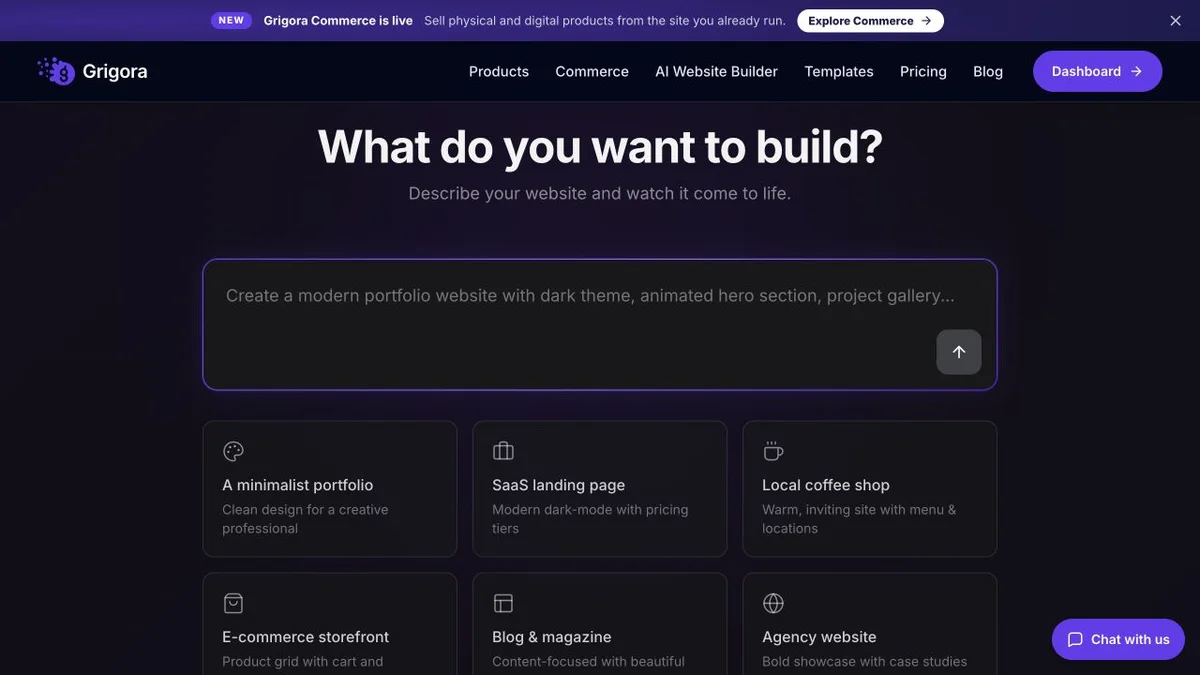
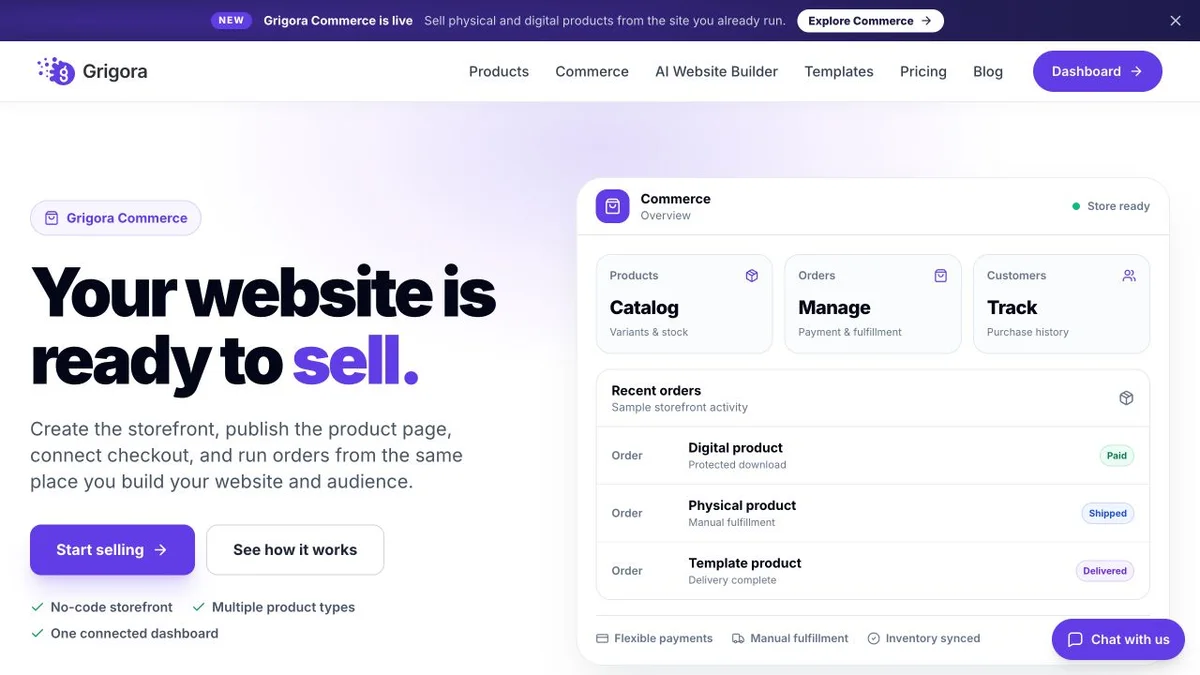
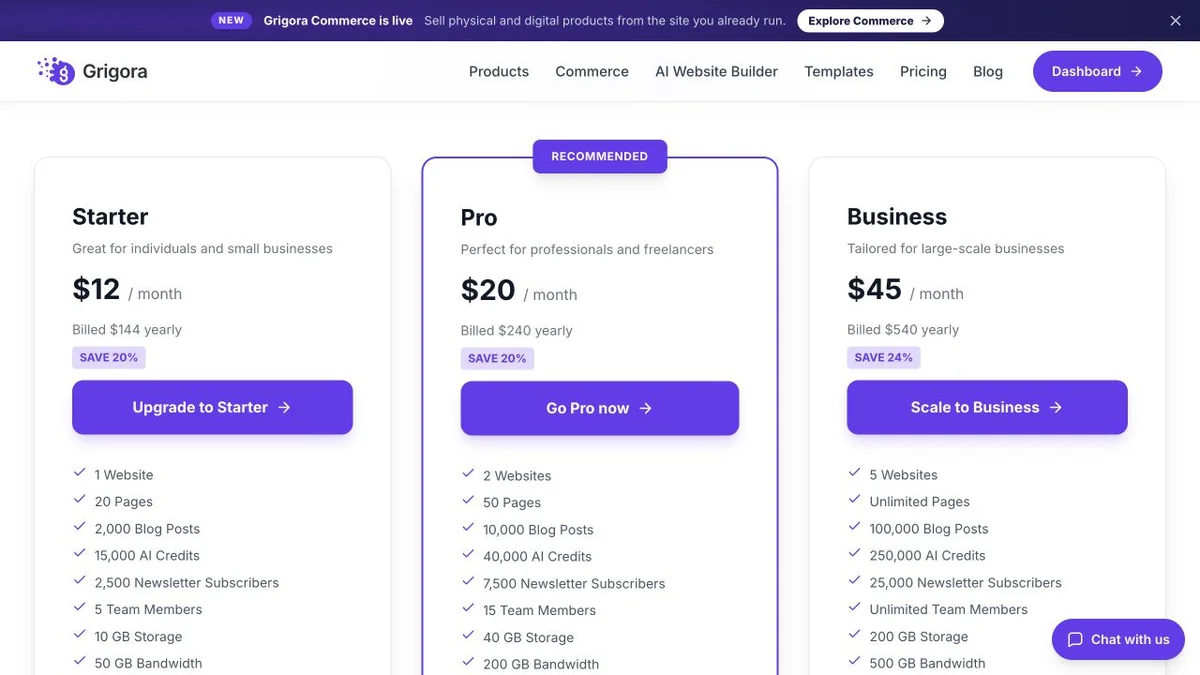
Current public product pages and plans, so you can inspect what you would be moving to. Open any image at full size.
Grigora vs Gatsby pricing
Gatsby itself costs nothing. The comparison is what a working, editable, selling website costs on each side.
Website, newsletter and store in one plan
Annual rates shown. Hosting, CDN, SSL, backups, the CMS, the newsletter and the store are included on every paid plan, with 0% platform commission through connected checkout; processing fees apply. There is also a free trial, and White Label is a separate plan at $199/mo.
Free framework, and gatsbyjs.com/pricing now points at Netlify
Gatsby release and licence data from registry.npmjs.org and the GitHub API, queried 11 September 2026. gatsbyjs.com/pricing returned a 301 redirect to netlify.com/pricing on that date, and the Netlify figures above were read live from netlify.com on 11 September 2026. Monthly prices only: no annual price is published on that page, so none is quoted here. Higher Pro credit tiers (5,000 to 20,000 per month) are named without prices, and Enterprise is custom priced with no published floor.
Gatsby costs $0 and delivers a build tool. Grigora Starter at $12/mo delivers the site, the hosting, the CMS, the newsletter and the store, with nobody needed to run a deploy.
The real cost: Grigora vs Gatsby
Take a small company site with a blog and a handful of products. On Gatsby the framework is free and everything that makes it a business website is a separate account, a separate bill or a developer's afternoon.
| What you pay for | Gatsby | Grigora |
|---|---|---|
| Framework licence | $0, MIT | Included |
| Hosting | Netlify Free at $0, Personal $9/month or Pro $20/month | Included |
| Editing surface for non-developers | A free or paid CMS, or content files in the repository | Included |
| Initial build | Implementation effort depends on the project | AI first draft, then edit |
| Email marketing | A separate platform such as Mailchimp or ConvertKit | Included, 2,500 to 25,000 subscribers |
| Store | Stripe integration, or a Shopify backend you code against | Included, 0% platform commission |
| Routine copy changes | CMS publishing or code changes, depending on setup | Edit and publish |
| Lowest hosting subscription option | $0 on Netlify Free, if you write all the code yourself | $12/mo on a paid plan, free trial available |
Netlify figures read on netlify.com, 11 September 2026; monthly billing only, as no annual price is published. Netlify meters usage in credits and publishes burn rates, but translating those into a monthly cost for a specific Gatsby site is an estimate, so no figure is given here. Payment-processor fees apply on both sides. Developer rates vary; the presence of a developer line item does not.
Gatsby and Grigora: public website references
These captures show each product’s public website. See the feature and pricing sections for capabilities and plan details.

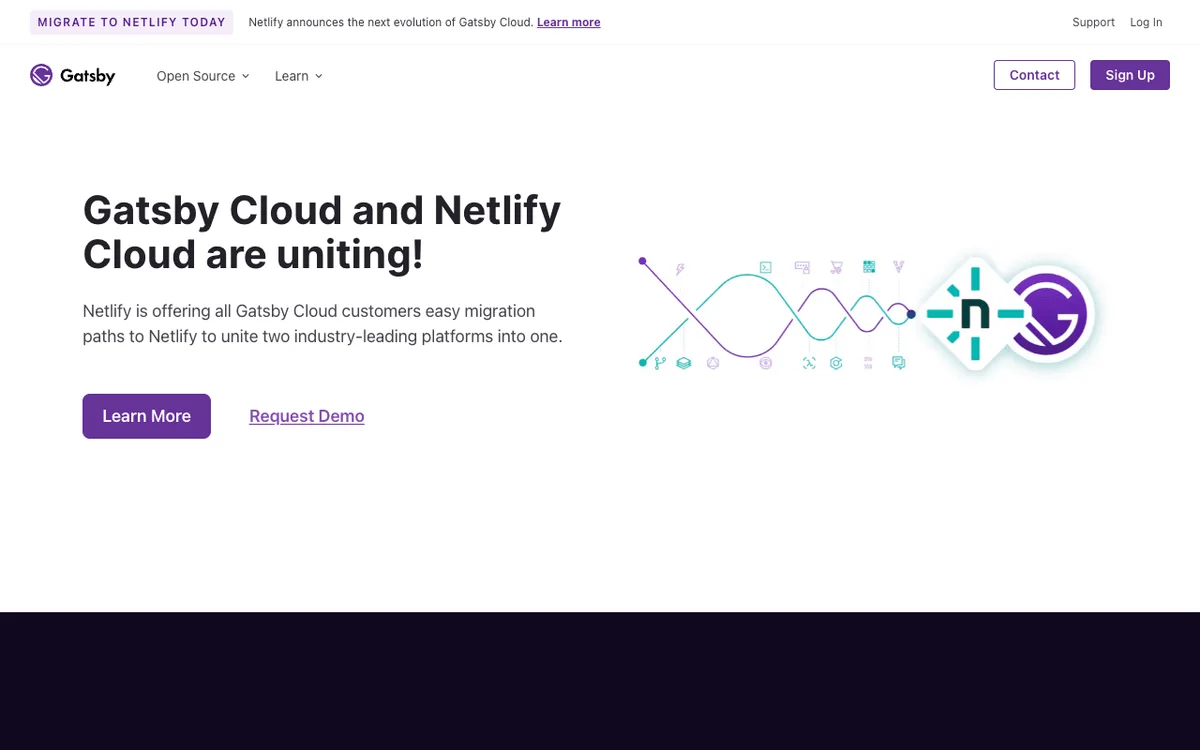
Is Grigora the right Gatsby alternative for you?
Where Grigora is a suitable Gatsby alternative, by situation.
For a marketing team without a developer
If your campaign calendar is blocked behind someone else's deploy queue, the framework is the bottleneck. Grigora puts the page, the form and the follow-up email in the same login.
… for a site whose React developer has moved on
An inherited site needs a clear plan for running builds, updating dependencies and recovering from failures. Compare maintaining that setup with moving its content into a managed platform.
… for founders who need to sell something this month
Gatsby has no cart and no checkout, so selling means building a storefront or paying for a second platform. Grigora's store, with variants, stock and digital downloads, is switched on per plan at 0% commission.
Gatsby is the right call if…
you have React developers, your content genuinely lives across several systems that must stay where they are, and you want SSG, DSG or SSR chosen per page with a build you own under an MIT licence. Nothing on this page replaces that.
Which one is right for you?
Choose Grigora if…
- Nobody on the team should need to run a build to publish
- You want the CMS, the newsletter and the store in one subscription
- Hosting, SSL, CDN and updates should not be your problem
- You would rather pay $12/mo than assemble five free tiers
- You are an agency and want to resell under your own brand
Choose Gatsby if…
- •One GraphQL schema over several content sources is the requirement
- •You want per-page rendering control and a configurable image pipeline
- •MIT-licensed code in your own Git repository is non-negotiable
How to move from Gatsby to Grigora
Inventory each Gatsby content source before exporting: Markdown, CMS records, APIs and generated pages can require different mappings. Test a representative sample in Grigora and retain media, relationships and business records separately. React components, authentication and server logic need explicit replacement decisions; a content export does not move that behaviour.
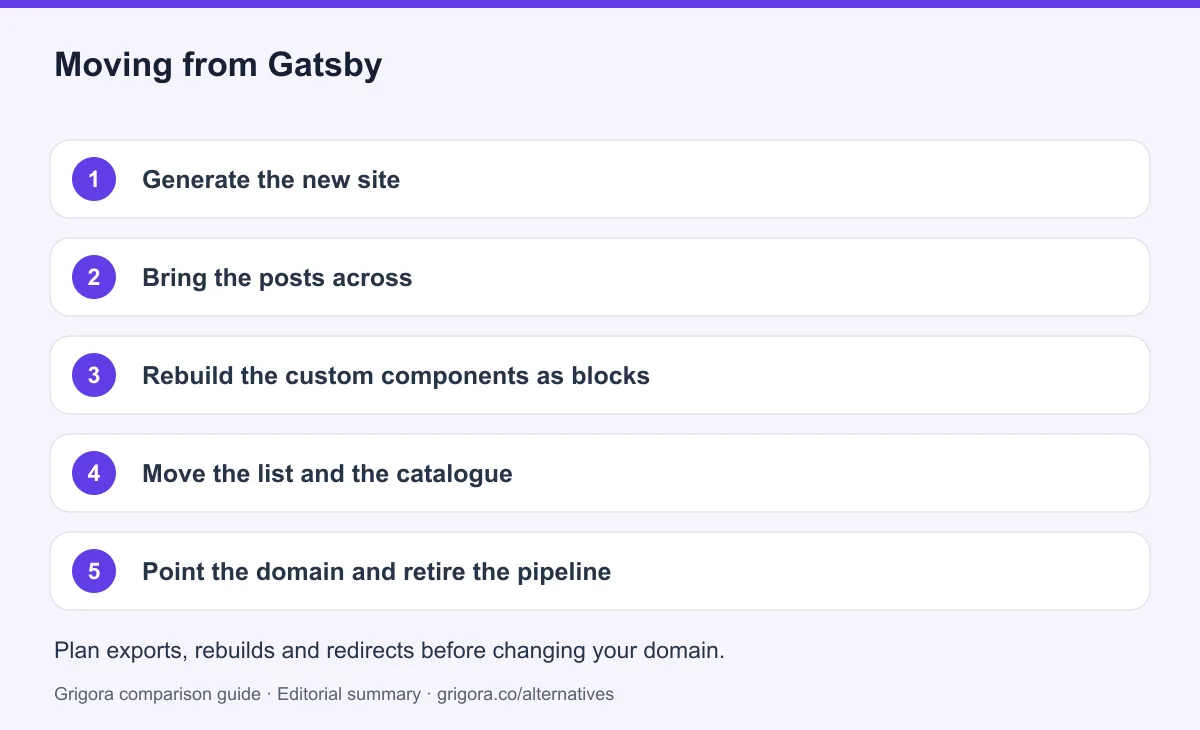
- 1
Generate the new site
Describe the business in a sentence and Grigora's AI produces a first draft with pages, layout and copy, or start from one of the available website templates.
- 2
Bring the posts across
Export content from the source CMS or retain Markdown/MDX and media from the repository. Test supported Grigora formats; MDX components and custom relations will need review or conversion.
- 3
Rebuild the custom components as blocks
Inventory custom React components, server functions and integrations. Recreate suitable layouts as blocks, but do not assume code injection can replace React behaviour, authentication or server logic.
- 4
Move the list and the catalogue
Export opted-in subscribers from the email provider and products from the commerce backend. Keep order history, subscription agreements and suppressed contacts, and validate variants, images and checkout separately.
- 5
Point the domain and retire the pipeline
Keep the current service active while testing the replacement. Preserve existing URL paths where possible, configure permanent redirects where you control the old address, and check canonicals, sitemaps, forms and checkout on mobile. Change DNS after these checks, then monitor errors and indexing before cancelling services you no longer need. Rankings can change during migration.
Why people look for a Gatsby alternative in 2026
Gatsby combines data from sources such as a headless CMS, Markdown and APIs through its GraphQL data layer. It can be useful for content-heavy websites that need custom rendering and source control. Teams considering a managed builder should compare their actual editing, deployment and integration workload before changing architecture.
The paid Gatsby products were retired after the acquisition
Netlify acquired Gatsby Inc. in February 2023 and Gatsby Cloud was subsequently folded into Netlify. Gatsby’s pricing route now leads to Netlify pricing, while the framework remains an open-source project. The official repository is not archived and the npm registry lists 5.16.1 as the latest stable release during this review. A separate cloud-product retirement should not be read as proof that the framework is abandoned.
The release cadence stopped looking like a roadmap
The registry lists Gatsby 5.16.1 from 10 February 2026 as the latest stable release. The repository is not archived and shows recent activity. Those facts should inform an update plan, but do not prove that the framework is abandoned or predict its roadmap. Review the version-support policy, dependencies and the team responsible for maintenance.
Services around the framework
Gatsby is a framework, so teams choose the surrounding CMS, host, email and commerce services. Those services may have free tiers or may already exist in the business. Editors can publish through a configured CMS, while developers own layouts, integrations and deployment. Compare that specific setup with Grigora’s included CMS, newsletter and store.
How Grigora compares
Grigora starts from the opposite end of the problem. Instead of a build tool that can be assembled into a website, it is a website that happens to have been generated for you. Describe the business in a sentence and the AI produces a first draft with pages, layout and copy, or pick from website templates. From there every block is editable on the page by whoever needs the page changed, with custom code injection for the bits that need it. There is no repository, no build and no deploy, because there is nothing to compile.
One subscription instead of six accounts
Grigora Starter bundles a managed site, CMS, newsletter and store for $12/mo billed annually, with published site, page, bandwidth, storage, subscriber and team allowances. Optional mailboxes and White Label are separately priced. A Gatsby site can combine free, paid or in-house services, so compare the actual stack and maintenance work rather than assuming a fixed number of suppliers or subscriptions.
Where Gatsby still wins: the data layer and the build you own
Gatsby’s data layer can combine several sources while leaving them in their existing systems. Its code lives in a repository and the framework is MIT licensed. Static output can move to compatible hosts, while SSR and DSG need runtime support. Grigora does not provide Gatsby’s multi-source GraphQL build layer, plugin architecture or code ownership. Keep Gatsby when these capabilities matter; consider Grigora when the team prefers its managed editing and business-tool workflow.
Frequently asked questions
Grigora is a Gatsby alternative when a team wants a managed website, CMS, newsletter and store without maintaining a React build. Gatsby remains useful for custom rendering, GraphQL data sourcing and code ownership. Existing Gatsby sites can support nontechnical editors through a CMS integration, so compare the actual workflow before replacing the framework.
Gatsby is free and MIT licensed; hosting and optional services are separate. During this review the npm registry listed 5.16.1 as the latest stable release, published 10 February 2026. Netlify advertises a free 300-credit plan, Personal at $9/month with 1,000 credits, and Pro at $20/month with 3,000 credits, with no annual rate published. Other hosts and CMS, email or commerce integrations may have different free and paid options.
Yes. Netlify announced the acquisition of Gatsby Inc. on 1 February 2023. Gatsby Cloud was wound down into Netlify and the Valhalla Content Hub was discontinued; Netlify did not publish a single end-of-service date for Gatsby Cloud, saying it depended on each customer's contract. The open-source framework continues under Netlify stewardship and the repository is not archived, but gatsbyjs.com/pricing, /dashboard and the Valhalla product page all redirect to Netlify today.
Yes, when the site is connected to a CMS with an editorial interface and publishing workflow. Gatsby core has no visual editor; code and Markdown-only setups need a different process. New layouts and complex integrations generally still need frontend work. Grigora includes its own CMS and page editor.
Gatsby core does not include a store or newsletter service. Projects can integrate a commerce provider, payment links and an email platform; free and paid options exist. The frontend and publishing workflow need configuration, though starters and existing CMS integrations can reduce the work. Grigora includes store and newsletter tools on its paid plans.
The GraphQL data layer, so content has to live in Grigora rather than being sourced from several systems. Per-page rendering modes and the configurable image pipeline, since delivery is managed. Code ownership, because there is no repository, no code export and no self-hosting, and no plugin ecosystem. In exchange you stop maintaining a build, a host, a CMS, an email platform and a payments integration.
Sources and comparison method
Published by Grigora, one of the products compared here. This is a comparison of public product documentation and published plans. Recommendations reflect the use cases described; they are not independent performance benchmarks. Homepage screenshots show how each product presents itself and do not establish feature availability.
Check the billing term, currency, regional availability, usage limits and add-ons before purchasing. A content export does not necessarily include the design, integrations or a working store. Migration steps need testing on your own site.
- Gatsby documentation
Framework, CMS integration, rendering and frontend implementation.
- Gatsby official repository
Maintained open-source project; repository is not archived.
- Gatsby npm registry
Latest stable version was 5.16.1 during review, published 10 February 2026.
- Netlify pricing
Current hosting credit plans; hosting and optional services are separate from Gatsby.
- Grigora pricing and included allowances
Annual and monthly prices, trial, team and usage allowances, newsletter tools and optional services.
Grigora references: plans and limits, commerce, MCP access, and help documentation.
Compare Grigora with other platforms


Swap the build pipeline for a working website
Site, CMS, newsletter and store in one plan, with hosting and updates included and nothing to deploy. Try Grigora free, no credit card required.
14-day free trial • No credit card required • Cancel anytime