
A Strapi alternative when free to download still leaves a server to run
Strapi is an excellent content API, and downloading it is where the work starts: a server, a database, the upgrade cycle, and a whole front end built on top before anyone sees a page. Grigora gives you the finished website, CMS, newsletter and store in one subscription from $12/mo.
Published by Grigora · Updated · Sources and method
Is Grigora the right Strapi alternative?
Grigora is a Strapi alternative for teams that need a managed website, CMS, newsletter and store together. Strapi is a stronger fit for API-driven applications, custom content models and self-hosting. The Community CMS is free software; Strapi Cloud hosting, paid CMS features and frontend development are separate cost decisions.
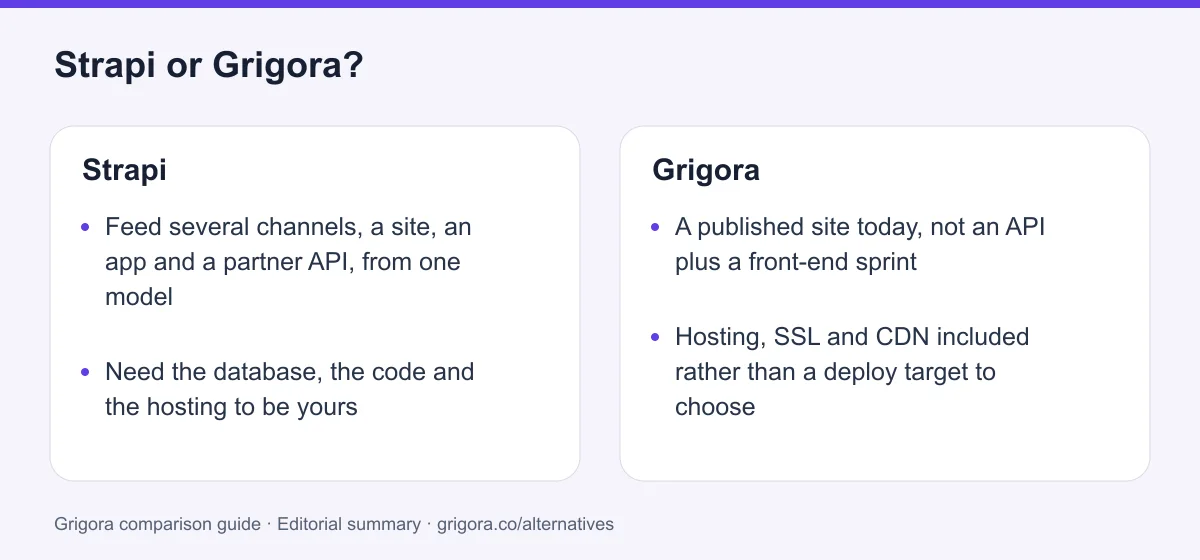
Choose Grigora if you want…
- A published site today, not an API plus a front-end sprint
- Hosting, SSL and CDN included rather than a deploy target to choose
- Upgrades, patches and Node versions handled by someone else
- A subscriber list and campaigns without a second platform
- A store with a catalogue and checkout and 0% platform commission
Stick with Strapi if you…
- •Feed several channels, a site, an app and a partner API, from one model
- •Need the database, the code and the hosting to be yours
- •Have the Node.js and DevOps capacity to run and upgrade it
Strapi or Grigora: the decision in one view
Strapi alternatives at a glance
How Grigora and the other platforms people weigh against Strapi compare on the essentials.
Swipe the table sideways to see every column
| Platform | Best for | Free access | Starting price | Sales fees | Data and site portability |
|---|---|---|---|---|---|
| Grigora | A finished site, newsletter and store in one plan | Free trial | From $12/mo billed annually | 0% platform fee; Stripe/Razorpay fees apply | Posts/content; rebuild design |
| Strapi | Self-hosted, API-first content for custom front ends | Self-hosted only | Free self-hosted; Cloud from $29/mo yearly | No store | Content/database; frontend separately |
| WordPress | A CMS that also renders the site | Software is free | Hosting + plugins | 0% (processing only) | Yes |
| Drupal | Complex structured content with a front end in core | Software is free | Hosting + developers | 0% (processing only) | Yes |
| Directus | A data layer over an existing SQL database | Self-hosted | Self-host or paid cloud | No store | Yes |
| Contentful | Hosted headless content for large teams | Limited free tier | Paid tiers, quote above entry | No store | Yes |
Grigora and Strapi prices were read from each vendor's own pricing pages on 11 September 2026, annual billing where it is offered. The other rows are described rather than priced, because their list prices were not checked on that date. Verify current pricing on each provider's site.
Sources for the overview table
- Grigora: official reference 1
- Strapi: official reference 1, official reference 2
Why people switch from Strapi to Grigora
The friction that shows up once the free download is running, and how Grigora handles it.
The free licence bought a server, not a site
Community is genuinely free forever, and it arrives as an admin panel and an API. Nothing is public until a front end exists, is deployed, has a domain and gets maintained alongside the backend.
Two repos and two deploys for one website
Backend and front end are separate applications with separate builds, separate hosting and separate failure modes. For a brochure site with a blog, that is a lot of moving parts for a page of text.
The hosted entry point got more expensive
The Strapi Cloud free plan closed to new signups on 1 July 2026 and remaining free projects were deleted on 1 September 2026. The cheapest hosted start is now Starter at $29/mo billed yearly, and that tier sleeps when idle and has no backups.
Features and hosting are billed separately
Live Preview, Releases and Content History sit behind a Growth licence at $45/mo, which per Strapi's support documentation is not included in a Cloud plan. Two invoices, and neither of them includes a newsletter or a store.
What Strapi does well
- MIT-licensed core you can self-host, fork and keep forever
- Unlimited content-types, components, relations and locales over REST and GraphQL
- Extensible in ordinary Node.js and TypeScript, with any npm package alongside
- Enterprise-grade editorial governance: RBAC, Releases, Content History, audit logs and SSO
Where Strapi falls short
- No front end at all: no themes, no templates, no pages, no site hosting
- Cloud hosting and CMS feature licences are separate purchases that stack
- No store, no marketing email and no SEO tooling in core
- You own the server, the upgrades and the security patches
Grigora vs Strapi at a glance
The differences that decide whether you are shipping a website or standing up a backend.
| Feature | Strapi | Grigora |
|---|---|---|
| Starting cost | Free to download, then server and build | $12/mo all-in |
| What a visitor sees on day one | Nothing until a front end exists | A live site |
| Website hosting | Separate deploy (Vercel, Netlify, AWS) | Included |
| Upgrades and security patching | Your team | Managed |
| REST and GraphQL content API | Yes | No |
| Visual editing of a live page | No | Yes |
| Newsletter and subscriber list | No | Included |
| Online store | No | Built in, 0% commission |
| Free SEO tools suite | No | Free tools |
Grigora vs Strapi: feature by feature
A category-by-category breakdown, pricing, AI, design, e-commerce, email, SEO, performance, and support.
What the MIT licence actually bills you for
Fit: GrigoraThe download is free and it is free forever: unlimited entries, unlimited API calls, unlimited content-types, locales, roles and admin seats on the Community edition. What the licence does not cover is the machine it runs on, the database behind it, the person who upgrades it, and the website that has to exist before any of it is visible to a customer.
| Feature | Grigora | Strapi |
|---|---|---|
| Software licence | Included in the plan | Free, MIT |
| Server and database | Included | Yours, or Strapi Cloud from $29/mo yearly |
| Website hosting | Included | A second deploy you set up |
| Front-end build | AI first draft, website templates | Next.js, Nuxt or similar, by you |
| Predictable monthly total | $12 to $45/mo | Depends how much you self-operate |
Takeaway: Free to download is not the same as free to operate, and on Strapi the gap is a server plus a front-end project.
The front end Strapi does not ship
Fit: GrigoraThis is the single biggest difference and Strapi is open about it. Strapi is headless: it stores content and serves it over REST and GraphQL. It draws no page, owns no URL, has no theme or template system, and Strapi Cloud hosts the Strapi application rather than your website. Everything a visitor actually looks at is a separate build on Vercel, Netlify, AWS or your own boxes.
| Feature | Grigora | Strapi |
|---|---|---|
| Themes or templates | website templates | No |
| Page builder or visual editing | Block editor on the live page | Live Preview of your own front end (paid tier) |
| Public URLs and routing | Handled | Your front-end framework |
| Website hosting, SSL and CDN | Included | Separate service |
| Time to something a customer can open | Minutes | As long as the front end takes |
Takeaway: Strapi finishes at the API. The part your customers see is a project that has not started yet.
Content-types, components and the API surface
Fit: StrapiStrapi's real strength, and an honest concession. Unlimited collection and single types, repeatable components, dynamic zones, relations, custom fields and unlimited locales, all exposed over both REST and GraphQL, with lifecycle hooks, middleware, policies and custom controllers written as ordinary code in your repo. Grigora's posts, categories, directories and collections are a much smaller model, and it is not a replacement for Strapi’s headless API.
| Feature | Grigora | Strapi |
|---|---|---|
| Custom content-types and fields | Posts, categories, collections, directories | Unlimited, fully configurable |
| Components and dynamic zones | No | Yes |
| REST and GraphQL access | No | Yes |
| Custom back-end code and npm packages | Custom code injection in the editor | It is a Node.js app you own |
| One content source feeding app, kiosk and partner API | No | Yes |
| Locales | Single-language sites | Unlimited via i18n |
Takeaway: If the content has to feed more than a website, Strapi is the better model and this page will not pretend otherwise.
Two purchases: Strapi Cloud and a CMS licence
Fit: GrigoraHosting and features are sold separately. A paid Strapi Cloud plan covers the runtime, database, CDN, email and backups. Per Strapi's support documentation, it does not include a CMS licence key, so Live Preview, Releases, Content History and SSO still need a Growth or Enterprise licence on top. The live Cloud pricing page does not state this either way, so treat it as documented rather than advertised.
| Feature | Grigora | Strapi |
|---|---|---|
| Hosting the backend | Included | Cloud Starter $348/yr, Pro $900/yr |
| Advanced CMS features | Included | Growth $45/mo, monthly only |
| Single sign-on | Not offered | $150/mo add-on on Growth, included on Enterprise |
| Enterprise pricing | $45/mo Business plan, published | Not published, contact sales |
| Extra editor seats | Team-member allowances vary by plan | Growth includes 3, then $15/mo each |
Takeaway: On Strapi the hosting bill and the feature bill are different invoices, and only one of them has a public ceiling.
Upgrades, CVEs and who owns the Node version
Fit: GrigoraStrapi is actively maintained, which cuts both ways: v5.53.0 shipped on 9 September 2026, and a self-hosted install only benefits if somebody applies it. That person also owns the Node runtime, the database migrations, the plugin compatibility matrix and the security advisories, including the five CVEs Strapi published in May 2026. Grigora has no version for you to be behind on.
| Feature | Grigora | Strapi |
|---|---|---|
| Core upgrades | Applied for you | Your release process |
| Security advisories | Handled by the platform | Yours to watch and patch |
| Plugin and dependency drift | Not applicable | npm audit and compatibility testing |
| Database migrations | Not applicable | Part of every major upgrade |
| Backups | Automatic | None on Cloud Starter; weekly on Pro |
Takeaway: Owning the server means owning the upgrade night, and the entry Cloud tier does not even include backups.
Selling: products, cart and checkout
Fit: GrigoraStrapi has no commerce layer at all. No products, no cart, no checkout, no payments, no stock, no tax or shipping, and no official commerce plugin. Strapi's own guidance is to model products as content-types and write the cart, the payment integration and the checkout yourself in the front end, or to bolt on a separate commerce engine. Grigora's store is switched on in the dashboard.
| Feature | Grigora | Strapi |
|---|---|---|
| Catalogue, variants and stock | Built in | Content-types you design |
| Cart and checkout | Built in | You build it in the front end |
| Payments | Stripe and Razorpay | Your own integration |
| Digital downloads | Built in | Custom work |
| Platform commission | 0% | No store to take a cut of |
Takeaway: Strapi can hold the product data. Everything between a product page and a paid order is a build.
Mailing list vs transactional send
Fit: GrigoraStrapi's Email feature is outbound transactional mail through a provider such as SendGrid or Nodemailer, and the docs are explicit that receiving or parsing incoming mail is out of scope. Strapi Cloud's unlimited emails means send volume, not marketing. There are no lists, segments, campaigns, broadcasts, automations or deliverability reports. Grigora ships the list and the campaign builder on every paid plan.
| Feature | Grigora | Strapi |
|---|---|---|
| Subscriber list | 2,500 to 25,000 by plan | No |
| Campaign builder and broadcasts | Included | No |
| Automations and segmentation | Included | No |
| Transactional send | Included | Via a provider you configure |
| Signup forms wired to the site | Yes | Front-end work plus an external platform |
Takeaway: Sending one password reset is not a newsletter, and Strapi never claimed it was.
Roles, releases, audit logs and the keys to the server
Fit: StrapiThe second honest concession, and it is substantial. Unlimited roles with fine-grained permissions, Releases for publishing several entries together, Content History at 30 days on Growth and 365 on Enterprise, Review Workflows and Audit Logs on Enterprise, SSO via SAML 2.0 or OAuth2, and a SOC 2 report. Underneath all of it, the database and the code are yours and nobody can meter your API or delete your project.
| Feature | Grigora | Strapi |
|---|---|---|
| Granular role-based access control | Basic roles | Unlimited roles, fine-grained |
| Scheduled multi-entry releases | No | Releases (paid tiers) |
| Version history on entries | Drafts and revisions | 30 days on Growth, 365 on Enterprise |
| Approval workflows and audit logs | No | Enterprise |
| SSO | No | Add-on on Growth, included on Enterprise |
| Own the database and the code | No | Yes |
Takeaway: For multi-team governance and true data ownership, Strapi wins outright, and the price of winning is that you run it.
Explore Grigora before switching from Strapi
Current public product pages and plans, so you can inspect what you would be moving to. Open any image at full size.
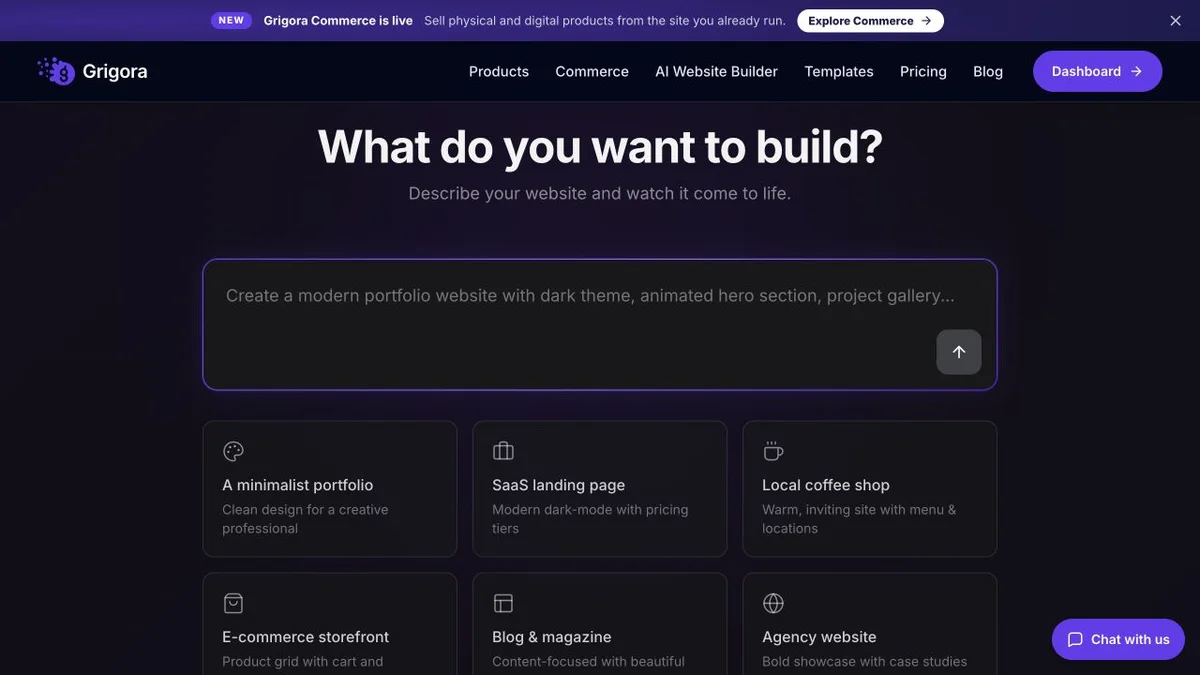
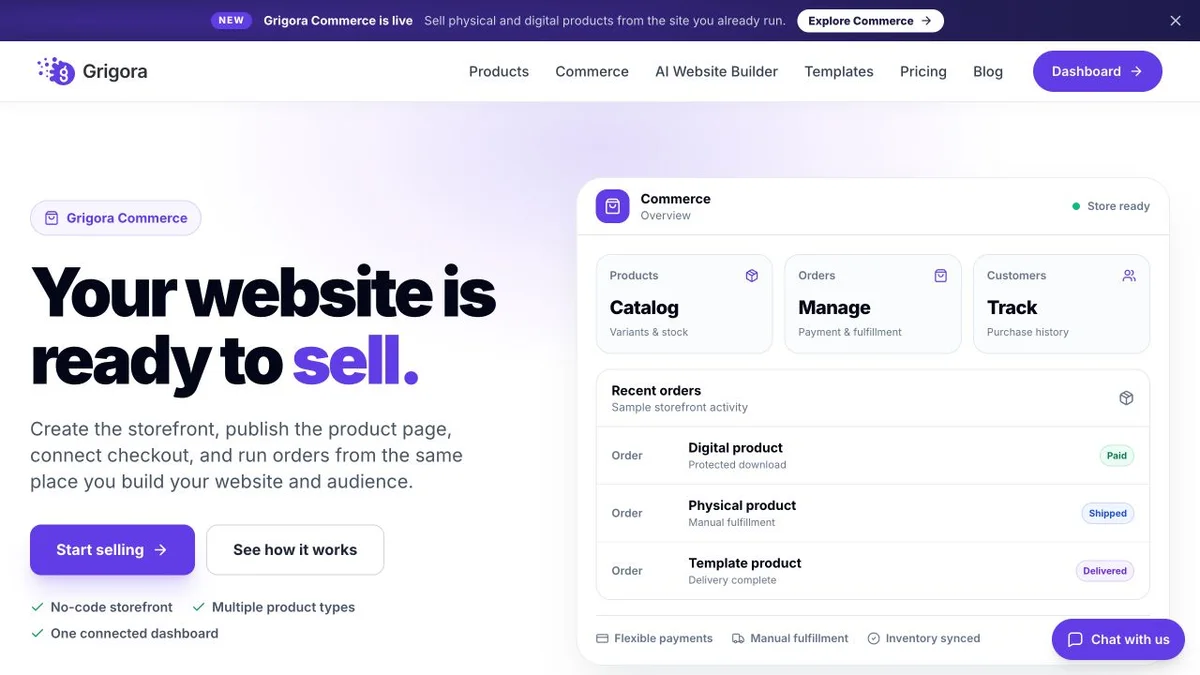
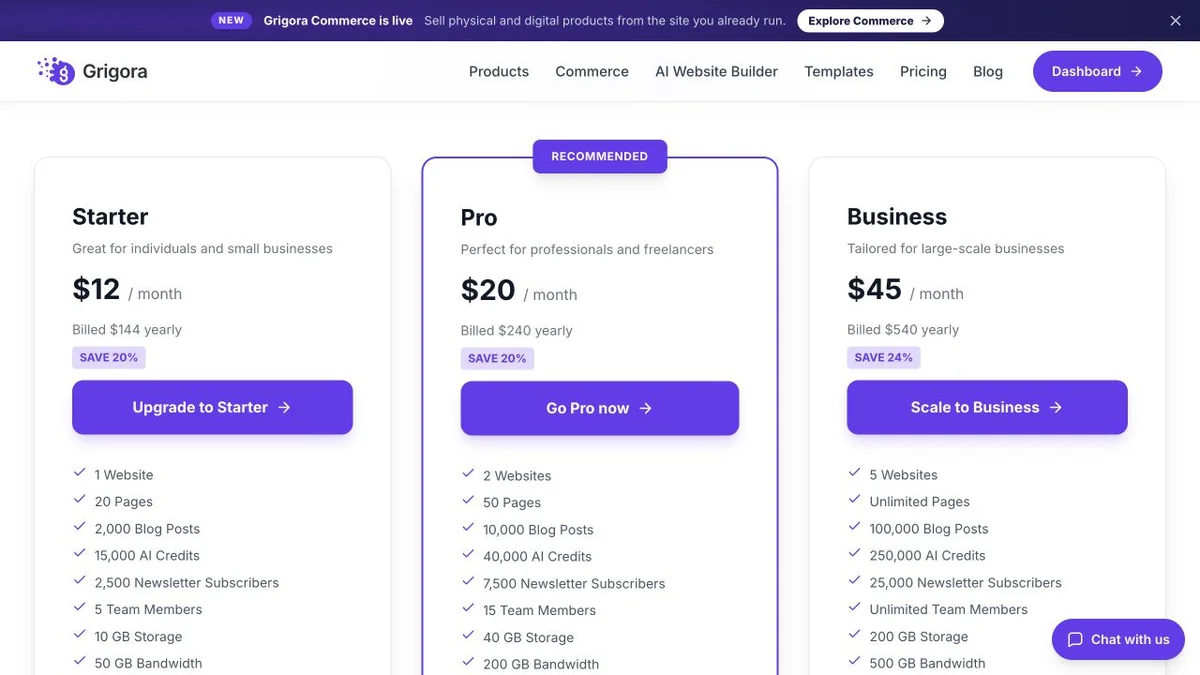
Grigora vs Strapi pricing
Strapi sells two things separately: somewhere to run it, and the features that are not in the free licence.
Website, newsletter and store in one plan
Annual rates shown; month-to-month billing is available at different rates. Grigora offers a free trial, with plan-based page, storage, bandwidth, team and subscriber allowances. The CMS, newsletter and store are included on paid plans. Stripe or Razorpay processing fees and optional products are additional; check current renewal terms.
Free licence, paid hosting, paid features
Read on strapi.io/pricing-cloud and strapi.io/pricing-self-hosted on 11 September 2026. The Cloud page advertises save up to 17% on yearly billing. Cloud Business is $450/mo or $4,500/yr. CMS Enterprise is quote-only, so no figure is given here. Per Strapi's support documentation, Cloud plans do not include a CMS licence key, so Growth or Enterprise features are billed on top; the live Cloud page does not say so either way. Strapi Cloud has no free plan: free signups closed 1 July 2026 and remaining free projects were deleted 1 September 2026. Growth features can be trialled free for 30 days, described on the page as on a self-hosted project.
Grigora Starter at $12/mo covers the site, the hosting, the CMS, the newsletter and the store. The cheapest hosted Strapi is $29/mo billed yearly for the backend alone, before a CMS licence, before a front end, and before anywhere to put it.
The real cost: Grigora vs Strapi
Take a small company site with a blog, a mailing list and a handful of products. Count everything you have to stand up on each side before it is live, and everything you keep paying for afterwards.
| What you pay for | Strapi | Grigora |
|---|---|---|
| Content backend | Free self-hosted, or Cloud Starter $348/yr | Included |
| Front end and website hosting | A separate build, deployed to Vercel, Netlify or AWS | Included, website templates |
| Advanced CMS features | Growth $45/mo on top of any Cloud bill | Included |
| Newsletter and subscriber list | A separate email platform | Included, 2,500 to 25,000 subscribers |
| Store and checkout | Built by you, plus a payment integration | Included, 0% platform commission |
| Upgrades, patching and Node versions | Your team, every release | Managed |
| Custom back-end code and database access | Any npm package, your own Postgres | Not available |
Payment-processor fees apply wherever you take money. Strapi Cloud is metered beyond its allowances: +$1.50 per 25,000 API requests, +$0.60 per GB of storage, +$30 per 100 GB of bandwidth, and +$1.50 per 100 extra Strapi AI credits, read on strapi.io on 11 September 2026. Developer time is the largest line on the Strapi side and the hardest to quote, so it is left unpriced here.
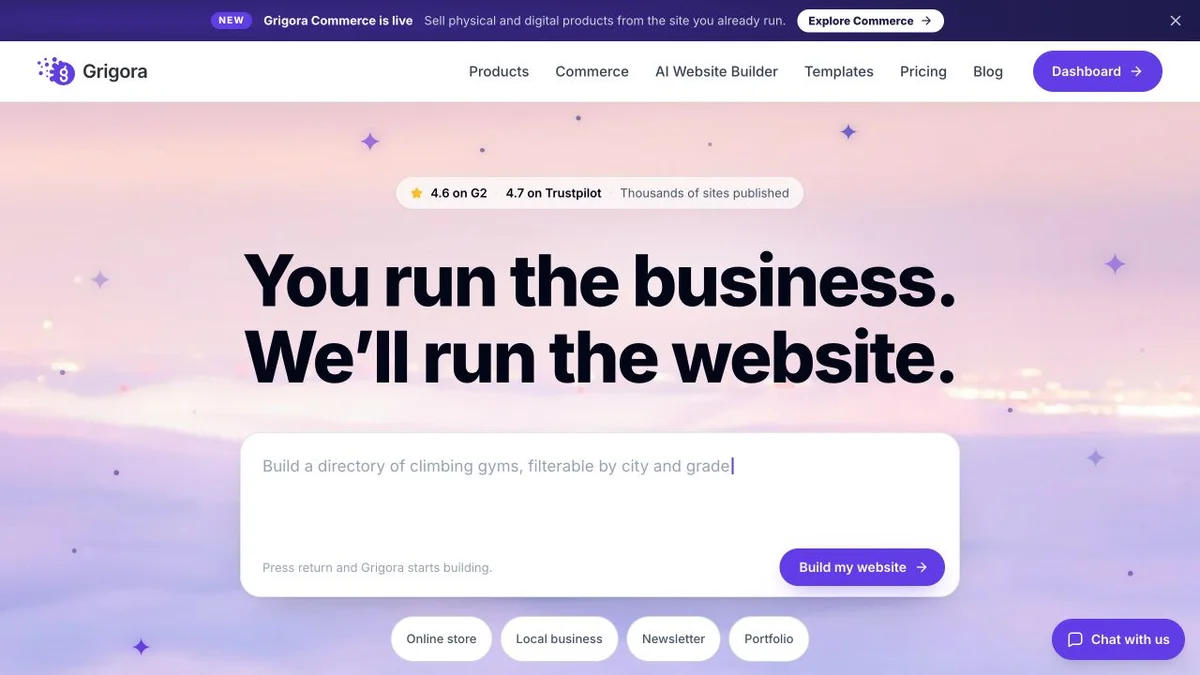
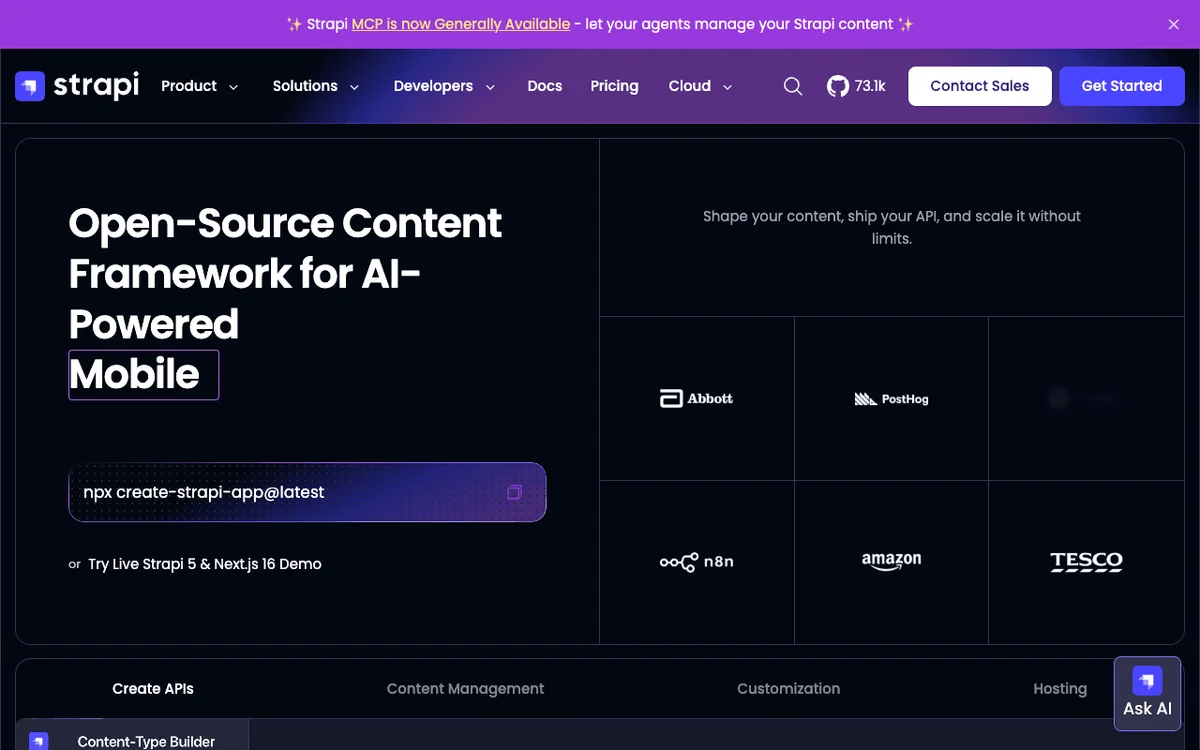
Strapi and Grigora: public website references
These captures show each product’s public website. See the feature and pricing sections for capabilities and plan details.
Is Grigora the right Strapi alternative for you?
Where Grigora is the stronger Strapi alternative, by situation.
Best Strapi alternative for a marketing site
When the content only ever feeds one website, an API in the middle adds a deploy pipeline and a front-end repo without adding anything a visitor can see.
… for founders without a DevOps rota
Somebody has to own the Node version, the database and the May 2026 style security advisories. If that somebody is also doing sales, a managed platform is the safer bill.
… for teams that lost the front-end developer
A Strapi instance with a half-finished Next.js front end is a stalled project. Grigora publishes pages without anyone touching a build pipeline.
Strapi is the right call if…
You are feeding a website, a mobile app and a partner integration from one content model, you need RBAC, approval workflows, audit logs or data residency, and you have the Node.js and DevOps capacity to run, upgrade and secure the thing you own.
Which one is right for you?
Choose Grigora if…
- You want the website itself, not an API to build one against
- Nobody on the team wants to own a server or an upgrade cycle
- One predictable bill beats hosting plus licences plus a front end
- You need a mailing list and a store without two more products
- Editors should publish without a deploy
Choose Strapi if…
- •One content model must feed several channels over REST or GraphQL
- •Self-hosting, data residency or full code ownership is a requirement
- •You need RBAC, review workflows, audit logs or SSO for a large team
How to move from Strapi to Grigora
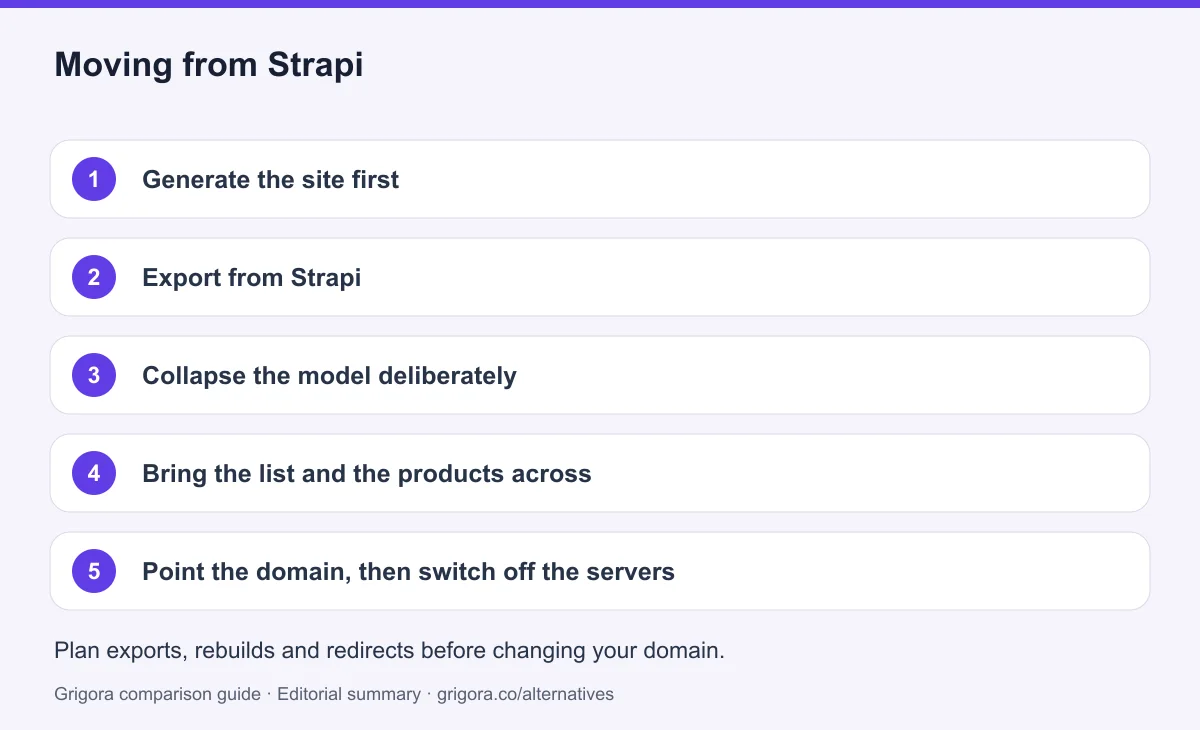
Strapi's own import, export and transfer tooling gets your content out cleanly, which is one of the better things about starting there. What you are really retiring is the server and the front-end repo. Before moving everything, test a representative content export and check supported import formats. Keep media backups, reconcile product variants and retain subscriber consent and unsubscribe records; an export does not guarantee a direct import.
- 1
Generate the site first
Describe the business in a sentence and Grigora produces a first-draft site with pages, layout and copy, so you can see the finished thing before you move any data.
- 2
Export from Strapi
Use strapi export or the REST and GraphQL endpoints to pull entries and media out of your instance, then map collection types to Grigora posts, categories, collections and directories.
- 3
Collapse the model deliberately
Most single-site Strapi schemas reduce to pages, posts and one or two collections. Rebuild what the website actually renders rather than reproducing every content-type.
- 4
Bring the list and the products across
Import subscribers into the built-in newsletter instead of a separate email platform, and load products into the Grigora store if you sell.
- 5
Point the domain, then switch off the servers
Keep the old service active while you test the new site. Match existing URL paths or configure permanent redirects, verify canonicals and the sitemap, and test forms and checkout on mobile. Change DNS after these checks, then monitor indexing and errors before cancelling services you no longer need. Rankings may change during a migration.
Why people look for a Strapi alternative in 2026
Strapi is not a bad product, and most people who leave it were never its audience. It is a headless CMS built for development teams: MIT-licensed, self-hostable, API-first, and deliberately unopinionated about what renders the content. That is exactly right when the content feeds a website, a mobile app and a partner integration at once. It is a strange way to publish twelve pages and a blog.
The licence is free, the operating bill is not
Community edition costs nothing forever, with unlimited entries, unlimited API calls, unlimited content-types and unlimited admin seats. None of that includes a machine to run it on, a managed database, an upgrade path, or a single line of the website. Teams discover the real number only after the download: hosting for the backend, hosting for the front end, and the time of whoever keeps both alive.
Nothing is public until you build the front end
Strapi renders no pages. There are no themes, no templates and no URLs a visitor can open, and Strapi Cloud hosts the Strapi application rather than your site. The website is a separate Next.js, Nuxt or SvelteKit project with its own repository, its own deploy and its own on-call story. For a company site, that second project is usually larger than the content work that justified the CMS.
The cheap way in got narrower
Strapi withdrew the Cloud free plan in 2026: new signups closed on 1 July 2026 and remaining free projects were deleted on 1 September 2026, per Strapi's own announcement. Hosted Strapi now starts at Starter, $35 a month or $348 a year, a tier that sleeps when idle, carries no backups, no CRON jobs and no uptime SLA. Meanwhile the features many teams assume are part of a paid plan, Live Preview, Releases, Content History and SSO, sit on a separate CMS licence from $45 a month, which per Strapi's support documentation a Cloud subscription does not include.
How Grigora compares
Grigora is the opposite shape. It is not an API you build a site against, it is the site: pages, blog, subscriber list, store and hosting in one subscription, with the AI writing a first draft from a description of the business and a block editor for everything after that. There is no server, no build pipeline and no version of the software for you to fall behind on.
One subscription with nothing left to deploy
Starter at $12 a month billed annually includes the website and its hosting, SSL and CDN, the CMS with categories, directories and moderated comments, a newsletter with 2,500 subscribers and campaign automations, and a store with no platform commission on your own Stripe or Razorpay account. On Strapi each of those is a separate decision: a host, an email platform, a commerce build, and the developer time that connects them to a front end you also wrote.
What you give up when you stop self-hosting
Quite a lot, and it should be said plainly. You lose the database, the code and the ability to run the whole thing on your own infrastructure. You lose Strapi’s REST and GraphQL delivery model. Grigora offers MCP management tools, which serve a different integration workflow. You lose components, dynamic zones and arbitrary content modelling, and you lose the governance layer: unlimited fine-grained roles, Releases, Content History, review workflows, audit logs and SSO. If those are requirements, keep Strapi and hire for it. If what you actually needed was a website that publishes itself, Grigora is the cheaper honest answer.
Frequently asked questions
Grigora is a Strapi alternative for teams that need a managed website, CMS, newsletter and store together. Strapi is a stronger fit for API-driven applications, custom content models and self-hosting. The Community CMS is free software; Strapi Cloud hosting, paid CMS features and frontend development are separate cost decisions.
The CMS Community edition is free forever under the MIT licence, self-hosted, with unlimited entries, API calls, content-types, locales, roles and admin seats. You supply the server, the database and the website. Strapi Cloud is not free: the free plan closed to new signups on 1 July 2026 and remaining free projects were deleted on 1 September 2026.
Read on strapi.io on 11 September 2026: Starter is $35 per project per month or $348 a year, Pro is $90 a month or $900 a year, and Business is $450 a month or $4,500 a year, with the page advertising up to 17% off for yearly billing. Self-hosted CMS Growth is $45 a month on top, and Enterprise is quote-only with no published price.
No. Strapi is headless. It ships no themes, templates, page builder or public URLs, and Strapi Cloud hosts the Strapi backend rather than your site. The front end is a separate application you build and deploy yourself, usually with Next.js, Nuxt or SvelteKit.
Neither. Strapi's Email feature is outbound transactional mail through a provider, with no lists, campaigns, segments or automations, and the docs put incoming mail out of scope. There is no commerce layer and no official commerce plugin, so products, cart, checkout and payments are all things you build or buy elsewhere.
Self-hosting and full ownership of the code and database, REST and GraphQL access to your content, components and dynamic zones, unlimited locales, and the governance features on Strapi's paid tiers such as fine-grained roles, Releases, Content History, review workflows, audit logs and SSO. You gain a live site, hosting, a newsletter, a store and no upgrade cycle.
Sources and comparison method
Published by Grigora, one of the products compared here. This is a comparison of public product documentation and published plans. Recommendations reflect the use cases described; they are not independent performance benchmarks. Homepage screenshots show how each product presents itself and do not establish feature availability.
Check the billing term, currency, regional availability, usage limits and add-ons before purchasing. A content export does not necessarily include the design, integrations or a working store. Migration steps need testing on your own site.
- Strapi pricing
Primary source for the product, plan or migration scope discussed in this comparison.
- Strapi pricing
Primary source for the product, plan or migration scope discussed in this comparison.
- Grigora pricing and plan limits
Annual and monthly billing, free trial, page/bandwidth/storage allowances, support and optional services.
- Grigora MCP tools
MCP management capabilities are distinct from a headless REST or GraphQL delivery API.
Grigora references: plans and limits, commerce, MCP access, and help documentation.
Compare Grigora with other platforms


Make the switch from Strapi to Grigora
Get the website, the CMS, the newsletter and the store in one place, with no server to run and no front end to build. Try Grigora free, no credit card required.
14-day free trial • No credit card required • Cancel anytime