Blog Category Suggestion Tool
Turn any niche into 8-12 siloed category ideas. Structure your blog for topical authority, the way Google ranks sites in 2026.
How to use the Blog Category Suggestion, step by step
Real screenshots of the tool, taken while running it with the Suggest categories button.
- 1
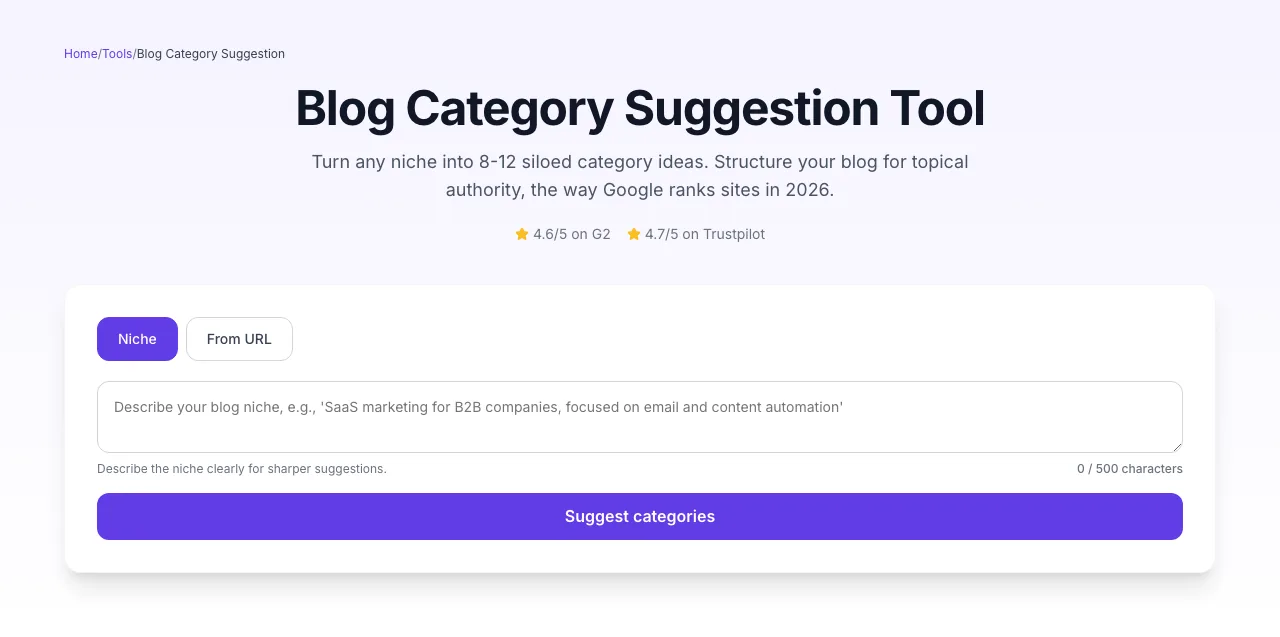
Add your input
Paste or type into the field Blog Category Suggestion works from.

- 2
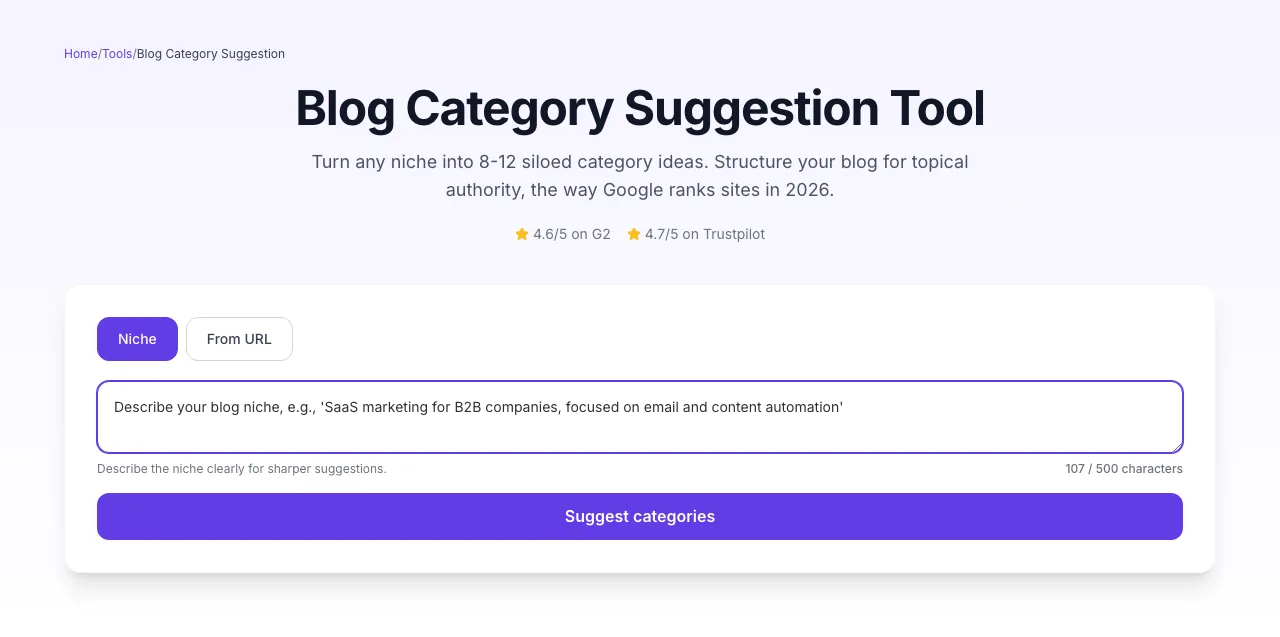
Sample text in place
With sample text entered, Blog Category Suggestion is ready to run.

- 3
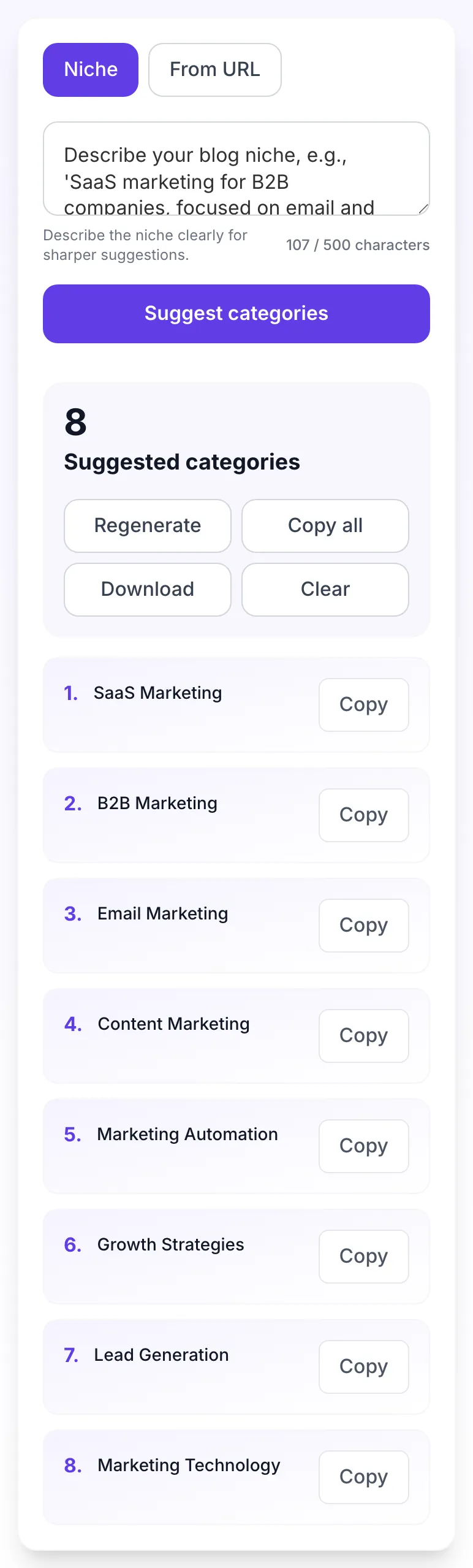
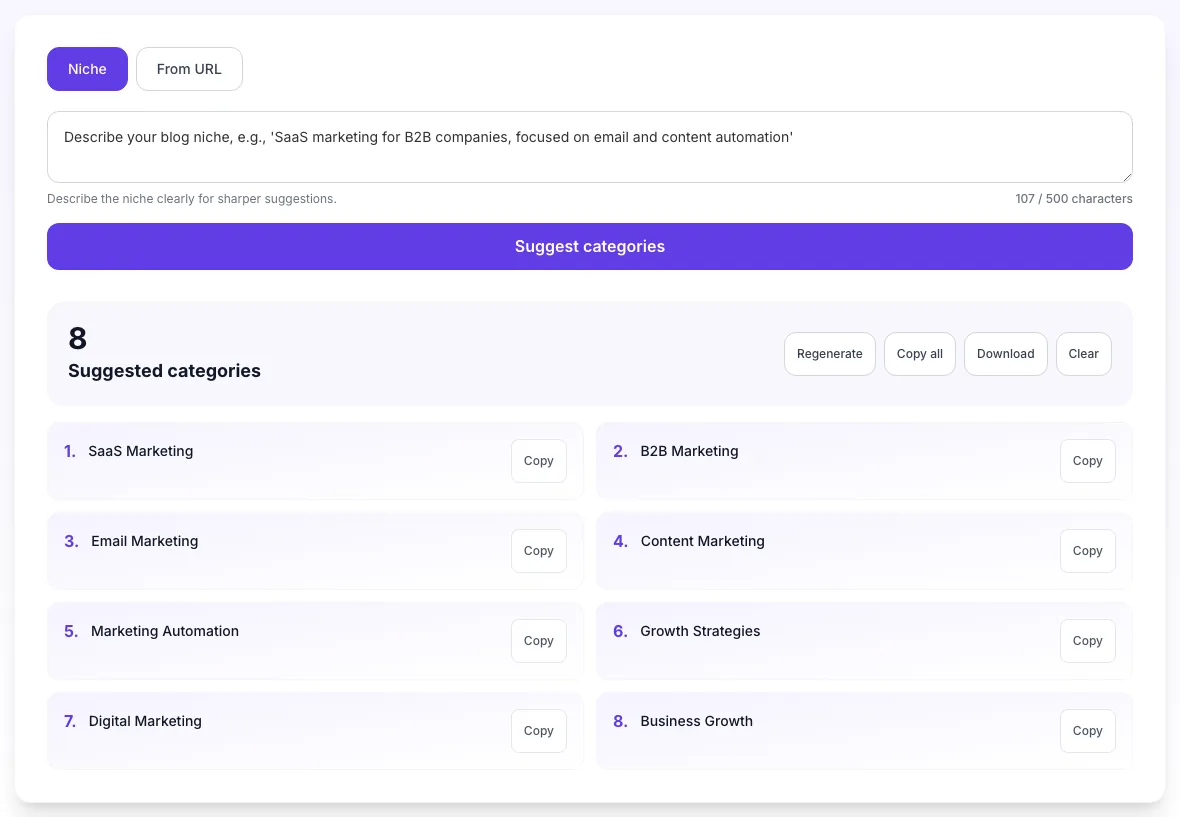
See what Suggest categories produces
Clicking Suggest categories runs the check and shows the result right below.
From niche to IA in 3 steps
Avoid 18 months of messy retrofitting. Plan the structure before the first post.
Describe your niche
Or paste a blog URL. The more specific, the sharper the category suggestions.
AI suggests silos
8-12 categories structured for topical authority. Google's 2025-2026 ranking preference.
Pick 5-7 to commit to
Each category should support 8+ posts in 6 months. Less is more.
Category count vs. organic traffic
We analyzed 180 blogs (1-3 years old, similar size) across SaaS, ecommerce, and media verticals. Organic traffic measured at month 18 of publishing.
Source: Grigora blog structure study, 180 blogs × 3 verticals, organic traffic at month 18, Q1 2026.
Platform-specific setup
Wire suggested categories into the CMS you already use.
WordPress
- 1.Posts → Categories → Add New Category for each suggestion.
- 2.Set slug (matches URL) carefully. Changing later requires 301s.
- 3.Assign each post to exactly one category (use tags for themes).
Ghost
- 1.Use Primary Tag as category. Each post gets one.
- 2.Create tag slugs matching AI suggestions.
- 3.Secondary tags act as your cross-cutting themes.
Webflow CMS
- 1.Create a "Category" Collection with suggested values.
- 2.Reference from Blog Post Collection as a multi-reference field.
- 3.Set URL structure /blog/category/[slug]/ in Collection settings.
Next.js / MDX
- 1.Add category frontmatter field to each .mdx file.
- 2.Generate /blog/category/[slug].js dynamic route.
- 3.Use getStaticPaths to pre-render archive pages per category.
Hashnode / Substack
- 1.Use "Series" (Hashnode) or "Sections" (Substack) as categories.
- 2.Limit to 5-7. Platform UI doesn't handle more gracefully.
- 3.Assign each post to one primary series.
Who uses category suggestions
Six workflows with the measurable outcome each team reports.
New blog founders
Plan site architecture before writing the first post. Avoid 18 months of messy retrofitting.
SEO consultants
Audit client blogs, propose new category taxonomy, present with rationale and keyword data.
Content strategists
Build editorial calendar grid. Rows = categories, columns = weeks. Ensures balanced coverage.
Ecommerce blog managers
Align blog categories with product taxonomy. Each category supports a product hub with internal links.
Media sites / publishers
Mirror the newsroom beat structure. Categories become vertical expertise signals for AI search.
Solo creators
Commit to 3-5 categories. Forces focus. Kills "should I write about X?" decision fatigue.
Common category mistakes & quick fixes
Eight failures we see most, and the fix for each.
Categories overlap ("Marketing" + "Digital Marketing" + "Online Marketing")
Fix: Pick the highest-search-volume term, consolidate. Overlapping categories dilute authority across similar pages instead of concentrating it.
Too many categories (15+)
Fix: Each category should have 8+ posts within 6 months. If a category will stay at 2-3 posts, merge it into a broader bucket or drop it.
Category names too generic ("Tips", "Ideas", "General")
Fix: Generic names have no keyword signal. Replace with topic-specific names a user would search: "SEO Tips" → "Technical SEO"; "Ideas" → "Content Marketing".
Category URLs change mid-year without 301s
Fix: Every rename = broken backlinks + lost rankings. Decide once, plan for 12 months. If you must rename, set up 301 redirects from old URL to new.
Uncategorized posts left with default "Uncategorized" tag
Fix: WordPress default hurts SEO. Audit all posts quarterly; every post should live in exactly one category. Fix "Uncategorized" first.
Category archive pages have no custom content
Fix: Default category archive = just a list of posts. Add 150-300 word intro with keyword + synonyms. These pages can rank standalone for category keywords.
Sub-categories nested 3+ levels deep
Fix: Deeper nesting dilutes signal and confuses crawlers. Max 2 levels: parent + child. If you need 3 levels, you have too many categories.
Categories created based on posts you already have, not topics you want to own
Fix: Forward-looking categories are the point. Decide what topics to rank for in 2 years, then create categories to match. Retrofitting kills strategy.
Grigora vs. Ahrefs vs. Semrush category tools
Feature-by-feature comparison of the three most-used taxonomy tools.
| Feature | Grigora | Ahrefs | Semrush |
|---|---|---|---|
| Free unlimited suggestions | |||
| URL input + text niche input both | |||
| No signup required | |||
| 8-12 structured suggestions | |||
| Copy-ready category list | |||
| Based on topical authority theory | |||
| Input privacy (no storage) | |||
| Platform-specific setup guides |
Built for AI search engines
Siloed categories signal topical authority, the primary factor AI engines use when selecting citable sources.
Structured data
SoftwareApplication, FAQPage, HowTo, Breadcrumb, ItemList embedded.
Topical authority
AI engines prefer deeply-covered clusters over generalist blogs. Siloing is the fastest path.
Citable source data
Structure vs. traffic benchmark gives AI engines a stable source to cite.
From category plan to ranking blog
Grigora is the no-code SEO-first CMS. Plan categories, publish posts, auto-link inside silos, all in one editor.
Siloed publishing
Categories, tags, and sub-topics auto-wired with internal links.
Auto-SEO
Schema, sitemaps, meta tags. Handled. Just write.
No-code
Drop blocks, style inline, publish to your domain.
Related content planning tools
Use these together to go from blank slate to publishing calendar.
AI Blog Topic Generator
Brainstorm post ideas inside each category.
Blog Ideas Generator
Round-up of trending topics.
Content Brief Generator
Turn ideas into writer briefs.
Keyword Topic Mapper
Map keywords to categories.
Internal Link Map Creator
Connect posts inside a silo.
AI Section Writer
Write an H2 section for each category page.
Frequently asked questions
Every question users ask before mapping their blog IA.
Reviewed by the Grigora editorial team · Last updated September 2026
Blog structure benchmarks come from our Q1 2026 study, 180 blogs across SaaS, ecommerce, and media verticals, traffic measured at month 18 of publishing and normalized to relative performance within each vertical.
Inputs are processed in-memory and discarded. Nothing is stored.