Free Sitemap Status Checker
Check if your sitemap is accessible, valid, and indexed by Google. Validate XML, count URLs, audit ping. Free.
How to use the Sitemap Status Checker, step by step
Real screenshots of the tool, taken while running it with the Find Sitemap button.
- 1
Add your input
Paste or type into the field Sitemap Status Checker works from.


- 2
A page URL in place
With a page URL entered, Sitemap Status Checker is ready to run.


- 3
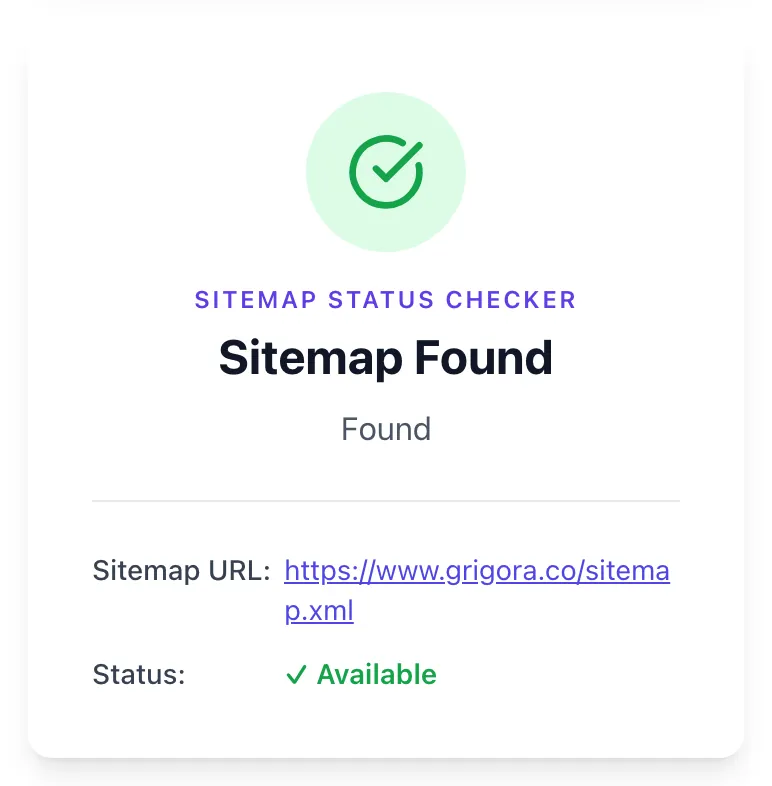
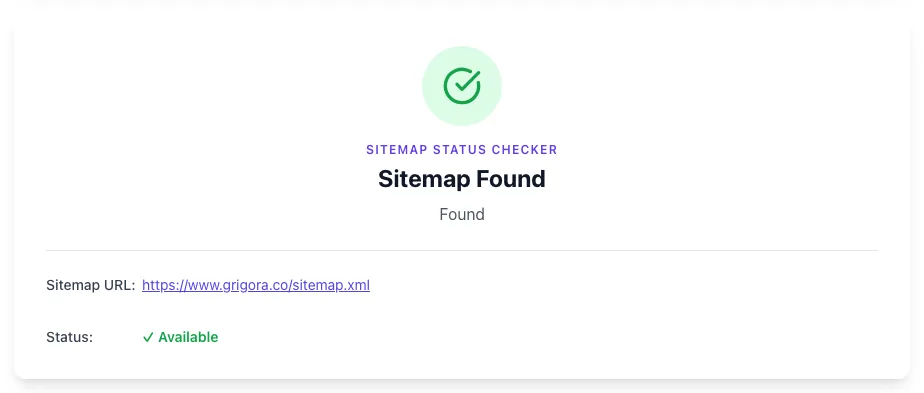
See what Find Sitemap produces
Clicking Find Sitemap runs the check and shows the result right below.
What this tool does
Sitemap Status Checker delivers fast, reliable results for check if your sitemap is accessible, valid, and indexed by google. validate xml, count urls, audit ping. free.
Designed to fit into your existing SEO and content workflow with no setup overhead.
How to use it
Five steps.
Enter your sitemap URL
Paste your sitemap URL (typically yoursite.com/sitemap.xml or yoursite.com/sitemap_index.xml) into the input field.
Run the validation
Click Check. The tool fetches the sitemap, parses XML, validates structure, and recursively checks any sub-sitemaps in an index.
Review the report
See HTTP status, URL count, lastmod validation, schema compliance, and any errors flagged by severity.
Fix flagged errors
Address malformed XML, missing lastmod, HTTP/HTTPS mismatches, or sitemap index issues. Re-validate after fixes.
Submit to Google Search Console
Once validation passes, submit the sitemap URL in GSC > Sitemaps. Add Sitemap: directive to robots.txt for auto-discovery by other crawlers.
When teams use it
Six common workflows.
Validate sitemap before launch
Before submitting to Google Search Console, validate sitemap structure, XML syntax, URL count, and lastmod accuracy. Catches errors that would otherwise show as red status in GSC and delay indexing.
Diagnose indexing problems
When GSC shows "submitted but not indexed" for many URLs, validate sitemap structure first. Eliminates technical sitemap issues as the cause before investigating content quality.
Migration validation
After CMS migrations or domain changes, validate that the new sitemap exists, is valid XML, and contains canonical URLs in the new structure. Catches HTTP-to-HTTPS issues and URL pattern errors.
Sitemap index troubleshooting
For large sites with sitemap_index.xml referencing 10+ sub-sitemaps, verify each child sitemap is accessible and valid. Find broken sub-sitemaps that GSC reports as "couldn't fetch".
Competitor sitemap analysis
Check competitor sitemaps to understand their site structure, content categories, and publishing cadence. /robots.txt usually references the sitemap; check for SEO competitive intelligence.
Monthly sitemap hygiene checks
Run a quick validation monthly. Sitemaps drift: CMS updates break generation, plugins introduce malformed entries, lastmod becomes stale. Catch issues before they hurt indexing.
Platform guides
Integrate with major platforms.
WordPress
- Install Yoast SEO or RankMath. Both auto-generate sitemap.xml at root
- Default URL: yoursite.com/sitemap_index.xml (Yoast) or yoursite.com/sitemap.xml (RankMath)
- Validate with our checker
- Submit in Google Search Console > Sitemaps after validation passes
Shopify
- Shopify auto-generates sitemap at yoursite.com/sitemap.xml, no plugin needed
- Sitemap index format with /sitemap_products_1.xml, /sitemap_collections_1.xml, /sitemap_pages_1.xml children
- Validate with our checker. Verify all sub-sitemaps return 200
- Submit yoursite.com/sitemap.xml in GSC; sub-sitemaps auto-discovered
Webflow
- Webflow auto-generates sitemap at yoursite.com/sitemap.xml when you publish
- Toggle on/off in Project Settings > SEO > Sitemap
- Validate after publish with our checker
- Submit in GSC after validation; CMS Collections auto-included if marked indexable
Next.js
- Use next-sitemap package or generate manually with getServerSideProps in pages/sitemap.xml.tsx
- For large sites, generate sitemap_index.xml referencing dynamic children (sitemap-blog.xml, sitemap-products.xml)
- Implement lastmod from CMS timestamps, not generation time
- Validate with our checker on every deploy; submit to GSC
Custom / static sites
- Generate sitemap.xml manually or with build scripts (Hugo, Jekyll, Eleventy auto-generate)
- Validate sitemaps.org schema compliance with our checker
- Add Sitemap: directive to robots.txt
- Submit to GSC and Bing Webmaster Tools; re-submit only when structural changes occur
Grigora vs. alternatives
Side-by-side.
| Capability | Grigora | Screaming Frog | GSC | Free Tools | Manual |
|---|---|---|---|---|---|
| XML validation against sitemaps.org schema | Yes | Yes | Yes | Yes | Manual |
| Sitemap index recursive check | Yes | Yes | Limited | No | Manual |
| lastmod format validation | Yes | Partial | Yes | Limited | Manual |
| URL count vs 50K limit warning | Yes | No | Yes | No | Manual |
| HTTPS canonical mismatch detection | Yes | Limited | Yes | No | Manual |
| Free with no signup | Yes | Yes | Trial only | Yes | N/A |
| Indexing status from GSC | No | Limited | Yes | No | Yes |
| Image and video sitemap validation | Yes | Yes | Yes | Limited | Manual |
Common errors and fixes
Eight issues users hit.
Sitemap returns 404 or 5xx error
Cause: Sitemap URL doesn't exist at the expected path, or server is misconfigured to return errors for /sitemap.xml.
Fix: Generate a sitemap (Yoast, RankMath, your CMS plugin, or custom code), upload to root, and verify accessible at https://yoursite.com/sitemap.xml. Update robots.txt with Sitemap: directive.
Malformed XML: parsing error
Cause: Special characters not encoded (& → &), unclosed tags, missing namespace declarations, or invalid datetime formats in lastmod.
Fix: Validate sitemap with W3C XML validator or our checker. Most issues: encode ampersands, ensure all `<url>` tags close, use proper xmlns="http://www.sitemaps.org/schemas/sitemap/0.9".
Submitted but not indexed (high ratio)
Cause: Sitemap includes 10,000 URLs but only 2,000 are indexed: typically thin content, duplicates, or non-canonical URLs being submitted.
Fix: Audit URLs in sitemap. Remove noindex pages, parameter URLs, and thin content. Improve content depth on pages worth indexing. Aim for 80%+ submitted-to-indexed ratio.
Sitemap exceeds 50,000 URL limit
Cause: Single sitemap file contains too many URLs: Google rejects parsing and reports error in GSC.
Fix: Split into multiple sitemaps (sitemap-blog.xml, sitemap-products.xml, sitemap-categories.xml) and create sitemap_index.xml as root referencing all. Each sub-sitemap stays under 50,000 URLs.
lastmod always shows current date
Cause: CMS or sitemap generator sets lastmod to the date the sitemap was generated, not when content actually changed.
Fix: Configure sitemap to pull lastmod from content modification timestamps in your CMS database. Yoast/RankMath do this correctly by default. Custom sitemaps need explicit lastmod logic.
Sitemap not referenced in robots.txt
Cause: Robots.txt missing the Sitemap: directive: crawlers other than Google may not auto-discover the sitemap.
Fix: Add `Sitemap: https://yoursite.com/sitemap.xml` to robots.txt at the root. Reload sitemap discovery in GSC, Bing Webmaster Tools, and any other search engines you target.
HTTP URLs in HTTPS sitemap (or vice versa)
Cause: Site migrated to HTTPS but sitemap still references http:// URLs: creates canonical mismatch.
Fix: Regenerate sitemap with consistent HTTPS URLs throughout. Verify with our checker that all `<loc>` values use the canonical https:// scheme.
Sitemap index referencing non-existent sub-sitemaps
Cause: sitemap_index.xml references sitemap-products.xml that returns 404: Google reports "Couldn't fetch" error in GSC for the sub-sitemap.
Fix: Verify each sub-sitemap URL is accessible (200 response). If a sub-sitemap is removed, update the index file. Re-submit sitemap_index.xml in GSC after fixes.
Original data
2026 study.
Frequently asked questions
Twelve answers.
Related free tools
Other utilities.
Robots.txt Tester
Test whether a URL is allowed or blocked, and by which rule.
Try itMeta Tag Generator
Generate page meta tags.
Try itMeta Description Generator
AI-write descriptions.
Try itSERP Snippet Preview
Visualize SERP rendering.
Try itOpen Graph Checker
Audit OG tags.
Try itMeta Title Checker
Audit page title.
Try itLink Metadata Scraper
Pull all metadata from URL.
Try it