This guide provides ready-to-use welcome email templates for different business scenarios, along with best practices for writing welcome emails that engage, convert, and build lasting relationships.
Grigora Mail
Welcome Email Template: 15+ Examples for Every Business Need
Karan Singh BhakuniUpdated 18 Sept 2026
- 10 min read
- 11 sections
- 5 questions answered
The short answer
A welcome email is the first message someone receives after subscribing to your list, creating an account, making a purchase, or joining your organization. It sets the tone for your entire relationship with that person and has some of the highest open rates of any email type, often reaching 50% to 60% or higher. Getting your welcome email template right is one of the most impactful things you can do for your email marketing and customer communication strategy.
Sending something like this yourself? Try Grigora Mail free
Contents11 sections
Read next25 Business Email Examples and Templates
Why Welcome Emails Are So Important
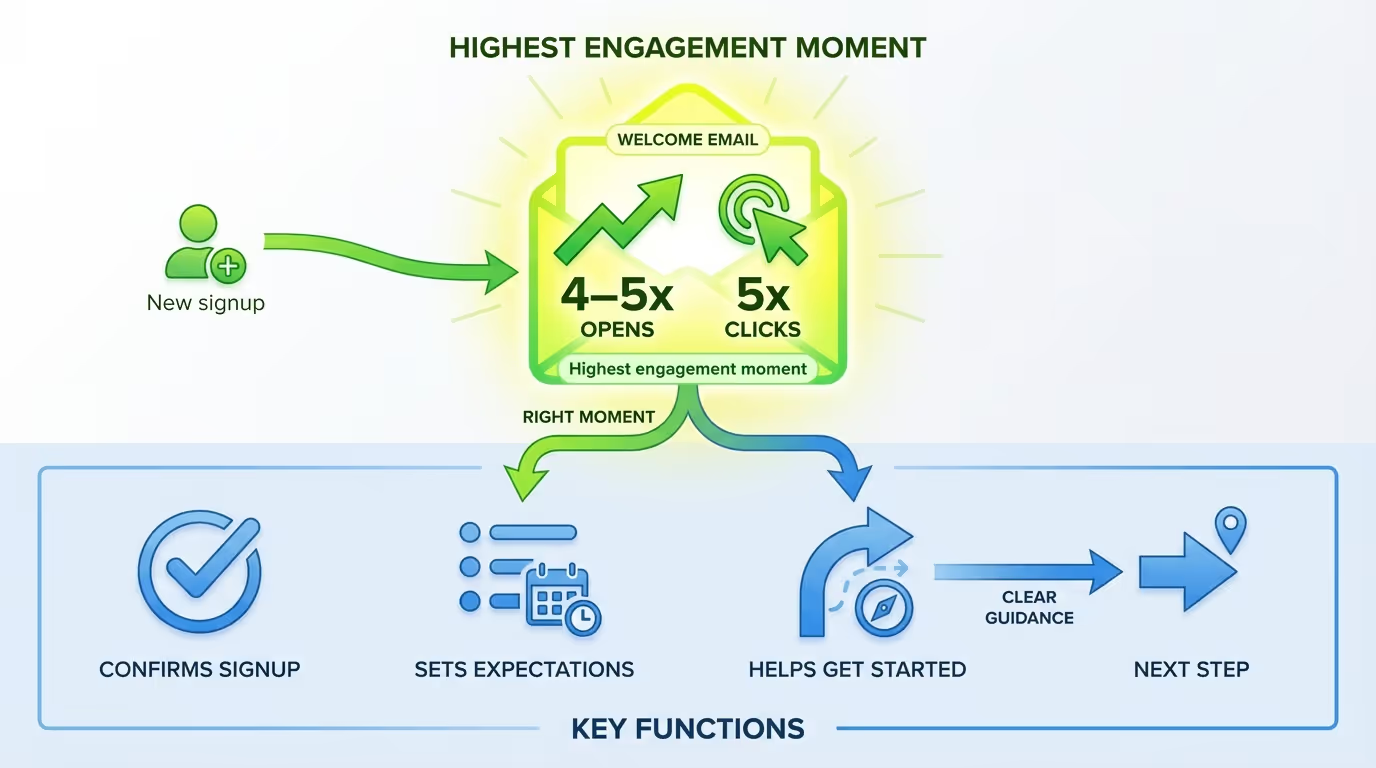
Welcome emails receive 4 to 5 times more opens and 5 times more clicks than regular marketing emails. They arrive at the exact moment when a new subscriber or customer is most engaged with your brand. This makes the welcome email your best opportunity to make a strong first impression, deliver immediate value, and guide people toward the next step in their journey with your business.
Beyond engagement metrics, welcome emails also serve practical purposes. They confirm that the subscription or sign-up was successful, set expectations for what the recipient will receive going forward, and provide essential information or resources they need to get started.
Welcome Email for New Newsletter Subscribers

When someone subscribes to your newsletter, they are expressing interest in your content. Your welcome email should deliver on that interest immediately.
Template: Newsletter Welcome
Subject: Welcome to [Newsletter Name]: Here's What to Expect
Hi [First Name],
Thank you for subscribing to [Newsletter Name]. You have joined [number] other [professionals/readers/enthusiasts] who receive our [frequency] updates on [topics covered].
Here is what you can expect from us:
Every [day/week/month], we will send you [brief description of content, e.g., "actionable tips on email marketing, real case studies from successful campaigns, and exclusive insights from industry experts"]. We keep our emails concise and focused on helping you [desired outcome].
To get you started, here are three of our most popular articles:
1. [Article Title 1]: [One-line description]
2. [Article Title 2]: [One-line description]
3. [Article Title 3]: [One-line description]
If you have any questions or topics you would like us to cover, just reply to this email. We read every response.
Welcome aboard,
[Your Name]
[Company]
Welcome Email for New Customers

After someone makes their first purchase, the welcome email should acknowledge the transaction, provide helpful information, and encourage them to continue engaging with your brand.
Template: E-commerce Customer Welcome
Subject: Welcome to [Brand Name]: Your Order Is Confirmed
Hi [First Name],
Welcome to the [Brand Name] family. Your order #[Order Number] has been confirmed, and we are already getting it ready for you.
While you wait for your [product] to arrive, here are a few things you might find helpful:
Track Your Order: You can check your order status anytime at [tracking link].
Get the Most From Your Purchase: Check out our [getting started guide/care instructions/usage tips] to make sure you get the best experience.
Join Our Community: Connect with other [Brand Name] customers on [social media platform] where we share exclusive tips, new arrivals, and behind-the-scenes content.
As a thank you for your first order, here is [incentive, e.g., "a 10% discount code WELCOME10 for your next purchase"]. It is valid for the next 30 days.
If you need anything at all, our support team is here to help at [support email] or [phone number].
Thank you for choosing [Brand Name],
[Your Name or Team Name]
Welcome Email for SaaS and App Sign-Ups
When users sign up for a software product or app, the welcome email should focus on helping them succeed with the product as quickly as possible.
Template: SaaS Onboarding Welcome
Subject: You're In. Let's Get You Set Up
Hi [First Name],
Welcome to [Product Name]. You have just taken the first step toward [key benefit]. Here is how to get the most out of your account in the next few minutes.
Step 1: Complete Your Profile
Add your [key information] to personalize your experience. [Link to profile settings]
Step 2: [Key Action]
[Brief instruction for the most important first action]. This is where most users start seeing results. [Link to feature]
Step 3: Explore [Feature]
Once you have the basics down, try [secondary feature] to [benefit]. [Link to feature]
Need help getting started? Here are some resources:
- [Quick Start Guide link]
- [Video Tutorial link]
- [Help Center link]
If you have questions, reply to this email or chat with us live at [support link]. We typically respond within [time frame].
Happy [using the product],
[Founder/Team Name]
[Product Name]

Also worth reading11 Reasons Why Every Business Needs a Website
Welcome Email for New Employees
A welcome email to a new employee sets the tone for their experience at your company. It should make them feel valued and prepared for their first day.
Template: New Employee Welcome
Subject: Welcome to [Company Name]: We're Excited to Have You
Hi [First Name],
On behalf of the entire [Company Name] team, welcome aboard. We are thrilled to have you join us as [Job Title] on [Start Date].
Here is what to expect on your first day:
Arrival: Please arrive at [location/address] by [time]. Ask for [contact person] at the front desk, and they will get you settled.
What to Bring: Your photo ID, [any required documents], and whatever you need to be comfortable. We will provide a laptop, access badges, and other equipment.
Schedule: Your first day will include an orientation session, team introductions, and time to set up your workspace. We have also planned a welcome lunch with your team at [time].
Important Links:
- [Employee Handbook: link]
- [Benefits Enrollment: link]
- [IT Setup Guide: link]
Your manager [Manager Name] will be your main point of contact and will reach out separately to discuss your first week's schedule. If you have any questions before your start date, feel free to email me directly.
We cannot wait to get started,
[HR Contact Name]
[Title] | [Company Name]
Welcome Email for Event Registrants
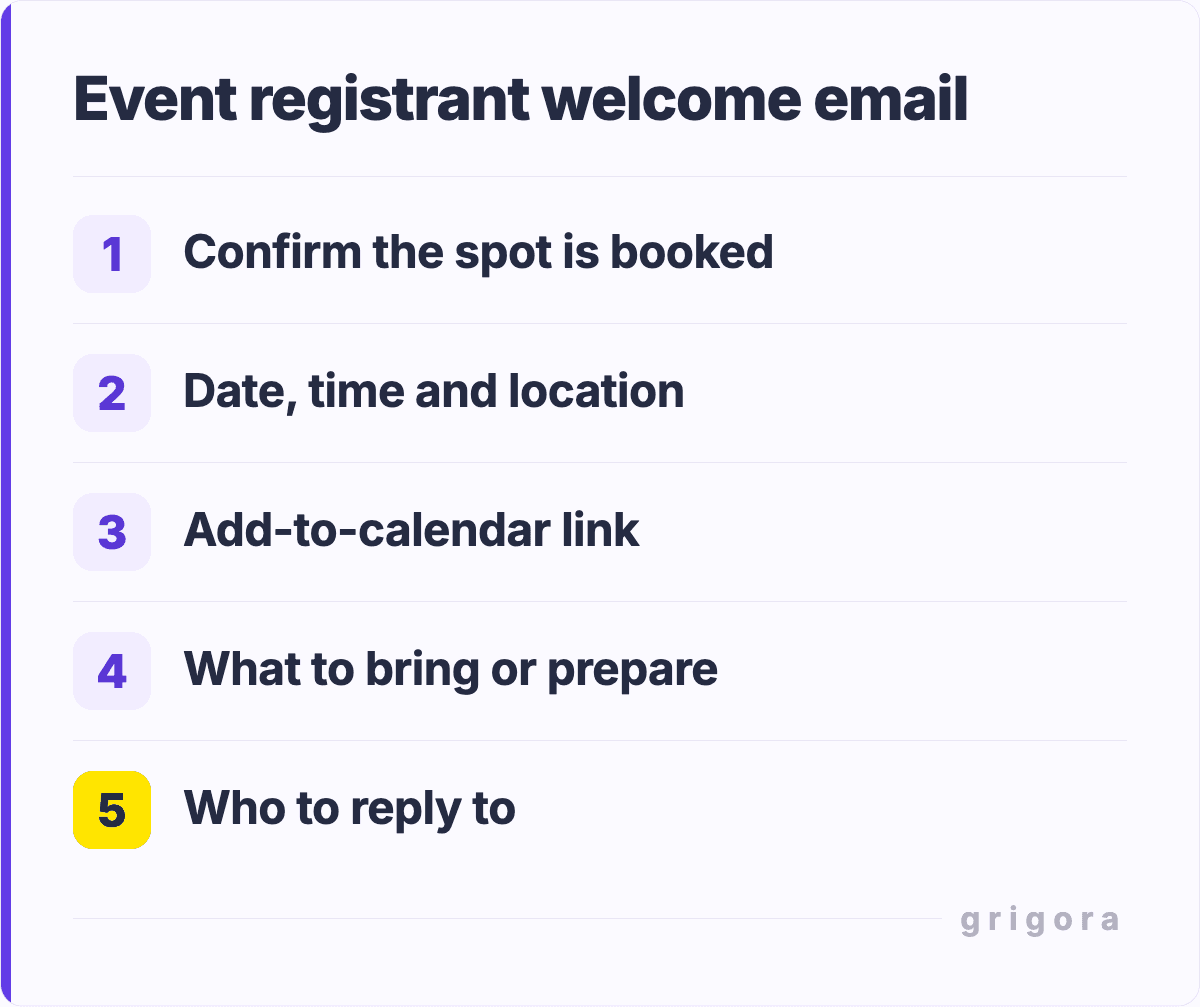
When someone registers for your webinar, conference, or workshop, the welcome email confirms their registration and provides essential event details.
Template: Event Registration Confirmation
Subject: You're Registered for [Event Name]: Here's Everything You Need
Hi [First Name],
You are all set for [Event Name] on [Date] at [Time] [Timezone].
Event Details:
Date: [Date]
Time: [Time] - [End Time] [Timezone]
Location: [Physical address or "Online via [Platform]"]
Access Link: [Link for virtual events]
What You Will Learn:
[Key takeaway 1]
[Key takeaway 2]
[Key takeaway 3]
Before the Event:
[Any preparation instructions, materials to review, or software to install]
Add this event to your calendar: [Calendar link]
We will send a reminder email [timeframe] before the event starts. If you have questions, reply to this email.
See you there,
[Organizer Name]
[Company/Organization]
Welcome Email Best Practices
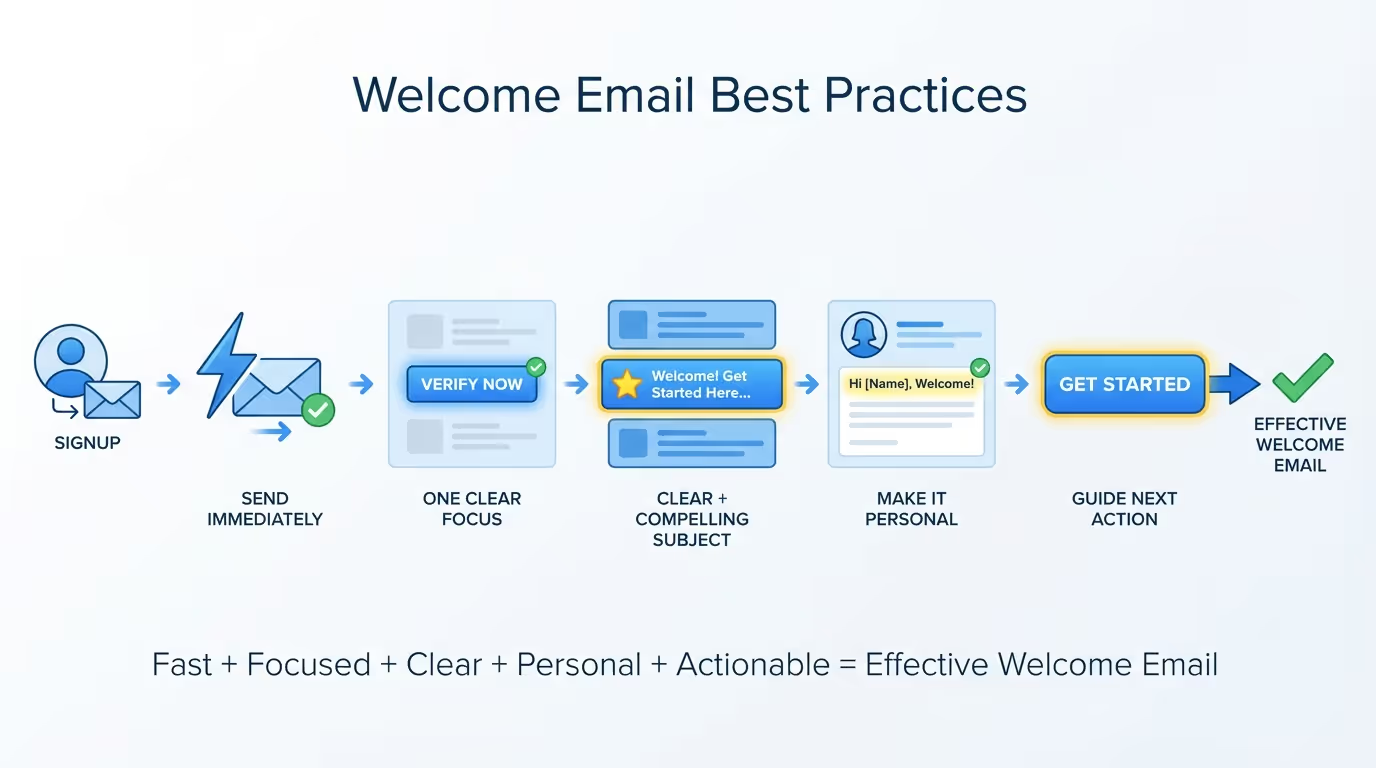
Regardless of the specific scenario, these best practices apply to all welcome emails.
Send Immediately
Welcome emails should be sent within minutes of the triggering action, not hours or days later. The recipient's interest and attention are highest right after they sign up. Delayed welcome emails miss this critical engagement window.
Keep the Focus Narrow
Do not try to communicate everything in the welcome email. Focus on one primary action you want the recipient to take, whether it is completing their profile, reading a resource, making a second purchase, or joining a community. Too many options lead to decision paralysis and inaction.
Write a Compelling Subject Line
The subject line should clearly communicate what the email is about and create a reason to open it. Using the word "welcome" helps recipients identify the email immediately. Adding a benefit or teaser increases open rates further.
Personalize When Possible
Use the recipient's first name and reference specific details about their action, such as the product they purchased, the plan they chose, or the event they registered for. Personalization makes the email feel like a conversation rather than an automated broadcast.
Include a Clear Next Step
Every welcome email should guide the recipient toward one specific action. Use a prominent button or link that makes the next step obvious and easy to take. Phrases like "Get Started," "Explore Your Dashboard," or "Read Your First Guide" work well.
Welcome Email Sequence vs. Single Welcome Email
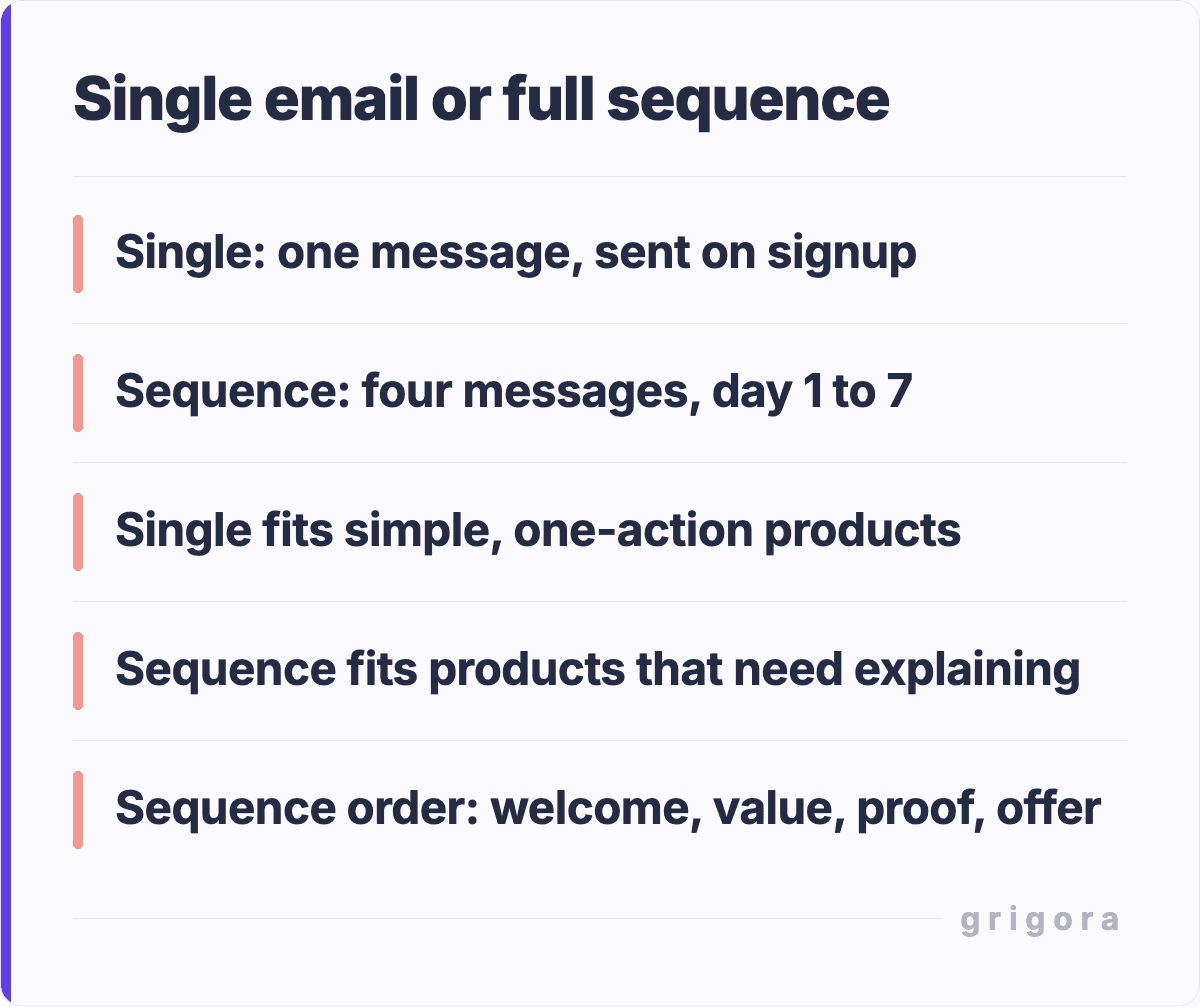
While a single welcome email works for simple scenarios, many businesses benefit from a welcome email sequence that sends multiple emails over the first few days or weeks.
When to Use a Sequence
A welcome sequence works best when your product or service has a learning curve, when you have multiple features or benefits to highlight, or when you want to nurture new subscribers toward a purchase. A typical welcome sequence might include a welcome and confirmation email on day one, a value-focused educational email on day two, a social proof or case study email on day four, and a call to action or special offer on day seven.
When a Single Email Suffices
A single welcome email is appropriate for simple confirmations like event registrations, straightforward subscriptions where the value proposition is clear, or situations where the recipient already has a strong understanding of what to expect.
How Grigora Powers Your Welcome Email Strategy
Your welcome email is only as effective as the destination it links to. Grigora helps you build professional landing pages, onboarding flows, resource centers, and product pages that your welcome emails can direct recipients to. With Grigora's fast page loading, responsive design, and built-in SEO optimization, every link in your welcome email leads to a polished, professional experience that reinforces your brand credibility and converts new subscribers into loyal customers.
Conclusion
A well-crafted welcome email template is one of the highest-impact assets in your communication toolkit. Whether you are welcoming newsletter subscribers, new customers, SaaS users, employees, or event attendees, the principles remain the same: send it immediately, deliver clear value, and include one obvious next step.
Use the templates in this guide as starting points, customize them for your brand voice and audience, and test different approaches to find what resonates best with your recipients. With strong welcome emails in place, you will build stronger relationships from the very first interaction.
Frequently Asked Questions
What should a welcome email include?
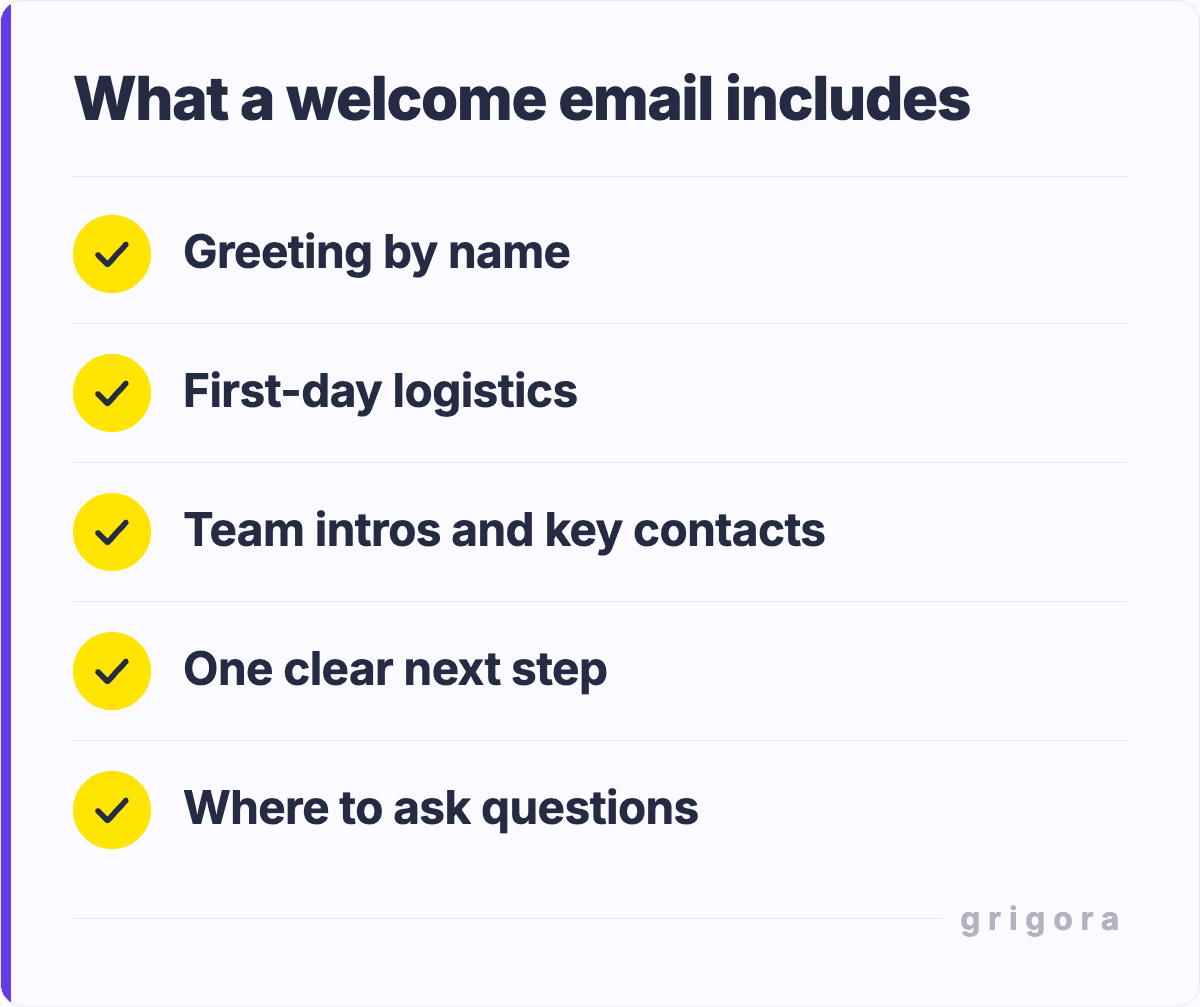
A welcome email should include a warm greeting with the recipient's name, confirmation of their action (subscription, purchase, sign-up), what they can expect next, one clear call to action, and relevant links or resources to get started.
When should a welcome email be sent?
Welcome emails should be sent immediately, within minutes of the triggering action. Studies show that welcome emails sent within the first hour receive the highest engagement rates. Delays of even a few hours can reduce open rates significantly.
What is a good open rate for welcome emails?
Welcome emails typically achieve 50% to 60% open rates, which is 4 to 5 times higher than regular marketing emails. If your welcome email open rate is below 40%, consider testing different subject lines or ensuring the email is sent immediately.
Should I include a discount in my welcome email?
Including a discount or incentive can boost conversion rates, especially for e-commerce businesses. Common approaches include offering 10% to 15% off the first purchase, free shipping, or a free trial extension. Test whether incentives improve your conversion rate versus providing value-focused content alone.
How long should a welcome email be?
Keep welcome emails concise, ideally between 100 and 300 words. The email should be scannable with clear sections, a prominent call-to-action button, and minimal paragraphs. Long welcome emails tend to overwhelm recipients and reduce click-through rates.
Practical writing on building a site, growing an audience and sending email people open. No more than one a week.
KS
Karan Singh Bhakuni
117 articles on the Grigora blog
More on Grigora Mail
Grigora Mail
25 Business Email Examples and Templates
We all send emails every day, but writing a good business email isn’t always as easy as it sounds. Sometimes you’re not sure how formal to be. Other times, you spend way too long phrasing a simple me
28 Feb 202628 min read
Guides
11 Reasons Why Every Business Needs a Website
Introduction In today's digital age, having a robust online presence is not just an option but a necessity for businesses of all sizes and industries. The cornerstone of this online presence is a…
7 Sept 202317 min read
Grigora Mail
30+ Professional Email Examples and Templates
Email remains the most powerful tool for professional communication. Whether you're introducing yourself to a potential client, requesting a meeting with a busy executive, following up on an…
3 Mar 202621 min read