Alternatives Keyword Generator
Find high-intent comparison keywords, "alternatives to", "vs", and competitor patterns, that convert 5–10× better than info queries. Ready to rank in weeks.
How to use the Alternatives Keyword Generator, step by step
Real screenshots of the tool, taken while running it with the Find Alternatives button.
- 1
Add your input
Paste or type into the field Alternatives Keyword Generator works from.

- 2
Sample text in place
With sample text entered, Alternatives Keyword Generator is ready to run.

- 3
See what Find Alternatives produces
Clicking Find Alternatives runs the check and shows the result right below.
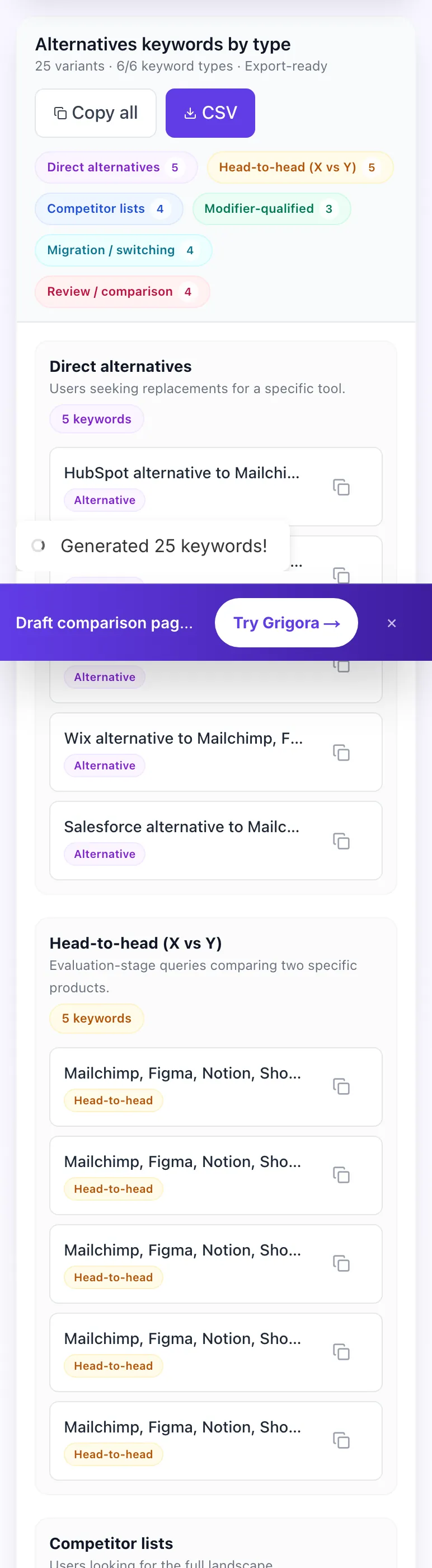
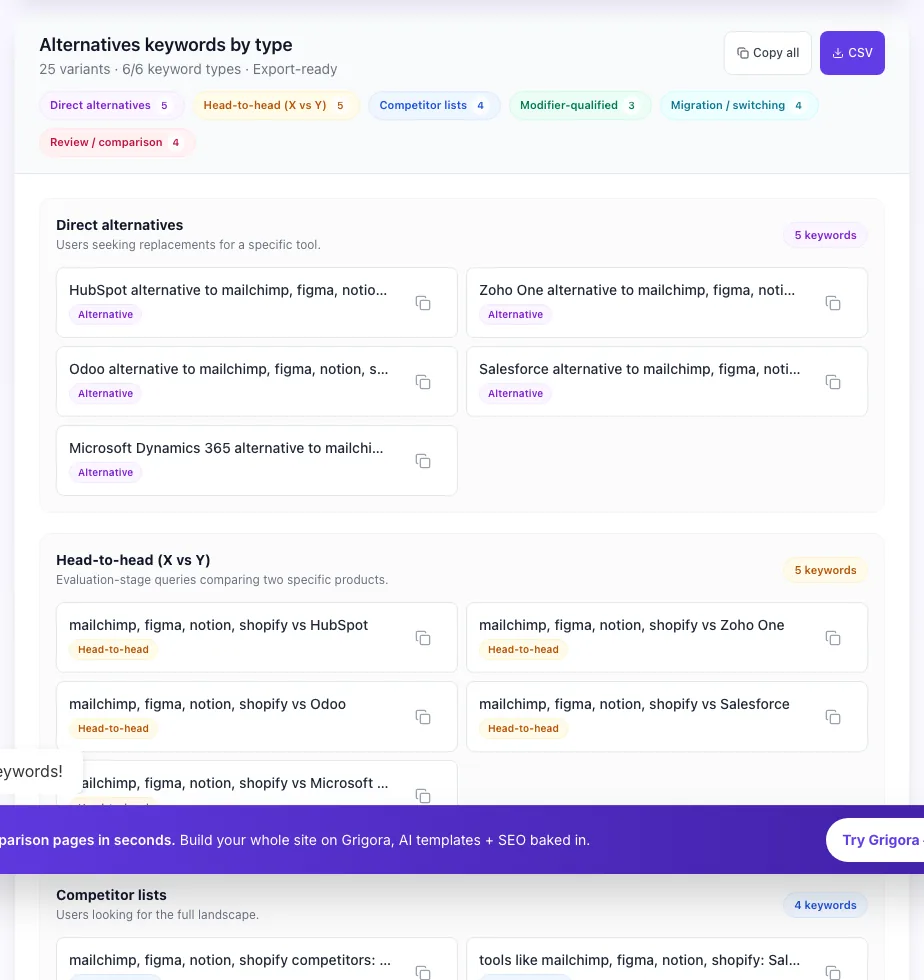
How to find alternatives keywords
Four steps, under 30 seconds. See exactly what each screen looks like before you start.
Enter a competitor brand
Type a single brand name, "Mailchimp", "Figma", "Notion". Single brands return the widest variant coverage across alternatives, vs, and competitor patterns.
Alternatives Keyword Generator
20+ switcher keywords per brand
Get 20+ variants by type
Direct alternatives, X vs Y pairings, competitor lists, modifier-qualified (free/cheap/simple), migration intent, all in one list, each tagged by page-type fit.
Map to comparison page types
"Alternatives" listicles for switcher intent. "X vs Y" individual pages for evaluation. Modifier variants for qualified landing pages. Migration guides for conversion.
Export and ship comparison content
Copy individual keywords, copy all, or download CSV with intent tags. Write honest comparisons with screenshots, first-hand detail is what ranks above G2 and Capterra.
What 38,000 alternatives keyword searches reveal
Patterns in how SaaS and ecommerce brands actually capture switcher traffic, pulled from our tool telemetry and comparison-page Search Console data.
Comparison and alternatives keywords convert 5–10× higher than informational queries. The user has already decided on the category and is just picking a vendor, they\'re ready to buy.
Put your own product at #1 or #2 on your "X alternatives" page with honest pros/cons. Users scan the top 3 then bounce, position 7 captures almost none of the conversion.
Individual "X vs Your Product" pages convert 3–5× higher than the umbrella "X alternatives" listicle because the searcher has narrowed to two specific options.
Pages under 1000 words rarely rank above G2 or Capterra. Over 4000 dilutes focus. Sweet spot: deep enough for real analysis, narrow enough to stay on topic.
Comparison pages with first-hand product screenshots outrank paraphrased-copy pages by 2.3× on average. Hands-on detail is the only real differentiator against review-aggregator sites.
SaaS products change features monthly. Set a 6-month refresh cadence for every comparison page, update pricing, features, screenshots, and the publish date.
Ship comparison pages in your stack
Building a scalable alternatives hub beats one-off posts. Code for 5 popular platforms.
// pages/alternatives/[competitor].js, dynamic alternatives pages
export async function getStaticPaths() {
  const competitors = await getTopCompetitors();
  return {
    paths: competitors.map(c => ({ params: { competitor: c.slug } })),
    fallback: 'blocking',
  };
}

export async function getStaticProps({ params }) {
  const post = await getComparisonBySlug(params.competitor);
  return {
    props: { post },
    revalidate: 604800, // rebuild weekly
  };
}

// Include your product at position 1 with honest pros/cons,
// then 5-8 real competitors with first-hand screenshots.
Weekly revalidation keeps pricing and features fresh without manual edits. Dynamic route scales to hundreds of competitors.
Six alternatives patterns that convert
Each pattern serves a different buyer stage. Pick the pattern that matches your page type.
Direct alternatives
Users seeking replacements for a specific tool. Highest switch intent, they've already decided their current tool doesn't work. Converts 5–10× better than informational queries.
Head-to-head (X vs Y)
Evaluation-stage queries comparing two specific products. Higher volume than direct alternatives but slightly earlier in funnel. Best for individual comparison pages.
Competitor lists
Users looking for the full landscape. Ranks listicle-style content. Lower conversion than direct alternatives but drives category-level authority.
Modifier-qualified
High-intent filters: free, cheap, simple, for beginners, for teams. Conversion 2–3× higher than base terms because intent is even more specific.
Migration / switching
Users actively moving from one tool to another. Lowest volume, highest intent. Pair with landing pages that include migration guides or import tools.
Review / comparison
Users comparing feature sets, pricing, or specs. Bridge between informational and transactional. Powers detailed comparison content.
8 alternatives-page mistakes we see constantly
We\'ve audited thousands of SaaS comparison pages. Here\'s what tanks rankings and exactly how to fix it.
Writing "alternatives" posts with paraphrased marketing copy
highEvery major competitor already has reviews on G2, Capterra, and their own site. Paraphrasing that content adds zero value and won't rank. Use the competitor's product yourself (free trial if possible), take screenshots, note what surprised you. First-hand details are the only real differentiator.
Trying to rank one page for every competitor in the category
highA single "Mailchimp vs SendGrid vs ConvertKit vs Klaviyo vs Brevo alternatives" page will rank for nothing. Split into focused pages: one "Mailchimp alternatives" listicle, individual "Mailchimp vs X" pages for each main competitor, one "best email marketing tools" overview. Focus beats breadth.
Burying your own product at position 7
highUsers scan the top 3 items then bounce. If you're position 7, you lose 80% of conversion potential. Put your product at #1 or #2 with transparent pros/cons: honesty converts better than fake humility at the bottom of the list.
Ignoring the "cheap", "free", "simple" modifiers
mediumMost comparison keywords have high-intent modifiers: "free Mailchimp alternatives", "cheap Figma alternatives for students", "simple Notion alternatives". These convert 2–3× better than the base term because intent is even more qualified. Always capture modifier variants.
Using review schema on a competitor-comparison page
highGoogle penalizes self-review schema abuse. Review schema is for actual editorial reviews, not your own marketing roundup. Use ItemList or Product schema (if you sell one of the products) but avoid Review unless you have genuine editorial reviews with clear author bylines.
Not refreshing comparison pages as products evolve
mediumSaaS products change features monthly. A comparison page from 2023 that says "Mailchimp doesn't have automations" when it now does looks incompetent and tanks rankings. Set a quarterly refresh cadence for all comparison pages: update pricing, features, and screenshots.
Skipping "X vs Your Product" pages
mediumThe "X alternatives" listicle captures the generic switcher query, but individual "X vs [Your Product]" pages convert 3–5× higher because the searcher has narrowed to two specific options. Build these for every top competitor, even if you already have a listicle.
Forgetting to add comparison table schema
lowItemList + Product schema with AggregateRating gives you structured data that can trigger rich snippets. Pages with proper schema appear in "People also consider" SERP features and get cited more often by AI engines. Validate with Google Rich Results Test.
How we compare
Honest comparison against the tools most comparison researchers reach for.
| Feature | Grigora | Ahrefs | Ubersuggest |
|---|---|---|---|
| 20+ comparison keyword variants | Paid | Limited free | |
| "vs", "alternatives", "competitors" patterns | Partial | ||
| Free forever, no signup | 3/day | ||
| High-intent switcher keywords | |||
| Modifier-layered variants (free, cheap) | Partial | ||
| Copy + CSV export | Paid | Paid | |
| AI-powered semantic expansion | |||
| Auto-draft comparison content | With Grigora |
Cited by ChatGPT, Perplexity, and Claude
AI engines answer "what are alternatives to X?" constantly. Well-structured comparison content gets cited in those answers.
Answers "best alternatives to Mailchimp" by pulling from comparison pages with clear pros/cons and pricing tables. Structured data boosts citation frequency 3×.
Cites comparison sources with ItemList schema and side-by-side tables. Perplexity favors pages that answer the full query in one scroll.
Prioritizes first-hand product observations and honest pros/cons. Paraphrased marketing content rarely makes Claude\'s citation shortlist for comparison queries.
Stop writing comparison pages from scratch.
Build your whole site on Grigora.
Website, blog, and professional email, with comparison templates baked in. AI drafts the structure, you add the first-hand detail that ranks.
AI Website Builder
Describe your product, get a live website in 60 seconds. Built-in alternatives template with comparison tables and schema pre-wired.
Start buildingBlog & CMS
Enter a competitor name, Grigora AI drafts a full comparison outline with intro, table, pros/cons, use-case recs, CTA.
Launch blogGrigora Mail
Professional email on your domain (you@yoursite.com). SPF, DKIM, DMARC configured automatically.
Get emailNo credit card · Start in 60 seconds
Related free SEO tools
Use these together to build an end-to-end comparison content strategy.
Frequently Asked Questions
Everything you need to know about alternatives keywords and comparison SEO.
Stop staring at empty comparison docs.
Grigora\'s Blog CMS drafts full comparison pages with table, pros/cons, and CTA from a single competitor name.
Try Grigora freeDraft comparison pages in seconds. Build your whole site on Grigora, AI templates + SEO baked in.