Testimonial Generator
Create realistic, professional testimonials for your products using AI.
How to use the Testimonial Generator, step by step
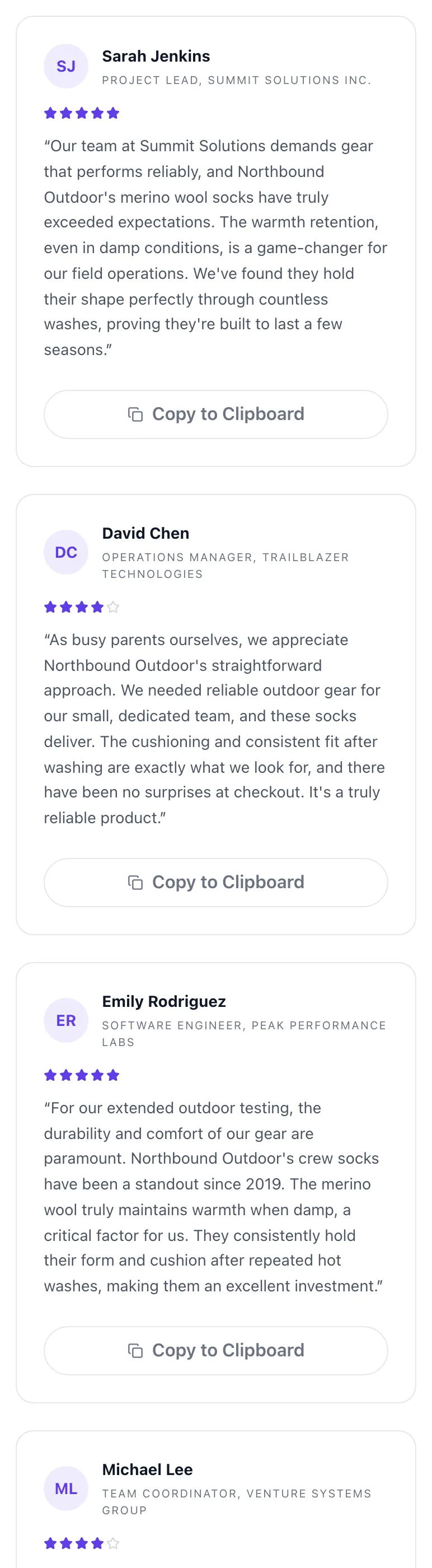
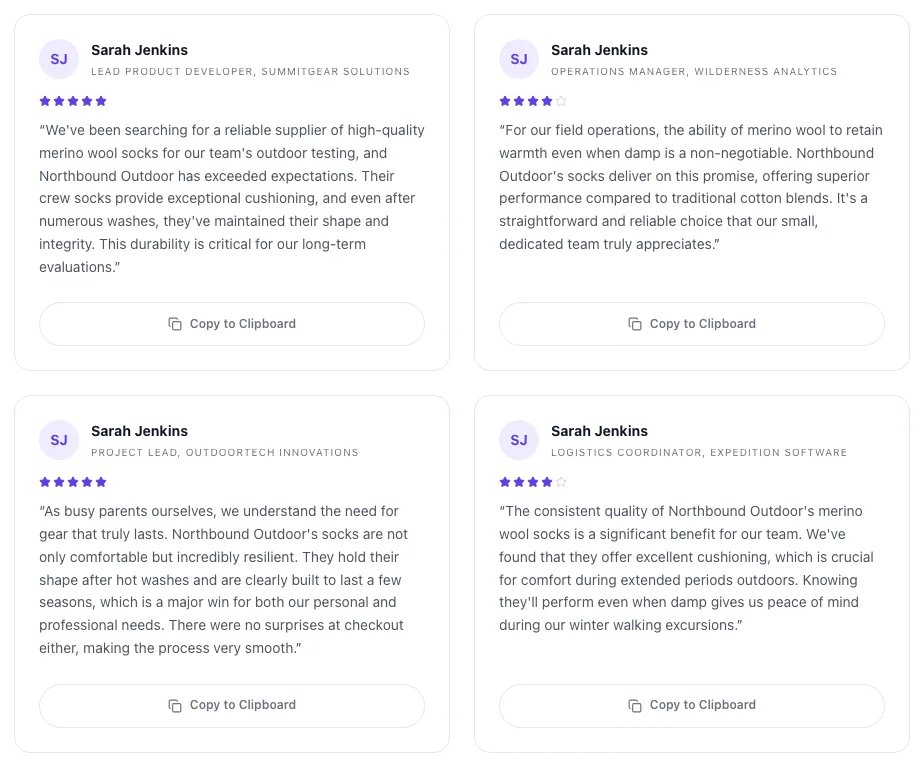
Real screenshots of the tool, taken while running it with the Generate Testimonials button.
- 1
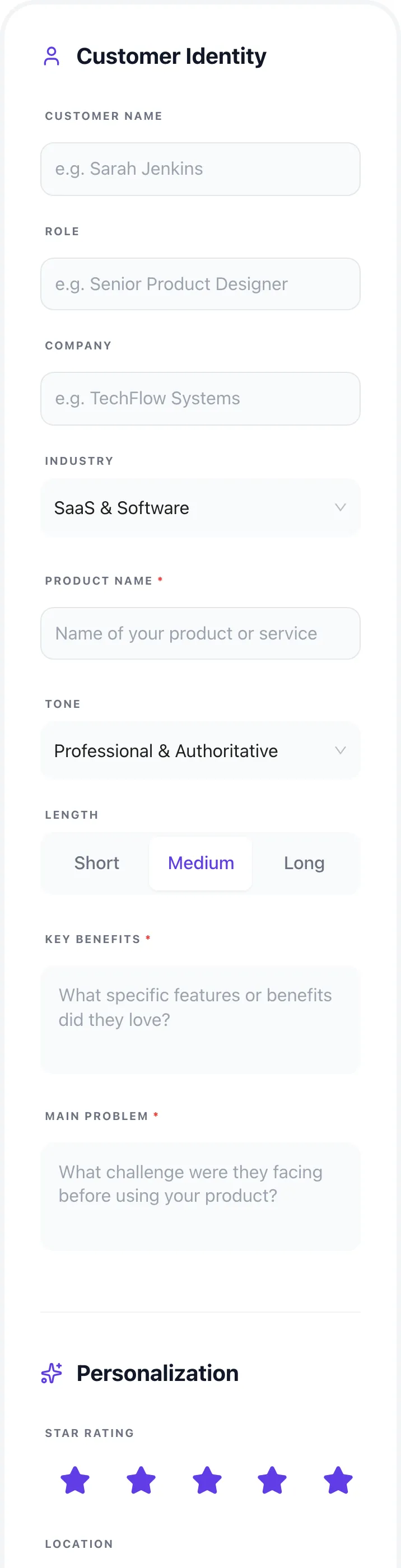
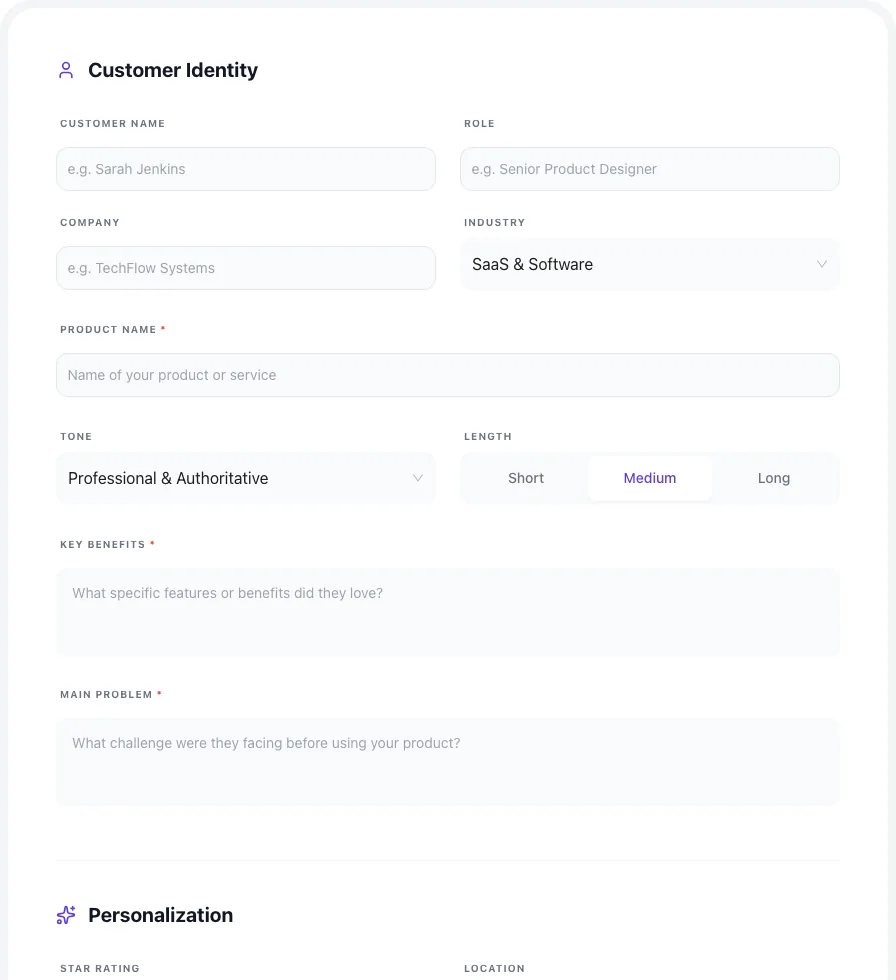
Add your input
Paste or type into the field Testimonial Generator works from.
- 2
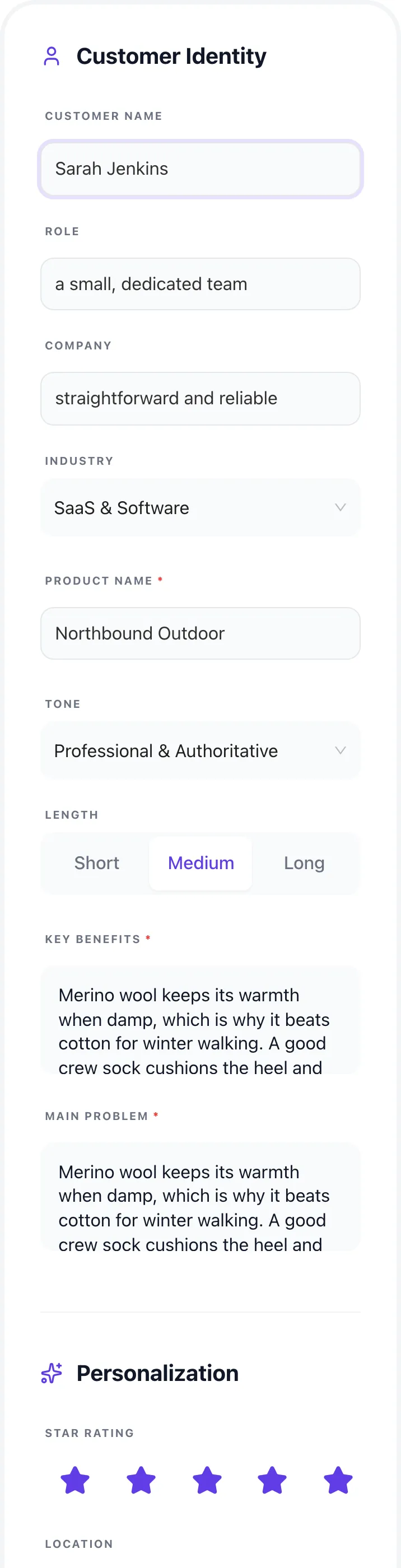
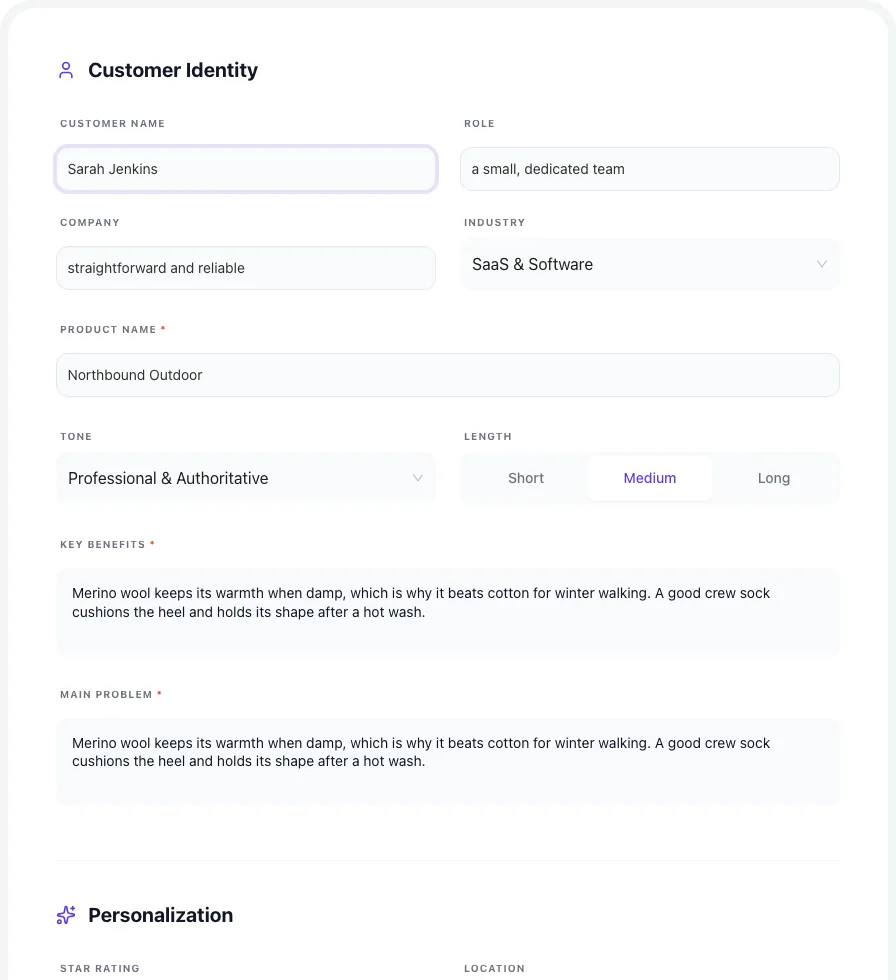
Sample text in place
With sample text entered, Testimonial Generator is ready to run.
- 3
See what Generate Testimonials produces
Clicking Generate Testimonials runs the check and shows the result right below.
What this tool does
Testimonial Generator creates realistic placeholder testimonials for mockups, prototypes, and collection examples.
Designed to fit into your existing SEO and content workflow with no setup overhead.
How to use it
Five steps.
Describe your product, customer, and outcome
Specify product type, target persona role, industry, and one specific measurable outcome to anchor the testimonial.
Choose tone, length, and persona seniority
Select short quote vs paragraph narrative; junior vs senior author; technical vs non-technical voice for natural variation.
Generate variants and pick favorites
Generate 5-10 variants per request; review for authenticity, specificity, and fit; mark the strongest 3-6 to use as placeholders.
Export with optional Review schema markup
Copy as plain text, Markdown, or schema-marked HTML; the schema is structured for placeholder use only and clearly labeled.
Replace with real testimonials before launch
Use the generated layout as a design guide; collect real customer testimonials via Senja, Vouch, or your own form before going live.
When teams use it
Six common workflows.
Designing landing page mockups before launch
Designers and developers building a new product landing page need realistic-looking placeholder testimonials to evaluate layout, typography, and visual hierarchy. Generated testimonials fill these placeholders during development, then get replaced with real customer testimonials before launch.
Inspiring customer testimonial collection forms
When designing a testimonial collection form for real customers, the generator outputs example testimonials that show structure: problem, solution, outcome. Use these as examples in your collection form to coach customers on what makes a useful testimonial.
Wireframing case study templates
Long-form case studies need testimonial pull-quotes throughout the document. During wireframing, generated quotes establish the visual rhythm; replace with real quotes from the case study subject before publishing.
Building demo environments and sandboxes
Sales demo accounts and product sandboxes benefit from realistic content including testimonials. Generated content seeds the demo environment so prospects evaluating the product see a representative experience without exposing real customer reviews.
Internal training and copywriting workshops
Marketing teams running copywriting workshops use generated testimonials as case studies in what works and what does not. Compare 5-6 variants of testimonials for the same product and discuss why some feel authentic and others feel artificial.
A/B testing testimonial placement and format
Conversion teams testing whether testimonials work better in hero, near pricing, or near CTA need consistent placeholder content for comparison. Generated content keeps the test focused on placement rather than testimonial quality variance.
Platform guides
Integrate with major platforms.
Standalone landing page (any platform)
- Use generated testimonials only as placeholders during design; replace with real testimonials before launch
- Place 3-6 real testimonials prominently: hero, after pricing, near final CTA
- Each testimonial includes name, title, company, real photo, and specific outcome
- Add Schema.org Review markup with itemReviewed, author, reviewRating, reviewBody
- Link to verified platform (G2, Trustpilot) for "see all reviews" credibility
Shopify product pages
- Use Shopify Reviews app (free) or Yotpo (paid) for collecting real customer reviews
- Display verified reviews on each product page; aggregate rating in schema
- Use generated testimonials only in collection-form examples to coach customers
- Set up Klaviyo or Mailchimp triggered email after delivery to request reviews
- Display real video testimonials via Vouch or Loox apps for highest conversion
WordPress / WooCommerce
- Use Strong Testimonials plugin (free) or WP Customer Reviews (free) for collection and display
- Build a Testimonials page using generated examples as design template
- Replace with real submissions; require author email, photo upload, and consent
- Add Review schema via Yoast SEO Premium or Rank Math Pro automatically
- Use Stamped.io or Reviews.io integration for verified review badges
SaaS landing page (Webflow / Framer / Next.js)
- Generate placeholder testimonials during build; tag clearly with "PLACEHOLDER" in CMS
- Set up real testimonial collection via Senja, Vouch, or Testimonial.to (free or low-cost)
- Embed verified G2 or Capterra widget on landing page for B2B credibility
- Build a /testimonials page with 20-50 real reviews; link from landing page
- Use Schema.org Review and AggregateRating; validate via Google Rich Results Test
Email marketing campaigns
- Quote real testimonials in email body, not just headers; pair with photo and link
- Use generated examples to teach copywriters what good testimonial selection looks like
- A/B test: testimonial in body (after value pitch) vs no testimonial; measure click rate
- Include FTC disclosure if any reviewer received compensation or free product
- Rotate testimonials monthly to keep content fresh and avoid the same one wearing out
Grigora vs. alternatives
Side-by-side with ChatGPT, Copy.ai, Senja / Vouch, and manual collection.
| Capability | Grigora | ChatGPT | Copy.ai | Senja / Vouch | Manual |
|---|---|---|---|---|---|
| AI testimonial generation for placeholders | Yes | Yes | Yes | No | No |
| Industry-specific persona variation | 12 industries | 5 | Generic | N/A | N/A |
| Schema.org Review markup output | Yes | No | No | Yes | Manual |
| FTC disclosure templates | Yes | No | No | Yes | Manual |
| Real testimonial collection workflow | Pointer to partners | No | No | Yes (Vouch, $40+/mo) | Manual |
| Free unlimited generation | Yes | Limited free | Trial only | Paid | Free |
| Output formats (text, schema, JSON) | 3 formats | 1 format | 1 format | Schema-focused | Manual |
| Persistent ethical-use warnings | Yes | No | No | No | N/A |
Common errors and fixes
Eight issues users hit.
Generated testimonial sounds artificial
Cause: Inputs were too generic, so the AI produced bland praise without industry-specific language or specific outcomes.
Fix: Re-generate with specific industry, specific use case, and one concrete outcome metric; longer prompts produce more authentic output.
Multiple testimonials sound identical
Cause: You generated several testimonials in the same session with similar parameters, leading to repeated structures.
Fix: Vary author persona (junior vs senior, technical vs non-technical), use case, and tone across generations to produce diverse voices.
Testimonial lacks specific outcomes
Cause: You did not specify a measurable result, so the AI defaulted to vague praise.
Fix: Include specific outcomes in the prompt: "saved 14 hours/week", "increased conversion 27%", "reduced ticket volume 40%".
Industry jargon mismatched to author
Cause: AI used developer terminology in a marketing-manager testimonial, signaling fabrication.
Fix: Adjust the persona role and seniority before generating; the AI calibrates language to match.
Star rating without underlying data
Cause: You added 5-star ratings to AI-generated testimonials with no real review data, an FTC violation if displayed publicly.
Fix: Only display ratings tied to real customer reviews; for placeholder use, display "rating: example" labels clearly.
Missing FTC disclosure for incentivized testimonials
Cause: You collected real testimonials in exchange for free product but did not disclose the material connection.
Fix: Add a clear, conspicuous disclosure near the testimonial: "Reviewer received a free product in exchange for an honest review."
Schema markup references missing data
Cause: Review schema includes author and rating but the page does not visibly display these fields.
Fix: Schema must mirror visible content; add the author name, role, and rating to the visible testimonial card.
Testimonial photos are AI-generated portraits
Cause: You used Generated Photos or similar service to create fake customer headshots, presenting them as real.
Fix: Use only real customer photos with explicit permission, or use clearly-labeled silhouette placeholders during design.
Original data
2026 study.
Frequently asked questions
Twelve answers.
Related free tools
Other utilities.