
A practical DatoCMS alternative for a managed website with a simpler content model
DatoCMS stores content beautifully and charges for it by the record. Your host then charges for the build minutes and the bandwidth that turn those records into pages. Grigora is one subscription that already includes the website, the hosting, the CMS, the newsletter and the store, from $12/mo.
Published by Grigora · Updated · Sources and method
Is Grigora the right DatoCMS alternative?
Choose DatoCMS for structured content shared across channels, GraphQL delivery, visual editing, media processing and controlled schema migrations. Choose Grigora when its integrated website renderer, CMS, newsletter and store cover your needs. DatoCMS hosts content and APIs, while your public website front end runs on separately selected infrastructure.
Choose Grigora if you want…
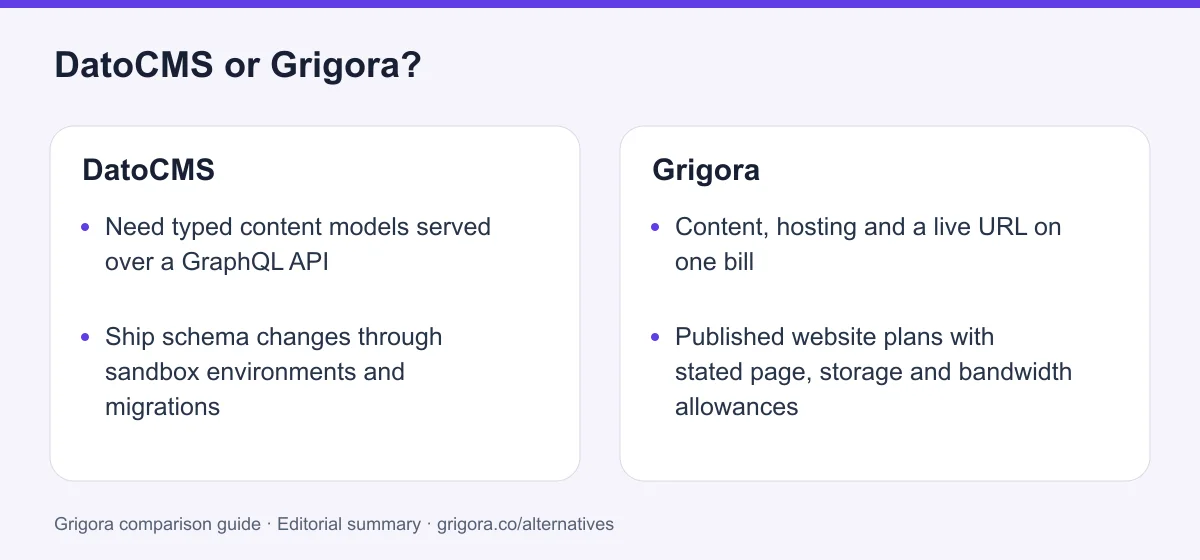
- Content, hosting and a live URL on one bill
- Published website plans with stated page, storage and bandwidth allowances
- Publishing that does not consume a build-minute allowance
- A subscriber list and campaigns in the same subscription
- A store with 0% platform commission, switched on in the dashboard
Stick with DatoCMS if you…
- •Need typed content models served over a GraphQL API
- •Ship schema changes through sandbox environments and migrations
- •Feed several channels, not just one website, from one record
DatoCMS or Grigora: the decision in one view
DatoCMS alternatives at a glance
How Grigora and the other platforms teams weigh against DatoCMS compare on the essentials.
Swipe the table sideways to see every column
| Platform | Best for | Free access | Starting price | Sales fees | Data and site portability |
|---|---|---|---|---|---|
| Grigora | Site, CMS, newsletter and store on one plan | Free trial | From $12/mo billed annually | 0% platform fee; Stripe/Razorpay fees apply | Posts/content; rebuild design |
| DatoCMS | Typed content served to a developer-built front end | Yes (300 records) | 199 EUR/mo, or 149 EUR/mo annually | No store | Yes |
| Contentful | Large enterprise content operations | Free tier offered | Published on contentful.com | No store | Yes |
| Sanity | Teams that customise the editing studio itself | Free tier offered | Growth $15/seat/mo plus usage | No store | Dataset/assets; frontend separately |
| Storyblok | Visual editing on top of a headless back end | Free tier offered | Growth $90.75/mo billed annually | No store | Content/assets; frontend separately |
| Webflow | Designer-built marketing sites with hosting | Yes | From $15/mo | 0% except 2% Ecommerce Standard; processing extra | Static code on eligible Workspace; CMS/store separately |
Grigora and DatoCMS figures verified on 11 September 2026, DatoCMS from datocms.com/pricing and quoted in euros exactly as published, since no dollar price exists on that page. The other rows are directional only. Verify current pricing on each provider's site.
Sources for the overview table
- Grigora: official reference 1
- Sanity: official reference 1, official reference 2
- Storyblok: official reference 1, official reference 2
- Webflow: official reference 1, official reference 2
When to consider a DatoCMS alternative
The meters DatoCMS users notice first, and what Grigora does instead.
The record count rises even when traffic does not
Every post, product description, author bio, landing page variant and translated field is a record. A team that publishes twice a week adds records forever, and past 100,000 on Professional they cost 9 EUR a month per 10,000 until the 200,000 wall.
Build minutes are billed by someone else entirely
A static front end rebuilds on every publish, and those minutes belong to Netlify, Vercel or whoever deploys you. The CMS invoice never shows them, which is exactly why they are easy to underestimate when the editorial team speeds up.
A good traffic month bills on both sides of the join
More visitors means more CDN bandwidth at 29 EUR per extra 150GB past the first terabyte, more CDA calls at 9 EUR per extra million on uncached requests, and more bandwidth at your host as well. Grigora includes hosting, CDN and delivery in the plan price.
Two ceilings inside each record cannot be bought past
DatoCMS applies record and API technical limits in addition to plan usage allowances. Consult the current technical documentation and test representative records; historical product updates may describe different block limits.
What DatoCMS does well
- Typed content models served over a fast, well documented GraphQL API
- Sandbox environments, scripted migrations and controlled environment promotion
- Deep localisation, per-field and per-locale, with built-in AI translation
- A real media pipeline: Imgix transforms, focal points and adaptive video
Where DatoCMS falls short
- No hosting, domains, SSL or rendered pages at all
- DatoCMS applies record and API technical limits in addition to plan usage allowances. Consult the current technical documentation and test representative records; historical product updates may describe different block limits.
- One project on Professional, 39 EUR a month for each additional one
- No store, no email marketing and no native web forms
Grigora vs DatoCMS at a glance
What each side charges for, and what each side leaves for you to buy elsewhere.
| Feature | DatoCMS | Grigora |
|---|---|---|
| Entry price | 149 EUR/mo billed annually | $12/mo billed annually |
| Hosting, domain and SSL | No | Included |
| Content metered | 300 records free, 100k on Professional | Not metered |
| Front end | You build and deploy it | Generated, then edited on the page |
| Traffic billed | 29 EUR per extra 150GB, plus host bandwidth | Included |
| Newsletter included | No | 2,500 to 25,000 subscribers |
| Online store included | No | Built in, 0% commission |
| GraphQL content API | Yes | No |
| Free SEO tools suite | No | Free SEO tools |
Grigora vs DatoCMS: feature by feature
A category-by-category breakdown, pricing, AI, design, e-commerce, email, SEO, performance, and support.
Record allowances and technical limits
Fit: GrigoraDatoCMS Professional includes 100,000 records and sells additional capacity, while individual records and API requests have technical constraints. The pricing allowance and technical limits answer different questions; test representative long and highly structured entries before migrating.
| Feature | Grigora | DatoCMS |
|---|---|---|
| Content billed by volume | Not metered | Records: 300 free, 100,000 on Professional |
| Cost of more content | Same plan price | 9 EUR/mo per extra 10,000 records |
| Ceiling on content volume | Not applicable | 200,000 records, then Enterprise |
| Blocks inside one record | Not capped this way | 500 per the current documentation |
| Size of a single record | Not capped this way | DatoCMS applies record and API technical limits in addition to plan usage allowances. Consult the current technical documentation and test representative records; historical product updates may describe different block limits. |
| Behaviour at the free ceiling | Free trial keeps serving | Service stops responding as expected |
Takeaway: Check both the plan allowance and current technical limits for the content you actually publish.
Three meters on one growing site
Fit: GrigoraThe awkward part of a headless stack is not any single price. It is that a successful year moves three dials at once: more content raises the record count, more deploys burn the host's build minutes, and more visitors raise bandwidth and API calls on both sides of the join.
| Feature | Grigora | DatoCMS |
|---|---|---|
| More content | No change to the bill | Record overage at 9 EUR per 10,000 |
| More deploys | Publishing is included | Build minutes, billed by your host |
| More traffic | Hosting and CDN included | 1TB/mo, then 29 EUR per extra 150GB |
| More API reads | Not applicable | 1M CDA calls/mo, then 9 EUR per extra 1M |
| Request throttles | Not applicable | 40 concurrent, 40/sec, 1,000/min per token |
| Bills to reconcile | One | CMS, host and any service filling the gaps |
Takeaway: Forecast record counts, API usage and host costs separately. Caching and rendering choices affect how traffic translates into usage.
The website DatoCMS does not ship
Fit: GrigoraDatoCMS hosts structured content, delivery APIs and media. Your chosen framework produces the public pages on separate hosting. Visual Editing helps editors work against the resulting website, while routing, rendering and deployment remain part of the implementation.
| Feature | Grigora | DatoCMS |
|---|---|---|
| Hosting, domain and SSL | Included on every plan | Buy separately |
| Templates | Website templates | Starter repos to clone and deploy |
| Publish produces a live URL | Yes | No |
| Front-end developer needed | No | Yes, plus a deploy pipeline |
| Time to something a visitor can open | Minutes | A front-end project |
Takeaway: Include your front-end implementation and hosting in a DatoCMS estimate; API and asset hosting are already part of its service.
Typed models and the GraphQL CDA
Fit: DatoCMSAn honest concession, and DatoCMS's strongest ground. You define models, fields and validations, then read them over a GraphQL Content Delivery API with a TypeScript client, a CLI, a playground and scoped API tokens. One record can feed a website, a native app, a kiosk and a signage screen. In a page-based builder, content lives on the page it was typed into.
| Feature | Grigora | DatoCMS |
|---|---|---|
| Custom models and field validation | Collections and directories | Typed, unlimited within plan caps |
| GraphQL delivery API | No | Yes |
| REST management API and CLI | No | Yes |
| One record, several channels | No | Yes |
| Preview and real-time update APIs | Editor preview | Dedicated GraphQL endpoints |
Takeaway: If content has to reach more than one front end, DatoCMS does something Grigora does not attempt.
Sandbox environments and schema migrations
Fit: DatoCMSThe second honest concession, and it is a different workflow from a managed website editor. Sandbox environments behave like git branches: fork an environment with its models, records, assets, plugins and locales, script a content migration, generate migration scripts from the diff between two environments, hold changes behind maintenance mode, then promote the sandbox into the primary environment using its documented workflow.
| Feature | Grigora | DatoCMS |
|---|---|---|
| Fork the whole content schema | No | Fast environment fork |
| Scripted content migrations | No | Yes |
| Migration scripts from an environment diff | No | Yes |
| Promote with no downtime | Publish replaces the live site | Primary environment hot swap |
| Environments included | Not applicable | 3, then 39 EUR/mo each up to 8 |
Takeaway: DatoCMS wins this outright, and note that the safety net itself is metered at 39 EUR a month past the third environment.
Extra projects, environments and locales
Fit: GrigoraProfessional includes exactly one project. A second site is 39 EUR a month, and so is a third, up to ten in total. Locales are 19 EUR a month each past the five included, with ten as the ceiling. Every dimension has an add-on price and then a wall, and the only door past the wall is an unpriced conversation.
| Feature | Grigora | DatoCMS |
|---|---|---|
| Sites on the entry paid plan | 1 on Starter, 2 on Pro, 5 on Business | 1 project |
| Cost of another site | Included up to the plan count | 39 EUR/mo each, 10 maximum |
| Languages | Not sold per locale | 5 included, 19 EUR/mo each, 10 maximum |
| Extra editors | Included on the plan | 10 included, then 9 EUR/mo each |
| Past the ceiling | Next plan up, price published | Enterprise, price not published |
Takeaway: At the published annual base rate, four Professional projects total €149 plus three €39 project add-ons per month, before usage and front-end costs.
Composable commerce versus a store that exists
Fit: GrigoraDatoCMS can model product content but does not provide a native cart, no checkout, no stock and no payments. Its own e-commerce page is candid about this: it sells a composable approach and asks you to plug in your PIM, cart, fulfilment, shipping and payment APIs through plugins. That integration is code, written and maintained by you.
| Feature | Grigora | DatoCMS |
|---|---|---|
| Catalogue, variants and stock | Built in | No |
| Cart and checkout | Built in | Someone else's API |
| Payments | Stripe and Razorpay | Your own payment provider, wired up |
| Digital downloads | Yes | No |
| Platform commission | 0% | Not applicable, it processes nothing |
Takeaway: DatoCMS can describe a product beautifully. It cannot take the money, and it never claims to.
No list, no forms, no send
Fit: GrigoraThere is no email sending, newsletter, campaign, automation, list or subscriber feature anywhere in DatoCMS, and no such row in the long plan comparison table. There are no native web forms either, so nothing on the site collects an address in the first place. DatoCMS's own footer signup is a third-party form.
| Feature | Grigora | DatoCMS |
|---|---|---|
| Subscriber list | 2,500 to 25,000 by plan | No |
| Campaign builder | Included | No |
| Automations and segmentation | Included | No |
| Forms that capture an address | Built in | Third-party embed |
| Professional mailbox | From $5/mailbox | Separate provider |
Takeaway: DatoCMS content management and newsletter delivery are separate services; Grigora bundles newsletter tools with its website plans.
SEO fields versus sitemaps, redirects and speed
Depends on your needsBoth sides hold half of this. DatoCMS gives you the inputs: a per-record SEO and social editor with preview, a slugs and permalinks field type, localisable default alt and title on assets, and a crawler-backed Site Search across your published pages. Everything that gets emitted at the edge belongs to your framework and your host, because DatoCMS owns no front end.
| Feature | Grigora | DatoCMS |
|---|---|---|
| Per-record metadata and social preview | Built in | SEO and social editor |
| Alt and title defaults on media | Per asset | Media SEO, localisable |
| Sitemaps and IndexNow submission | Built in | Your framework's job |
| Redirects and canonical control | Built in | Your host's job |
| On-site search | Site search | Site Search, 200 pages free, 5k on Professional |
| Free SEO tools suite | Free SEO tools | No |
Takeaway: DatoCMS gives you excellent fields to fill in. Nothing it stores becomes a sitemap, a redirect or a fast page without your code.
Explore Grigora before switching from DatoCMS
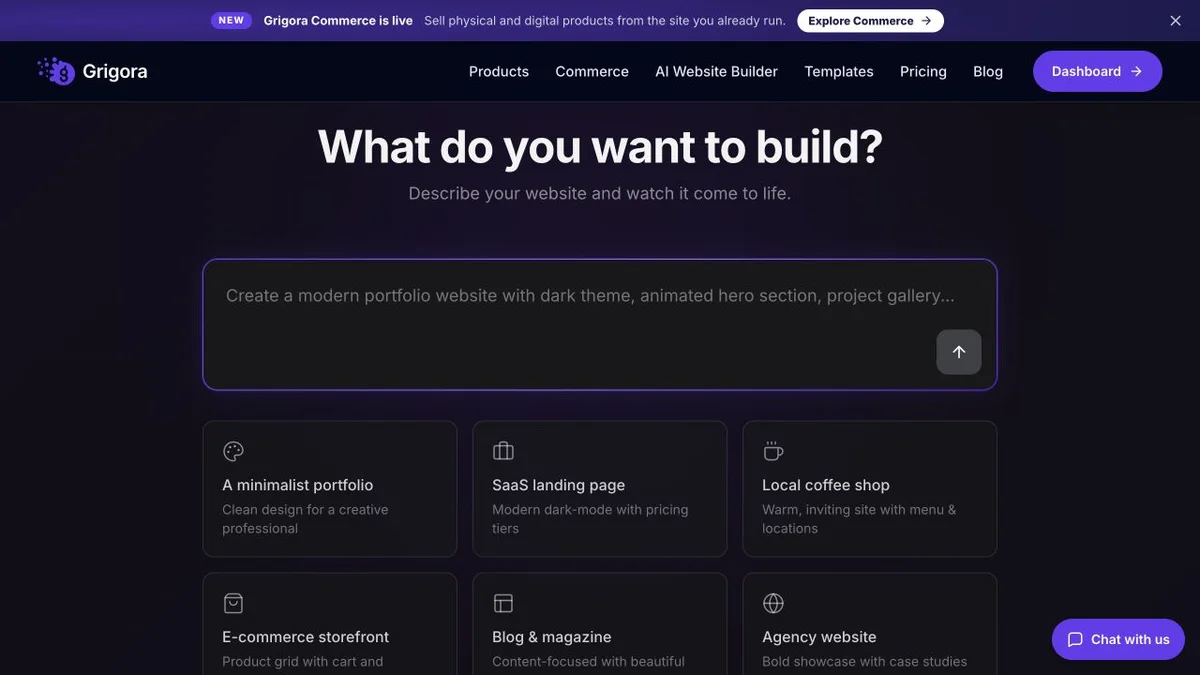
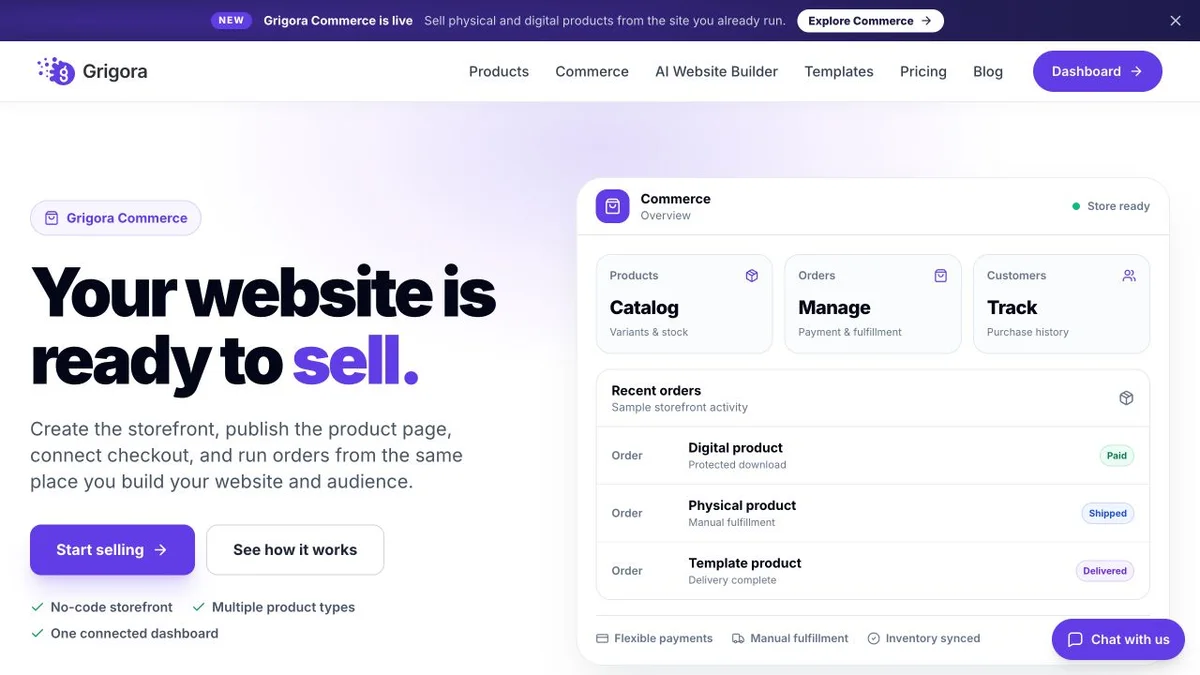
Current public product pages and plans, so you can inspect what you would be moving to. Open any image at full size.
Grigora vs DatoCMS pricing
DatoCMS publishes in euros only. Here are its rates as printed, next to the total cost of a Grigora plan.
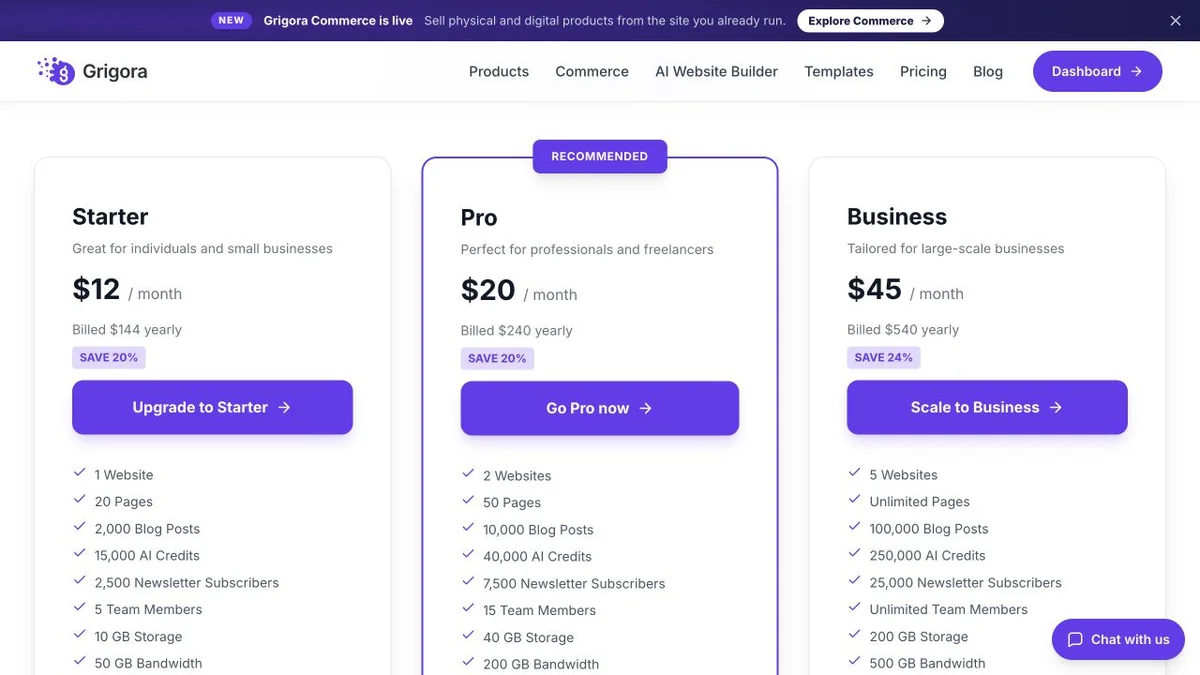
Website, hosting, newsletter and store in one plan
USD annual equivalents shown: Starter $12, Pro $20 and Business $45 per month; month-to-month prices are $15, $25 and $59. A free trial is available. Paid plans include website, CMS, newsletter and store features with stated page, storage, bandwidth and AI allowances. Stripe or Razorpay processing fees apply; fulfillment is manual and domain registration is separate.
Metered content, priced in euros
DatoCMS lists Professional at €199/month or €149/month billed annually; prices here remain in euros without conversion. The free plan permits three projects, with small per-project allowances. Additional Professional projects and sandbox environments are €39/month; additional locales are €19/month. Enterprise and agency arrangements need their own current terms.
Grigora Business at $45/mo runs five sites with hosting, email and a store included. DatoCMS Professional at 149 EUR/mo billed annually runs one project, and the front end those records feed is still yours to build and host.
The real cost: Grigora vs DatoCMS
A realistic scenario: an agency running four client sites, each with a blog that keeps growing, four languages, and traffic that doubles over a year. Count every meter, not just the CMS line.
| What you pay for | DatoCMS | Grigora |
|---|---|---|
| CMS subscription | 149 EUR/mo (Professional, billed annually) | $45/mo Business (annual) |
| Three extra client projects | 39 EUR/mo each, 117 EUR/mo | Included in the 5-site plan |
| Front-end hosting and build minutes | Separate host, billed by builds and bandwidth | Included |
| Front-end build and upkeep | A developer per stack, ongoing | AI draft plus website templates |
| Growth overages | 9 EUR per 10k records, 29 EUR per 150GB, 9 EUR per 1M API calls | None, content and traffic are not metered |
| Email marketing | External platform plus an embed | Included, up to 25,000 subscribers |
| Store | Cart, checkout and payment APIs you integrate | Included, 0% commission |
| Content reused across apps and screens | GraphQL CDA, included and excellent | Not available |
Euro figures as published on datocms.com/pricing on 11 September 2026. Host charges vary by provider and are not quoted here. Payment-processor fees apply to Grigora's store. The last row is a straight loss for Grigora and is listed deliberately.
DatoCMS and Grigora: public website references
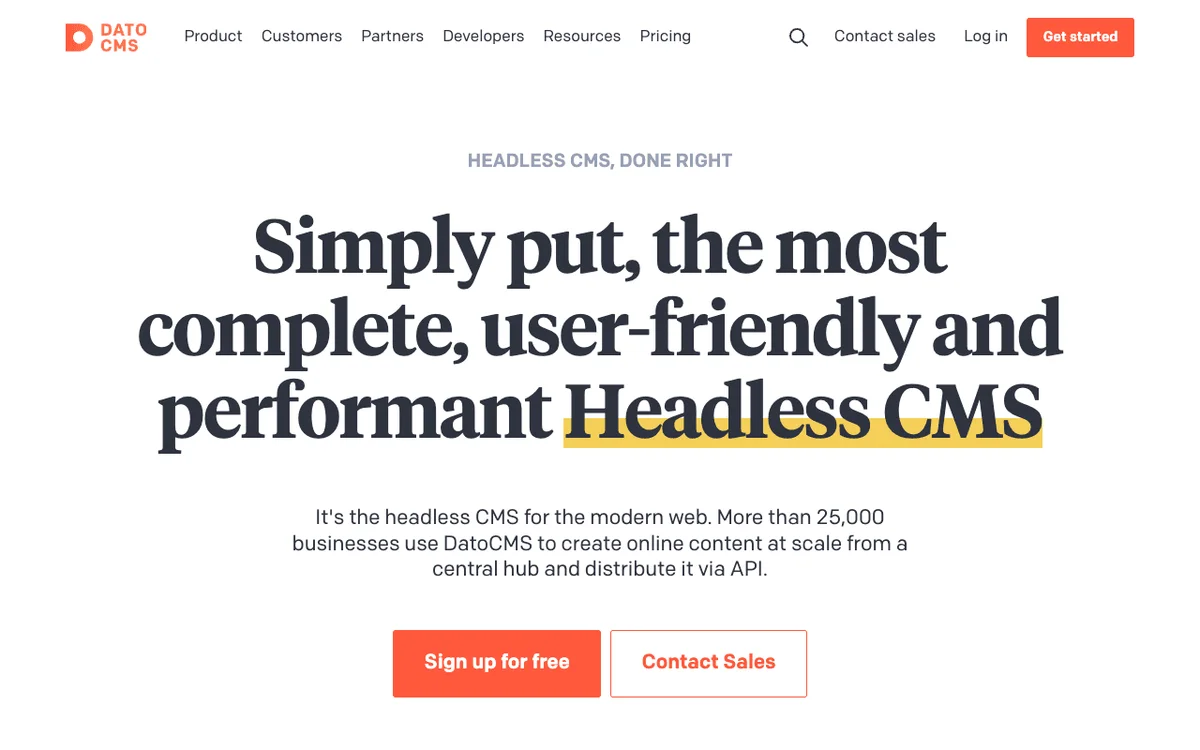
These captures show each product’s public website. See the feature and pricing sections for capabilities and plan details.

Is Grigora the right DatoCMS alternative for you?
Where Grigora is the stronger DatoCMS alternative, by use case.
Best DatoCMS alternative for a marketing site that keeps publishing
When the content is posts, pages and case studies for one website, a record counter and a bandwidth allowance are costs with no matching benefit.
… for teams without a front-end developer
DatoCMS assumes someone clones a starter repo, writes the queries and owns the deploy. If nobody on the team does that, the content sits in an API with no page attached.
… for agencies billing per client site
Every extra project is 39 EUR a month on Professional and stops at ten. Grigora Business covers five sites at $45/mo, and White Label is available at $199/mo.
DatoCMS is the right call if…
Your content genuinely feeds several channels, your developers want typed models over GraphQL, and schema changes need to ship through sandbox environments and migration scripts. Grigora does none of that, and this page will not pretend it does.
Which one is right for you?
Choose Grigora if…
- You want content and a live, hosted page on the same bill
- A growing archive should not become a record overage
- Traffic spikes should not bill twice, at the CMS and the host
- You need a newsletter and a store without a second vendor for each
- You run several sites and want them counted by plan, not by add-on
Choose DatoCMS if…
- •One record must serve a website, an app and a screen
- •Your developers want typed models behind a GraphQL API
- •Schema changes belong in sandbox environments and migrations
How to switch from DatoCMS to Grigora
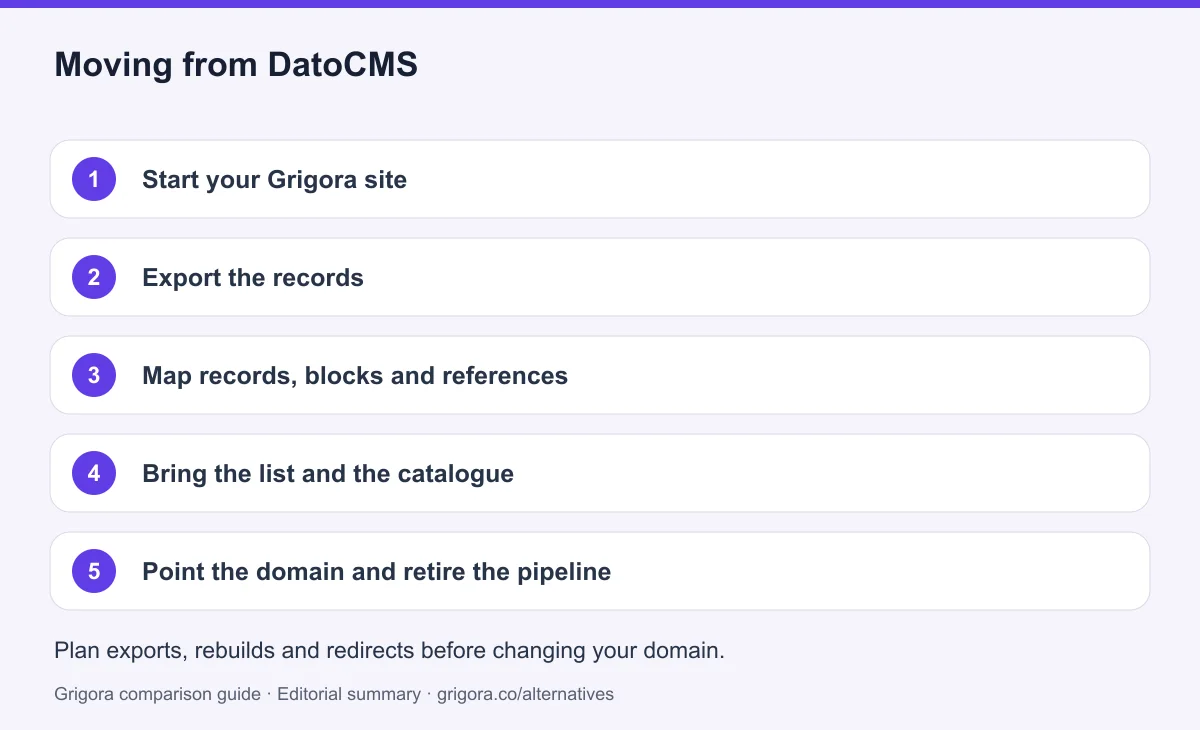
Use a representative export to validate records, blocks, references, assets and locales in Grigora before moving the full project. API access makes extraction possible; it does not make content models interchangeable.
- 1
Start your Grigora site
Describe the business in a sentence and the AI generates a first-draft site with pages, layout and copy, or start from one of the website templates.
- 2
Export the records
Pull records and assets through the Content Management API or the CLI. Export the locales you actually publish, not every draft environment.
- 3
Map records, blocks and references
Preserve the relationships and languages that the site requires. Test long records, structured text, media and linked content against Grigora’s available fields before choosing a migration scope.
- 4
Bring the list and the catalogue
Export permission-based subscribers from the email provider, and compatible product data from the commerce engine. Test unsubscribe behavior, checkout and order handling separately.
- 5
Point the domain and retire the pipeline
Test metadata, redirects, canonical URLs, media and forms before switching DNS. Monitor indexing and errors afterward and retain backups and rollback access. Search positions can change even with correct redirects.
Why people look for a DatoCMS alternative in 2026
DatoCMS provides structured editing, GraphQL delivery, media processing and environments for developer-led projects. An alternative makes sense when those capabilities are less important than reducing front-end implementation and integrating website, email and store operations.
Records, blocks and bytes are three different ceilings
DatoCMS applies record and API technical limits in addition to plan usage allowances. Consult the current technical documentation and test representative records; historical product updates may describe different block limits.
The build pipeline is a cost DatoCMS never shows you
A headless CMS with a static front end rebuilds the site when content changes. Those build minutes are metered by Netlify, Vercel or whoever deploys the project, and they scale with how often the editorial team presses publish. This is not a criticism of DatoCMS, which hosts content APIs and media but does not host your public website front end. It is a warning about how the total is assembled: the invoice that arrives from the CMS is only ever part of the picture, and the part that grows fastest when a content team gets productive is usually the one on the other invoice.
A good traffic month is billed twice
Professional includes one terabyte a month of CDN bandwidth and one million Content Delivery API calls, then charges 29 EUR for each extra 150GB and 9 EUR for each extra million calls. The delivery API also enforces 40 concurrent requests per project, 40 requests a second and 1,000 a minute per token on uncached reads. Meanwhile the host is counting bandwidth of its own on the pages it serves. The launch that finally works is the month both numbers go up together, which is a strange incentive to build into a publishing stack.
How Grigora compares
Grigora starts at the other end of the problem. The site is generated from a description of the business, edited block by block on the page, and hosted on the same subscription that holds the content. There is no repository to clone, no deploy to configure and no join between two vendors where the bandwidth gets counted twice. Publishing produces a URL, which sounds unremarkable until you have run a headless stack for a year.
One plan, and nothing counted by the record
Starter at $12 a month billed annually includes the website and hosting, the CMS with posts, categories, author profiles, directories and moderated comments, a newsletter with 2,500 subscribers, and a store with no platform commission through supported Stripe or Razorpay checkout. Pro at $20 covers two sites and 7,500 subscribers. Business at $45 covers five sites and 25,000 subscribers, which on DatoCMS Professional would be 149 EUR a month plus four extra projects at 39 EUR each, before any overage and before the front ends exist. Grigora publishes page, storage, bandwidth and AI allowances, so check those limits before estimating a growing site.
Where DatoCMS still wins, and it is not close
Content modelling, API delivery, environments and localisation. If a single record has to feed a website, a mobile app and a screen in a shop, DatoCMS does that and Grigora does not. If your developers want typed models queried over GraphQL with a TypeScript client and scoped tokens, that is DatoCMS's home ground. If schema changes must be branched in a sandbox, scripted as migrations, generated from an environment diff and promoted with a hot swap, no website builder on this site offers an equivalent and it would be dishonest to suggest otherwise. Localisation is the same story: per-field granularity, optional locales, selective per-locale publishing and built-in AI translation go well past anything a page-based platform does. The question is not which product is more capable in the abstract. It is whether your project needs a content API and a build pipeline, or a website.
Frequently asked questions
Grigora is worth evaluating for a managed website, blog, newsletter and store with a simpler content model. Retain DatoCMS when GraphQL delivery, reusable structured content, localization and schema migration workflows are essential.
DatoCMS publishes in euros only. As read on datocms.com/pricing on 11 September 2026, the Free plan is 0 EUR with 300 records, 10GB a month of bandwidth and hard caps that stop the service rather than billing you. Professional is 199 EUR a month, or 149 EUR a month billed annually, and includes one project, 10 collaborators, 100,000 records, 1TB a month of bandwidth and 1M Content Delivery API calls. Enterprise is listed as 'Custom' with no figure published. There is no dollar price and no currency selector on the page.
No. DatoCMS stores content and serves it over APIs. DatoCMS hosts content and APIs, while the public website front end is hosted separately. Its Starter Projects are code repositories for Next.js, Astro, Remix, Svelte and Vue that a developer clones and deploys to a separate host, which is billed separately for build minutes and bandwidth.
Neither. DatoCMS models product content but has no native cart, checkout, stock or payments, and its own e-commerce page asks you to plug in your PIM, cart, fulfilment, shipping and payment APIs. There is also no email sending, list or campaign feature anywhere in the product, and no native web forms to collect an address with. Grigora includes both a store with 0% platform commission and a newsletter with up to 25,000 subscribers.
DatoCMS Free has hard allowances that cannot be exceeded. Paid plans support specified add-ons and overages, but technical and plan maximums still apply. Monitor records, API calls, assets and bandwidth, and use the current limits documentation for your project.
Typed content models with validation, the GraphQL Content Delivery API and its tooling, sandbox environments with scripted migrations and controlled environment promotion, deep per-field localisation with AI translation, and an image and video pipeline with Imgix transforms, focal points and adaptive streaming. Grigora replaces none of those. It replaces the front-end build, the host, the email platform and the commerce integration you were paying for around DatoCMS.
Sources and comparison method
Published by Grigora, one of the products compared here. This is a comparison of public product documentation and published plans. Recommendations reflect the use cases described; they are not independent performance benchmarks. Homepage screenshots show how each product presents itself and do not establish feature availability.
Check the billing term, currency, regional availability, usage limits and add-ons before purchasing. A content export does not necessarily include the design, integrations or a working store. Migration steps need testing on your own site.
- DatoCMS pricing
Euro prices, projects, collaborators, allowances and add-on costs.
- DatoCMS documentation
Content models, visual editing, API delivery, import/export and environments.
- DatoCMS API technical limits
Technical API limits are separate from subscription usage allowances.
Grigora references: plans and limits, commerce, MCP access, and help documentation.
Compare Grigora with other platforms


Make the switch from DatoCMS to Grigora
Put the content, the live site, the newsletter and the store on one bill, with nothing counted by the record, the build or the gigabyte. Try Grigora free, no credit card required.
14-day free trial • No credit card required • Cancel anytime