
A Sanity alternative for a managed website with content tools included
Grigora is a Sanity alternative for teams that need a managed website, blog, newsletter and store from $12/month billed annually. Sanity is better suited to custom schemas, GROQ queries, collaborative Studio workflows and content reused across channels. Growth is listed at $15 per occupied seat monthly, with usage allowances; Grigora does not replace Sanity’s headless content architecture.
Published by Grigora · Updated · Sources and method
Is Grigora the right Sanity alternative?
Grigora is a Sanity alternative for teams that need a managed website, blog, newsletter and store from $12/month billed annually. Sanity is better suited to custom schemas, GROQ queries, collaborative Studio workflows and content reused across channels. Growth is listed at $15 per occupied seat monthly, with usage allowances; Grigora does not replace Sanity’s headless content architecture.
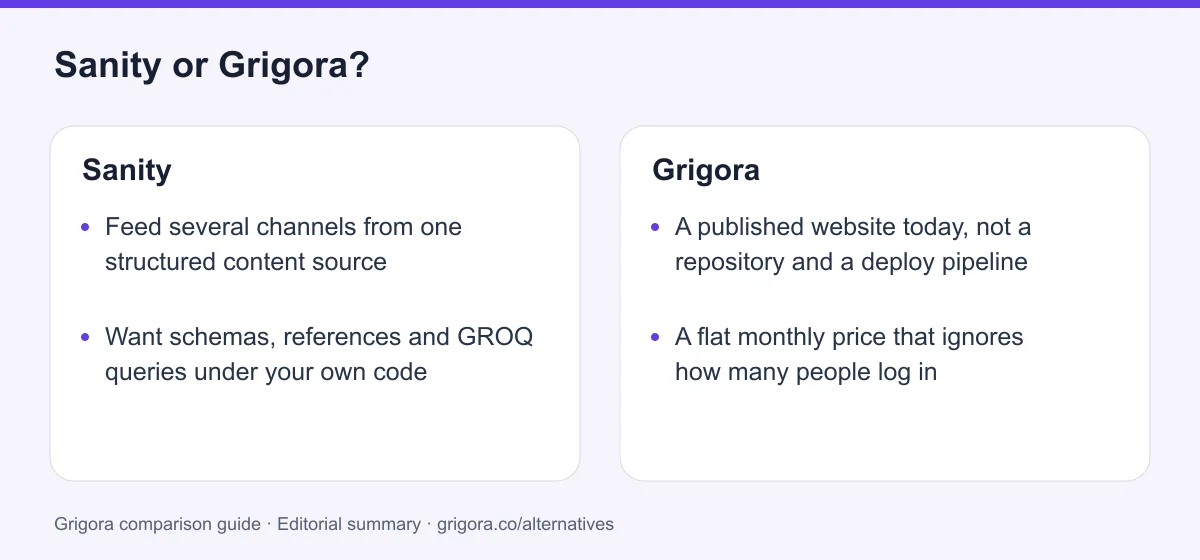
Choose Grigora if you want…
- A published website today, not a repository and a deploy pipeline
- A flat monthly price that ignores how many people log in
- No invoice line for API requests, bandwidth or assets
- A store and a subscriber list already inside the plan
- Editors who publish without waiting on a frontend release
Stick with Sanity if you…
- •Feed several channels from one structured content source
- •Want schemas, references and GROQ queries under your own code
- •Have developers who will own the frontend and its hosting
Sanity or Grigora: the decision in one view
Sanity alternatives at a glance
How Grigora and the other platforms people weigh against Sanity compare on the essentials.
Swipe the table sideways to see every column
| Platform | Best for | Free access | Starting price | Sales fees | Data and site portability |
|---|---|---|---|---|---|
| Grigora | A managed site with everything included | Free trial | From $12/mo billed annually | 0% platform fee; Stripe/Razorpay fees apply | Posts/content; rebuild design |
| Sanity | Structured content for custom frontends | Yes | Growth $15/seat/mo plus usage | No store | Dataset/assets; frontend separately |
| Contentful | Headless content for large teams | Yes | Per-seat paid tiers | No store | Yes |
| Strapi | Self-hosted headless CMS | Software is free | Free self-hosted; Cloud from $29/mo yearly | No store | Content/database; frontend separately |
| Storyblok | Visual editing on a headless backend | Yes | Growth $90.75/mo billed annually | No store | Content/assets; frontend separately |
| Webflow | Designer-grade visual builds | Yes | From $15/mo | 0% except 2% Ecommerce Standard; processing extra | Static code on eligible Workspace; CMS/store separately |
Sanity figures read from sanity.io/pricing on 11 September 2026; Sanity's self-serve plans bill monthly only, so no annual rate exists for them. Grigora and Webflow prices are billed annually. Verify current pricing on each provider's site.
Sources for the overview table
- Grigora: official reference 1
- Sanity: official reference 1, official reference 2
- Strapi: official reference 1, official reference 2
- Storyblok: official reference 1, official reference 2
- Webflow: official reference 1, official reference 2
Reasons to consider moving from Sanity to Grigora
Consider these trade-offs against your existing setup before planning a move.
The bill grows with the team, not the website
Growth is $15 per occupied seat per month. A marketing hire, a freelancer and an agency contact are three more seats on a site that has not changed size. Grigora charges for the plan, not the people in it.
The content was ready and the website was not
Sanity renders nothing. Until somebody builds and hosts a frontend, a beautifully modelled content lake has no public page attached to it, and the launch date belongs to whoever has the spare engineering time.
Usage is metered, so the invoice moves
API requests, CDN requests, bandwidth, assets, AI credits and function invocations all bill per unit above the included quota. Growing traffic is a good problem that arrives as a variable charge.
One vendor quietly became five
The content platform, the frontend host, the commerce platform, the email platform and the analytics tool are five contracts and five integrations. Grigora's plan covers the site, the CMS, the newsletter and the store in one.
What Sanity does well
- Genuine content modelling: typed schemas in code, references, Portable Text
- GROQ and GraphQL query the content the way you would query a database
- Sanity Studio is a React app you can extend into a purpose-built editor
- Every revision retained, real-time multiplayer editing, generous free seats
Where Sanity falls short
- No website is rendered or hosted, so launching needs a developer and a second vendor
- Priced per occupied seat with API, bandwidth and asset usage metered on top
- No store, no payments and no email marketing anywhere in the product
- Low self-serve ceilings: 25,000 documents and 2 datasets on Growth, lifted only by $299 and $999 per month add-ons
Grigora vs Sanity at a glance
What each product actually hands you on the day you pay for it.
| Feature | Sanity | Grigora |
|---|---|---|
| Starting cost | $0 free, then $15 per seat/mo | $12/mo billed annually |
| What the bill counts | Seats, API calls, bandwidth, assets | A flat plan |
| Published website included | No | Yes |
| Hosting, SSL and CDN for the site | Separate vendor | Included |
| Templates | Starter repos to clone | Template library |
| Online store | No | Built in, 0% commission |
| Email marketing | No | Included |
| Structured content API | GROQ and GraphQL | No |
| Free SEO tools suite | No | Free tools |
Grigora vs Sanity: feature by feature
A category-by-category breakdown, pricing, AI, design, e-commerce, email, SEO, performance, and support.
Seats, API calls and what the invoice counts
Fit: GrigoraSanity's Growth plan is $15 per occupied seat per month, and the quotas underneath it are metered. Requests, bandwidth, assets, AI credits and function invocations all have an included allowance and a price per unit above it. That is a reasonable model for a platform team with a cost centre. It is an awkward model if you wanted to know what the website costs next March.
| Feature | Grigora | Sanity |
|---|---|---|
| How the bill is calculated | Flat plan, $12 to $45/mo | $15 per occupied seat/mo plus metered usage |
| Cost of adding a sixth editor | $0 | $15/mo |
| API requests metered | No | $1 per 25k above the included 250k/mo |
| Bandwidth metered | No | $0.30 per GB above the included 100GB/mo |
| Annual billing discount | Yes, $12 against $15 month to month | Not offered on Free or Growth |
Takeaway: Sanity’s published unit rates support a usage-based budget; Grigora uses plan allowances. Estimate realistic content, traffic and collaboration needs for either product.
The website Sanity does not ship
Fit: GrigoraThis is the honest centre of the comparison. Sanity hosts the Studio and the content APIs. It does not render a page, serve a domain or publish anything a visitor can read. Going live means a second application, written by a developer, deployed to a second vendor, on a second bill.
| Feature | Grigora | Sanity |
|---|---|---|
| A page a visitor can open | Published from the editor | Only once you build the frontend |
| Design starting point | website templates | Starter repos to clone and extend |
| Hosting, SSL and CDN for the site | Included | Vercel, Netlify, AWS or similar |
| Time to a public homepage | Minutes | A development project |
| Developer needed to launch | No | Yes |
Takeaway: Sanity hosts your content and your editing tool. The website is still software that somebody has to write.
Schemas, references and GROQ
Fit: SanitySanity's real product is the content model, and it is excellent. Schemas are typed and versioned with your code, documents reference other documents, Portable Text keeps rich text structured rather than trapped in markup, and GROQ queries across the lot. Sanity's own marketing shows a query that finds every document pointing at a product. Grigora has posts, categories, collections and directories, which is a fraction of that.
| Feature | Grigora | Sanity |
|---|---|---|
| Content types | Posts, categories, collections, directories | Unlimited, defined in code |
| References between documents | Basic | Typed references, arrays, deep joins |
| Query language over your content | No | GROQ and GraphQL |
| Rich text model | Block editor output | Portable Text |
| One source feeding a site, an app and a screen | No | Yes |
Takeaway: If the same content has to reach more than one front end, Sanity is the right shape and Grigora is not.
Sanity Studio as an editor you rebuild
Fit: SanityThe second thing Sanity does better. Studio is a React application you configure, extend with custom input components and plugins, and shape into a tool that matches how your team actually works, with an App SDK behind it. The Presentation tool adds click-to-edit and drag-and-drop on top of your own frontend. Grigora gives you one dashboard and one on-page editor, and you take them as they are.
| Feature | Grigora | Sanity |
|---|---|---|
| Editing interface | Grigora dashboard and on-page editor | React app you configure and extend |
| Custom input components | No | Yes |
| Plugins and App SDK | No | Yes |
| Real-time multiplayer editing | No | Yes |
| Click to edit the live page | Built in | Presentation tool, wired to your frontend |
Takeaway: Sanity lets you build the editor your team deserves, provided you also have someone free to build it.
Document ceilings, datasets and the add-ons that lift them
Fit: GrigoraThe self-serve ceilings are lower than most people expect and expensive to raise. Free stops at 10,000 documents, Growth at 25,000, and both include exactly two datasets. Lifting the quotas is a $299 per month add-on that takes documents to 50,000. A third dataset is $999 per dataset per month, and a fourth is another $999.
| Feature | Grigora | Sanity |
|---|---|---|
| What the plan meters | Sites, AI credits, subscribers | Documents, datasets, API calls, bandwidth, assets |
| Document ceiling | Plan-based content allowances | 10,000 on Free, 25,000 on Growth |
| Raising the ceiling | Not applicable | +$299/mo add-on, lifts to 50,000 |
| Environments or datasets | 1 to 5 sites by plan | 2 included, +$999 per extra dataset/mo |
| Private content on the free plan | Free trial | Free datasets are public only |
Takeaway: A third Sanity dataset costs more per month than a full year of Grigora Business.
Selling: product content against an actual checkout
Fit: GrigoraSanity can model a product beautifully and cannot sell one. There is no cart, no checkout, no payment processing, no inventory and no order management anywhere in the product. Sanity Connect for Shopify syncs Shopify's products into the Content Lake, which is useful and is not a shop. The shop, and the bill for it, stay with Shopify.
| Feature | Grigora | Sanity |
|---|---|---|
| Cart and checkout | Built in | No |
| Payments | Stripe and Razorpay | None, Sanity processes no payments |
| Variants, stock and digital downloads | Built in | Modelled as content only |
| Orders and fulfilment | Built in | Lives in Shopify or similar |
| Platform commission | 0% | Not applicable, there is no store |
Takeaway: Sanity holds the product copy. Everything that takes money is a separate platform you buy and wire up.
SEO fields you invent against SEO already shipped
Fit: GrigoraSanity ships no SEO tooling at all: no sitemap, no robots.txt, no redirect manager, no meta preview, no keyword research, no analytics. Its docs touch SEO in passing, on an example alt-text field. You define your own metadata fields in the schema and render the tags in your frontend. Community Studio plugins for SEO previews exist and are third-party and unsupported.
| Feature | Grigora | Sanity |
|---|---|---|
| Meta and Open Graph fields | Built in | Fields you define, tags you render |
| Sitemap and robots.txt | Generated | Your frontend's job |
| Redirect manager | Built in | No |
| IndexNow submission | Yes | No |
| Free SEO tools | Free tools | No |
Takeaway: On Sanity, SEO is a schema you design and code you maintain. On Grigora it is a panel with switches in it.
SSO, roles, releases and who answers you
Depends on your needsSanity's collaboration and governance primitives go further than Grigora's, and almost every step up is gated. Comments, tasks and scheduled drafts start at Growth. Single sign-on and custom access control are shown as Enterprise only, with no published price. Content Releases, for launching a dated set of documents together, is listed against Enterprise as well, and the live table is ambiguous about whether it is an inclusion or a separately priced add-on.
| Feature | Grigora | Sanity |
|---|---|---|
| Single sign-on | No | Enterprise only, price not published |
| Permission roles | Basic roles | 2 on Free, 5 on Growth, custom on Enterprise |
| Comments, tasks and scheduled drafts | No | Growth and above |
| Coordinated multi-document launch | No | Content Releases, listed against Enterprise |
| Dedicated support | Email, priority on higher plans | +$799/mo add-on on Growth |
Takeaway: Sanity offers deeper governance, with capabilities varying across Free, Growth, add-ons and Enterprise. Check the specific role and workflow controls you need.
Explore Grigora before switching from Sanity
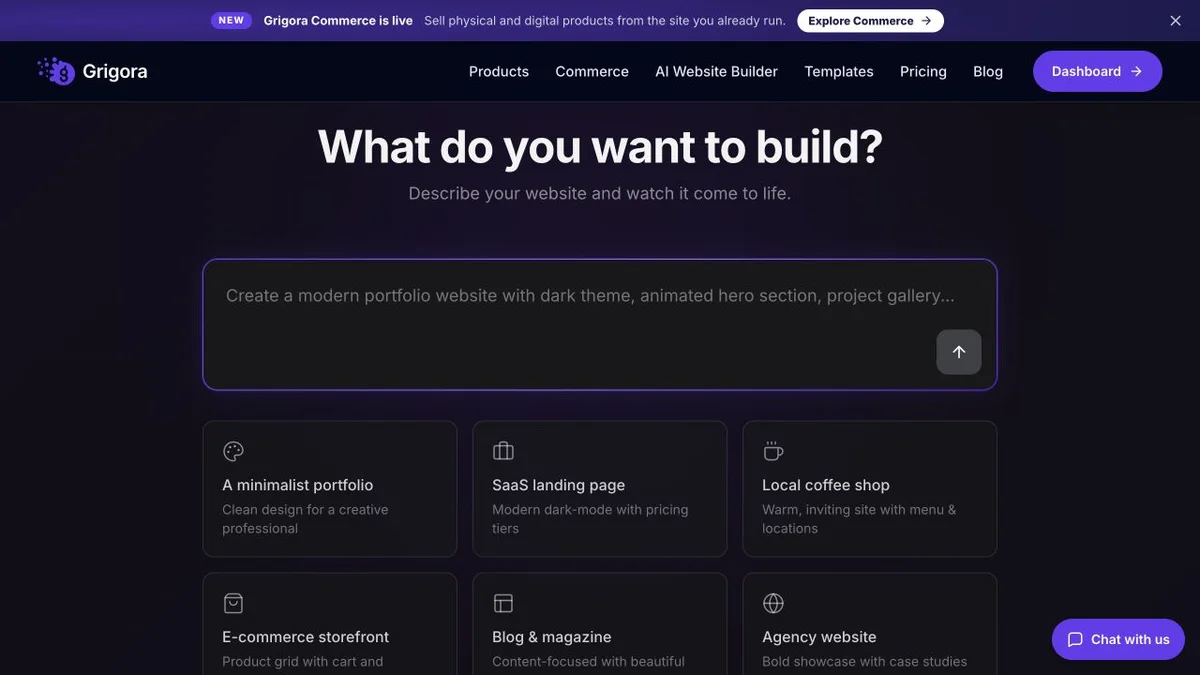
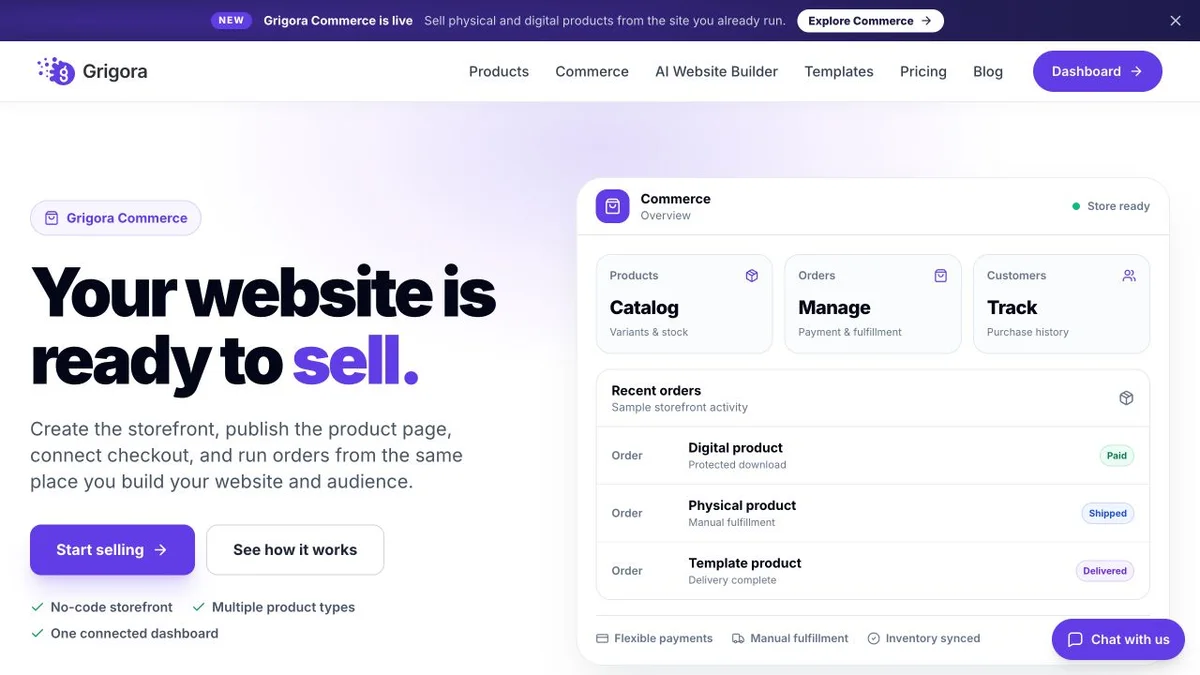
Current public product pages and plans, so you can inspect what you would be moving to. Open any image at full size.
Grigora vs Sanity pricing
One flat plan against a per-seat subscription with metered usage, before the frontend exists.
Website, newsletter & store in one plan
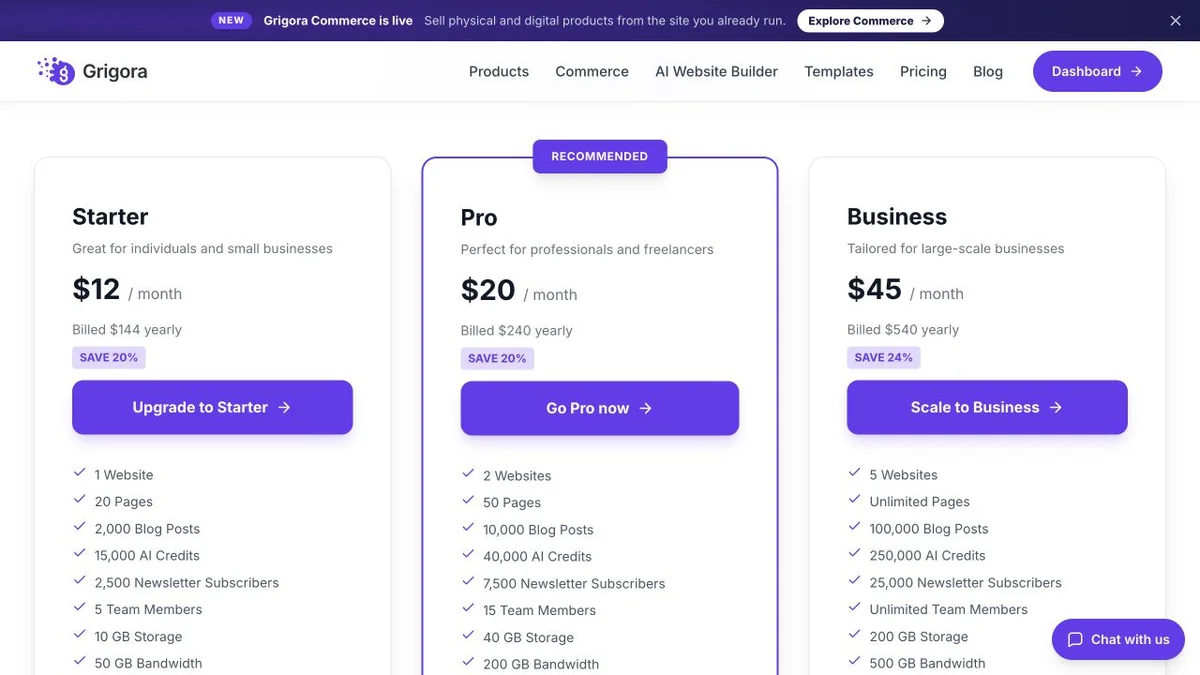
Grigora Starter, Pro and Business rates are $12, $20 and $45 per month billed annually ($144, $240 and $540 per year), or $15, $25 and $59 month to month. Plan limits apply to sites, storage, bandwidth, AI credits and newsletter subscribers. Payment-provider fees and optional paid services are additional.
Priced per seat, then per unit of usage
Read from sanity.io/pricing on 11 September 2026. Sanity's pricing FAQ states that only monthly payments are supported for self-serve plans, so Free and Growth have no annual rate to compare. Enterprise pricing is not published. Only occupied seats bill and Viewer-role users are free. Usage above the included quotas is charged per unit, including $1 per 25k extra API requests, $1 per 250k extra API CDN requests, $0.50 per extra GB of assets, $0.30 per extra GB of bandwidth and $0.05 per extra AI credit.
Grigora Business is $45/month billed annually and includes five sites, a CMS, newsletter and store within published usage allowances. Six Sanity Growth seats cost $90/month before a custom frontend and additional services; those products serve different needs, so compare a complete implementation budget.
The real cost: Grigora vs Sanity
Take a six-person content team running one marketing site with a blog, a small catalogue and a monthly newsletter. Here is what each side has to pay for before that site is live.
| What you pay for | Sanity | Grigora |
|---|---|---|
| Platform subscription | $15 per occupied seat/mo, so $90/mo for six | $45/mo Business, seats not billed |
| The website itself | A Next.js or Astro app, built by a developer | AI first draft, then edit |
| Frontend hosting | Separate vendor (Vercel, Netlify, AWS) | Included |
| Online store | Shopify or similar, bought and wired up | Included, 0% platform commission |
| Email marketing | Klaviyo, Braze or Mailchimp, plus the integration | Included (2,500 to 25,000 subscribers) |
| Usage above the quotas | $1 per 25k API requests, $0.30 per GB bandwidth, $0.05 per AI credit | Plan limits, no per-request billing |
| One content source feeding an app or in-store screen | Built in through GROQ and the APIs | Not available, content serves the Grigora site |
Sanity figures from sanity.io/pricing, 11 September 2026. Payment-processor fees apply to Grigora's store and to whatever commerce platform you pair with Sanity. Developer rates and frontend hosting vary; the fact that both are line items does not.
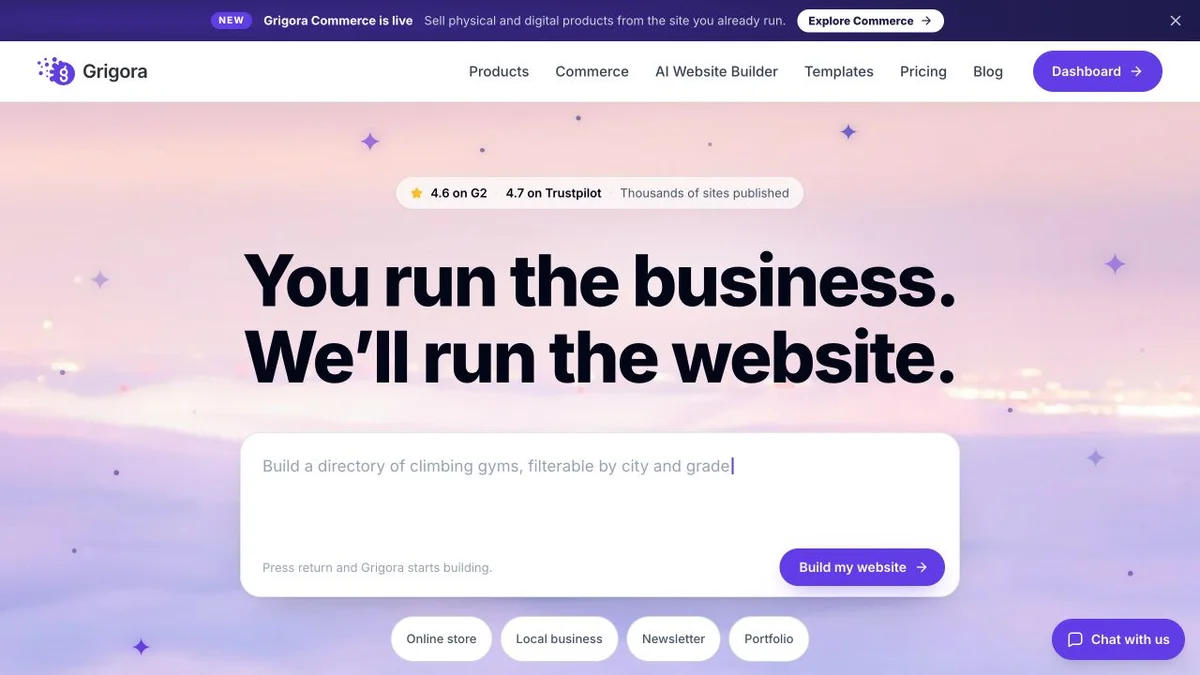
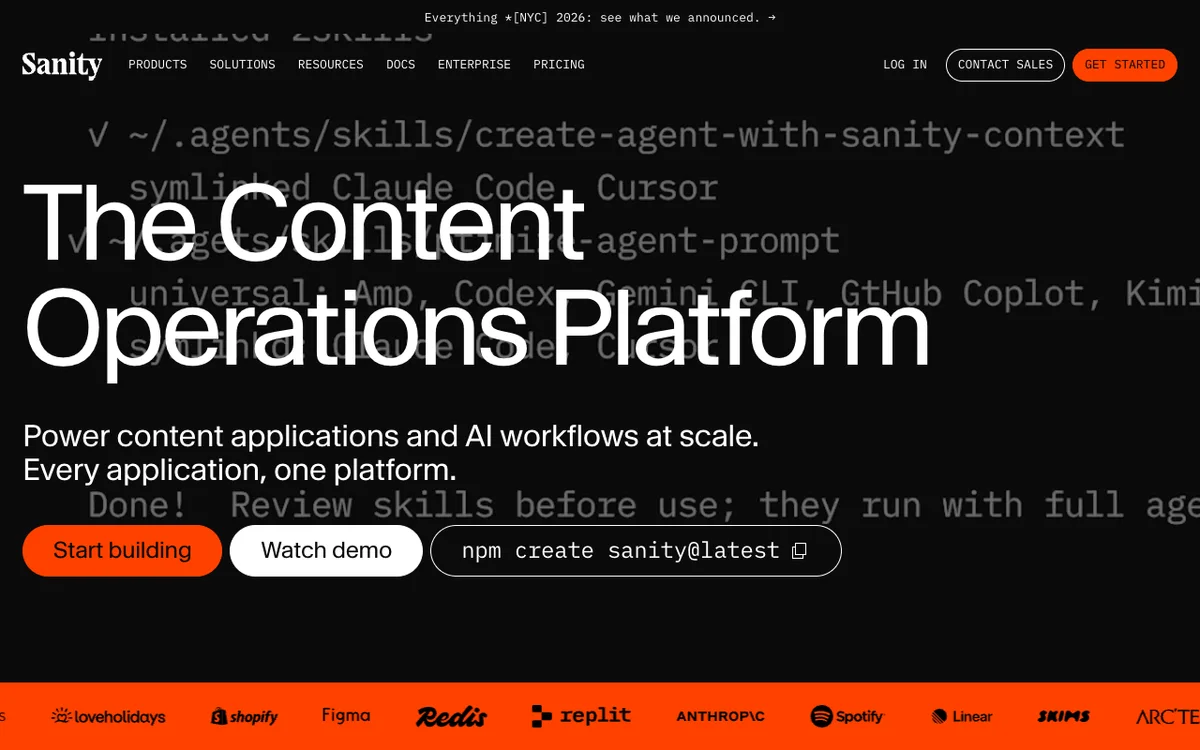
Sanity and Grigora: public website references
These captures show each product’s public website. See the feature and pricing sections for capabilities and plan details.
Is Grigora the right Sanity alternative for you?
Where Grigora is a suitable Sanity alternative, by use case.
Sanity alternative for a team without a frontend developer
If the person who was going to build the Next.js app has moved on, the content lake is full and nothing is published, a managed platform ends that stand-off in an afternoon.
… for founders who only ever needed one website
One site, a blog, a few products and a newsletter does not need schemas, datasets and a deploy pipeline. It needs pages that are already live.
… for teams tired of per-seat and per-request billing
When every new editor is $15/mo and a traffic spike shows up as metered API and bandwidth charges, a flat plan is easier to defend to finance.
Sanity is the right call if…
You are feeding a website, a mobile app, in-store screens and an email system from one structured source, your developers want GROQ and a Studio they can extend, and you are happy to own the frontend and its hosting. Grigora cannot do any of that, and this page will not pretend otherwise.
Which one is right for you?
Choose Grigora if…
- You want a published site without commissioning a frontend
- A flat monthly price beats seats plus metered usage
- You need a store and a subscriber list in the same plan
- Nobody on the team wants to own hosting, builds or deploys
- You are an agency delivering small client sites under your own brand
Choose Sanity if…
- •One content model has to serve several channels at once
- •Your developers want schemas in code and GROQ over the data
- •You will build, host and maintain the presentation layer yourself
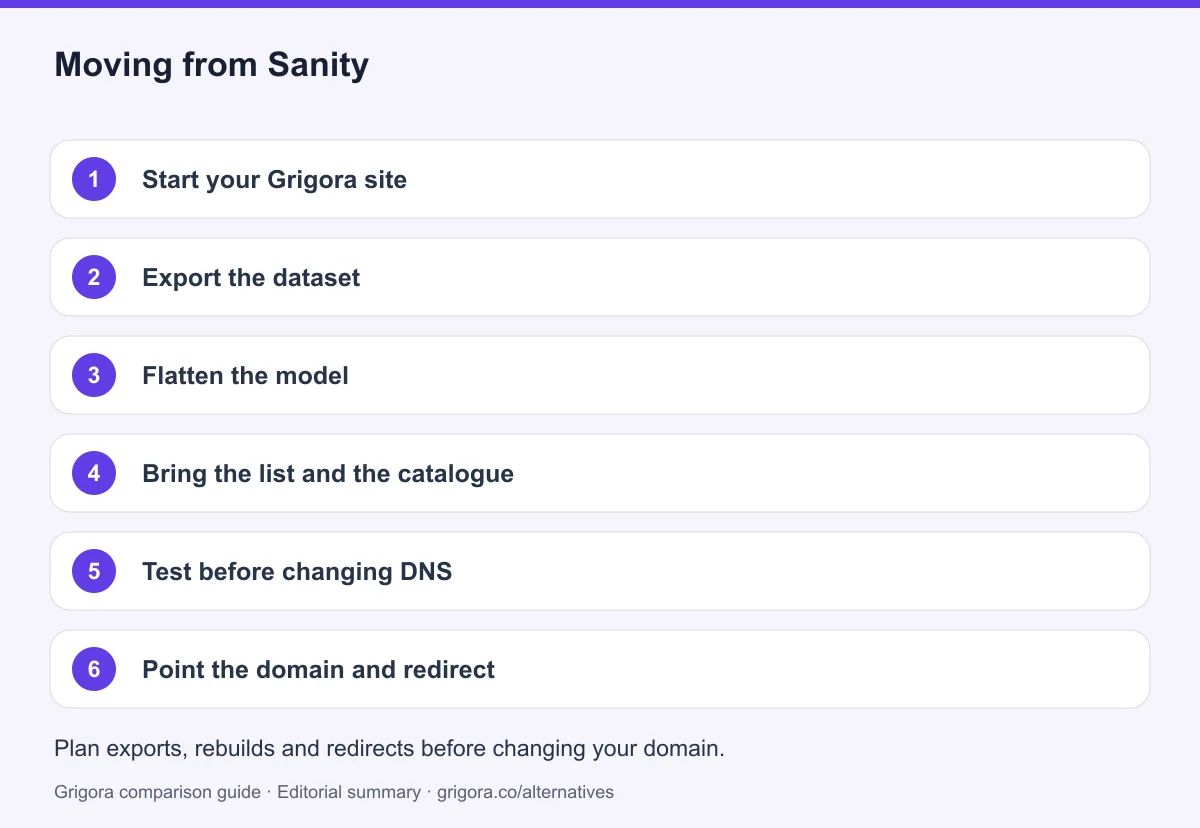
How to switch from Sanity to Grigora
Your content is already exportable: the Content Lake is queryable over the API and datasets export cleanly. The work is deciding what the content model becomes once it no longer feeds a custom frontend.
- 1
Start your Grigora site
Describe the business in a sentence and the AI generates a first-draft site with pages, layout and copy, or start from one of the website templates.
- 2
Export the dataset
Export your Sanity dataset or query the documents you need over the API, and keep the assets. Portable Text needs conversion, including custom blocks, marks and asset references; test the result before a full import.
- 3
Flatten the model
Some schemas map to pages, posts and supported directories; custom document types may require a different structure or an external service. Map them deliberately rather than recreating every document type.
- 4
Bring the list and the catalogue
Import subscribers into the built-in newsletter, and move products into Grigora Commerce if you were pairing Sanity with a separate store.
- 5
Test before changing DNS
Export the dataset and assets, then trial-convert Portable Text with its custom blocks and marks. Resolve references and localized fields explicitly; not every document type should become a public page. Check page titles, descriptions, canonical URLs, internal links, image alt text, forms and checkout on the new site. Keep an old-to-new URL map, add relevant 301 redirects and monitor indexing after launch; redirects cannot guarantee unchanged rankings.
- 6
Point the domain and redirect
Connect your domain, redirect the old frontend's URLs to map previous addresses to their closest replacement, then stop paying for the frontend host and the Sanity seats.
Why people look for a Sanity alternative in 2026
Sanity is not in trouble and nobody should read this page as an obituary. It is independent and well funded, with an $85M Series C led by Bullhound Capital announced in May 2025 and total funding reported at around $173 million, and it was itself the acquirer in late 2024 when it bought the team behind Begin.com. The company has spent the last two years repositioning, from headless CMS to what it now calls a Content Operating System, with a homepage that reads The Content Operations Platform and Content Agent, an Agent API, Functions, a Media Library and an MCP server as the headline products. That is a confident roadmap for an engineering-led audience. It is also a roadmap that moves steadily further away from anyone who just wanted a website.
The content layer arrived and the website did not
The single fact that sends people looking is simple: Sanity renders nothing. It hosts your Studio and your content APIs, and that is the boundary. Your actual site is a separate application written in React, Next.js, Astro or Nuxt and deployed to Vercel, Netlify or AWS. Teams discover this at different moments. Some understand it on day one and budget for it. Others sign up, model their content carefully, fill the Content Lake with polished copy, and then find that publishing means a pull request. A content platform with no front end is a warehouse with no shopfront, and the shopfront is the expensive part.
Seats and API calls instead of a plan
The Free tier is unusually generous on people: twenty user seats, plus unlimited Viewer-role users at no cost. Growth is where the shape of the pricing shows itself. It is $15 per occupied seat per month, up to fifty seats, and every quota underneath it is metered. Above the included 250,000 API requests a month it is $1 per 25,000. Above 100GB of bandwidth it is $0.30 per gigabyte. Assets are $0.50 per extra gigabyte, AI credits $0.05 each, function invocations $1.00 per extra million. None of those numbers is outrageous on its own. Together they mean your content platform costs a different amount every month, driven partly by how many people logged in and partly by how popular your site was.
The ceilings are low and lifting them is not cheap
A 25,000-document limit on Growth sounds enormous until you run a product catalogue, a localised blog and a few years of archives through it. The lift is a $299 per month add-on that takes you to 50,000 documents along with higher request and bandwidth quotas. Datasets are tighter still: two are included, and a third costs $999 per dataset per month, with a fourth another $999 on top. On the free plan, datasets are public only, which means anyone holding your project ID can read your content. Then there is the governance line. Single sign-on and custom access control are shown as Enterprise on the live pricing table, with no published price, and Content Releases sits there too, labelled ambiguously enough that it is unclear whether it is an inclusion or a separately priced add-on. Either way, finding out is a sales conversation.
How Grigora compares
Grigora starts from the other end of the problem. You describe the business in a sentence and the AI produces a first-draft site with pages, layout and copy, or you start from one of website templates. That site is already hosted, already on a CDN, already carrying an SSL certificate, and already publishable to your own domain. There is no repository, no build step, no deploy target and no second vendor. Editors change a block on the page and press publish, and the change is live, without a release cycle standing between the copy and the reader.
One managed plan for the website and publishing workflow
Starter is $12 a month billed annually, Pro is $20 and Business is $45, with published allowances for sites, users, storage, bandwidth and other usage. Every paid plan carries the same set: the CMS with posts, categories, author profiles, directories and moderated comments with admin replies; email marketing with a subscriber list, campaign builder, automations and segmentation, from 2,500 subscribers on Starter up to 25,000 on Business; an online store with a catalogue, variants, stock and digital downloads, taking 0% platform commission on top of your Stripe or Razorpay fees; and SEO controls with metadata, schema, sitemaps and IndexNow submission, backed by free SEO tools on the marketing site. Set that against the Sanity stack for the same outcome: the seats, then a frontend someone builds, then a host for it, then a commerce platform, then an email platform, and the integrations between all of them. Six Growth seats alone are $90 a month before any of those exist. Grigora Business is $45 with all of them included, and a $999 third Sanity dataset costs more in one month than a full year of it.
Where Sanity still wins, and it is not close
Content modelling, querying and editor customisation. If you need twenty typed content types with real references between them, Portable Text that survives being rendered five different ways, and GROQ to ask questions of the whole corpus, Sanity is the correct answer and Grigora is not in the conversation. The same goes for feeding one content source to a website, a native app, in-store screens, an email system and an AI agent at once, which is precisely what Sanity is built for and precisely what Grigora, as a platform that renders its own site, does not do. Sanity Studio being a React application you can extend with custom inputs, plugins and workflows is a genuine advantage that no managed site platform matches, and so are real-time multiplayer editing, document history within the plan’s retention window, and Content Releases for coordinating a dated multi-document launch. Reviewers consistently note a steep learning curve alongside those strengths, which is the honest trade: Sanity rewards teams with the engineering capacity to take it on. This page is for the much larger group who have the content, do not have that capacity, and still need a website that people can actually visit.
Frequently asked questions
Grigora is a Sanity alternative for teams that need a managed website, blog, newsletter and store from $12/month billed annually. Sanity is better suited to custom schemas, GROQ queries, collaborative Studio workflows and content reused across channels. Growth is listed at $15 per occupied seat monthly, with usage allowances; Grigora does not replace Sanity’s headless content architecture.
The Free plan is $0 forever with 20 user seats, 2 public-only datasets and 10,000 documents. Growth is $15 per occupied seat per month for up to 50 seats, 2 datasets and 25,000 documents. Add-ons on Growth are $299/mo for higher quotas, $799/mo for dedicated support and $999 per month for each extra dataset. Enterprise is custom and unpublished. Figures read from sanity.io/pricing on 11 September 2026.
Not for the self-serve plans. Sanity's pricing FAQ states that only monthly payments are supported for Free and Growth, so there is no discounted annual rate to compare against Grigora's $12, $20 and $45 annual tiers. Enterprise annual terms are arranged through sales, with no published figure.
No. Sanity hosts the Studio and the content APIs but renders and hosts no pages. The website is a separate application you build in Next.js, Astro, Nuxt or similar and host with another provider, which means a developer and a second bill before a single page is public.
Neither. There is no cart, checkout, payment processing, inventory or order management, and no campaign builder, subscriber list or sending infrastructure. Sanity Connect for Shopify syncs Shopify products into the Content Lake, but the shop stays in Shopify. Grigora includes both a store with 0% platform commission and email marketing on every paid plan.
Schema-defined content types, references between documents, Portable Text, GROQ and GraphQL queries, a customisable Studio, real-time co-editing and the ability to serve one content source to several channels. Grigora has no headless API and no code export. What you gain is a published website, hosting, a newsletter, a store and a flat monthly price.
Sources and comparison method
Published by Grigora, one of the products compared here. This is a comparison of public product documentation and published plans. Recommendations reflect the use cases described; they are not independent performance benchmarks. Homepage screenshots show how each product presents itself and do not establish feature availability.
Check the billing term, currency, regional availability, usage limits and add-ons before purchasing. A content export does not necessarily include the design, integrations or a working store. Migration steps need testing on your own site.
- Sanity plans and usage pricing
Free/Growth tiers, per-seat billing, dataset add-ons and usage charges.
- Sanity Content Lake documentation
Document storage, querying and content-platform architecture.
- Grigora pricing and included features
Annual and monthly billing, plan allowances, included features and trial terms.
Grigora references: plans and limits, commerce, MCP access, and help documentation.
Compare Grigora with other platforms


Make the switch from Sanity to Grigora
Get the website, CMS, newsletter and store in one managed plan, with published usage allowances. Start with Grigora’s free trial.
14-day free trial • No credit card required • Cancel anytime