
A Flotiq alternative when the missing pieces are yours to build
Flotiq is an API-first content backend for custom websites and applications. Grigora combines a managed website, CMS, newsletter and store from $12/mo billed annually. Choose around frontend ownership, content delivery and the workflow your editors need.
Published by Grigora · Updated · Sources and method
Is Grigora the right Flotiq alternative?
Grigora is a Flotiq alternative for teams that want a hosted website, CMS, newsletter and store together. Flotiq is better aligned with custom frontends and multichannel content delivered through a generated OpenAPI contract. Both offer MCP capabilities, but Grigora does not replace Flotiq’s headless delivery model or its custom deployment options.
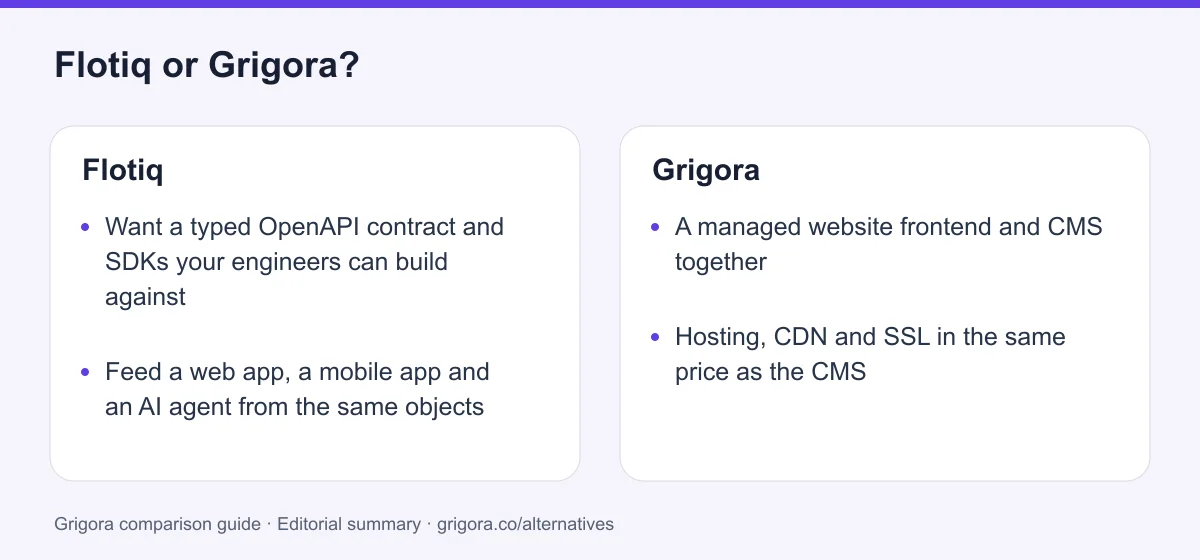
Choose Grigora if you want…
- A managed website frontend and CMS together
- Hosting, CDN and SSL in the same price as the CMS
- A newsletter and subscriber list without finding a second vendor
- An included product catalogue and checkout
- One plan covering several sites instead of one bill per project
Stick with Flotiq if you…
- •Want a typed OpenAPI contract and SDKs your engineers can build against
- •Feed a web app, a mobile app and an AI agent from the same objects
- •Need on-premise or hybrid deployment for a security review
Flotiq or Grigora: the decision in one view
Flotiq alternatives at a glance
How Grigora and the other platforms on a Flotiq shortlist compare on the essentials.
Swipe the table sideways to see every column
| Platform | Best for | Free access | Starting price | Sales fees | Data and site portability |
|---|---|---|---|---|---|
| Grigora | All-in-one sites, fully managed | Free trial | From $12/mo billed annually | 0% platform fee; Stripe/Razorpay fees apply | Posts/content; rebuild design |
| Flotiq | API-first content behind your own frontend | Yes, perpetual | $37/mo billed yearly | No store | Yes |
| Strapi | Self-hosting the CMS yourself | Software is free | Free self-hosted; Cloud from $29/mo yearly | No store | Content/database; frontend separately |
| Contentful | Large enterprise content operations | Yes | Published tiers, then sales | No store | Yes |
| DatoCMS | Media-heavy structured content | Yes | Published tiers | No store | Yes |
| Sanity | Custom editing interfaces | Yes | Growth $15/seat/mo plus usage | No store | Dataset/assets; frontend separately |
Flotiq’s plans are billed per Space. The other headless platforms have different plans and limits; verify their current terms. A headless CMS usually needs a separately deployed website frontend and integrations for email or checkout.
Sources for the overview table
- Grigora: official reference 1
- Strapi: official reference 1, official reference 2
- Sanity: official reference 1, official reference 2
Why people switch from Flotiq to Grigora
What a small ecosystem costs you once the project is real.
The shelf runs out before the website does
Review the exact plugins and API integrations your project needs, including the plan allowance. Newsletter and storefront requirements may add separate services and frontend work.
Every gap arrives as another supplier
Hosting goes to Netlify or Vercel, checkout to Snipcart, email to whatever you can reach through Zapier, Pabbly or n8n. Each one is a login, an invoice and a thing that breaks on its own schedule.
The bill multiplies by project, not by traffic
Each Space has its own plan and its own limits, so three client sites on Basic is $111/mo billed yearly for three Basic Spaces, or $117 month-to-month. Grigora's Business plan covers five sites for $45/mo billed annually.
API usage over a rolling window
The API allowance runs on a rolling 30-day window and limits are hard stops rather than overages, so one misconfigured build loop keeps eating headroom long after you fix it.
What Flotiq does well
- Generated OpenAPI schema, SDKs and a Postman sandbox for your own content types
- Strong editing desk: version history, DeepL translation and real-time co-editing
- A genuinely usable free tier with 100k API calls and unlimited free Spaces
- On-premise and hybrid deployment plus Azure AD SSO on Custom plans
Where Flotiq falls short
- No website: no builder, no themes, no hosting, no domains, no forms
- No email marketing of any kind, and no email tool in the marketplace
- No commerce beyond a starter that depends on a paid Snipcart subscription
- Per-Space billing and hard limits on a rolling 30-day API window
Grigora vs Flotiq at a glance
What each side leaves for you to source somewhere else.
| Feature | Flotiq | Grigora |
|---|---|---|
| Starting paid price | $37/mo billed yearly | $12/mo all-in |
| Publishes a live website | No | Yes |
| Hosting, CDN and SSL for your pages | Netlify or Vercel, your account | Included |
| Marketplace depth | Around a dozen official plugins, 1 to 10 per tier | Features, not plugins |
| Newsletter and subscriber list | No | Included |
| Cart and checkout | Snipcart, on its own subscription | Built in, 0% commission |
| Generated OpenAPI schema and SDKs | Yes | No |
| How you are billed | Per Space, one Space per project | Per plan, 1 to 5 sites |
| Free SEO tools suite | No | Free tools |
Grigora vs Flotiq: feature by feature
A category-by-category breakdown, pricing, AI, design, e-commerce, email, SEO, performance, and support.
Built-in tools and plugin allowances
Depends on your needsFlotiq publishes separate allowances for official and custom plugins by plan. Its headless model also allows frontend and external-service integrations beyond the plugin marketplace. Grigora includes website, newsletter and store tools, but does not provide the same custom frontend architecture.
| Feature | Grigora | Flotiq |
|---|---|---|
| How features arrive | Built into every plan | Official plugins, metered per tier |
| Official plugins on Free / Basic / Growth | Not metered | 1 / 5 / 10 |
| Custom plugins you write yourself | No | 1 (localhost only) / 2 / 5 |
| Catalogue size | No marketplace | Reported at around a dozen official plugins |
| Any email marketing tool in the catalogue | Included natively | No |
| Commerce tools in the catalogue | Store included | One, Snipcart |
Takeaway: Evaluate the integrations your application needs rather than using marketplace size as a proxy for capability.
The OpenAPI contract and generated SDKs
Fit: FlotiqFlotiq generates OpenAPI specifications and SDKs for custom content types and provides MCP access for agents. Grigora also offers MCP management tools, but does not expose an equivalent headless content-delivery API or generated SDK contract.
| Feature | Grigora | Flotiq |
|---|---|---|
| Generated OpenAPI schema for your own types | No | 3.1, 3.0 and Swagger 2.0 |
| Generated SDKs | No | Yes |
| Postman sandbox | No | Yes |
| MCP server for AI agents | MCP management tools | OAuth 2.1 login, added September 2026 |
| Content served to apps and screens beyond the website | No | The entire point of the product |
Takeaway: Choose Flotiq for OpenAPI-based content delivery; compare MCP operations separately from delivery APIs.
Who builds and hosts the actual pages
Fit: GrigoraFlotiq hosts the CMS and delivers content through APIs. You choose and host a separate frontend, which can use frameworks such as Next.js. Standard plans are managed cloud services, while the current pricing page explicitly offers on-premise or hybrid options through a custom agreement.
| Feature | Grigora | Flotiq |
|---|---|---|
| Page builder and templates | Block editor, website templates | No |
| Hosting, CDN and SSL for your pages | Included | Netlify or Vercel, billed to you |
| Domain connection | Included | Handled by your host |
| Forms on your pages | Built in | Build them yourself |
| Self-hosting the CMS | No | Custom on-premise/hybrid agreement |
| Frontend developer required | No | Yes |
Takeaway: Include frontend development and hosting in a Flotiq project; ask sales about custom deployment requirements.
Spaces: one project, one subscription
Fit: GrigoraFlotiq bills per Space, and the docs confirm each Space carries its own plan with limits calculated separately. That is generous at zero, because the FAQ says you can run unlimited projects on the free tier, and expensive the moment projects go live. Three client sites on Basic is three subscriptions, $111 a month billed yearly, or $117 month-to-month, before anyone has hosted a page.
| Feature | Grigora | Flotiq |
|---|---|---|
| Billing unit | One plan, 1 to 5 sites | Per Space, limits counted separately |
| Three live projects | $45/mo Business covers 5 sites | Three Basic Spaces: $111/mo billed yearly |
| Free projects | Free trial | Unlimited free Spaces, per the FAQ |
| Seats included | 5 / 15 / unlimited team members by plan | 2 free, 3 on Basic, 6 on Growth |
| Adding a colleague | Check included team capacity | $12 per seat/mo above the included count |
Takeaway: Grigora's bill grows with the number of sites on one plan; Flotiq's grows with the number of subscriptions.
Hard stops and the 30-day rolling API window
Depends on your needsFlotiq's limits do not bill as overage, they stop you. The pricing FAQ says that once you reach the limit of roles, users, content types or API calls you cannot create another item until you delete something or upgrade. The awkward part for planning is the API allowance: it runs on a rolling 30-day window rather than resetting on the first of the month, so a bad build loop or one busy week keeps eating your headroom for a month afterwards.
| Feature | Grigora | Flotiq |
|---|---|---|
| API calls included | Different managed-site/MCP model | 100k / 300k / 1M per month |
| How the allowance resets | Check each published plan allowance | 30-day rolling window, not a monthly reset |
| Behaviour at the limit | Sites, pages, bandwidth, storage, teams and subscribers | Creation blocked until you delete or upgrade |
| Overage billing | None | None, because limits are hard stops |
| Content objects | Posts, collections and products | 1,000 / 10,000 / 100,000 |
| Content types | Built-in models | 20 / 50 / unlimited |
Takeaway: Monitor Flotiq’s rolling API allowance and item limits. Grigora has bandwidth, storage, content and team limits of its own.
The editing desk: history, translation and co-editing
Fit: FlotiqAs a place to work on structured content, Flotiq is genuinely good and better than Grigora in several specific ways. Version history with restore, draft and public modes, scheduled publishing, in-place relation editing, DeepL translation for multilingual content, a full-text search API with filtering and custom ranking, and real-time collaborative editing added in the 3 September 2026 release. Grigora's CMS is complete for running a website, and it does not co-edit.
| Feature | Grigora | Flotiq |
|---|---|---|
| Real-time collaborative editing | No | Added September 2026 |
| Version history with restore | Not part of the published feature set | 30-day retention on every tier |
| Multilingual content | No | DeepL translation built in |
| Full-text search API with custom ranking | No | Yes |
| AI writing in the editor | Yes | Surfer SEO plugin for guidance |
| Moderated comments with admin replies | Yes | No |
Takeaway: For the act of editing content, Flotiq is the better desk; it just has nowhere to publish the result.
Selling something: Snipcart, or nothing
Fit: GrigoraFlotiq has no commerce at all. No cart, no checkout, no payments, no orders, no tax or shipping engine, no stock. Products are ordinary content objects. The official 'NextJS eCommerce - Green Shop' starter borrows its cart and checkout from Snipcart, a separate third-party product on its own subscription; the starter ships with a public test key and the docs note you have to buy Snipcart for commercial use. Snipcart is also the only commerce entry on the integrations page.
| Feature | Grigora | Flotiq |
|---|---|---|
| Cart and checkout | Built in | Snipcart, a separate paid product |
| Orders, tax and shipping | Built in | No |
| Variants and stock | Yes | Product data stored as content objects |
| Digital downloads | Yes | No |
| Platform commission | 0% | Flotiq takes none; Snipcart and your processor bill separately |
| Payment gateways | Stripe and Razorpay | Whatever your cart vendor supports |
Takeaway: Flotiq can supply product content to an external commerce frontend. Compare the combined commerce service and implementation cost with Grigora’s included store.
SEO in a separately implemented frontend
Depends on your needsFlotiq can store SEO fields in content models, while the frontend generates metadata, structured data and sitemaps. Its Surfer SEO and Search Console plugins support editorial workflows. Grigora provides those publishing controls within the managed website platform.
| Feature | Grigora | Flotiq |
|---|---|---|
| Meta titles, descriptions and canonicals | Built in | Your frontend's job |
| Sitemaps and IndexNow submission | Yes | No |
| Redirect manager and robots.txt | Built in | No |
| Keyword guidance in the editor | AI writing assistance | Surfer SEO plugin |
| Search Console data inside the CMS | No | Google Search Console plugin |
| Free SEO tools suite | Free tools | No |
Takeaway: Compare controls and test representative pages for crawlable content, accurate metadata and performance. No platform guarantees rankings or citations in AI answers.
On-premise, SSO and the security review
Fit: FlotiqFlotiq’s current Custom plan offers on-premise and hybrid deployments; standard plans are cloud hosted. Its pricing also lists SSO and service-level options. Obtain the security documentation, deployment scope and support agreement required by your organisation. Grigora is a managed website service and does not offer the same self-hosting model.
| Feature | Grigora | Flotiq |
|---|---|---|
| On-premise or hybrid deployment | No | Custom plan only |
| Single sign-on | No | Azure AD |
| Published uptime targets per tier | Managed hosting, no tiered SLA published | 99% / 99.9% / >99.99% |
| ISO 27001 | Not published | Listed, though per-tier coverage is not readable |
| Regulated-sector references | Small business and agency focus | Cites a 2022 banking deployment |
Takeaway: If a security review rules out a multi-tenant renderer, Flotiq has a route that Grigora simply does not have.
Explore Grigora before switching from Flotiq
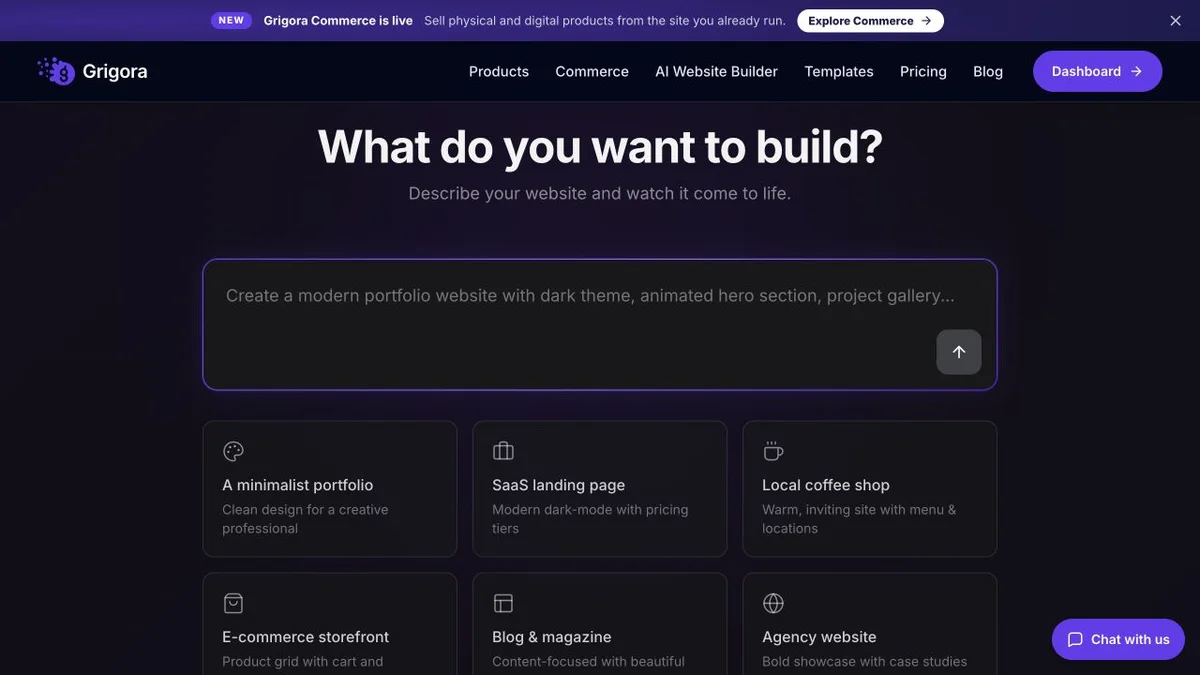
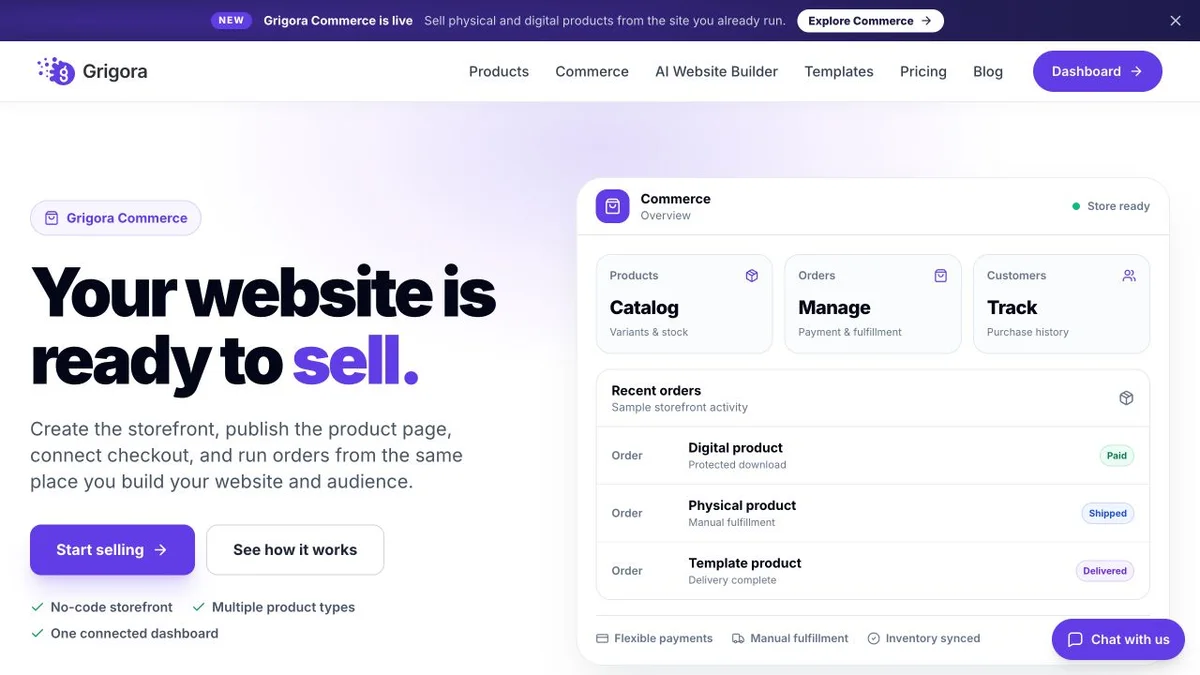
Current public product pages and plans, so you can inspect what you would be moving to. Open any image at full size.
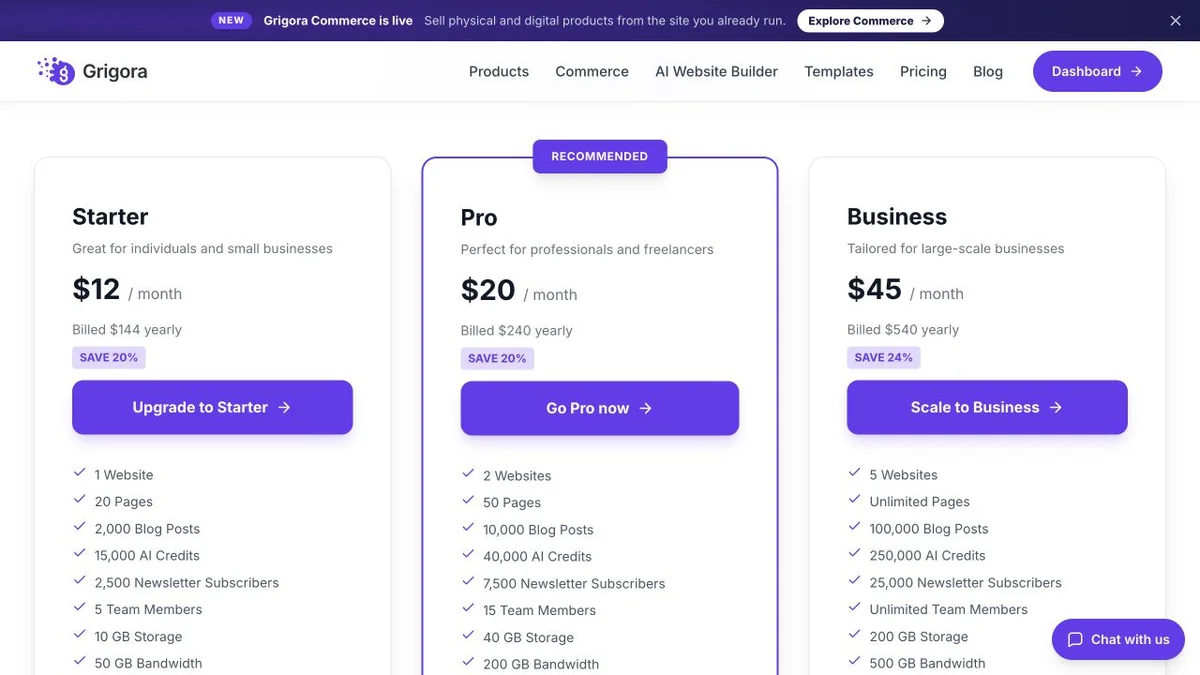
Grigora vs Flotiq pricing
Flotiq's list price is per Space. Compare it to a Grigora plan that already contains the website, the newsletter and the store.
Website, newsletter & store in one plan
Annual rates shown. Hosting, CDN, SSL, backups, the CMS, the newsletter and the store are included on every paid plan, with 0% platform commission through connected Stripe or Razorpay checkout; processing fees apply.
Priced per Space, with hard limits
Read from flotiq.com/pricing on 11 September 2026. The page opens on the yearly toggle, so $37 and $114 are the discounted annual rates; the monthly rates are $39 and $120. Custom has no published price. Prices are per Space, and one Space is one project. Extra seats are $12 per seat/mo on Basic and Growth. Third-party listings showing a 'Pro' plan or millions of API calls are out of date.
Flotiq Basic at $37/mo billed yearly buys one project's content API. Grigora Starter at $12/mo buys the site that content was for, plus hosting, a newsletter and a store.
The real cost: Grigora vs Flotiq
For a business website, compare the CMS plan, frontend implementation, hosting and any store or email service. An existing frontend team or reusable code can change the total substantially.
| What you pay for | Flotiq | Grigora |
|---|---|---|
| CMS subscription | $37/mo billed yearly on Basic, per Space | $12 to $45/mo for 1 to 5 sites |
| The website itself | A Next.js codebase, built and maintained by a developer | AI first draft, then edit in the block editor |
| Hosting, CDN and SSL | Netlify or Vercel on your own account | Included |
| Email marketing | An outside platform, wired up via Zapier, Pabbly or n8n | Included, 2,500 to 25,000 subscribers |
| Cart and checkout | A Snipcart subscription plus processor fees | Included, 0% platform commission |
| Second and third project | A second and third Space, billed separately | Covered by Pro or Business |
| A typed API for your own engineers | OpenAPI 3.1 schema and generated SDKs, included | Not available |
Flotiq figures from flotiq.com/pricing, 11 September 2026. Snipcart's own pricing was not checked for this page, so no figure is quoted for the real cost of a Flotiq store. Payment-processor fees apply on both sides, and developer rates vary widely; the presence of a developer line item does not.
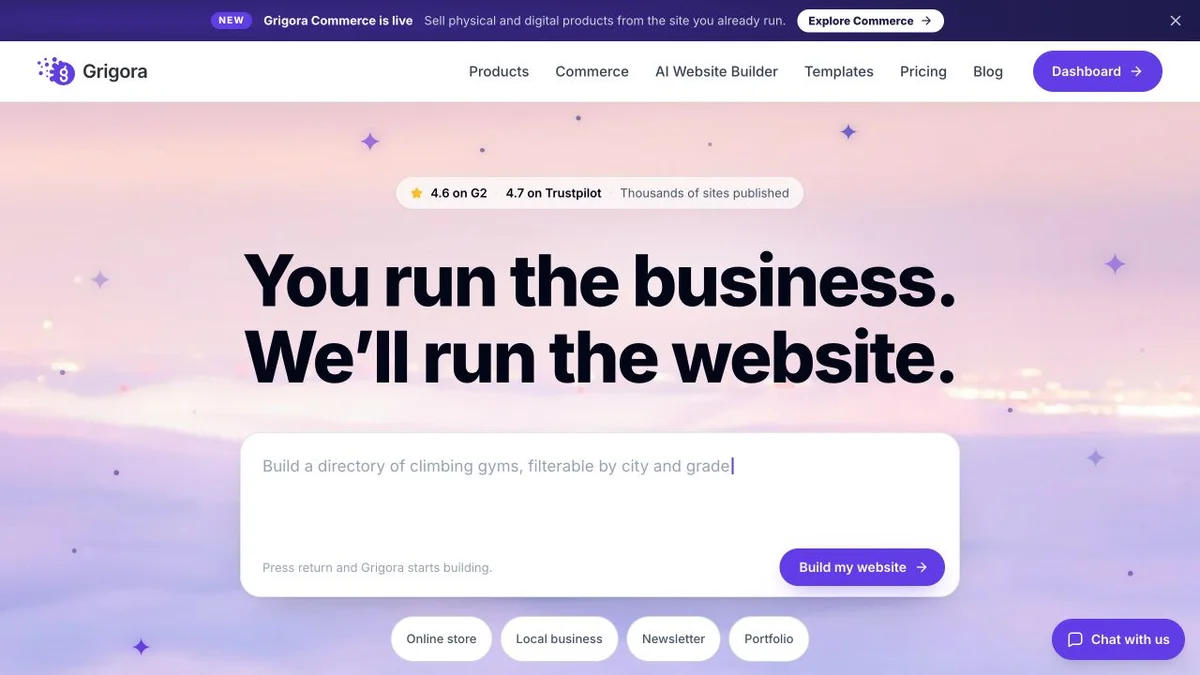
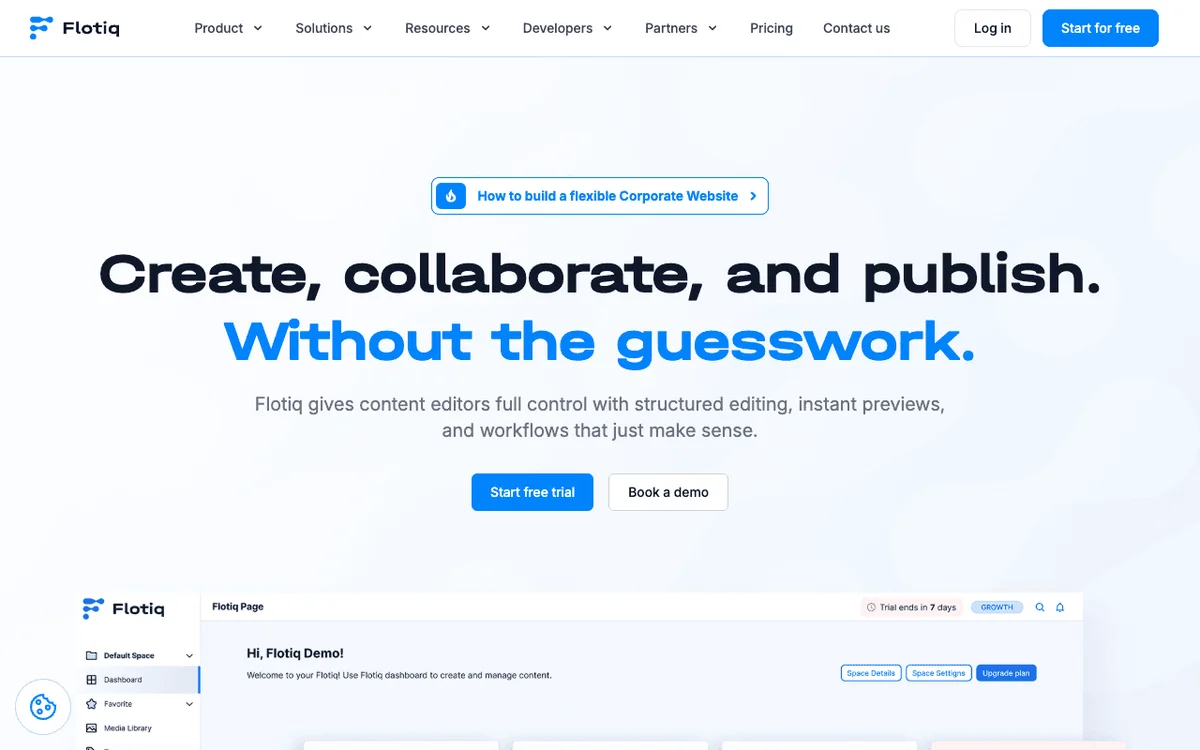
Flotiq and Grigora: public website references
These captures show each product’s public website. See the feature and pricing sections for capabilities and plan details.
Is Grigora the right Flotiq alternative for you?
Where Grigora is the stronger Flotiq alternative, by use case.
For a business that needs a website
A Flotiq website needs a separately implemented frontend. If the team prefers a hosted editor and publishing workflow, compare Grigora using the content types and integrations the site needs.
… for agencies juggling several client projects
Per-Space billing means each client is a fresh subscription. One Grigora Business plan at $45/mo covers five sites, and White Label is available at $199/mo if you resell under your own brand.
… for teams who need email and a shop
Flotiq has no email marketing anywhere in the product and no commerce beyond a Snipcart starter. Both are standard on every paid Grigora plan, with 0% platform commission through connected Stripe or Razorpay checkout; processing fees apply.
Flotiq is the right call if you already have a frontend team
If engineers are building the frontend anyway and want a generated OpenAPI contract, SDKs, multi-channel delivery or an on-premise option, Flotiq is doing something Grigora does not do at all. Keep it.
Which one is right for you?
Choose Grigora if…
- You need a live site, not a schema describing one
- Nobody on the team is going to maintain a Next.js codebase
- A newsletter and a store should be in the plan, not in the marketplace
- You run several sites and want them on one subscription
- You would rather have SEO controls than SEO advice
Choose Flotiq if…
- •A typed OpenAPI contract and generated SDKs matter to your engineers
- •The same content has to feed apps, screens and agents as well as a site
- •On-premise or hybrid deployment is a hard requirement
How to switch from Flotiq to Grigora
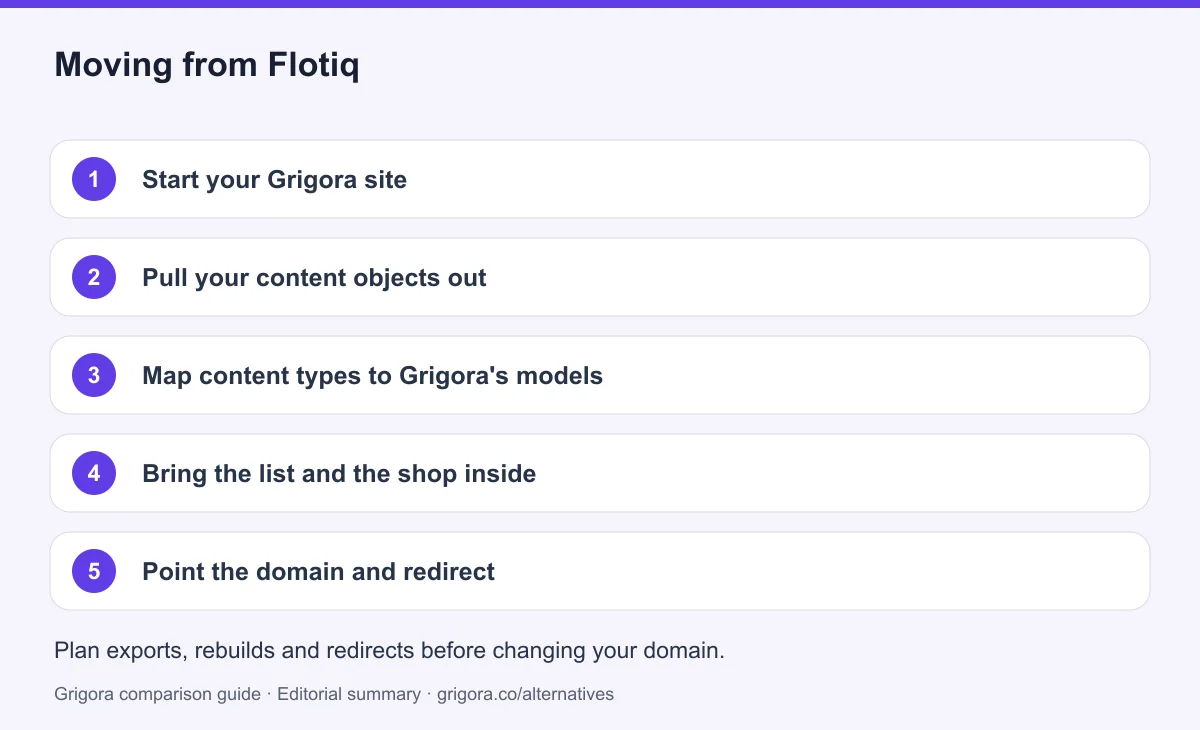
Flotiq content comes out through the same API it went in through, which is the advantage of an API-first backend. The work is mostly on the frontend you are retiring. Test a representative sample against Grigora’s supported import formats before moving everything. Back up media and business records separately, and retain marketing consent and unsubscribe records; an export is not proof of a direct import.
- 1
Start your Grigora site
Describe the business in a sentence and the AI generates a first-draft site with pages, layout and copy, or start from one of the available website templates.
- 2
Pull your content objects out
Export your content types and objects through the Flotiq API or its generated SDKs, and download the media library before you cancel the Space.
- 3
Map content types to Grigora's models
Map content types and relationships to supported Grigora posts and collections. Preserve a complete API export and test complex relations; do not flatten fields until the team confirms the information is no longer needed.
- 4
Bring the list and the shop inside
Export opted-in contacts from the separate email service and test products from the commerce provider. Check recurring payments, order history, variants and media before retiring any integration.
- 5
Point the domain and redirect
Keep the current service active while testing the replacement. Preserve existing URL paths where possible, configure permanent redirects where you control the old address, and check canonicals, sitemaps, forms and checkout on mobile. Change DNS after these checks, then monitor errors and indexing before cancelling services you no longer need. Rankings can change during migration.
Why people look for a Flotiq alternative in 2026
Flotiq is an actively developed headless CMS with a focus on OpenAPI-based content delivery and editing tools. A comparison with Grigora is mainly about architecture: whether your team wants to own a frontend or use a managed website platform. Company size and marketplace counts do not determine whether it meets a project’s requirements.
Around a dozen plugins, rationed by tier
Flotiq’s plugin catalogue adds integrations to its content editor, including SEO-related tools. The pricing limits access to official plugins by tier, and custom plugin limits also apply. Newsletter delivery and storefront checkout generally require external services or implementation; a marketplace count alone does not establish whether a specific integration is available.
Flotiq publishes objects, not pages
Flotiq supplies a managed content API and editor. A developer builds or configures the frontend and chooses a host; that frontend implements pages, forms, metadata and other public behaviour. Standard plans use cloud hosting, while current Custom terms offer on-premise and hybrid deployments. Grigora instead hosts the website and its CMS together.
One Space, one invoice, three client sites
Billing is per Space, and the docs are explicit that each Space carries its own payment plan with limits calculated separately. On the free tier that is a gift: the pricing FAQ says you can experiment with unlimited projects, so a dozen prototypes cost nothing. Once projects go live it inverts. Three client sites on Basic is three subscriptions, $111 a month billed yearly, or $117 month-to-month, and none of that has hosted a single page. The limits are hard stops rather than overages, so when you hit the ceiling on roles, users, content types or API calls you cannot create another item until you delete something or upgrade. The API allowance is the one to watch, because it runs on a rolling 30-day window rather than resetting monthly.
How Grigora compares
Grigora is built from the opposite end. Instead of a content layer waiting for a frontend, it is a finished website you edit: AI generation from a description of the business, website templates, a block editor with custom code injection, and hosting, CDN and SSL already attached. The CMS underneath handles posts, categories, author profiles, directories and moderated comments with admin replies. Nothing in that list is a plugin, so there is no catalogue to check and no per-tier allowance to spend.
The parts Flotiq sends you shopping for are in the plan
Grigora Starter includes newsletter campaigns for up to 2,500 subscribers and a product store with Stripe or Razorpay checkout; processor fees apply. Its publishing settings cover metadata, structured data, sitemaps and IndexNow. With Flotiq, newsletter and commerce services are separately integrated, while the frontend and CMS fields can implement SEO requirements and its plugins can support the workflow.
Where Flotiq still wins: the contract and the deployment options
Two things here are straight losses for Grigora and this page will not blur them. The first is the developer contract. Flotiq generates an OpenAPI schema for your own content types in 3.1, 3.0 and Swagger 2.0, ships generated SDKs, scoped specs and docs and a Postman sandbox, and added an MCP server with OAuth 2.1 login in September 2026. Grigora offers MCP management, but not the same OpenAPI delivery contract or generated SDKs. Flotiq is appropriate when content must feed several custom applications. The second is deployment. Custom plans support on-premise and hybrid installs, Azure AD single sign-on is available, uptime targets are published per tier, and ISO 27001 appears on the security row, though which tiers carry it is not legible on the comparison table. If your security review forbids a multi-tenant renderer, Grigora is not the answer and Flotiq might be.
Frequently asked questions
Grigora is a Flotiq alternative for teams that want a hosted website, CMS, newsletter and store together. Flotiq is better aligned with custom frontends and multichannel content delivered through a generated OpenAPI contract. Both offer MCP capabilities, but Grigora does not replace Flotiq’s headless delivery model or its custom deployment options.
Flotiq's Free plan is $0 with 100k API calls a month, 1,000 content objects and 20 content types. Basic is $39/mo billed monthly or $37/mo billed yearly, and Growth is $120/mo billed monthly or $114/mo billed yearly. A Custom plan exists with no published price. The pricing page opens on the yearly toggle, so the first figures you see are the discounted annual rates. Prices read from flotiq.com/pricing on 11 September 2026.
Flotiq manages content and serves it through APIs; a website needs a separate frontend and host. Standard plans are hosted cloud services. Its current pricing page also offers on-premise and hybrid deployment on a custom agreement, so the older blanket statement that self-hosting is impossible is too broad.
Neither. There is no newsletter, broadcast, automation, subscriber list or transactional email anywhere in the product, and no email tool in the plugin catalogue. For commerce, product data can live as content objects, but the official ecommerce starter takes its cart and checkout from Snipcart, a separate paid product. Grigora includes both on every paid plan.
Flotiq’s Free plan includes 100,000 API calls, 1,000 content objects, 20 content types, two team members and one official plugin. The pricing FAQ allows multiple free projects, with limits applied per Space. Check current API-key scopes and role restrictions before using it for a production workflow with several editors.
You give up Flotiq’s generated OpenAPI contract, SDKs and headless delivery to custom applications. Grigora has its own MCP tools, so agent access is not absent, but operations differ. Check multilingual editing, real-time collaboration, field relationships and custom deployment before moving.
Sources and comparison method
Published by Grigora, one of the products compared here. This is a comparison of public product documentation and published plans. Recommendations reflect the use cases described; they are not independent performance benchmarks. Homepage screenshots show how each product presents itself and do not establish feature availability.
Check the billing term, currency, regional availability, usage limits and add-ons before purchasing. A content export does not necessarily include the design, integrations or a working store. Migration steps need testing on your own site.
- Flotiq pricing and deployment options
Annual/monthly rates, usage limits, plugin allowances and Custom on-premise/hybrid deployment.
- Flotiq Spaces documentation
A separate plan and limits apply to each Space.
- Grigora MCP tools
Grigora has agent-management tools; these are distinct from Flotiq’s headless delivery API.
- Grigora pricing and included allowances
Annual and monthly prices, trial, team and usage allowances, newsletter tools and optional services.
Grigora references: plans and limits, commerce, MCP access, and help documentation.
Compare Grigora with other platforms


Make the switch from Flotiq to Grigora
Get the website, the newsletter and the store in one subscription, published and hosted, with no frontend to build. Try Grigora free, no credit card required.
14-day free trial • No credit card required • Cancel anytime