
A Prismic alternative for a hosted website without maintaining a slice library
Grigora is a Prismic alternative for teams that want a managed website, CMS, newsletter and store from $12/month billed annually. Prismic suits developer-defined slice libraries, localization and content delivery to custom frontends. Its standard CMS requires a frontend implementation; compare any separately sold AI website product on its own terms rather than assuming the CMS subscription includes it.
Published by Grigora · Updated · Sources and method
Is Grigora the right Prismic alternative?
Grigora is a Prismic alternative for teams that want a managed website, CMS, newsletter and store from $12/month billed annually. Prismic suits developer-defined slice libraries, localization and content delivery to custom frontends. Its standard CMS requires a frontend implementation; compare any separately sold AI website product on its own terms rather than assuming the CMS subscription includes it.
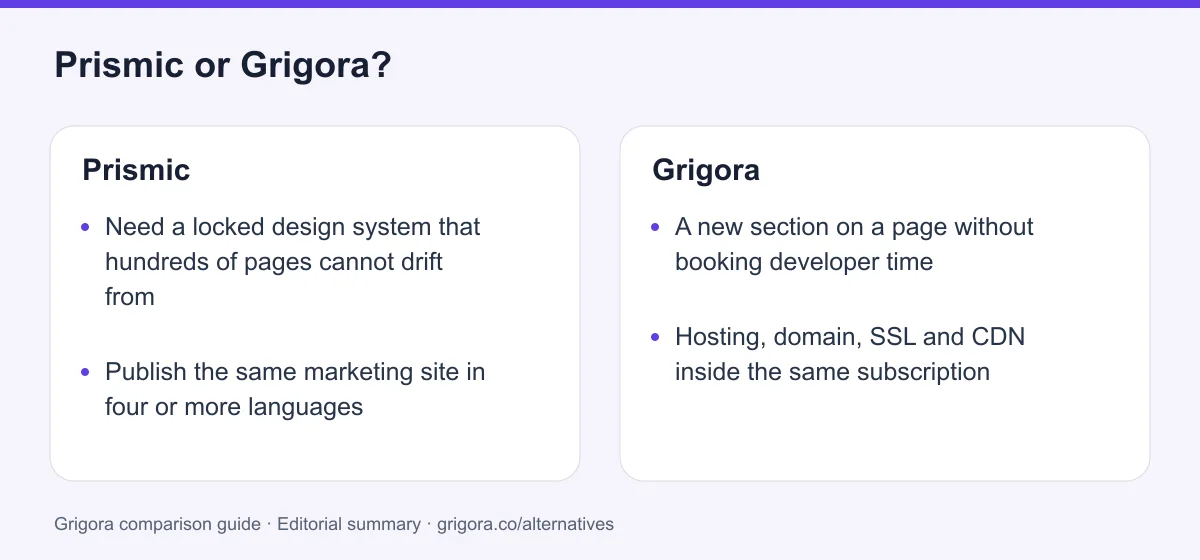
Choose Grigora if you want…
- A new section on a page without booking developer time
- Hosting, domain, SSL and CDN inside the same subscription
- One plan covering up to five sites instead of one bill per site
- A subscriber list and campaigns without a second vendor
- A checkout that takes money rather than a catalogue field
Stick with Prismic if you…
- •Need a locked design system that hundreds of pages cannot drift from
- •Publish the same marketing site in four or more languages
- •Have front-end engineers who will own the site for its whole life
Prismic or Grigora: the decision in one view
Prismic alternatives at a glance
How Grigora and the platforms people usually shortlist against Prismic compare.
Swipe the table sideways to see every column
| Platform | Best for | Free access | Starting price | Sales fees | Data and site portability |
|---|---|---|---|---|---|
| Grigora | A finished site, CMS, newsletter and store in one plan | Free trial | From $12/mo billed annually | 0% platform fee; Stripe/Razorpay fees apply | Posts/content; rebuild design |
| Prismic | Marketing pages assembled from developer-built slices | Yes, 1 user | From $10/mo per repository, billed annually | None, it sells nothing | Documents/assets; frontend separately |
| Contentful | Governed content across many channels | Yes, with hard caps | Published tiers, then sales | None, it sells nothing | Yes |
| Storyblok | Visual editing on a headless backend | Yes | Growth $90.75/mo billed annually | None, it sells nothing | Content/assets; frontend separately |
| Sanity | Developer-shaped content with a custom studio | Yes | Growth $15/seat/mo plus usage | None, it sells nothing | Dataset/assets; frontend separately |
| Webflow | Designer-grade sites that render themselves | Yes | From $15/mo | 0% except 2% Ecommerce Standard; processing extra | Static code on eligible Workspace; CMS/store separately |
Only the Grigora and Prismic figures were read live on 11 September 2026, Prismic's from prismic.io/pricing. Prismic prices are per repository and billed annually. The other rows are directional and were not price-checked that day. Headless platforms charge for delivering content, not for a rendered site, so front-end hosting is an extra bill on every one of them. Verify current pricing on each provider's site.
Sources for the overview table
- Grigora: official reference 1
- Prismic: official reference 1, official reference 2
- Storyblok: official reference 1, official reference 2
- Sanity: official reference 1, official reference 2
- Webflow: official reference 1, official reference 2
Reasons to consider moving from Prismic to Grigora
Consider these trade-offs against your existing setup before planning a move.
Every new section starts as a developer ticket
A slice is modelled in Slice Machine, written as a component and pushed to the repository before it appears in the builder. Marketing waits for the sprint. On Grigora the block already exists, and adding one is a decision rather than a request.
The slice library becomes its own maintenance job
Ten slices covering two hundred pages is the success story. The other version is forty slices with variants, each one code that has to be updated when the brand changes, tested when the framework upgrades and documented so editors know which to pick.
The bill multiplies with the number of sites
Because pricing is per repository, a second brand site is a second subscription with its own seats, locales and allowances. Grigora's Pro plan covers two sites and Business covers five, on one account.
The marketing stack is still missing
No store, no email, no forms, no analytics, no redirects. Prismic's own roadmap still lists real-time collaboration and autosave as in progress and commenting as next, so even some editor basics are pending. Grigora ships the CMS, the newsletter and the store together.
What Prismic does well
- Slices bind marketers to the design system, so brand drift is structural rather than policed
- Localisation is inside the document, with two locales even on the free plan
- Releases, scheduling, revision history, GraphQL and the Migration API all ship free
- The front end is your own code in your own repository, so leaving costs a content migration, not a rebuild
Where Prismic falls short
- Nothing is rendered or hosted: the site is a framework app you build and operate
- Every slice is a component a developer writes before a marketer can use it
- Billing is per repository, so seats, locales and quotas never pool across sites
- Support stays Basic up to $675/mo, with no backups or restore outside Enterprise
Grigora vs Prismic at a glance
The differences that decide whether marketing waits on a developer.
| Feature | Prismic | Grigora |
|---|---|---|
| Entry price | $0, then $10/mo per repository | $12/mo, everything in |
| What publishing produces | JSON from an API | A live page on your domain |
| Adding a new type of section | Model and code a slice first | Drop a block and edit it |
| Hosting, domain and SSL | No | Included |
| Templates to start from | None, you write components | website templates |
| Newsletter and campaigns | No | Included |
| Online store | Catalogue sync only, no checkout | Built in, 0% commission |
| Billing unit | Per repository, one site each | 1 to 5 sites per plan |
| Languages per site | 2 free, up to 8 on Platinum | One |
Grigora vs Prismic: feature by feature
A category-by-category breakdown, pricing, AI, design, e-commerce, email, SEO, performance, and support.
Who writes the slice before a marketer can place it
Fit: GrigoraPrismic's Page Builder is pleasant to work in, and the list of things you can place inside it is a list of components somebody already built. A slice is a developer artefact: modelled in Slice Machine, written as a React, Vue or Svelte component, pushed into the repository. Until that exists, the marketer opens the builder and finds nothing to add.
| Feature | Grigora | Prismic |
|---|---|---|
| Adding a section nobody built yet | Drop a block, edit it in place | Model the slice, code it, ship it |
| Who does that work | Whoever needs the page changed | A front-end developer |
| Where it happens | In the editor, on the page | Slice Machine, then a pull request |
| First page after signing up | AI first draft in minutes | After a framework project exists |
| Custom code when you want it | Code injection on any plan | The entire front end is code |
Takeaway: The Prismic editor is only ever as rich as the slice library behind it, and that library is a development backlog with a queue.
Slice libraries and brand drift at two hundred pages
Fit: PrismicThis is Prismic's strongest argument and it is a fair one. Because slices are developer-defined and bound to the design system, marketers can combine them but cannot break out of them. Prismic's own case studies put numbers on it: SportsShoes reports over two hundred bespoke pages built from just ten slices, and EVRI runs roughly forty slices with variants covering nearly every design handed to it. A free-form block editor gives anyone permission to drag anything anywhere, and brand drift is the default outcome.
| Feature | Grigora | Prismic |
|---|---|---|
| Can an editor break the design | Yes, blocks are free-form | No, the slice constrains them |
| Design-system enforcement | Convention and review | Enforced by the component itself |
| Reuse across hundreds of pages | Templates and saved sections | A governed slice library |
| Permission tiers | Basic roles | User roles from Medium up, custom roles on Enterprise |
| Pages per component, vendor case study | Not published | 200+ pages from 10 slices (SportsShoes) |
Takeaway: If twenty-five marketers publish against one design system, Prismic's constraint is the product and Grigora's freedom is the risk.
Billed per repository, and a repository is one site
Fit: GrigoraPrismic's pricing table is explicit that the figure is per month and per repository, and its FAQ defines a repository as an independent working space with its own content, users, endpoint and subscription. Nothing pools. Three brand sites on the Small tier means three separate subscriptions, three separate seat counts and three separate locale allowances.
| Feature | Grigora | Prismic |
|---|---|---|
| What the price buys | A plan covering 1 to 5 sites | One repository |
| Three sites at the second paid tier | Business, $45/mo for up to 5 | Three subscriptions at $25/mo each |
| Do user seats pool across sites | One team, one account | No |
| Do API calls and CDN pool | Hosting included; bandwidth allowances apply | No |
| Entry price | $12/mo annual, everything included | $10/mo per repository, content only |
Takeaway: Budget each repository separately and compare the users, locales and usage it requires; per-repository pricing can suit independently managed sites.
The Next.js app you still have to build, deploy and keep alive
Fit: GrigoraPrismic does not host, does not supply a domain, ships no theme and renders no page. That is the design, not an oversight, and Prismic says so plainly: its own homepage FAQ concedes that Prismic requires an initial technical setup and points teams without technical resources at its partner agency network. Everything a visitor sees is an application you write and operate.
| Feature | Grigora | Prismic |
|---|---|---|
| Hosting and CDN for the site itself | Included | Your own, billed separately |
| Domain and SSL | Included | Yours to arrange |
| Themes or templates to start from | website templates | None, you write components |
| Framework and dependency upgrades | Handled by the platform | Yours, for the life of the site |
| Route for a team with no developer | Sign up and describe the business | A partner agency |
Takeaway: The subscription buys the back half of a website. The front half is an engineering commitment that never ends.
Locales, translation and the free tier that already has two
Fit: PrismicLocalisation in Prismic is built into the document rather than bolted on beside it, and it starts before you pay anything. The free plan carries two locales; the ladder runs three, four, five and eight on Platinum, with custom counts on Enterprise. AI-assisted translation shipped in June 2025, and a source page can be fanned out across locales in one pass. Grigora does not document equivalent native locale relationships and governance; generating text in different languages is a separate feature.
| Feature | Grigora | Prismic |
|---|---|---|
| Locales on the free plan | No equivalent locale allowance documented | 2 |
| Locales on paid tiers | No | 3, 4, 5, then 8 on Platinum |
| Translations inside the same document | No | Yes |
| AI-assisted translation | AI text generation; no equivalent locale workflow documented | Shipped June 2025 |
| Publish one page across every locale | No | Yes |
Takeaway: If your marketing site runs in four languages, this category alone decides it, and it does not decide in Grigora's favour.
Document API, Migration API and the MCP server
Fit: PrismicPrismic's programmable layer is genuinely strong and unusually ungated. The Document API, GraphQL, webhooks, the Asset API and the Migration API are on every plan including the free one, along with Releases, scheduling and full revision history, which most builders hold back for upper tiers. Prismic MCP and the Prismic CLI both landed on 8 June 2026, so an AI client can model types, draft pages and run bulk audits against a repository with a human approving the publish.
| Feature | Grigora | Prismic |
|---|---|---|
| Headless content API | No | Document API and GraphQL, every plan |
| Scripted bulk content changes | By hand in the dashboard | Migration API, generally available August 2025 |
| MCP server for AI clients | MCP server access | Prismic MCP and CLI, June 2026 |
| Staged publishing and history | Draft and publish | Releases, scheduling and revision history on the free plan |
| Third-party catalogue sync | Native store instead | Integration fields |
Takeaway: A strong content API, free from the first tier, and it is the part of the product a marketer never once touches.
Selling and sending: SKU meters, no checkout, no list
Fit: GrigoraPrismic takes no commission because Prismic handles no money. The only commerce-adjacent feature is the Integration field, which pulls a third-party catalogue into content so an editor can reference products. Prismic's docs describe it as integrating third-party data such as e-commerce catalogues, and the catalogue is metered as SKUs. Email is not in the plan comparison table at all.
| Feature | Grigora | Prismic |
|---|---|---|
| Cart and checkout | Built in | No |
| Payments | Stripe and Razorpay, 0% platform commission | None, it processes nothing |
| Catalogue, variants, stock, digital files | Included | Reference a catalogue held elsewhere |
| Catalogue metering | Confirm catalogue needs against plan limits | 100 SKUs free, then $1 per 100 on Medium and up |
| Subscriber list and campaigns | 2,500 to 25,000 subscribers included | No |
| Signup forms wired to the site | Yes | No |
Takeaway: Nothing in Prismic's plan table sells anything or sends anything, so both arrive as separate subscriptions with separate logins.
Three metadata fields against a head someone has to render
Fit: GrigoraPrismic gives page types an SEO and Metadata tab holding a meta title, a meta description and a meta image, plus a UID and a canonical field. It stores those values. Whether any of them reach the head of the page is a job for the framework you wrote, because Prismic never serves the page. There is no sitemap generator, no robots file, no redirect manager and no Core Web Vitals reporting, for the same reason.
| Feature | Grigora | Prismic |
|---|---|---|
| Meta title, description and image | Set and rendered for you | Stored as fields, rendered by your code |
| Sitemap | Generated | Your framework's job |
| Schema controls | Built in | You write the JSON-LD |
| IndexNow submission | Yes | No |
| Free SEO tools | Free tools | No |
| SEO metadata assistant | AI writing included | Still flagged beta, last updated November 2024 |
Takeaway: Prismic holds your title tag. The frontend implements the metadata and redirect behavior; ongoing editing can be self-serve once the developer has exposed the right controls.
Basic support at $675 a month, and a $3,000 add-on
Fit: GrigoraRead the support row of the comparison table and it says Basic for Free, Starter, Small, Medium and Platinum alike. Basic means the community forum. Priority support arrives only on Enterprise, and so do backups, restore, SSO, custom roles, InfoSec review, SLAs and a named customer success contact. There are no backups on any self-serve plan, at any price.
| Feature | Grigora | Prismic |
|---|---|---|
| Support on the top self-serve plan | Email, priority on higher plans | Basic, the community forum |
| Backups and restore | Automatic | Enterprise only |
| Single sign-on | No | Enterprise only |
| Development environment | Not applicable | $3,000/year add-on on Platinum, yearly invoiced only |
| Uptime and support SLAs | Not published | Enterprise only |
| Pay by invoice | Card | Platinum and Enterprise only |
Takeaway: Check the support, backup and restore commitments of the selected plan rather than equating a support label with the absence of recovery options.
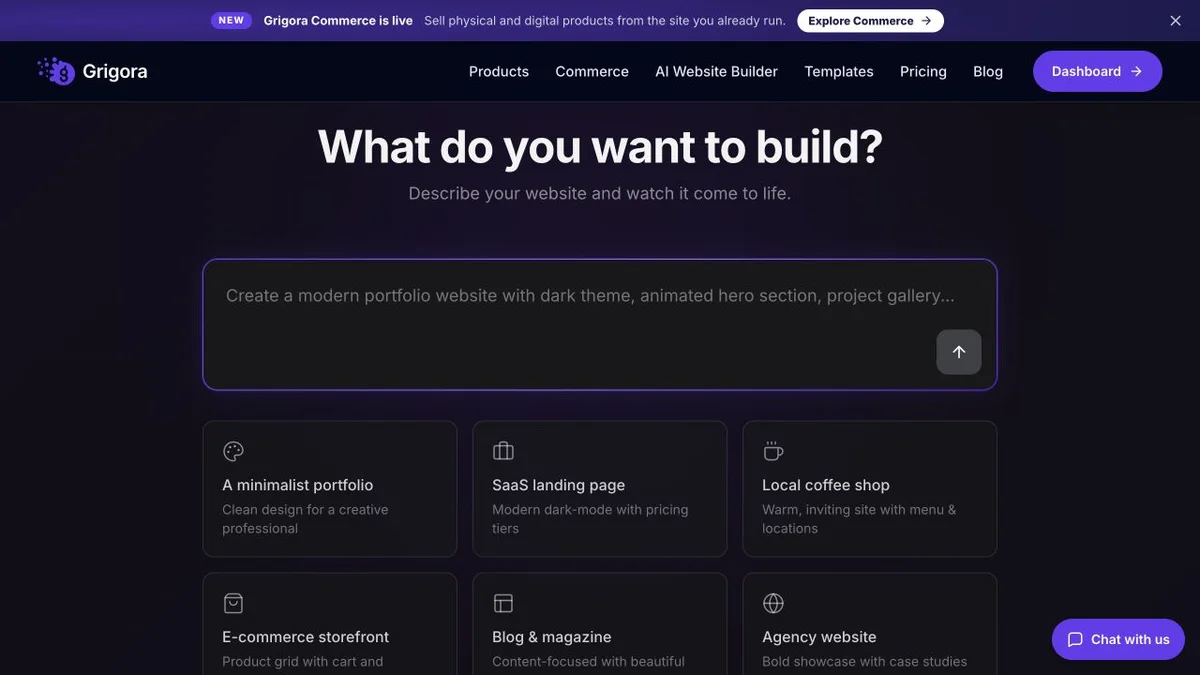
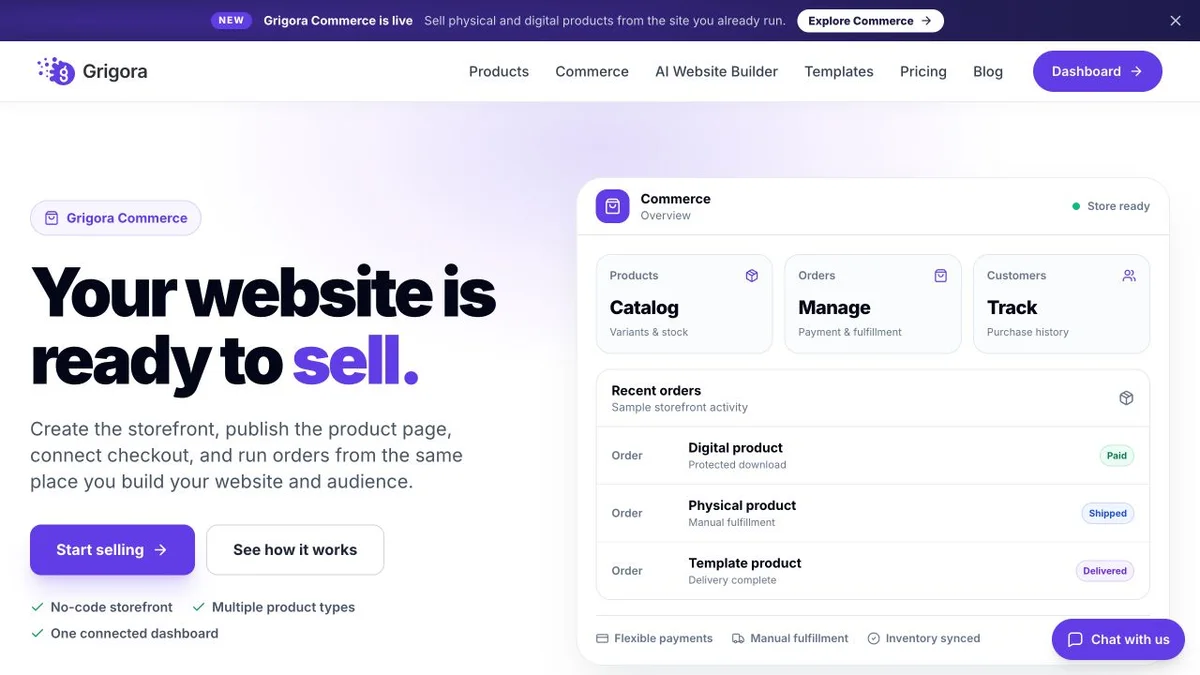
Explore Grigora before switching from Prismic
Current public product pages and plans, so you can inspect what you would be moving to. Open any image at full size.
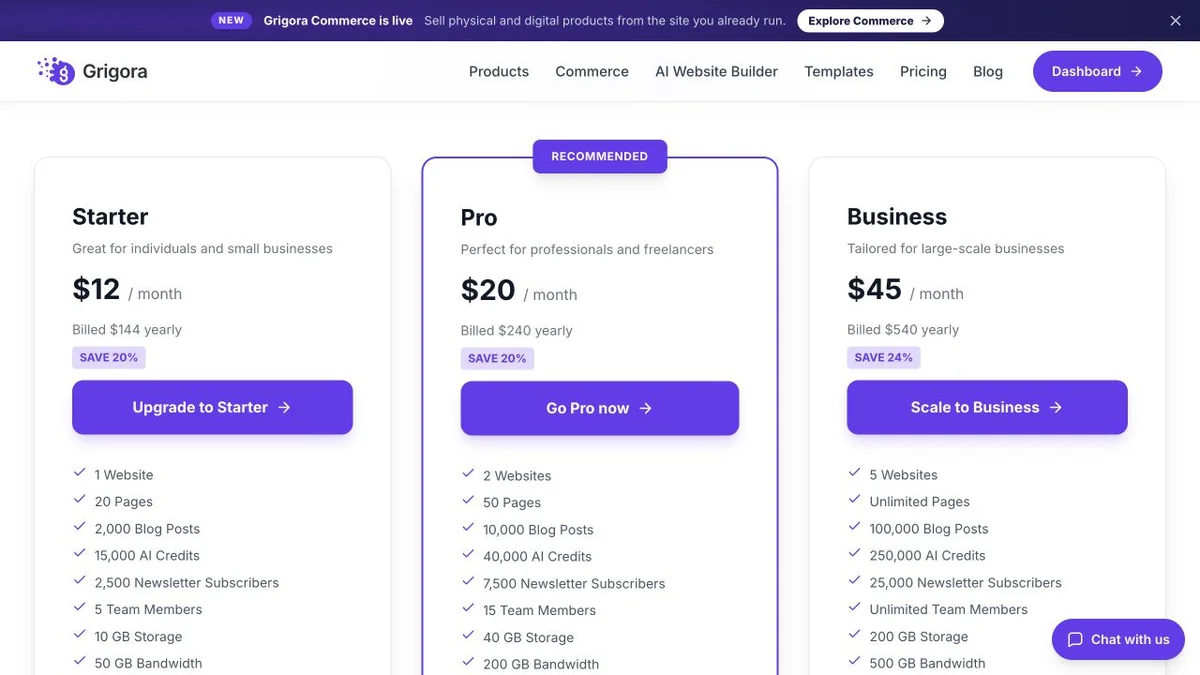
Grigora vs Prismic pricing
Prismic prices a content repository. Grigora prices a working website. Read both lines before comparing the headline numbers.
Website, newsletter & store in one plan
Grigora Starter, Pro and Business rates are $12, $20 and $45 per month billed annually ($144, $240 and $540 per year), or $15, $25 and $59 month to month. Plan limits apply to sites, storage, bandwidth, AI credits and newsletter subscribers. Payment-provider fees and optional paid services are additional.
Per repository, and the front end is extra
Read live at prismic.io/pricing on 11 September 2026. All figures are per repository and billed annually; a repository is one site, and seats, locales, API calls and CDN do not pool between them. Small sits between Starter and Medium at $25/mo. Monthly billing is reported at roughly 20 to 25% more, around $15, $30, $180 and $750, taken from the pricing page's own plan data rather than a toggled view. Enterprise is quoted as Custom with no published figure. The AI landing page builder is not in these plans and its price is not published; Prismic says only that it is sold separately through its sales team. Overages run at $0.30/GB of CDN, $0.25/GB on Platinum, and $1 per 100 integration-field SKUs beyond the first 100 on Medium and above.
Grigora Starter at $12/mo covers the site, the hosting, the CMS, the newsletter and the store. Prismic Starter at $10/mo covers one repository of content, and everything a visitor actually sees is still to be built and hosted at your expense.
The real cost: Grigora vs Prismic
Model a small marketing team running one main site plus two campaign microsites, publishing weekly, with a newsletter and a handful of digital products. Count the slice library, because someone has to write it before anyone can publish.
| What you pay for | Prismic | Grigora |
|---|---|---|
| CMS subscription | $25/mo on Small, per repository | $12 to $45/mo, everything included |
| Three sites | Three separate subscriptions, nothing pools | Pro covers 2 sites, Business covers 5 |
| Slice library | Developer time for every section type, then upkeep | website templates and a block editor, nothing to code |
| Front end and hosting | A Next.js or Nuxt app you build, deploy and maintain | Included, with domain, SSL and CDN |
| Newsletter | A separate sending platform, no email in the plan table | Included, 2,500 to 25,000 subscribers |
| Selling digital products | Shopify or custom code; integration SKUs metered past 100 | Included, 0% platform commission |
| Publishing in four languages | Built in, 5 locales on Medium with translation workflow | Verify locale requirements; no equivalent governance documented |
| Support and backups | Community forum up to $675/mo; backups Enterprise only | Email support, automatic backups |
Prismic figures are annual-billed list prices read at prismic.io/pricing on 11 September 2026 and are per repository. Payment-processor fees apply to Grigora's store on either platform's economics. Developer rates vary by market; the presence of a slice-building line item does not.
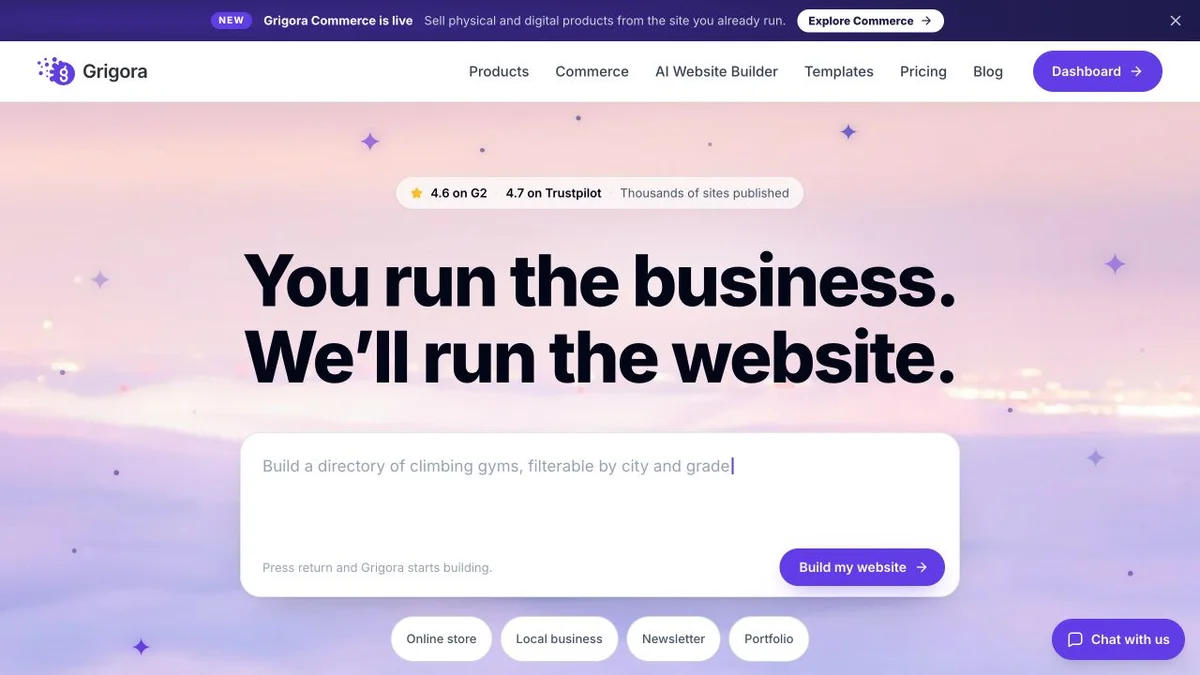
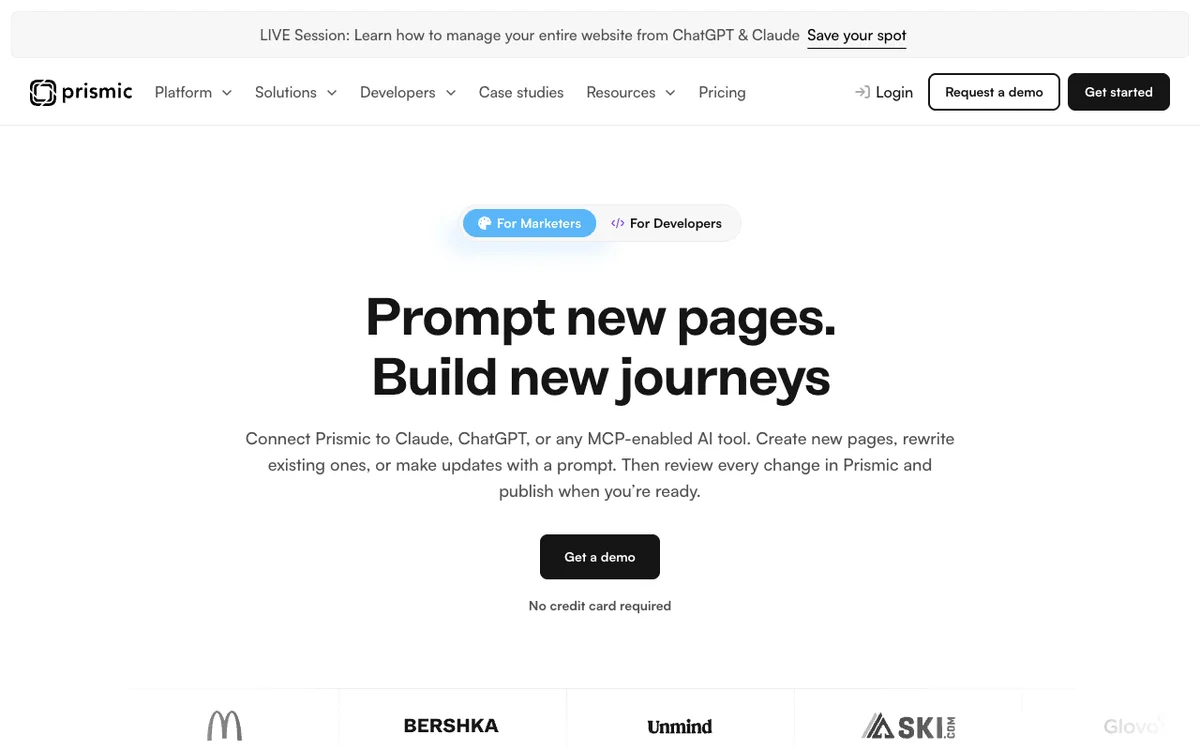
Prismic and Grigora: public website references
These captures show each product’s public website. See the feature and pricing sections for capabilities and plan details.
Is Grigora the right Prismic alternative for you?
Where Grigora is the stronger Prismic alternative, and where it is not.
Prismic alternative for marketing teams without engineers
If every new section means a slice ticket, the builder is not really yours. Grigora's blocks are finished on arrival, so the page changes when you decide it should.
… for teams running several small sites
Prismic bills per repository and nothing pools across them. One Grigora Business plan covers five sites with one team, one login and one invoice.
… for founders who need the site to sell and send
A catalogue field is not a checkout and a content API is not a mailing list. Grigora includes the store with 0% platform commission and the newsletter on every paid plan.
Prismic is the right call if…
you have front-end engineers who will own the site permanently, you publish in four or more languages, and you need hundreds of pages held inside a design system that marketers cannot break. Prismic does that better than Grigora will.
Which one is right for you?
Choose Grigora if…
- Nobody on the team can write a React component this quarter
- You want hosting, domain and SSL inside the same bill
- Two or three sites should not mean two or three subscriptions
- The site has to take payments and send campaigns
- You would rather edit the page than file a request about it
Choose Prismic if…
- •Developers will maintain the slice library and the front end long term
- •Multi-locale publishing is a requirement rather than a wish
- •You need a content API, Releases and a scripted migration path
How to switch from Prismic to Grigora
Prismic provides content and asset APIs, but export and mapping need to account for linked documents, locales and slices. The part you stop maintaining is the front-end project and the slice library that feeds it.
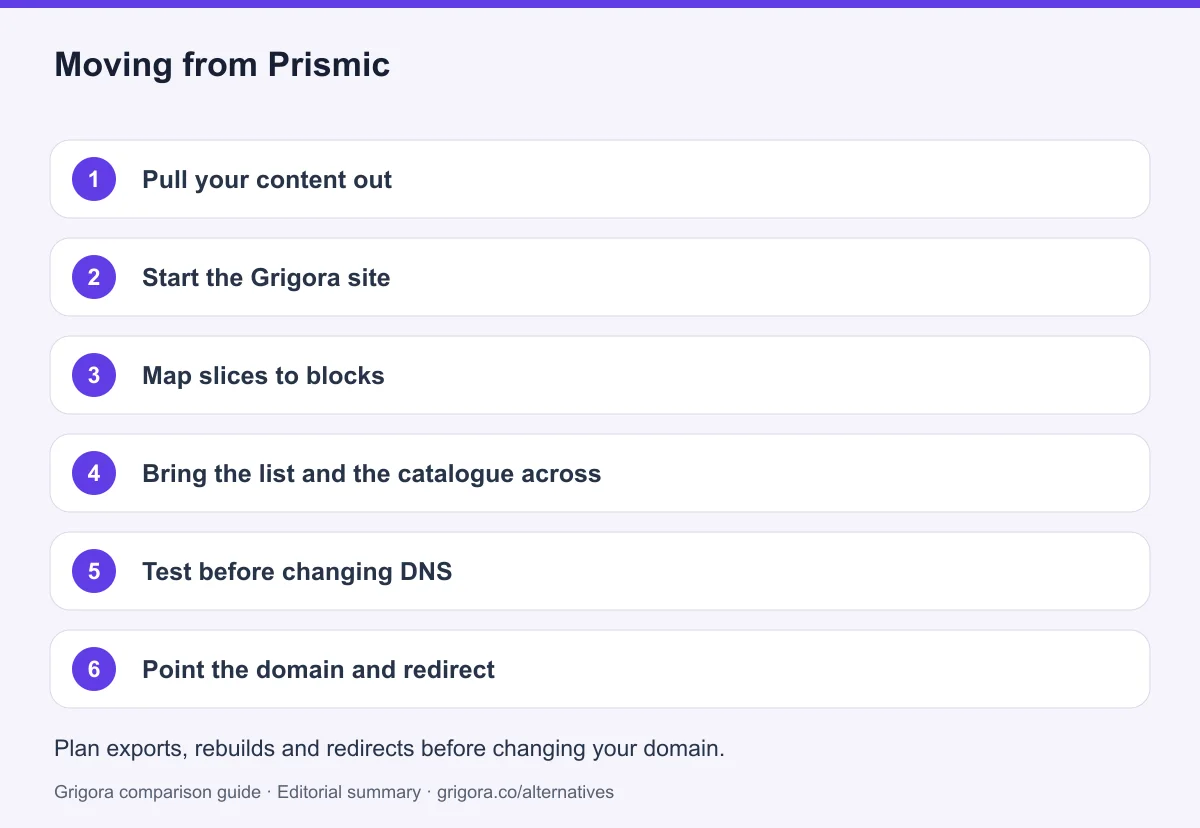
- 1
Pull your content out
Export documents through the Document API or GraphQL and your media through the Asset API. Prismic puts these on every plan, including the free one, so nothing is gated behind an upgrade first.
- 2
Start the Grigora site
Describe the business in a sentence and the AI produces a first-draft site with pages, layout and copy, or start from one of the website templates instead.
- 3
Map slices to blocks
Most slice libraries collapse into a much shorter list of Grigora blocks. Map by what the section does rather than what it was called, and retire the variants nobody used.
- 4
Bring the list and the catalogue across
Import subscribers into the built-in newsletter, and rebuild products directly in Grigora Commerce rather than referencing a catalogue held somewhere else.
- 5
Test before changing DNS
Export documents and assets, preserving UIDs, locales, links and slices. Map each slice type to a supported block and review preview, release and translation workflows that will not transfer automatically. Check page titles, descriptions, canonical URLs, internal links, image alt text, forms and checkout on the new site. Keep an old-to-new URL map, add relevant 301 redirects and monitor indexing after launch; redirects cannot guarantee unchanged rankings.
- 6
Point the domain and redirect
Connect your domain, redirect the old URLs to map previous addresses to their closest replacement, then decommission the front-end hosting and close the repository subscription.
Why people look for a Prismic alternative in 2026
Prismic is not a bad product and the teams that fit it are well served. It is a headless CMS with an unusually good editing surface, sold as of 2026 as an agentic web platform for marketers and AI rather than as a CMS. The pitch is that developers define reusable slices once and marketers then assemble pages at volume without a ticket per page. The problem starts one step earlier than the pitch does, at the moment a marketer wants a section that nobody has built yet.
A slice has to be modelled and coded before it exists
Slice Machine is a developer tool. You define the fields, write the component in React, Vue or Svelte, preview it locally and push it to the repository. Only then does it appear as an option in the Page Builder. That loop is good engineering practice and it is still a loop that runs at the speed of a sprint.
The consequence is a two-speed team. Assembling pages from existing slices is fast and pleasant. Anything outside the library is not marketing work at all, it is a request with a queue position. Teams who joined Prismic to stop depending on developers often find they have changed what they depend on developers for, not how often.
The bill counts repositories, not projects
Prismic's pricing table is headed per month and per repository, and its FAQ defines a repository as an independent working space with its own content, users, endpoint and subscription. A second brand site is therefore a second subscription. Seats do not pool, locales do not pool, API calls and CDN allowances do not pool.
For a single flagship site that is fine. For an agency, a group brand or a company running a main site plus campaign microsites, the arithmetic gets uncomfortable quickly, and the seat counts reset every time you add a site.
Everything the visitor sees is still yours to build
No hosting, no domain, no template, no rendered page. Prismic's own homepage FAQ concedes that it requires an initial technical setup and routes teams without technical resources to its partner agency network, which is an honest thing to publish and also the whole issue for a small marketing team.
Add the pieces that are simply absent and the gap widens. There is no store and no cart, only an Integration field that syncs a catalogue held elsewhere and meters it at $1 per 100 SKUs past the first hundred on the upper tiers. There is no email of any kind. SEO is three metadata fields your own code must render, with an assistant still marked beta and last updated in November 2024. Support stays at Basic, meaning the community forum, right up to the $675 a month Platinum plan.
How Grigora compares
Grigora starts where Prismic stops. The AI generates a first-draft site from a sentence about the business, or you pick one of website templates, and the result is already hosted on a domain with SSL and a CDN behind it. Blocks are finished components you place and edit, so the question of who codes the section before the marketer can use it never comes up.
One plan instead of a repository plus a stack
Starter is $12 a month billed annually and includes the website and hosting, the CMS with posts, categories, author profiles, directories and moderated comments, a newsletter with 2,500 subscribers and campaign automations, and a store with catalogue, variants, stock and digital downloads at 0% platform commission. Pro at $20 covers two sites, Business at $45 covers five. On Prismic each of those sites is its own subscription, and the newsletter and the store are not in the plan table at all.
The SEO layer follows the same pattern. Metadata, schema controls, sitemaps and IndexNow submission are part of the platform because the platform renders the page, and there are free SEO tools on the marketing site. Prismic can hold the same values in a field; whether they reach the head of a page depends on code you wrote.
Where Prismic still wins, and it is not close
Governance and localisation. A slice library is a genuinely better answer to the question of how twenty-five marketers publish hundreds of pages without wrecking the design, and Prismic's own case studies show it holding: two hundred bespoke pages from ten slices at SportsShoes, roughly forty slices covering nearly every design at EVRI. Grigora's block editor gives an editor more freedom than that, which is exactly the risk at scale.
Localisation is the harder concession. Prismic carries two locales on the free plan and up to eight on Platinum, with translation inside the document, an AI-assisted translation feature from June 2025, and the ability to fan a page out across every locale at once. Grigora has not documented an equivalent native locale workflow with translation relationships and locale-level governance. AI text generation in another language is a separate capability. Add the Document API, GraphQL, the Migration API and the MCP server that shipped in June 2026, and the developer story is Prismic's from start to finish. If your site needs that, buy it. If your site needed a website and a team that can change it, that machinery is cost without benefit.
Frequently asked questions
Grigora is a Prismic alternative for teams that want a managed website, CMS, newsletter and store from $12/month billed annually. Prismic suits developer-defined slice libraries, localization and content delivery to custom frontends. Its standard CMS requires a frontend implementation; compare any separately sold AI website product on its own terms rather than assuming the CMS subscription includes it.
Prismic publishes a free plan at $0 and paid tiers at $10, $25, $150 and $675 a month, all billed annually and all priced per repository, read live at prismic.io/pricing on 11 September 2026. Monthly billing is reported at roughly 20 to 25% more. Enterprise is quoted as Custom with no published figure, and the AI landing page builder is sold separately with no price published.
Because a section in Prismic is a slice, and a slice is a component. It is modelled in Slice Machine, written in React, Vue or Svelte, and pushed to your repository before it appears in the Page Builder. Marketers can rearrange and fill existing slices freely, but a section type nobody has built yet does not exist until a developer builds it.
No. Prismic stores and delivers content through an API. You build the front end in Next.js, Nuxt or SvelteKit and host it yourself, and you supply the domain. Prismic's own homepage FAQ says it requires an initial technical setup and points teams without technical resources to its partner agencies. Grigora includes hosting, domain connection, SSL and CDN in the subscription.
Not directly. Prismic has no cart, no checkout and no payments, and takes no commission because it processes no money. Its Integration field syncs a third-party catalogue into content, metered at 100 SKUs free then $1 per 100 on Medium and above. There is no email product at all. Grigora includes a store with 0% platform commission, using Stripe and Razorpay, plus a subscriber list and campaigns on every paid plan.
Prismic’s locale relationships, slice-based design controls and headless Document, GraphQL and Migration APIs are not direct Grigora equivalents. Grigora also offers MCP management tools, so MCP access alone is not a reason to stay or switch. Compare the particular tools, frontend requirements, translation governance and publishing workflow you need.
Sources and comparison method
Published by Grigora, one of the products compared here. This is a comparison of public product documentation and published plans. Recommendations reflect the use cases described; they are not independent performance benchmarks. Homepage screenshots show how each product presents itself and do not establish feature availability.
Check the billing term, currency, regional availability, usage limits and add-ons before purchasing. A content export does not necessarily include the design, integrations or a working store. Migration steps need testing on your own site.
- Prismic pricing
Per-repository tiers, included users/locales and separately scoped offers.
- Prismic documentation
Frontend, content API, migration and MCP workflows.
- Grigora pricing and included features
Annual and monthly billing, plan allowances, included features and trial terms.
Grigora references: plans and limits, commerce, MCP access, and help documentation.
Compare Grigora with other platforms


Make the switch from Prismic to Grigora
Build the site, the newsletter and the store in one place, with no slice to code first and nothing to deploy. Try Grigora free, no credit card required.
14-day free trial • No credit card required • Cancel anytime