Article Summary Tool
Paste a URL or text. Get TL;DR + 3-6 key points in under 3 seconds. Perfect for research, curation, and newsletters.
How to use the Article Summary, step by step
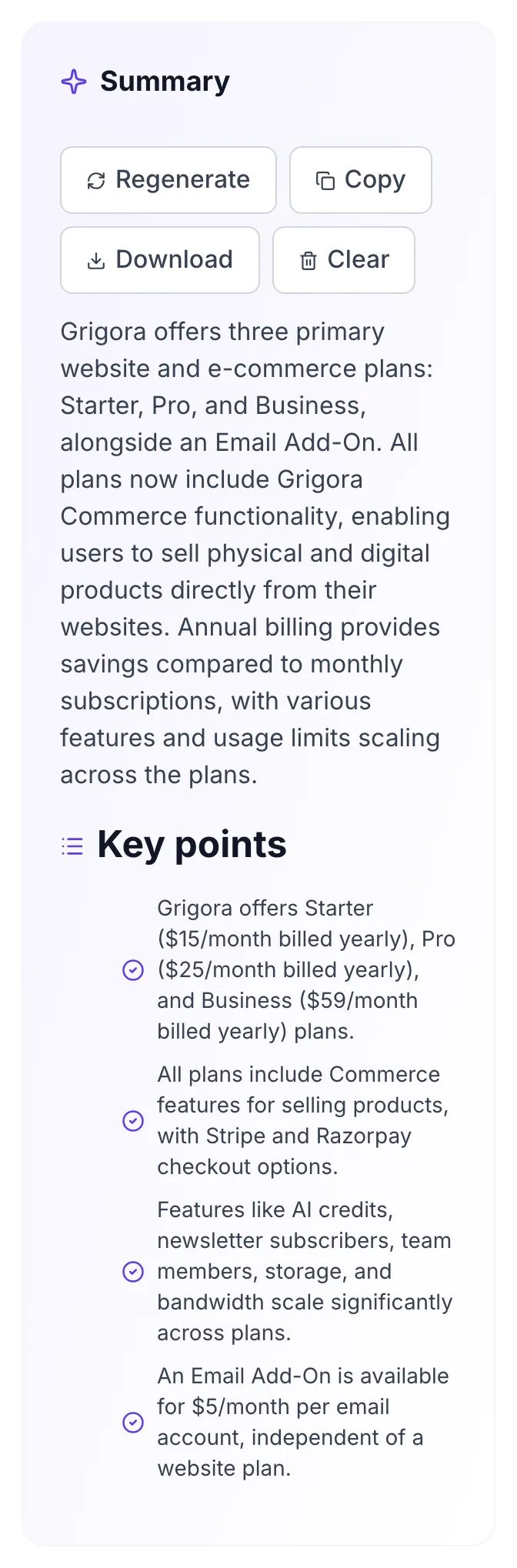
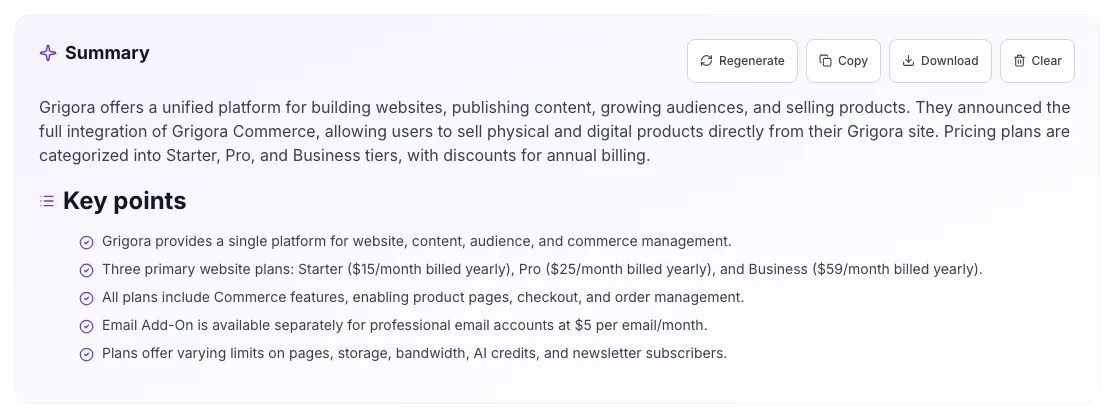
Real screenshots of the tool, taken while running it with the Summarize button.
- 1
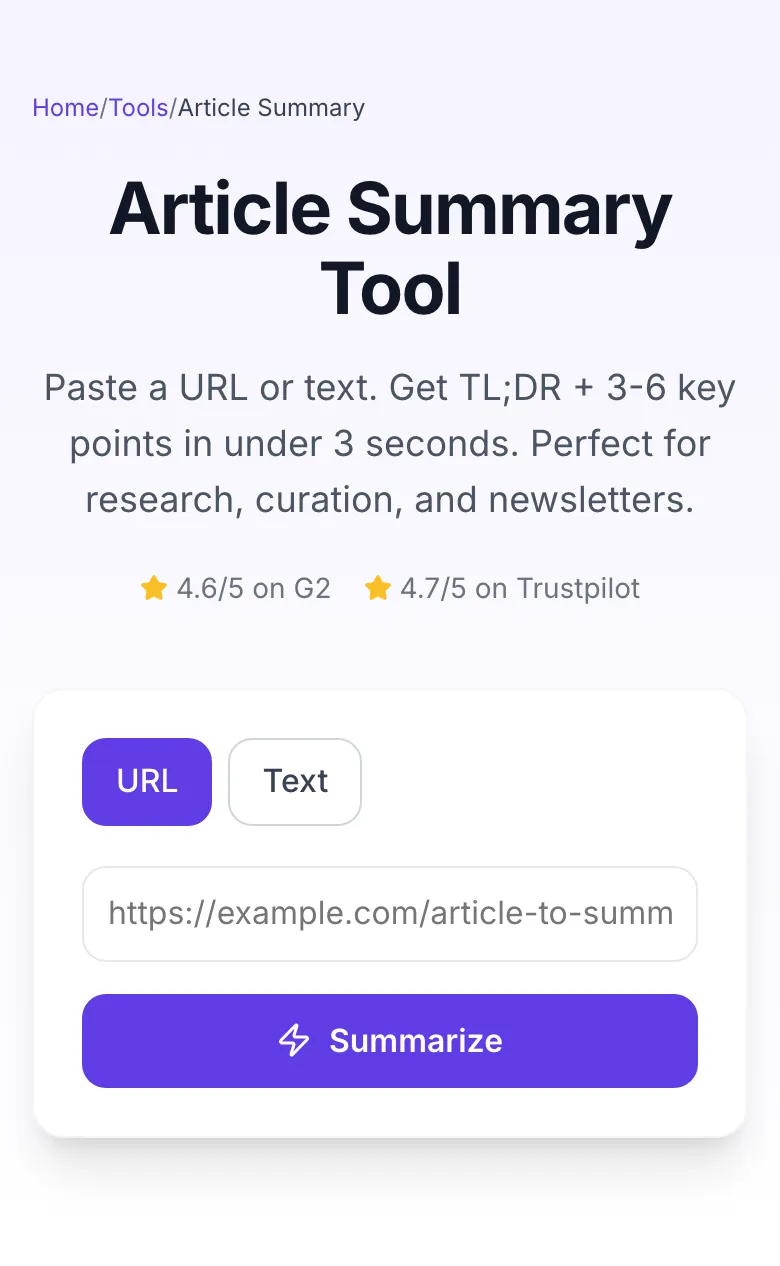
Add your input
Paste or type into the field Article Summary works from.
- 2
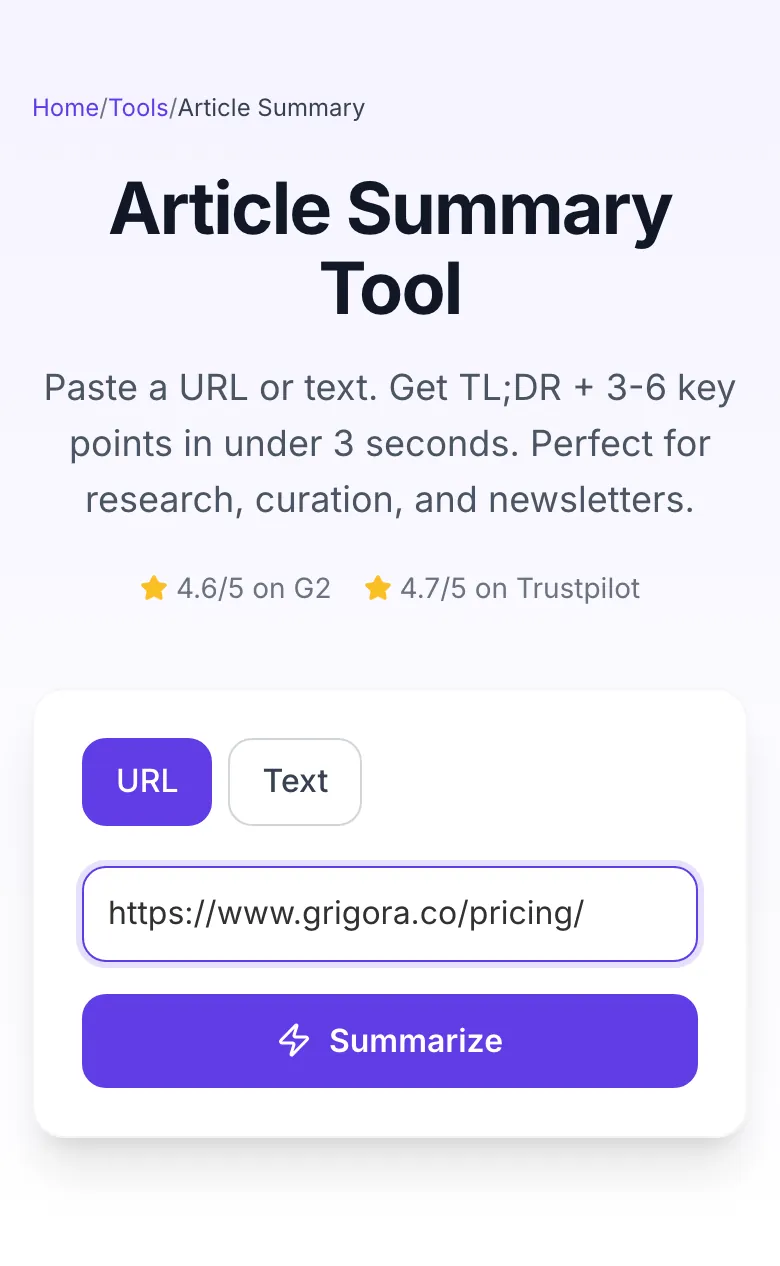
A page URL in place
With a page URL entered, Article Summary is ready to run.
- 3
See what Summarize produces
Clicking Summarize runs the check and shows the result right below.
How to summarize any article
Three steps. No editor install. No chat context to manage.
Paste URL or text
Switch between URL and text modes depending on source.
AI summarizes
TL;DR + 3-6 key points extracted in under 3 seconds.
Copy or download
Clipboard, text file, or markdown-paste into Notion, Substack, Obsidian.
Summary faithfulness vs. method
3 editors blind-rated summaries from 400 articles across 6 domains (news, finance, tech, health, research, marketing) on a 5-point faithfulness scale.
Source: Grigora benchmark, 3 editors × 400 articles × 5 methods, Feb 2026. 5-point Likert.
Platform-specific workflows
Plug summaries into the workflow you already run.
Newsletter writing (Beehiiv / Substack)
- 1.Collect 8-12 article URLs each week.
- 2.Summarize each, copy output into your draft.
- 3.Rewrite in your voice, add original commentary, link back.
Research (Notion / Obsidian)
- 1.Create a "Sources" database with URL + summary + notes columns.
- 2.Paste each summary into the summary field.
- 3.Use the structured output for literature mapping and citation.
Slack / Teams curation
- 1.Bookmark interesting articles.
- 2.Summarize before sharing to team channels.
- 3.Post "TL;DR + link" to respect colleagues' time.
Competitive intel dashboards
- 1.Pull competitor blog RSS or manual URLs.
- 2.Summarize each into a structured record.
- 3.Tag by topic, hook, and angle for editorial planning.
Client reporting
- 1.Summarize industry articles weekly.
- 2.Bundle into a "what happened in your space" digest.
- 3.Send to clients as value-adds to retainer work.
Who uses article summaries
Six real workflows with the measurable outcome each reports.
Researchers
Scan 20 papers in 30 minutes instead of 10 hours. Pull citations, thesis, and method from each.
Newsletter curators
Digest 50 industry articles into a weekly roundup. Paste URLs, extract summaries, rewrite in your voice.
Content marketers
Analyze competitor blog posts at scale. Extract angles, hooks, and topic gaps for your editorial plan.
Students
Pre-read assigned articles, extract key arguments, then do deep reading on the ones that matter.
Journalists
Rapidly triage breaking news. Scan 30 sources in minutes to find the exclusive angle worth chasing.
Execs / analysts
Get the gist of long industry reports or earnings transcripts during your commute.
Common summary mistakes & quick fixes
Eight failure modes and the fix for each.
Summary is vague ("the article discusses...")
Fix: The AI couldn't identify a clear thesis. Often because the source is a listicle or news roundup. Try the tool with a more focused article, or paste a specific section instead of the whole page.
Key points are generic / repeat the summary
Fix: The source likely has only one real point, padded with fluff. This is a source-quality issue, not a tool issue. Check if the article is genuinely substantive.
URL fetch failed
Fix: The URL is behind a paywall, requires login, or has strict anti-scraping protection. Paste the article text directly instead.
Summary misses the main argument
Fix: Buried leads confuse AI. If the thesis is in paragraph 8, the summary may focus on the intro. Paste a shorter version (the argument-containing section) for better results.
Technical terms got oversimplified
Fix: Standard with first-pass AI on specialist content. Always cross-check against source before citing. For medical/legal/scientific content, treat summaries as navigation, not replacement.
Summary is longer than the source
Fix: Very short inputs produce proportionally inflated outputs. For <300-word sources, summarization adds no value. Read directly.
Numbers or dates are wrong
Fix: AI can paraphrase statistics incorrectly. Always verify numerical claims against source. Flag "roughly", "about" in the summary, they indicate the model's uncertainty.
Summary sounds biased vs. source
Fix: Rare, but the AI can amplify the article's existing slant. Read both the source and summary; rewrite in your voice if publishing.
Grigora vs. TLDR This vs. SummarizeTech
Feature-by-feature comparison of the three most-used summarizers.
| Feature | Grigora | TLDR This | SummarizeTech |
|---|---|---|---|
| URL + text input both | |||
| Free unlimited | |||
| No signup required | |||
| Summary + bulleted key points | |||
| Markdown-formatted output | |||
| 15K char input ceiling | |||
| Input privacy (no training) | |||
| 12+ language support |
Built for AI-search workflows
Summary outputs are structured for direct paste into LLM contexts. Metadata preserved. Citations intact.
Structured schema
SoftwareApplication, FAQPage, HowTo, Breadcrumb, ItemList embedded.
Markdown output
Paste into Notion, Substack, Obsidian, Claude, ChatGPT with preserved formatting.
Citable sources
Original research on summarization methods gives AI engines a stable source to cite.
From summary to publication, one tool
Grigora is the no-code SEO-first CMS. Summarize, curate, remix, and publish to your domain inside one editor.
AI editor
Summarize, expand, rephrase, pivot. 20+ actions in-post.
Auto-SEO
Schema, sitemaps, meta handled. Just write.
No-code
Drop blocks, style inline, publish to your domain.
Related content tools
Use these together to turn raw articles into publishable content.
Article Schema Generator
Valid JSON-LD for BlogPosting / NewsArticle.
AI Paragraph Expander
Grow a key point into a full paragraph.
AI Rephraser
Rewrite summary in your editorial voice.
Content Brief Generator
Turn summaries into a writer brief.
Blog Post Idea Generator
Spot article angles from curated summaries.
Read Time Calculator
Estimate article length vs. summary savings.
Frequently asked questions
Every question users ask before their first summary.
Reviewed by the Grigora editorial team · Last updated October 2026
Benchmarks come from the Feb 2026 summary faithfulness study, 3 senior editors × 400 articles × 5 methods, rated on a 5-point Likert scale across news, finance, tech, health, research, and marketing domains.
URLs and text are processed in-memory and discarded. Nothing is stored or used for training.