Do recruiters look at portfolio websites? Yes, when the job involves work you can show, though mostly after the first screen rather than during it. In jobs where the evidence is a licence or a sales record rather than a body of work, the link is closer to decoration on a CV.
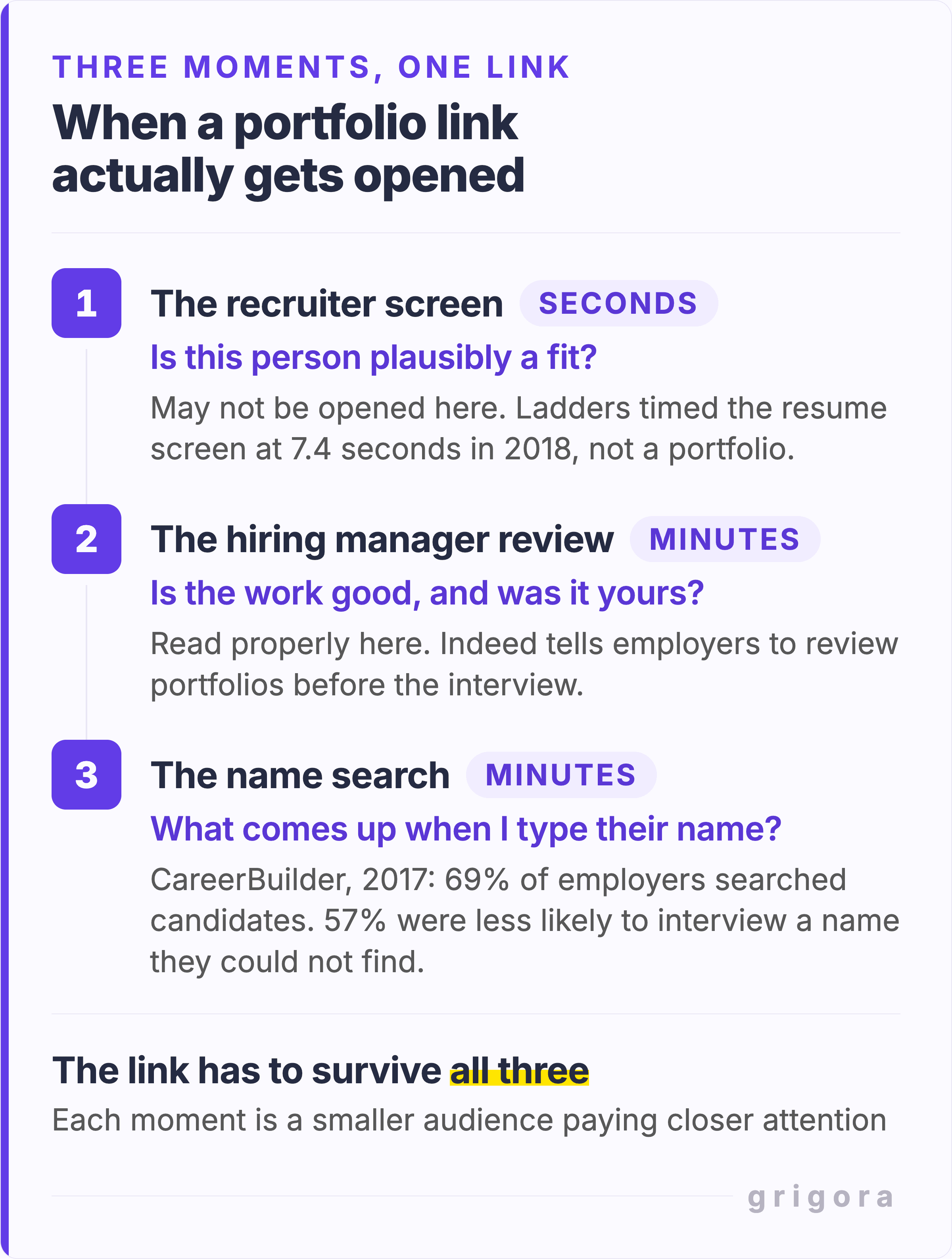
There are three separate moments, and they behave differently. The recruiter sorting applications works from the CV and may not click at all. Once you are on a shortlist, the people deciding who to interview open the site and read it properly. And at any point, somebody may type your name into Google.
So the question is less whether anyone looks and more whether what they find survives the click. Before the link goes anywhere, paste it into Grigora's free Website Grader for a score out of 100 and a list of what fails.
Do recruiters look at portfolio websites? It depends which moment you mean
Three moments, three levels of attention. Your link has to survive all of them.
The recruiter screen, measured in seconds
At the top of the funnel the recruiter is matching you to a requisition and working from the CV, not the site. Ladders' 2018 eye-tracking study put the initial resume screen at 7.4 seconds on average, up from about six seconds in 2012. It measured resumes, and I have not found an equivalent study of websites.
Which means the CV has to carry the evidence on its own. At this stage the site may never open.
The hiring manager review, where the site gets read
This is the moment the site exists for. Indeed's guidance to employers says portfolios are highly valued in writing, design, publishing and tech roles, calls it essential that both recruiters and hiring managers review them once candidates are shortlisted, and suggests a rating scale so every candidate is judged against the same criteria.
What gets judged is not only the finished piece. In a Muse article built on six hiring managers' views, last updated in 2020, almost every one said they zero in on the intro. Ed Fry, one of the six, wanted the reasoning behind each project: "What was the idea and objective? How did you go about making decisions? What was the outcome?"
That is where a lot of portfolios lose. The design gets three weekends and the writing gets an hour, when the writing is what is being assessed. A plain page with four honest case studies beats a beautiful one with four screenshots and a job title.
The name search, at any point
The third moment has nothing to do with the link you sent. A Harris Poll survey for CareerBuilder of 2,380 hiring and HR managers, run between 16 February and 9 March 2017, found 69% used search engines to research candidates, up from 59% the year before. In the same survey, 57% were less likely to interview somebody they could not find online.
That survey is nine years old, and I have not found a newer one measuring the same thing at that scale. Take the direction as reliable and the figure as history.
Which roles get their portfolio opened, and which do not
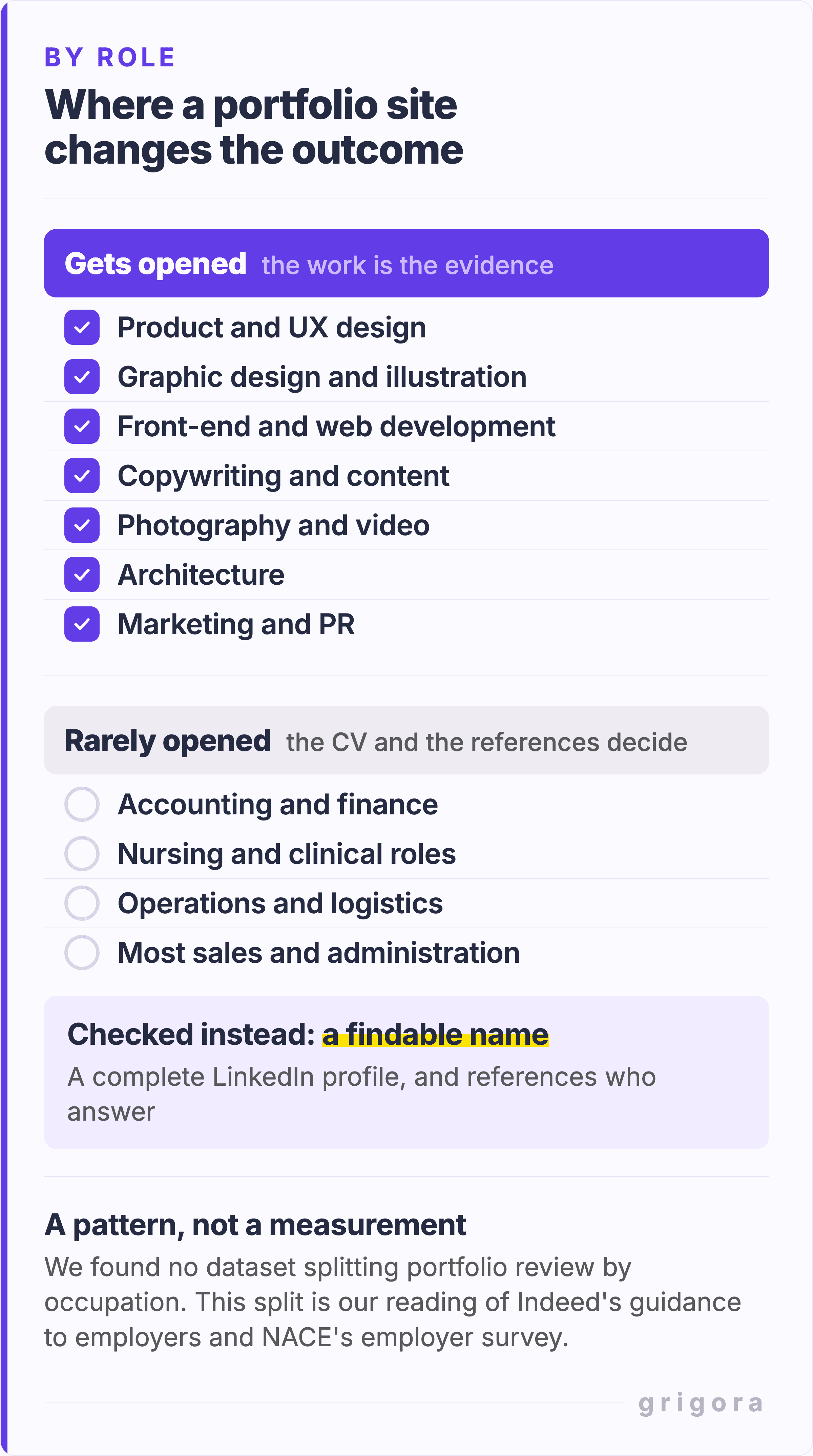
I could not find a dataset that breaks portfolio review down by occupation, so read the split below as a pattern rather than a measurement, drawn from Indeed's guidance and from what employers say they want to see.
Where the link changes the outcome, and where a findable name does the same job.
Role
Site opened?
What carries the weight
Product and UX design
Nearly always, pre-interview
Case studies naming your role and outcome
Graphic design and illustration
Nearly always
Range, craft, whether it is yours
Front-end and web development
Often, alongside a code host
Live demos that load, readable source
Copywriting and content
Often
Published pieces with bylines and results
Photography and video
Nearly always
A tight edit, not the full archive
Architecture
Usually, often as a PDF instead
Drawings, process, what got built
Marketing and PR
Sometimes
Campaigns with numbers attached
Accounting, nursing, operations, most sales and admin
If your job sits in the last row, a site still makes your name searchable and gives you one page to point at. Performing fields run on their own conventions, and we have a separate guide to building an actor website.
The portfolio statistics you keep seeing, and which ones hold up
A handful of numbers turns up again and again on pages answering this question. Traced back, most of them shrink or vanish.
"93% of hiring managers would look at a portfolio, and only 15% of candidates have one." Half of it traces. It is usually credited to Profy.dev, which no longer resolves, but the Internet Archive's copy of the article has the source: Johannes Kettmann sent two questions to more than 300 recruiters and React team leads and reported answers from 60-odd hiring managers. 93% would be likely to look at the portfolio site of an inexperienced candidate. Nothing in it counts how many candidates have one, and 51% said a candidate without a site had the same chances. His own conclusion: "you don't need a personal website to get a job. On the contrary, it can even backfire."
"41% of recruiters ask for a portfolio and 80% say it beats an interview", credited to a 2024 LinkedIn Global Hiring Trends report. LinkedIn's recruiting research includes The Future of Recruiting. The 2025 edition, built on 1,271 recruiting professionals across 23 countries, covers AI, quality of hire and skills-based hiring, and neither its report page nor its executive summary mentions portfolios. Neither figure traces to any LinkedIn report I can find.
"Recruiters spend six seconds on your portfolio." That is the Ladders eye-tracking number for resumes, moved onto websites by somebody along the way. I could not find a published eye-tracking study of portfolio sites.
"56% of hiring managers are more impressed by a personal website than any other branding tool." Real, and narrower than it sounds. The surviving record is a press release from 4 February 2014: an independent study commissioned by Workfolio found 56 percent of 300 hiring managers named personal websites "the most impressive tool candidates can have". Workfolio sold personal websites, and I could not find the study itself anywhere.
"Portfolio links boost interview invitations by up to 30%." I could not find a source for it. It travels with "studies show" in front of it and nothing behind.
One more finding holds up, caveat attached. In a survey of 121 hiring professionals, published by Hover on 16 February 2017, 86% agreed or strongly agreed they would visit a portfolio when offered one, and 71% agreed its quality would influence their decision. The authors flag their own problem: most respondents were Hover customers, so they own domain names, which "may skew the results towards favoring online portfolios". Read next to the React survey, the pattern is consistent: most reviewers will look if you give them a link, and what they find matters more than whether a link exists.
Where to put the link so it actually gets clicked
A link nobody runs into is no link.
The CV header, beside your email. Written out in full as well as hyperlinked, so it still works when the CV is printed or its text is pasted into an application form.
LinkedIn's Contact info. LinkedIn lets you display up to three website links on a profile, so spend them deliberately.
Your email signature. Every email you send during a search carries it, including the ones that are not applications.
The application form, when there is a box for it. Not every form has one, so keep the link on the CV as well.
Give the link a name. "Portfolio", "Case studies", "Selected work". A bare domain says nothing about what is about to open, and at 7.4 seconds nobody is curious. If you are still choosing the address, we have a guide to naming a portfolio website.
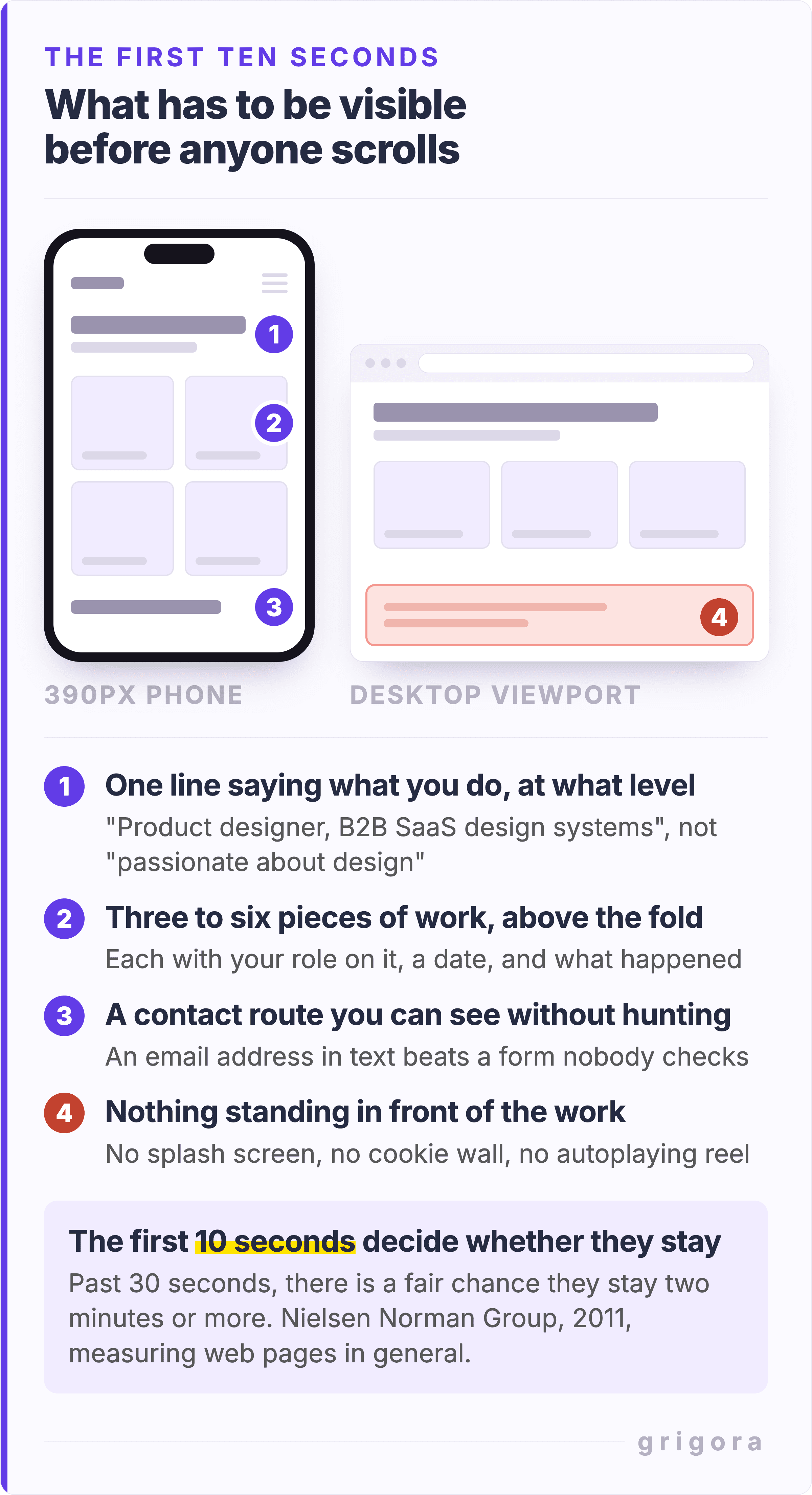
I found no published measurement of how long reviewers stay on portfolio sites, so use the closest proxy. Nielsen Norman Group's 2011 analysis of dwell time, built on Microsoft research across 205,873 pages and more than two billion dwell times, found the first 10 seconds decide whether somebody stays, and that past 30 seconds there is a fair chance they stay two minutes or more.
So the page has two jobs: survive ten seconds, then earn the next two minutes.
What has to be legible before a reviewer decides whether to keep reading.
One line that says what you do, and at what level
"Product designer, B2B SaaS design systems" tells a reviewer in under a second whether to keep reading. "Passionate about creating meaningful experiences" tells them nothing, and it sits in the intro, the part The Muse's hiring managers said they zero in on.
Three to six pieces of work, each with a role, a date and an outcome
Role, because on team projects nobody can tell what you did. Date, because undated work reads as abandoned. Outcome, because that is what an interviewer picks up and asks about. Our guide to how many pages a portfolio should be breaks the count down by industry.
A way to reach you that is not a form nobody checks
An email address on the page, in text. A form as well is fine, but a recruiter working a shortlist will not fill in four fields and hope. If you use one, check where its replies land.
Five things that get a portfolio website closed
Every one is self-inflicted, which is the good news: all five are yours to fix.
The link is broken or misspelled. It ends the visit before it starts, and it is the easiest mistake to avoid. Check the links inside the site too: a case study that 404s reads worse than no case study. Grigora's free Broken Link Checker covers 404s, redirect loops and soft 404s, up to 500 links per scan.
The page is slow. Good Core Web Vitals are Largest Contentful Paint (LCP) within 2.5 seconds, Interaction to Next Paint of 200 milliseconds or less and Cumulative Layout Shift of 0.1 or less. If your home page opens on a full-width hero image, that image is probably your LCP element, so it is the first thing to shrink. Grigora's Page Performance Checker Lite runs a Lighthouse audit from a clean browser and names the LCP element and the sources of layout shift.
Nothing is dated. An undated portfolio looks abandoned, and a reviewer cannot tell whether your best piece is from last quarter or from university. Put a year on every project, and if the newest is three years old, say what you have done since.
There is a wall in front of the work. A 40MB PDF, a login, a password sent in a separate email. Nielsen Norman Group's position, restated in August 2020, is that PDFs are unfit for reading online, sized for paper rather than screens, and better replaced by an HTML page that offers the PDF as an optional download.
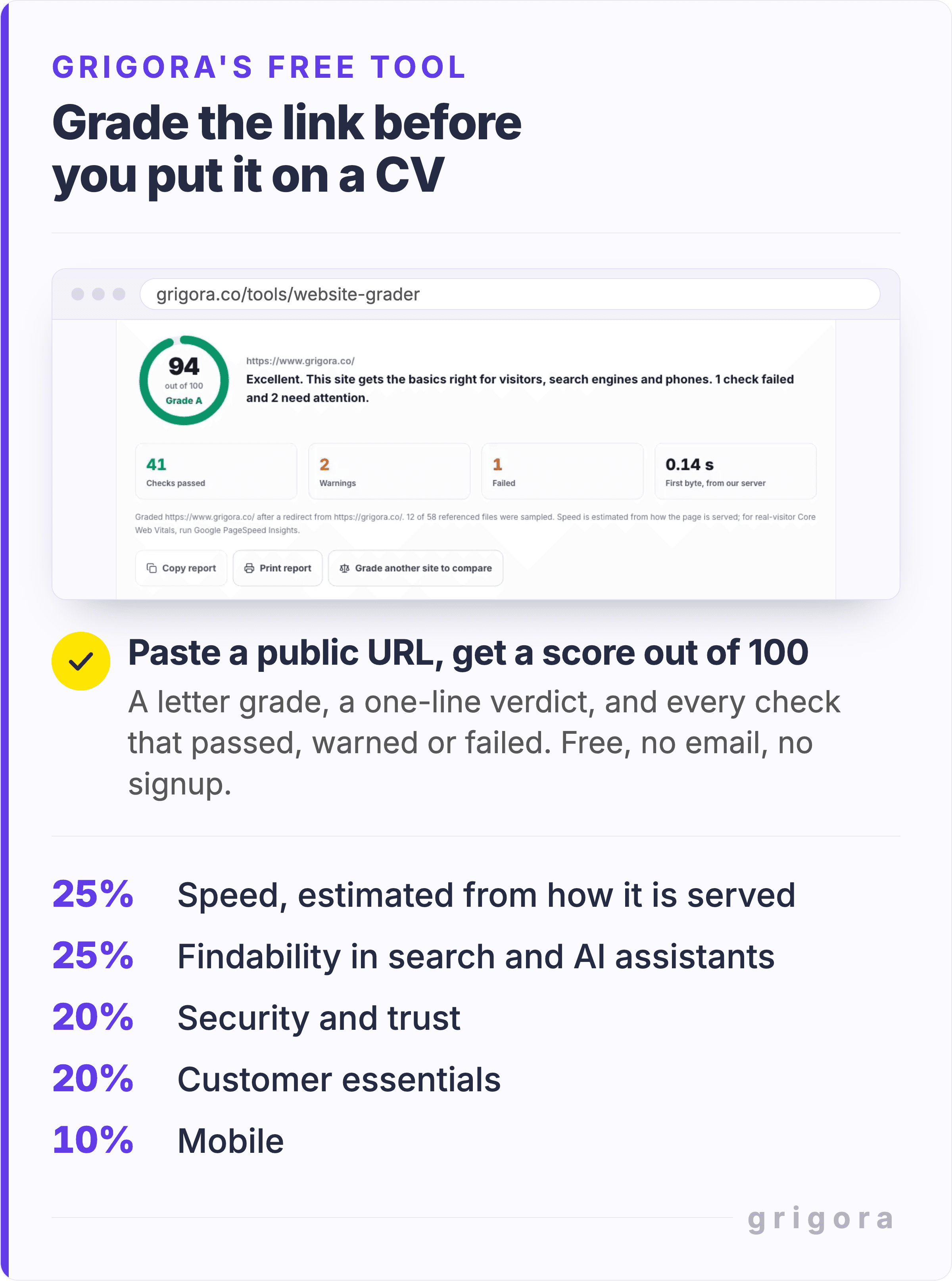
For one pass over the basics, go back to the Website Grader from the top of this page. It scores a public URL out of 100 across five weighted areas: speed 25%, findability 25%, security and trust 20%, customer essentials 20%, mobile 10%. The capture below shows its summary for grigora.co: a score, a grade, a one-line verdict and counts of checks passed, warned and failed. The full report lists each check underneath. Its speed score is estimated from how the page is served, not measured in a browser, so pair it with the performance checker.
One pass over a live URL, before you put the link on a CV.
Make sure Google finds you when they search your name
Search your own name before an employer does, in a private window, with and without your city. If your site is missing, check three things: whether it is new, whether anything links to it yet, and whether it still carries a noindex rule from when it was being built.
That last one is quick to rule out. Grigora's free Noindex Checker reads the meta robots tag and the X-Robots-Tag header of any URL you paste.
Then look at what the result says. Grigora's free SERP Preview Tool shows where your title and description get cut, measuring 580px for a desktop title, 530px on mobile and 920px for the description.
One note on structured data, because it gets oversold. Person markup with sameAs links lists your other profiles for search engines, but it will not dress up your result. Google's ProfilePage documentation, updated 8 September 2026, says that markup helps Search understand creators who post in online communities, including in its Discussions and Forums feature. Nothing in it promises a richer listing for a personal site.
Keeping the site quiet while you are still employed
You can have a public portfolio your current manager does not stumble into, but the controls are cruder than people expect. Google's noindex rule drops a page from Search "regardless of whether other sites link to it", as a meta robots tag or an X-Robots-Tag HTTP header.
There is a trap, and Google states it outright: if the page is also blocked in robots.txt, the crawler never fetches it, never reads the noindex rule, and the page can still appear in results. Blocking is not hiding, and the same distinction decides which pages to keep out of your sitemap.
Work under NDA is a separate problem. Noindex keeps a page out of Search, not out of the hands of anyone who has the address, so check what the agreement allows before any of it goes on a public URL. If the answer is nothing, describe the problem and your part in it without the confidential detail, or walk through it in the interview. And leave your home address and personal number off the site entirely.
Building one in an afternoon
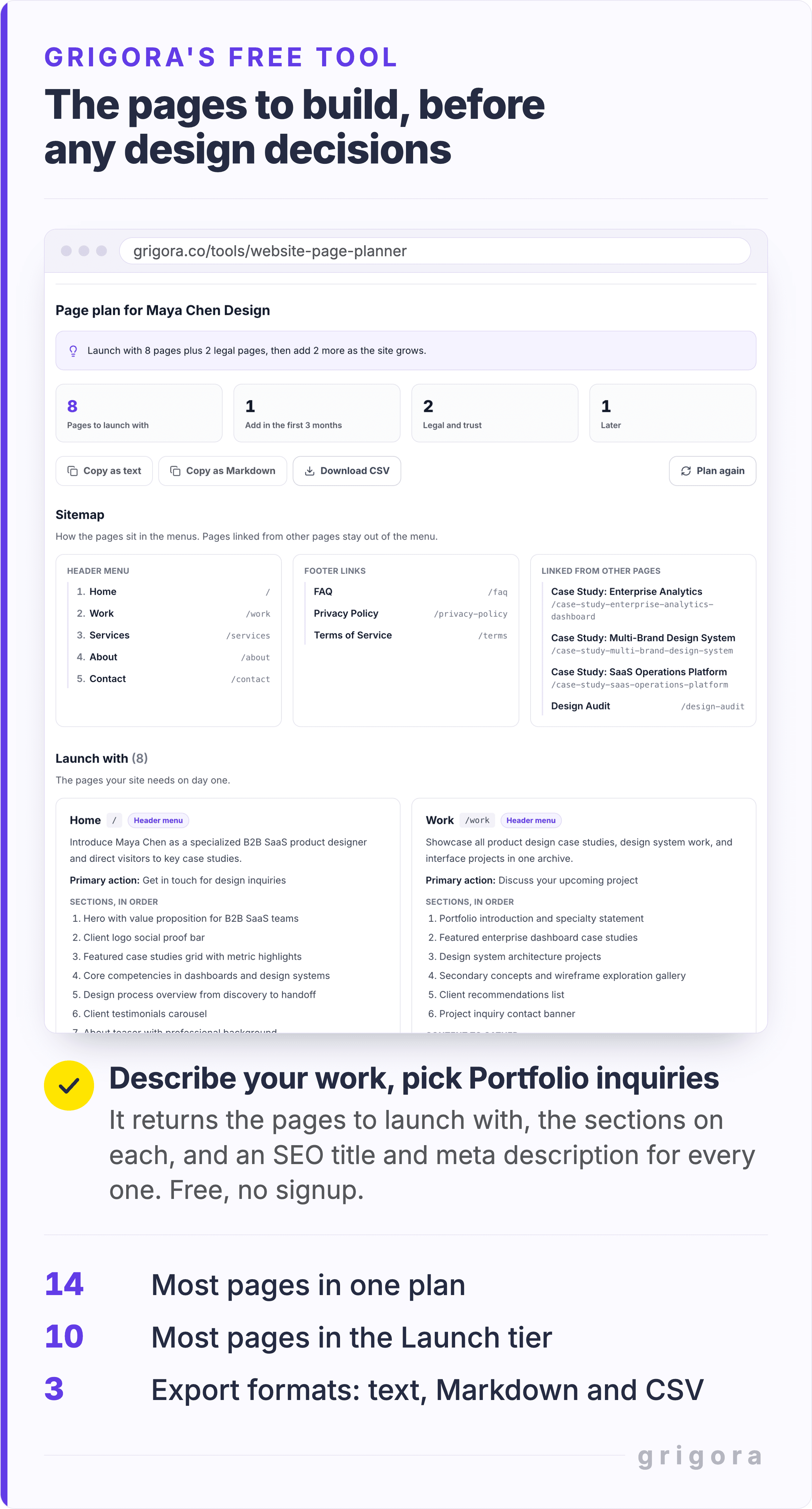
Start with the plan, not the design. Grigora's free Website Page Planner takes a plain description of what you do, with portfolio inquiries as one of its six goals, and returns the pages to launch with, the pages to add over the first three months, the sections each one needs, and an SEO title and meta description for every page. The capture below is a real plan for a freelance product designer who picked portfolio inquiries: eight pages to launch with, the case studies linked from the Work page rather than the menu, and the sections for each page.
A real plan for a freelance product designer: the pages to launch with, where each one sits, and the sections it needs.
Then pick a template or describe your work to the AI builder, add the projects, publish, and run the grader on the live URL. The trial runs 14 days with no card needed.
None of that is the hard part. What gets you hired is the work inside the site and the sentences explaining each piece.
Portfolio website FAQs
Do recruiters actually click the portfolio link on my CV?
Sometimes, and more often after the first screen than during it. The recruiter matching you to a requisition works from the CV; the portfolio gets read once you are shortlisted, by the people deciding who to interview. A link written out in your CV header and labelled as a portfolio is easy to open when that moment comes.
How long do recruiters spend looking at a portfolio website?
No published study measures it that I could find. The "six seconds" figure comes from eye-tracking of resumes, not websites. For web pages in general, Nielsen Norman Group found the first 10 seconds decide whether a visitor stays, so what you do and your best work need to be visible without scrolling.
Do I need a portfolio website if I already have LinkedIn?
For most roles, a complete LinkedIn profile covers what a recruiter needs at the screen. A site earns its place when the work needs showing rather than describing, or when you want some say in what a search for your name returns.
Is Behance or Dribbble enough, or do I need my own website?
They are good for being found and for showing craft, and in some fields they are where the audience already is. What they do not give you is your own address, full control of the layout, or protection from the platform changing its rules. Keep the profile and link it to a site you own.
Where should I put my portfolio link on my CV?
In the header, next to your email and LinkedIn, written out in full so it still works on a printed or pasted copy. Label it "Portfolio" or "Selected work" so nobody has to guess what opens. If one project is especially relevant to the job, link its case study from the matching line of your experience too.
Do I need a portfolio website for a job that is not creative?
Usually not for the application itself. In accounting, nursing, operations and most sales, a findable name, a complete LinkedIn profile and references do the work. A site still helps at the name-search stage, especially if you share your name with somebody else.
Can my current employer find my portfolio website?
Yes, if it is public and carries your name, which is rather the point of one. Noindex keeps pages out of Google, but anyone who has the address, from your LinkedIn profile or an old application, can still open it. If your current employer must not see it, keep the link off public profiles and send it only with applications.
How many projects should a portfolio website show?
Three to six on the home page, each with your role, a date and an outcome, and the fuller set one click deeper. Reviewers are sampling, not auditing. If the newest piece is three years old, fix that before you add a seventh.
Get the next guide by email
Practical writing on building a site, growing an audience and sending email people open. No more than one a week.