Free Website Grader
Grade a website
We load the page from our server, check its certificate, robots.txt, sitemap and a sample of its files, and score it out of 100 across five categories with published weights. No email, no signup.
Public pages only, one page per grade. Pages behind a login and private network addresses are refused, and nothing is stored.
The Website Grader scores any public page out of 100 across five areas that matter most to a small business website: speed, findability in search and AI assistants, security, mobile and customer essentials. The weights are published below, every check explains itself, and there is no email gate. It also works as a website checker, website score checker, site grader or website audit tool.
- Free, no email or signup
- Weights published on this page
- Reads the live page and its headers
- Built for small business websites
Seeing one of these warnings?
Not secure, NET::ERR_CERT_DATE_INVALID, ERR_CERT_COMMON_NAME_INVALID, Blocked by robots.txt, Excluded by 'noindex' tag. Grade the page above and the report names the cause.
A fresh start instead of a fix list
Describe your business and get a new website
Grigora's AI builder writes a complete multi-page website from a description, and it can study your current site as a reference. Every plan includes hosting with free SSL and a CDN. 14 day free trial, no card needed.
How to use the Website Grader
Four steps from an address to a ranked list of fixes.
Enter the page URL
Type your homepage or any public page. A bare domain such as example.com works.
Grade it
Press Grade my website. Our server loads the page, its certificate, robots.txt, sitemap and a sample of its files.
Read the score
Each category shows its score and every check behind it, with why it matters and how to fix it.
Fix and grade again
Work through the top fixes, publish the changes, then grade the page again to confirm them.
How to use the Website Grader, step by step
Real screenshots of the tool, taken while grading a live website.
- 1
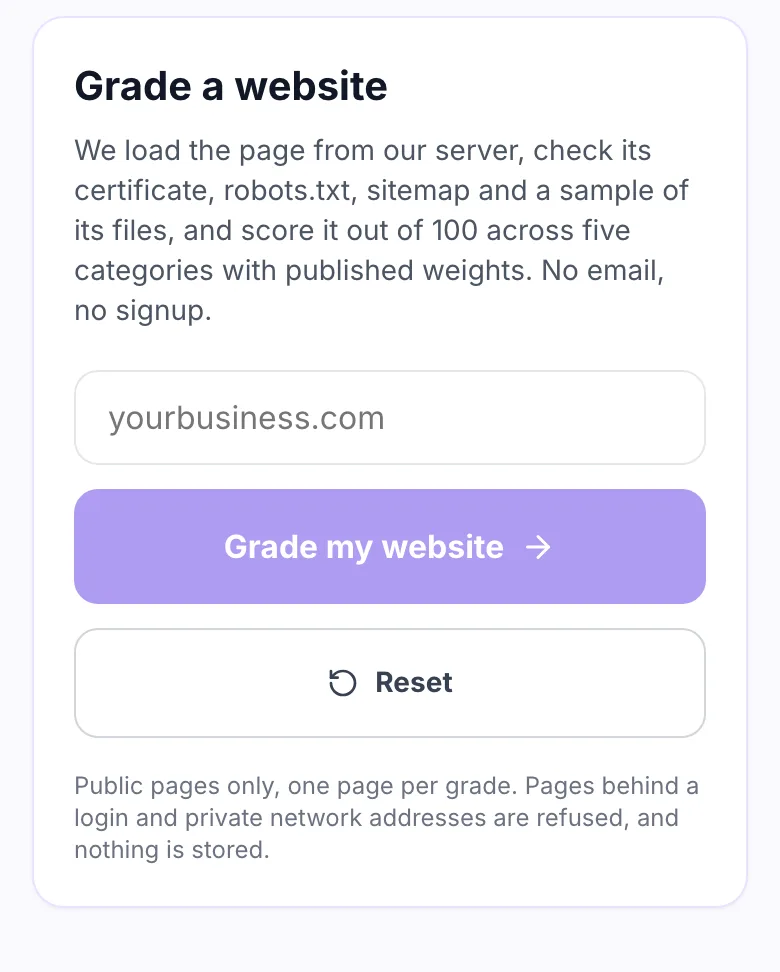
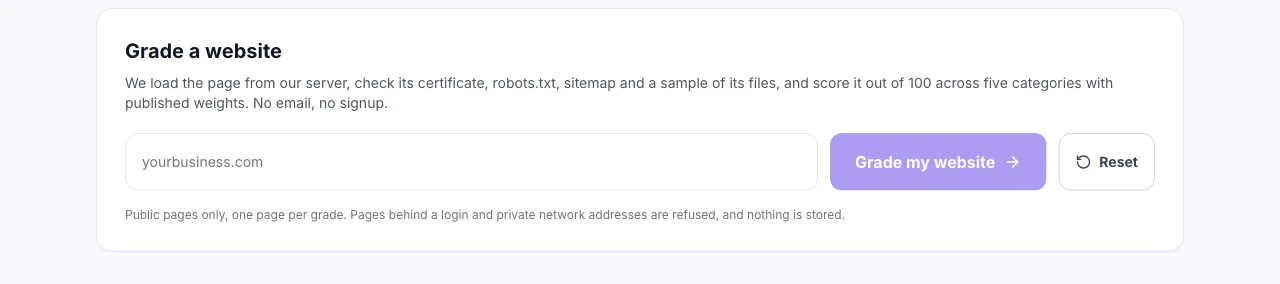
Enter your website address
A bare domain is fine. The grader checks the exact page you enter, which is usually your homepage.
- 2
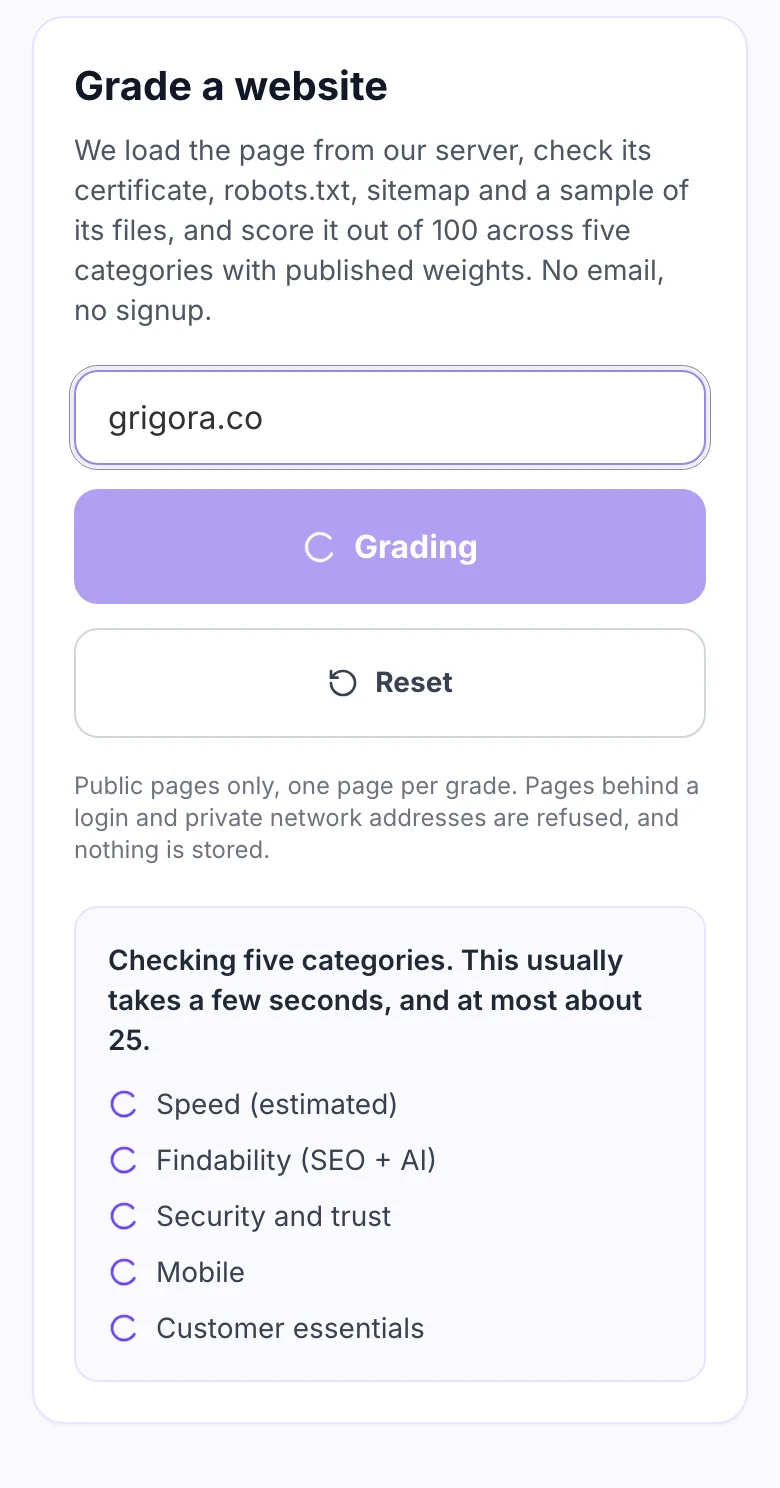
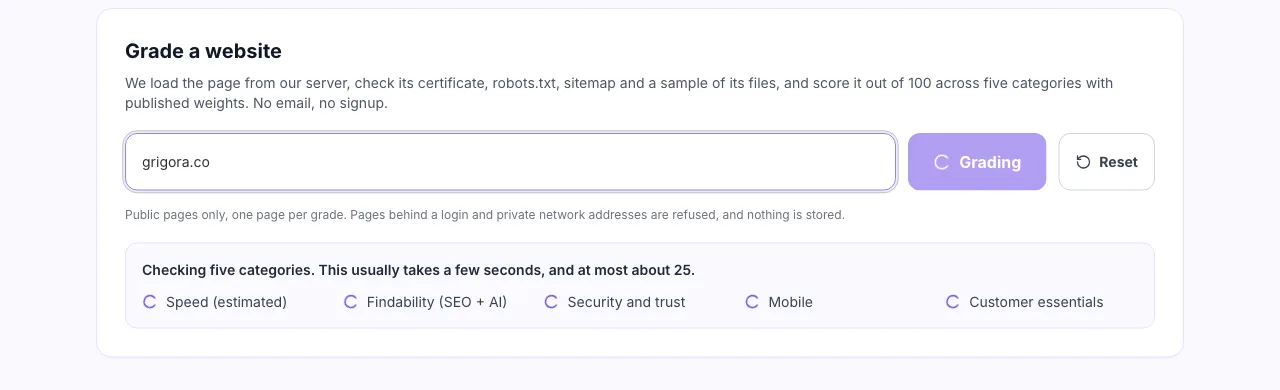
Let the five categories run
Speed, findability, security, mobile and customer essentials are checked together from our server, usually in a few seconds.
- 3
Start with the top fixes
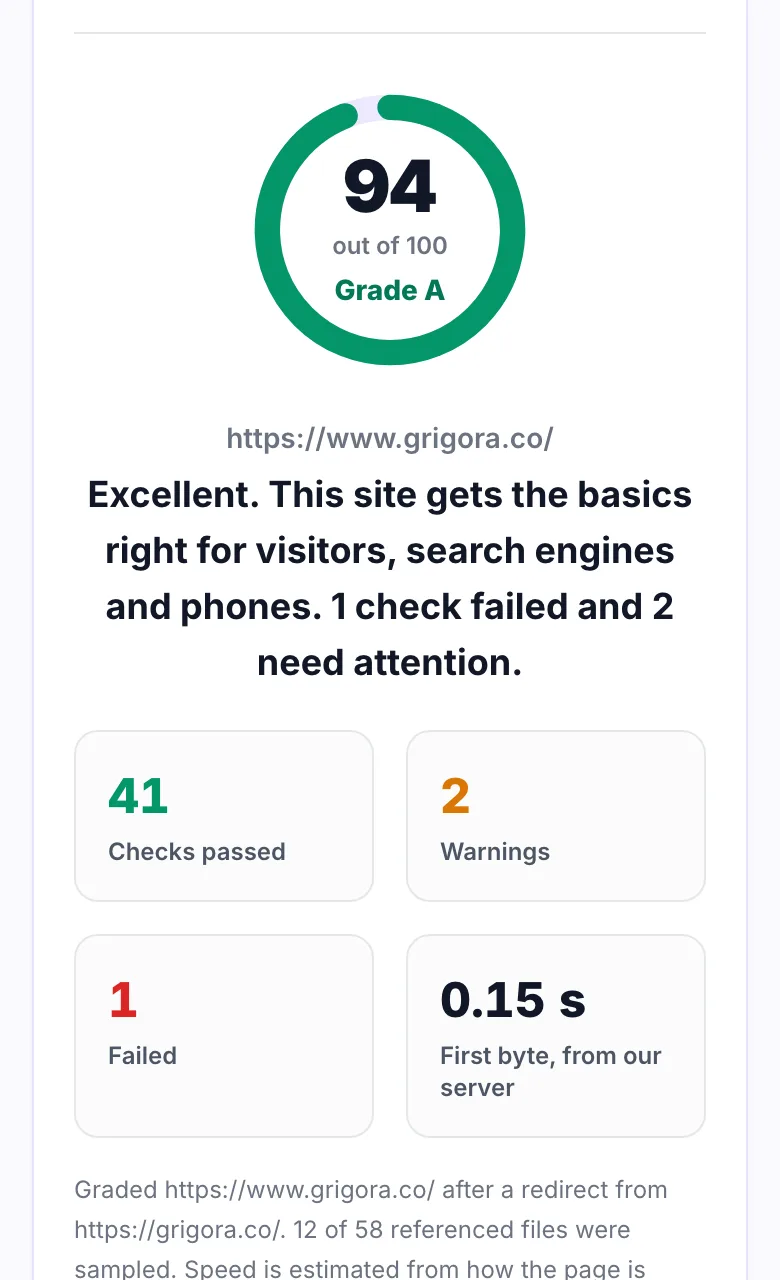
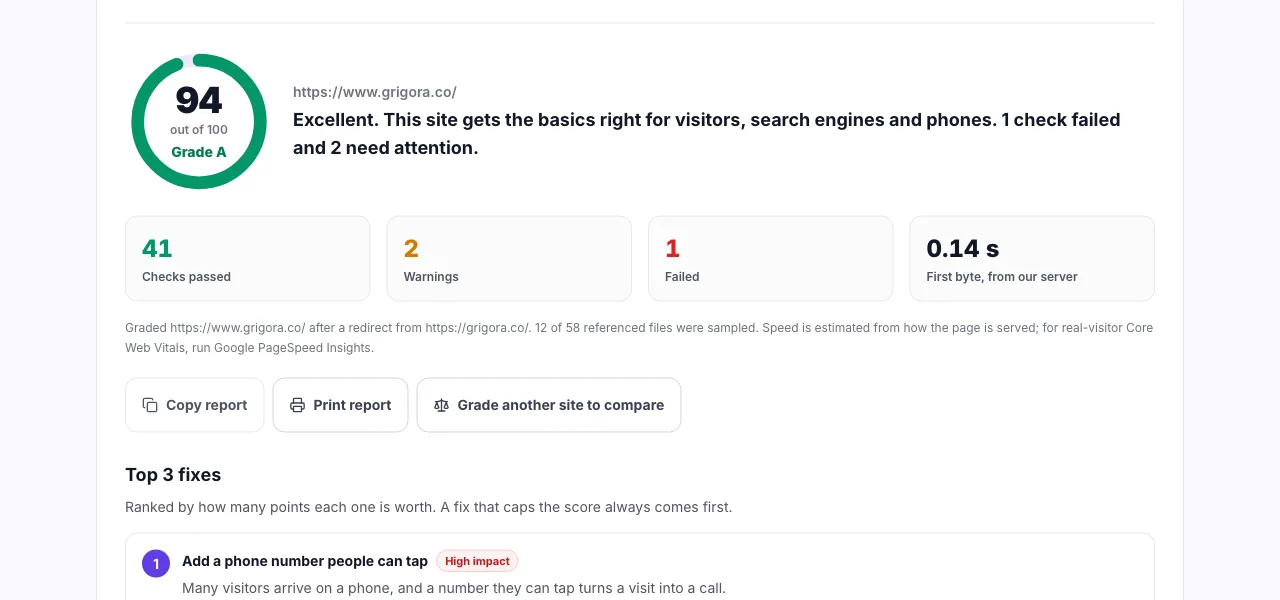
The score ring and letter grade sit above the five category scores, and the top fixes are ranked by how many points each one is worth.
How the score works
Five categories, each scored 0 to 100 from its checks, then combined with these weights.
| Category | Weight | What it covers |
|---|---|---|
| Speed (estimated) | 25 | Estimated from how the page is served: server response time, page and file sizes, compression, caching, image formats and scripts that block rendering. |
| Findability (SEO + AI) | 25 | Whether search engines and AI assistants can find, read and describe the page: title, description, headings, canonical, indexing rules, sitemap, structured data and real text in the HTML. |
| Security and trust | 20 | HTTPS with a valid certificate, the redirect from http, basic security headers and insecure files on a secure page. |
| Mobile | 10 | The viewport setup that makes a page fit a phone, zoom that is not blocked, tiny inline text and responsive images. |
| Customer essentials | 20 | What a customer looks for: a tappable phone number, a way to get in touch, an address or business details, social profiles, icons, a share image, a current copyright year and a privacy policy. |
- Each check passes for full points, warns for half or fails for none. Checks marked Info are shown but never scored, and anything we could not check in time is left out of the score rather than counted against you.
- Grades: A 90 or more, B 80 to 89, C 70 to 79, D 50 to 69, F under 50.
- Two problems cap the total. A page that does not load over working HTTPS with a valid certificate scores at most 49, and a page that tells search engines not to index it, or is blocked in robots.txt, scores at most 59.
- Speed is estimated from how the page is served, because no browser runs. For real-visitor Core Web Vitals, use Google PageSpeed Insights.
What each category checks
Every check in the report, grouped the way it is scored.
Speed (estimated)
Weight 25
- Server response time (time to first byte)
- HTML size and Brotli or gzip compression
- Weight of up to 12 sampled images, scripts and stylesheets
- Images over 300 KB, and images not in WebP or AVIF
- Images without a width and height, and lazy loading below the fold
- Scripts in the head that block rendering, and the number of stylesheets
- Third-party services, redirects before the page, HTTP/2 and browser caching
Findability (SEO + AI)
Weight 25
- A page title of 30 to 60 characters and a meta description of 70 to 160
- Exactly one H1 heading
- A canonical URL that points at the page itself
- No noindex in the meta robots tag or the X-Robots-Tag header
- robots.txt lets Google crawl the page, and a sitemap is published
- Page language, Open Graph tags and structured data
- Alt text on images and link text that says where it goes
- Real text in the HTML, so crawlers that skip JavaScript can read it
- AI crawler rules and llms.txt, reported but not scored
Security and trust
Weight 20
- HTTPS with a certificate browsers trust
- Days left before the certificate expires
- A redirect from http to https
- X-Content-Type-Options, X-Frame-Options or frame-ancestors, and Referrer-Policy
- Files loaded over http on an https page (mixed content)
- HSTS, Content Security Policy and advertised software versions, reported but not scored
Mobile
Weight 10
- A viewport tag set to the device width
- Pinch zoom not blocked
- Font sizes under 12px written into inline styles
- Responsive images with srcset or picture
- Tap targets and layout need a real phone screen, so they point to a visual check instead of being scored
Customer essentials
Weight 20
- A phone number people can tap to call
- An email link, a contact form or a contact page
- An address, a map or LocalBusiness structured data
- Links to social profiles or review sites
- A favicon and an Apple touch icon
- A share image that actually loads
- A copyright year that is not out of date
- A privacy policy link, which matters most when a form collects details
Many checks link to a free tool that goes deeper, such as the SSL Checker, the Mixed Content Checker, the Meta Viewport Checker and the Favicon Checker. To see which fonts a site uses, try the Website Font Detector.
When to grade your website
Six moments a quick grade pays off.
Before you launch
Catch a missing title, a noindex left on from staging or an http link before the first customer visits.
After a redesign or move
Platform moves are where redirects, certificates and page titles quietly break.
When enquiries go quiet
Check that visitors on a phone can still find your number, your form and where you are.
Sizing up a competitor
Grade their homepage next to yours and see category by category where each site is ahead.
Deciding what to fix first
The top fixes are ranked by how many points each one is worth, so the order is already worked out.
Before paying for an audit
Clear the basics yourself, so a paid review can spend its time on strategy instead.
What a good small business website has
What to aim for, including a few things no automated check can judge.
- It loads over https with no warnings, and every http address redirects to it.
- It fits a phone screen without pinching, and the phone number is one tap away.
- The first screen says what you do, where you do it and how to get in touch.
- Every page has its own title and description, written for the people searching.
- Photos are compressed, saved as WebP or AVIF and sized for the screen they appear on.
- Your name, address and phone match your Google Business Profile, and the page carries LocalBusiness structured data.
- A contact form or email link, with a privacy policy that covers what the form collects.
- A share image, a favicon and a current copyright year, so the site looks cared for.
- Search engines are allowed in, and a sitemap lists every page you want found.
Fixing it on your platform
Where the most common fixes live, by platform.
WordPress
- Turn on page caching and Brotli or gzip compression with your host or a caching plugin.
- Set a title, meta description and share image for each page with an SEO plugin.
- Convert large photos to WebP and keep the width and height on every image.
- Ask your host to redirect http to https and renew the certificate automatically.
Shopify
- Shopify provides the certificate for your store domain, so start with the Findability checks.
- Edit the homepage title and meta description under Online Store, then Preferences.
- Add the social sharing image in the same Preferences screen.
- Compress hero and banner images before uploading them to the theme.
Wix and Squarespace
- Confirm the site is published on your own domain and loads over https. Both platforms issue the certificate for you.
- Fill in each page's SEO title and description in its page settings.
- Add your phone number as a clickable link and put a contact form on a Contact page.
- Upload a social share image in the site's SEO or social settings.
Grigora
- Every plan includes hosting with free SSL and a CDN, and a custom domain on any paid plan.
- The AI builder writes a complete multi-page site from a description, with forms that send submissions to your dashboard.
- Grade the published site here, then ask the builder in chat to fix the page content it flags, such as titles, descriptions, share images, contact links and a privacy page.
Why scores differ from PageSpeed Insights and other graders
Different tools measure different things, so the same site can score very differently.
PageSpeed Insights runs Lighthouse, which loads the page in a test browser on a simulated phone, and shows field data from real Chrome users over the previous 28 days when a site has enough traffic. Its Performance score is about loading speed, measured in a browser, and it also reports Accessibility, Best Practices and SEO scores.
Other graders choose their own checks and weights. Some lean on SEO factors such as keywords and backlinks, and several run Lighthouse too, so a lab speed test is part of their score.
This grader never runs a browser. It reads how the page is served and what is in its HTML, adds security, findability and customer checks, and publishes every weight, so a change in the score always traces back to a check you can see.
Use both: this grader for a practical to-do list, and PageSpeed Insights for real-visitor speed. Our guide on how to make a website mobile friendly explains the Core Web Vitals it reports.
Common problems and how to fix them
The failures the grader finds most often, and what to change.
Not secure in the address bar
Cause: The page loads over http, or the certificate is missing, expired or issued for another name.
Fix: Install a certificate (most hosts include a free one), then redirect every http address to https.
Excluded by 'noindex' tag
Cause: A meta robots tag or X-Robots-Tag header says noindex, often left switched on from a staging site.
Fix: Remove noindex, publish, then ask Google to recrawl the page in Search Console.
Blocked by robots.txt
Cause: A Disallow rule matches the page. "Disallow: /" copied from a staging site blocks everything.
Fix: Delete or narrow the rule, then test it with the free Robots.txt Tester.
No meta description
Cause: The page leaves search engines to pick a snippet from whatever text they find.
Fix: Write 70 to 160 characters that say what you offer, for whom and where.
Page shrinks to a tiny desktop view on phones
Cause: There is no viewport tag, or it fixes the width, as in width=1024.
Fix: Use <meta name="viewport" content="width=device-width, initial-scale=1">.
Images over 300 KB
Cause: Photos uploaded straight from a camera or phone at full size.
Fix: Resize them to the size they are shown at, compress them and save them as WebP or AVIF.
Render-blocking scripts
Cause: Scripts in the head without async or defer hold up the first paint of the page.
Fix: Add defer to them, or move them to the end of the body.
A phone number nobody can tap
Cause: The number is plain text, so a phone cannot dial it.
Fix: Link it as tel: with the full international number, for example tel:+15551234567.
What one grade covers
The limits of this tool, stated plainly.
Frequently asked questions
Short answers about the Website Grader.
Related free tools
Other checks that pair with the Website Grader.
SEO Audit Mini Tool
Quick SEO checks for one URL: title, description, H1, schema and more.
Try itSSL Checker
Check a certificate, its expiry and chain, and the redirect to HTTPS.
Try itMobile Friendly Test Lite
Check viewport, tap targets, font size and content width.
Try itPage Performance Checker Lite
A quick look at load time, page weight and response size.
Try itBroken Link Checker
Find links on a page that no longer resolve.
Try itWebsite Launch Checklist
Work through what to verify before a site goes live.
Try itBuild your next website with Grigora
A complete multi-page website from a description, with hosting, free SSL and a CDN on every plan. 14 day free trial, no card needed.
Start your free trial