Most product descriptions should run 50 to 300 words: near the bottom of that range for a simple product the buyer already understands, near the top for anything with doubts about size, fit or compatibility. The better question is how long this product's description should be, and the answer is set by what a buyer still does not know at the moment they decide to pay. Count the words at the end, not the start.
How long should a product description be for each type of product
Sort by the buyer's open question, not the price tag. Price is a poor proxy for uncertainty: a $900 chair somebody has bought before needs less copy than a $30 cable with a compatibility problem.
The product
Start at
What the words are doing
A repeat buy the customer already knows
20 to 60 words
Confirming it is the same item.
A familiar product with no open questions
50 to 120 words
What makes yours different, plus materials and care.
Anything with size, fit or compatibility doubts
120 to 300 words
Answering the two or three doubts that stop the order.
Break the bands when the product says to. If 40 words answer every question your support inbox gets, the description is finished. If 600 words still do not say whether the lid is dishwasher safe, it is not. Whether you land on 180 words or 220 makes no difference to anyone, Google included.
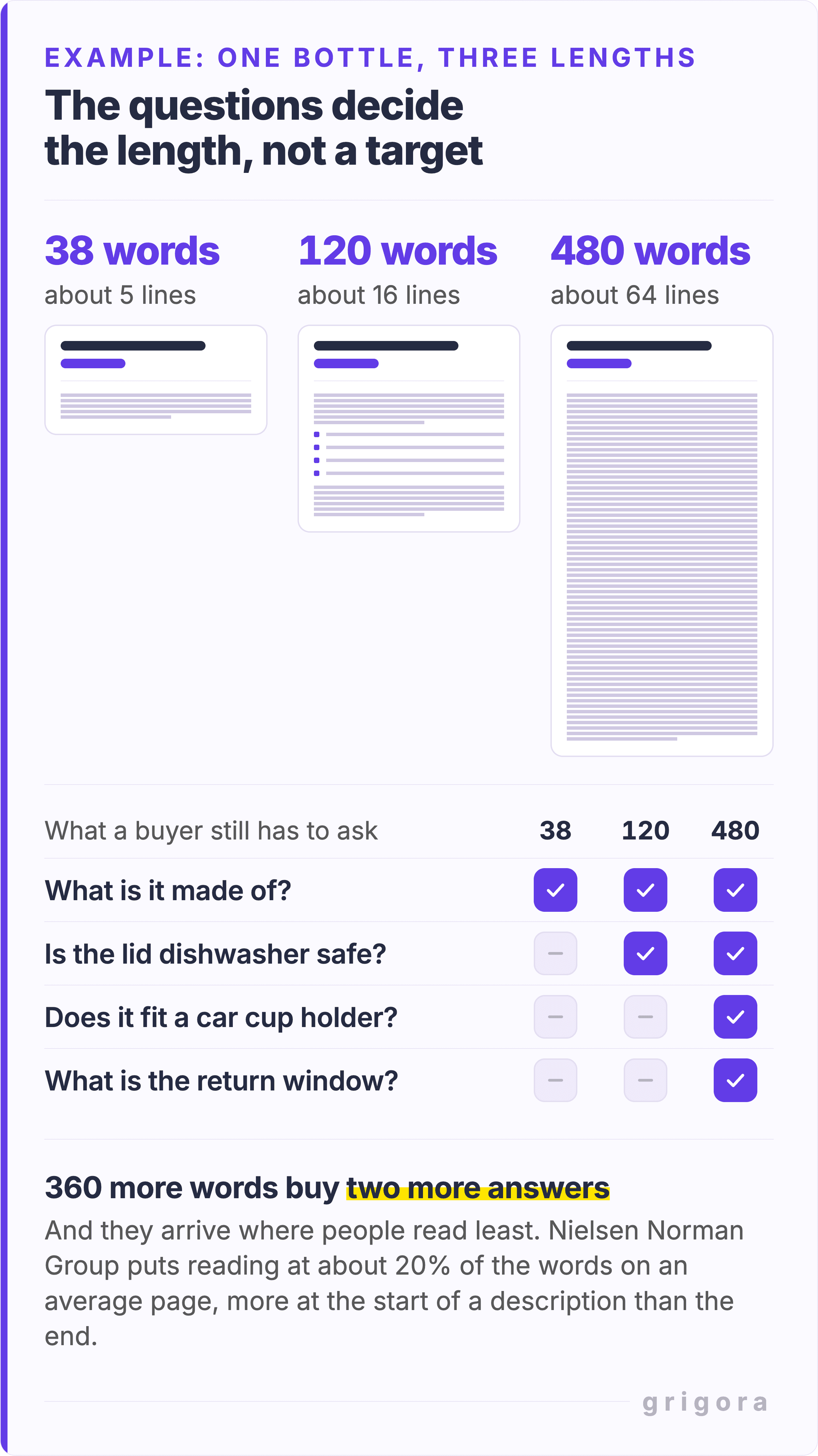
Three lengths, one bottle. The last 360 words answer two more questions, in the part of the page people read least.
Does product description length matter for SEO?
Not directly. The word count line above sits in Google's list of warning signs for content written for search engines first. Elsewhere on the same page, Google asks whether content provides "a substantial, complete, or comprehensive description of the topic". Length is not a target, but thin is still thin.
There is no 300-word minimum either. What hurts is copying. Google's spam policies list "reproducing content feeds from other sites without providing some type of unique benefit to the user" as scraping, and describe thin affiliate pages as ones where "the product descriptions and reviews are copied directly from the original merchant without any original content or added value". Run the manufacturer's copy and you are publishing the same text as every other stockist.
Mass production is the other risk. The same page names "using generative AI tools or other similar tools to generate many pages without adding value for users" as scaled content abuse. Padding every SKU to 500 words to hit a target can fall under it, whoever or whatever does the typing.
So rewrite supplier copy before you add a single word. Our guide to rewriting website content walks through it, from auditing what you have to the rewrite itself. Put the main search phrase in the product name and once in the opening line, where a buyer would use it anyway. Cut any sentence that exists only to repeat it.
Two more catalogue fixes are worth doing in the same pass. Filter URLs such as ?size=m mostly belong out of your sitemap, and our guide to which pages to leave out of your sitemap explains why. Product photos want descriptive file names, and naming product photos at scale covers doing hundreds at once.
Meta descriptions and Product structured data
If your store reuses the opening of the description as the meta description, Google says there is no limit on how long a meta description can be, but the snippet is "truncated in Google Search results as needed, typically to fit the device width". So put the point first. For large catalogues, the same page says programmatic generation of meta descriptions "can be appropriate and are encouraged", as long as they stay human-readable and differ from page to page.
For Product structured data, Google's merchant listing documentation requires name, image and offers, and says the description "is not mandatory" but "strongly recommended". Grigora's free Product Schema Checker checks that set in your browser, along with price format, currency codes and GTIN check digits. A missing description comes back as a warning, not an error, which matches Google's wording.
Product description character limits on Google Shopping, Meta and WooCommerce
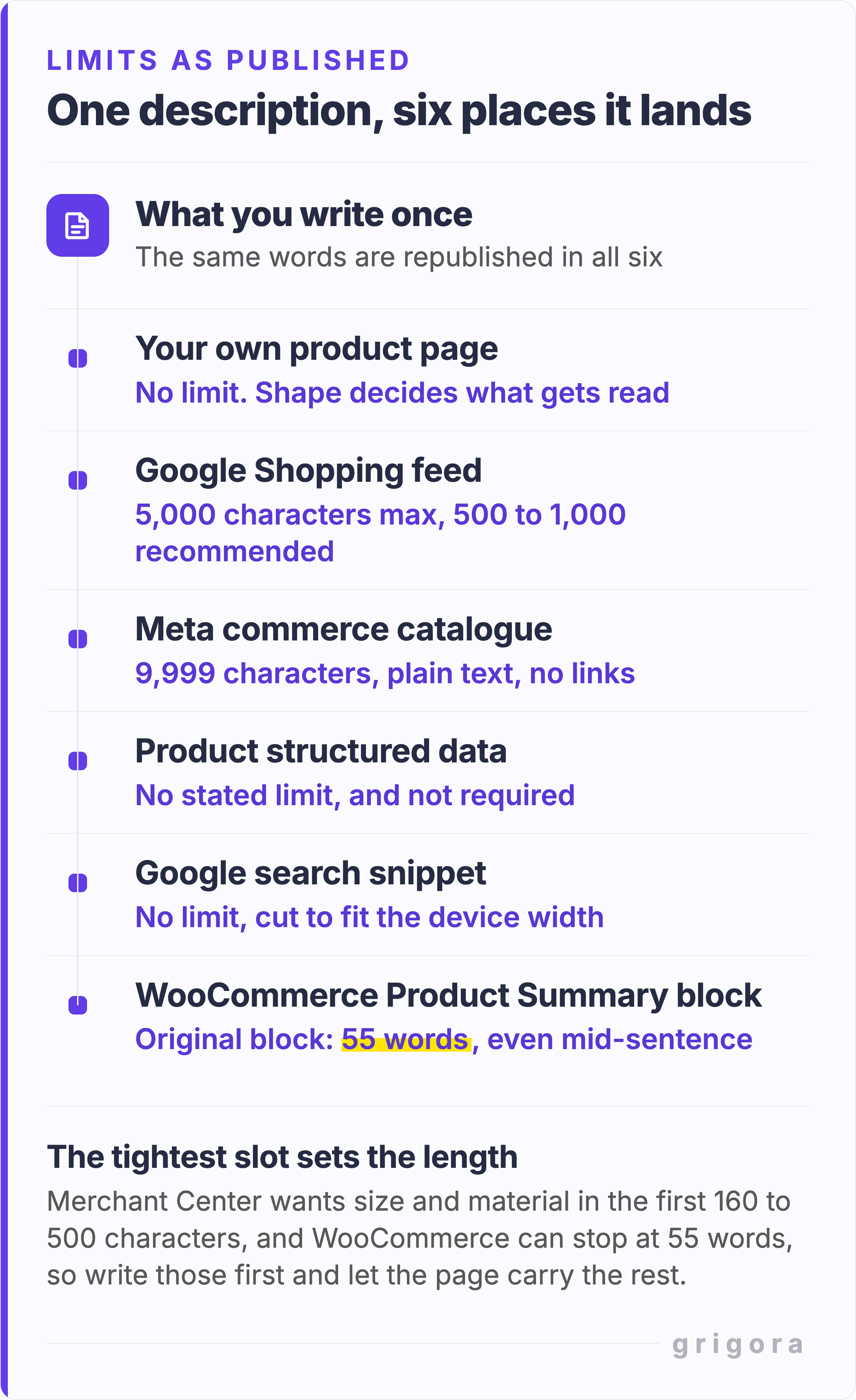
The same text rarely stays on your product page. It goes into a shopping feed, a social catalogue, structured data and, on WooCommerce, a summary block, and each sets its own rule. Only the store template counts words; the rest count characters or set no limit at all.
Where it gets republished
The limit
What to do about it
Your own product page
None
Your call. Shape decides whether any of it gets read.
Google Merchant Center feed
5,000 characters max, 500 to 1,000 recommended
Size, material and key features in the first 160 to 500 characters.
Meta commerce catalogue
9,999 characters
Plain text, no HTML, no links, different from the title.
Product structured data (merchant listing)
None stated; description recommended, not required
name, image and offers are required. Supply a description anyway.
Google search snippet
No limit on the meta description
Cut to fit the screen, so put the point first.
WooCommerce Product Summary block
55 words in the original block, 0 to 200 in the 9.6 block
Write your own short description, under 55 words, so nothing gets cut mid-sentence.
Google Shopping
Google's product data specification caps the description at 5,000 characters, asks that it match the description on your landing page, and rules out promotional text such as "free shipping", all capital letters, links to your store and details about competitors. Line breaks, lists and italics are allowed. Copy written like an advert breaks those rules at any length.
If you generate descriptions with AI, Google wants them in a different attribute. Its guidance on AI-generated content says they must go in structured_description, with the digital source type set to trained_algorithmic_media, instead of the plain description attribute.
Before you submit, run the file through the free Product Feed Validator. It reads CSV, TSV or XML in your browser, so nothing is uploaded, and checks it against Merchant Center rules, including the 5,000-character description limit, the 150-character title limit and GTIN check digits. It checks Google's rules, not Meta's.
Meta catalogues
Meta's commerce catalogue takes up to 9,999 characters in plain text, with no HTML, no links, nothing in all capitals, and a description that differs from the title. No sensible description comes near that ceiling, so the rules that matter are plain text and no links: a description exported with its HTML still in it breaks the first.
Write to the tightest slot, not the biggest
WooCommerce shows why. When a product has no short description, the original Product Summary block falls back to the full description and cuts it at 55 words, mid-sentence if need be. It applies the same 55-word cut to a short description that runs longer. WooCommerce rebuilt the block with a setting from 0 to 200 words, where 0 means no cut, and shipped it in version 9.6 on 20 January 2025. It did not swap the new block into existing Single Product templates, so check which one yours uses.
The fix works on every platform. Put the details that decide a sale in the first two or three sentences, and write a 20 to 40 word short description yourself. Then every slot, from Merchant Center's first 160 characters to a 55-word cut, starts with something complete.
Mostly they skim. Nielsen Norman Group's analysis of real browsing data estimated that users read about 20% of the text on the average page, and that "users read half the information only on those pages with 111 words or less". The data is a 2008 study that logged 25 people's browsing, so treat it as a direction, not a dial.
The experiment usually cited for "cut your copy" advice is older still: Morkes and Nielsen, 1997. A version cut to about half the control's word count measured 58% higher usability. A scannable layout scored 47% higher, objective writing 27%, and all three together 124%. Cutting was the biggest single lever, yet it delivered less than half of what the three did together. That part tends to get dropped.
On product pages, Nielsen Norman Group reported in August 2014 that users skim text when reading online, reading more at the beginning of the description than the end. In the same study, 20% of task failures, times somebody could not finish a purchase they were asked to make, came down to incomplete or unclear product information. People stop reading, and they also fail when the answer was never there.
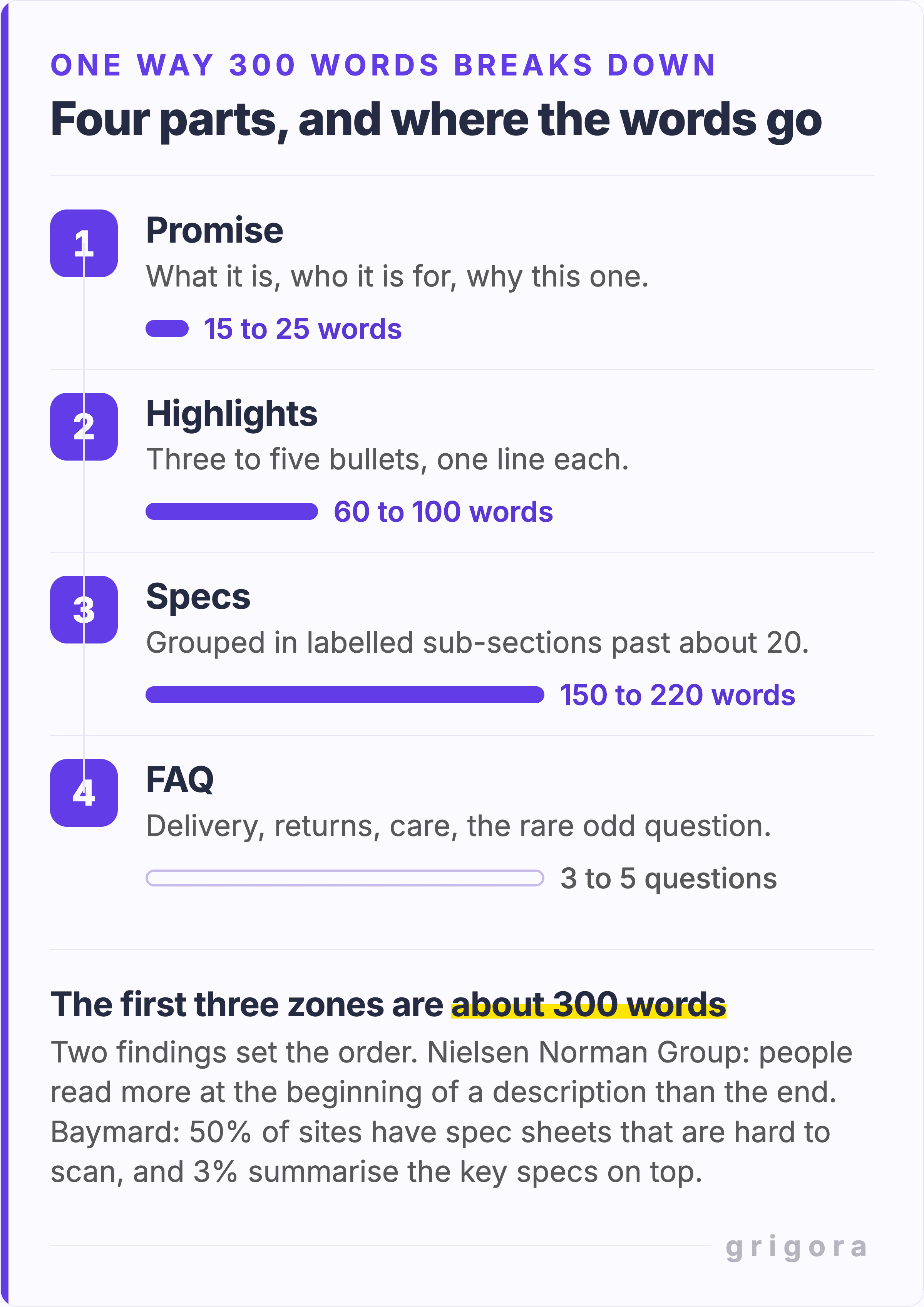
Three to five highlights. The decisions a buyer is actually making, such as size, fit, material or what is in the box. One line each, facts rather than adjectives.
A grouped spec block. Baymard's example of a spec sheet long enough to need labelled sub-sections is anything more than 20 specs. On a sheet longer than two screens, Baymard also suggests a short summary of the key specs on top.
An FAQ for everything else. Delivery, returns, care, the odd compatibility question. Our guide to how many questions an FAQ page should have covers the count and the markup.
One way to split about 300 words across the first three parts. The bands are an example to adjust, not a rule.
The FAQ is the real answer to most length questions. Descriptions run long because they carry questions that belong somewhere else. Move those into the FAQ and the description shrinks without losing a fact.
How to work out the right length for your product
Measure instead of guessing. Run this on one product, repeat it across a category, and you have a house standard.
List the questions from real sources. Support email, chat transcripts and return reasons, not guesses. A return is a question somebody paid to have answered too late.
Answer each one in a sentence. No linking phrases yet. The draft's length is now set by evidence, not by a target.
Delete anything true of every product in the category. "Made from high-quality materials" is equally true of your competitors' products, so it tells the buyer nothing.
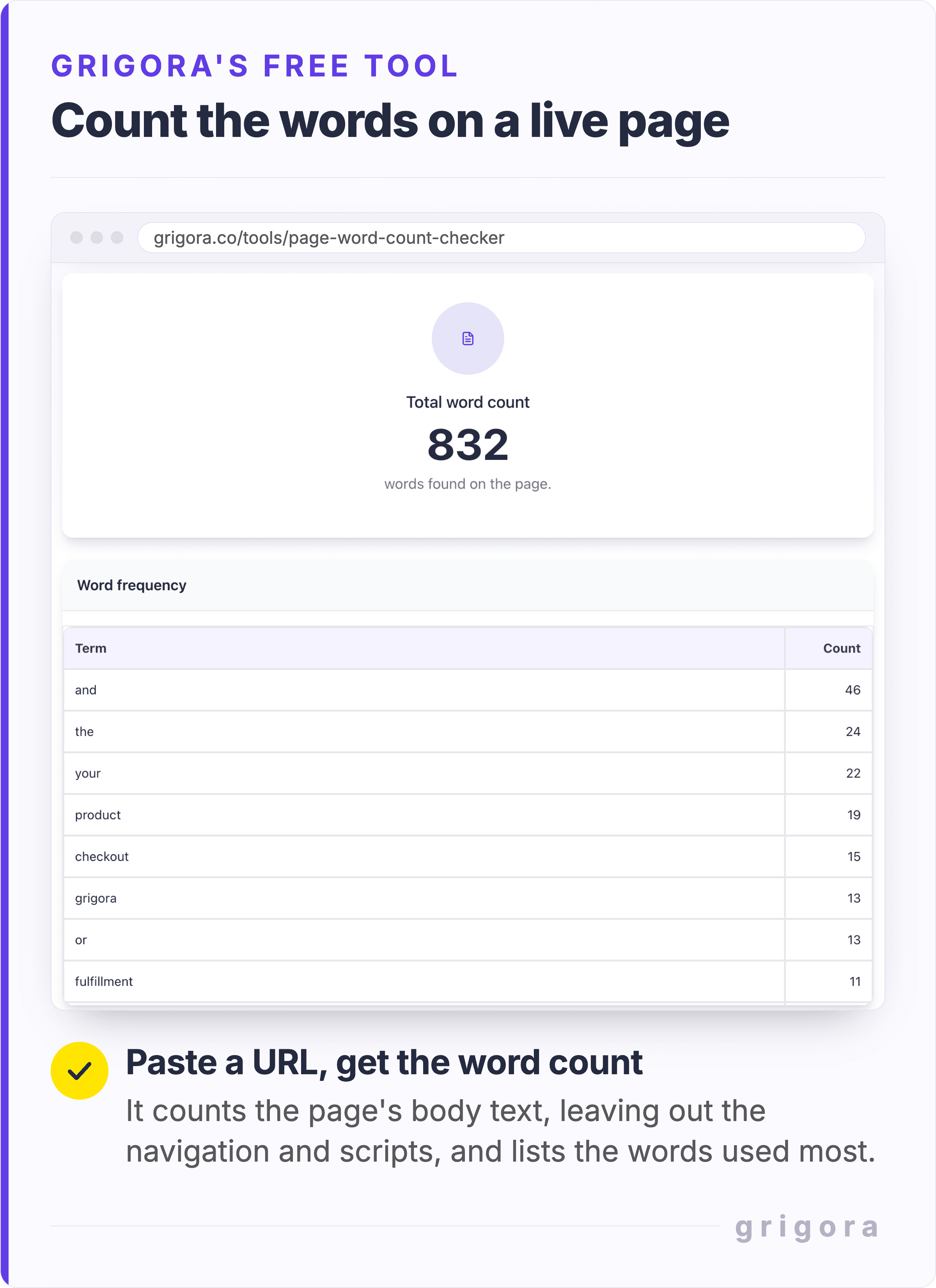
Benchmark against real product pages. Run three competitors' pages for the same kind of product through the free Page Word Count Checker. It counts the body text, leaving out navigation and scripts, so the total covers more than the description. Read it as an upper bound.
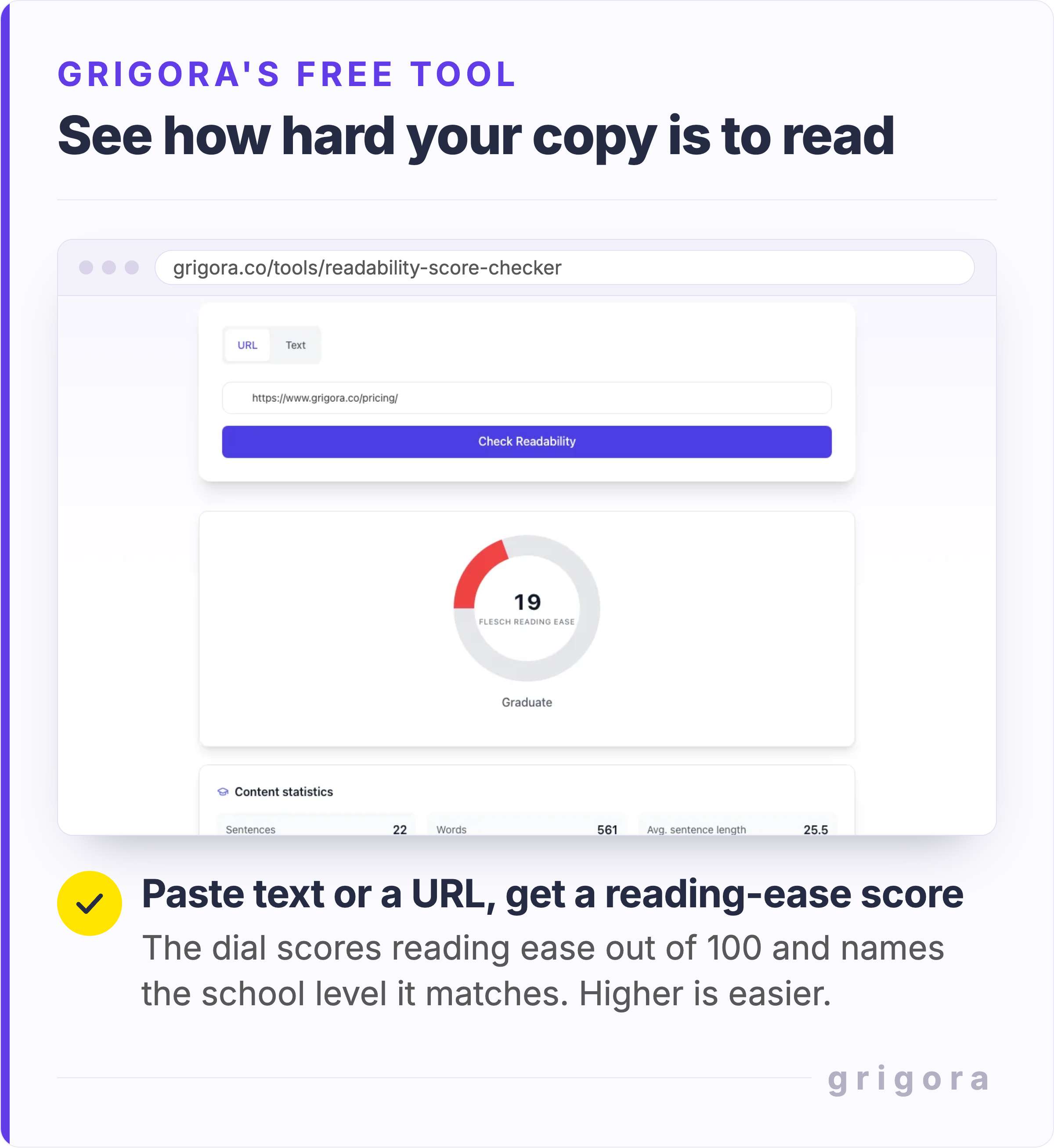
Check the sentences, not just the total. Paste your draft into the free Readability Score Checker for a Flesch Reading Ease score, a grade level and the average sentence length.
The Page Word Count Checker on a live page: 832 words, and the words it uses most.
Long descriptions often fail on sentence length before they fail on word count. A 480-word description built from 15-word sentences can read easily. The same 480 words in 25-word sentences is hard going, and a word counter will not tell you which one you wrote.
The Readability Score Checker: a reading-ease score of 19 reads at graduate level, which is hard going for a product page.
Statistics to check before you quote them
Three claims get repeated around this question. None of them holds up as quoted.
"40% of returns are caused by bad product descriptions." The source is a Shotfarm survey of 1,542 consumers, released on 28 October 2015, and it says something narrower: 40% of shoppers had returned an online purchase in the past year because of poor product content. A share of shoppers is not a share of returns. The same release found 86% unlikely to buy again from a retailer that gave inaccurate product information.
"Cutting text by 54% improves comprehension." This traces to a 1998 Nielsen Norman Group rewrite of two Sun white papers, where the new version was 54% of the original length, a cut of 46%. Its headline figure is a usability score combining task time, errors, memory and satisfaction, not comprehension, and the rewrite also added headings and bullets, dropped the marketing language and split three pages into eight. The 159% gain belongs to all of it.
"Write at least 300 words for SEO, and never more than 600." Both halves circulate on copywriting blogs with nothing underneath them. Google has no preferred word count, no platform publishes a 600-word rule, and the feed limits above are set in characters.
Writing product descriptions in Grigora Commerce
Grigora Commerce has no field called description. A product starts with a Product name and a Product promise, which explains what the customer receives, who the product is for and why they should buy it. Highlights and FAQs follow: short points to scan, then answers about usage, delivery and access. That is three of the four parts above built into the form; specs go in the highlights or the FAQs.
The same product form holds the SEO title, meta description, canonical URL and search visibility, so page copy and search copy get written in one sitting. See what Grigora Commerce covers, or compare plans: the trial runs 14 days and needs no card.
Product description length FAQs
How many words should a product description be?
50 to 300 words for most products. A repeat buy the customer already knows needs 20 to 60. Something technical or awkward to return often needs 300 or more, most of it in specs and FAQs rather than prose.
Is 100 words enough for a product description?
Often, yes. Nielsen Norman Group's browsing data suggests people read about half the information only on pages of 111 words or less, so at 100 words a good share of it gets read. It is enough if it answers what your returns log and support inbox ask about that product.
What is the character limit for a product description on Google Shopping?
Merchant Center accepts up to 5,000 characters, but Google recommends around 500 to 1,000, roughly 85 to 170 words. Put size, material and anything else that decides a click in the first 160 to 500 characters.
Can I use the manufacturer's product description on my own site?
You can, but your page then says exactly what every other stockist's page says. Google's spam policies call reproducing feeds without a unique benefit scraping, and single out product descriptions copied straight from the original merchant. Keep the manufacturer's specs, which are facts, and rewrite the prose around what your own buyers ask.
What is a short product description, and do I need one?
It is a separate summary of a sentence or two, and in WooCommerce it has its own field that shows in the summary area of the product page. Leave it empty and the original Product Summary block fills that space with the full description, cut at 55 words. A 20 to 40 word summary written on purpose beats any automatic cut.
Do longer product descriptions rank better on Google?
No. Google's helpful content guidance says it has no preferred word count. What it asks instead is whether a page gives a substantial, complete description of its topic, and padding does not make a description more complete.
Should my Google Shopping description match my product page?
Yes. Google's product data specification asks that the feed description accurately describe the product and match the description on your landing page. Order the page copy so its first 160 to 500 characters carry the details Google wants up front, and one text serves both.
Where should the keyword go in a product description?
In the product name, the SEO title and the meta description, and once in the first sentence of the description, phrased the way a buyer would search. After that, write for the buyer. Repeating the phrase at the bottom, or adding a paragraph for search engines, adds nothing a shopper needs.
Get the next guide by email
Practical writing on building a site, growing an audience and sending email people open. No more than one a week.